
Wristwatches · Wristwatch
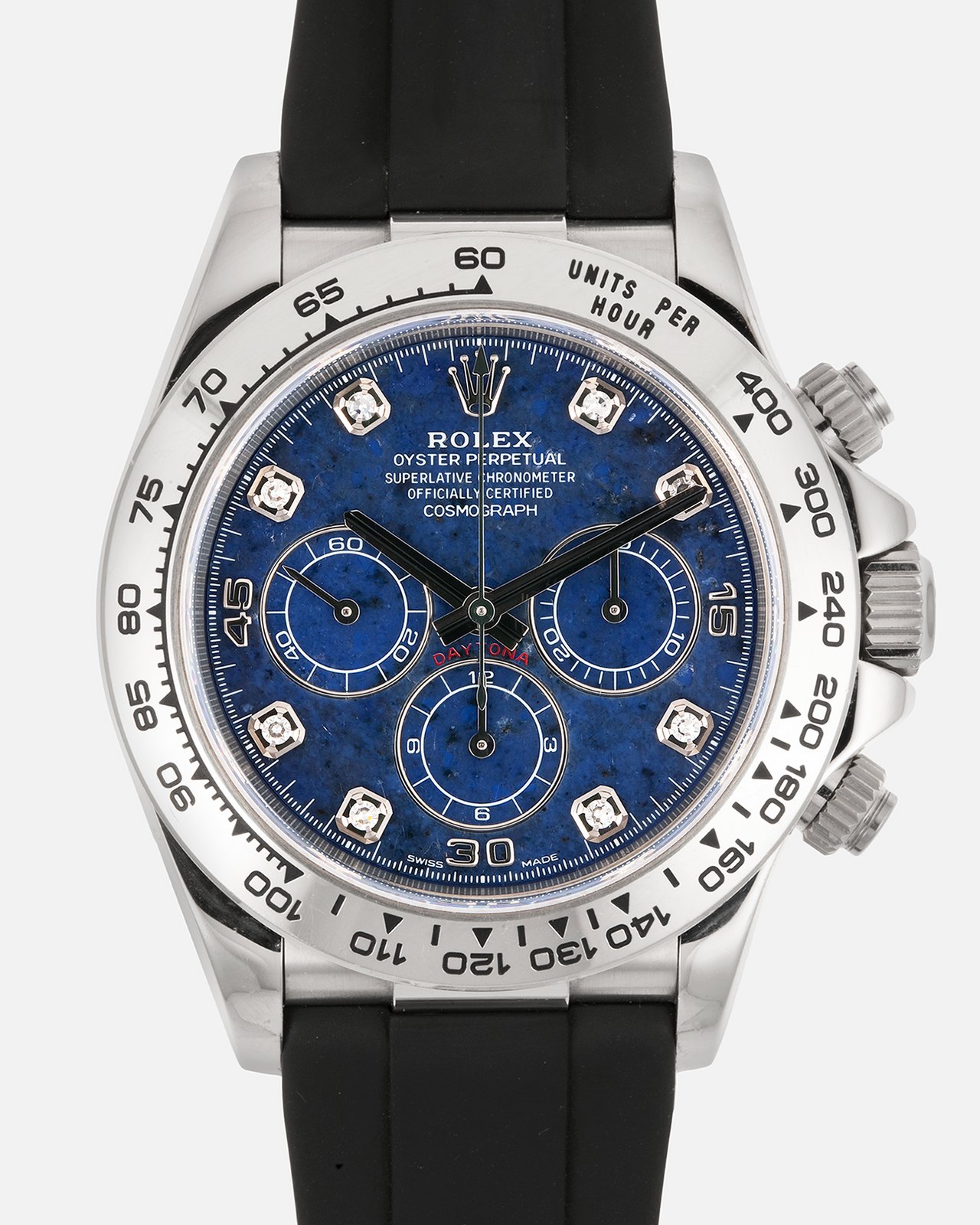
Rolex Cosmograph Daytona Sodalite Ref. 16519 WG, 1999
- Maker / attribution
- Rolex (maker)
- Date
- 1999
- Historical period
- Mechanical Renaissance (1990 – 2010)
- Country of origin
- Switzerland
- Object type
- Wristwatch
- Stock no.
- Product 7020207800407
- Credit line
- Dealer listing, S.Song Watches (product 7020207800407)
- Catalogue title (original)
- Rolex Cosmograph Daytona Sodalite Ref. 16519 WG (English)
View the source record (dealer listing) ↗ (opens another website in a new tab)Suggest a correction
Record summary
Catalogued by S.Song Watches (dealer), Seattle (stock number Product 7020207800407), this is a wristwatch by Rolex, made in Switzerland, dated 1999. The Atlas places it in the Mechanical Renaissance period (1990 – 2010) of its Wristwatches collection. The record is illustrated with 6 photographs.
Assembled from the source record's structured fields. Dates and attributions are given as the source states them; where a field is missing the Atlas leaves it blank rather than estimating.
Catalogue description
Dealer description — S.Song Watches
Known as one of the world's most desirable watches and perhaps the most widely-recognized chronograph model in the world of horology, the Rolex Cosmograph Daytona's design has remained ever-present in the world of motorsport and the watchmaking industry ever since its debut in 1963. Progress of evolution rather than revolution, the current-day Daytona still possesses similarities to the first model of the ’60s despite being in its 6th generation. The Daytona, like most of Rolex’s lineup, has largely existed as a no-fuss tool watch with usability and legibility paramount. That being said, despite its reputation, Rolex do from time to time create highly unusual and crazy-looking watches that are so antithetical to the brand’s DNA that they somehow become cult icons. Models downright insane such as the Rainbow Daytona and Leopard Daytona were panned in the beginning as being ostentatious strangely grew on collectors overtime, now commanding huge premiums as they realized it is often the downright weird models that eventually become the most desirable. With that being said, this particular early Ref. 16519 Cosmograph Daytona fitted with an exotic sodalite stone dial you see here today is exactly just that. For further context, sodalite is a visually striking blue mineral frequently utilized in jewelry-making for its ornamental appeal. Initially discovered in Greenland during the early 1800s, its popularity soared after a significant deposit was unearthed in Ontario, Canada in 1891. The name "sodalite" reflects its notably high sodium content, contributing to its remarkable hardness yet inherent brittleness. Often mistaken by many for lapis lazuli, sodalite distinguishes itself with distinctive white streaks rather than the pyrite inclusions that give lapis lazuli its sparkly golden speckle. It is important to mention that integrating such a fragile material into the dial poses a substantial technical challenge. The procedure entails meticulously cutting a homogeneous sodalite disc and then precisely machining it into an exceedingly thin slice before affixing it to the base of the dial, followed by the addition of other dial components, including the three recessed sub-dials as we see on the Ref. 16519. Although it might seem straightforward in theory, the reality is quite the opposite. The result, as evidenced by this example we have here, is truly mesmerizing to behold and admire. Throughout my time with it, I was constantly drawn to the beauty of the sodalite stone dial, often finding myself completely engrossed and oblivious to the passing of time. The spectrum of shades of blue exhibited on the dial, ranging from a soft, powdery blue to a deep, rich hue, is truly remarkable. It is also worth highlighting that the sodalite Daytona comes in a handful of dial variations. Our example here is adorned with 8 individual diamond hour markers, complemented by applied Arabic numerals on the 3, 6 and 9 positions. Powering the Ref. 16519 from within is a modified Cal. 4030 that is based on the Zenith El Primero Cal. 400. For those who are unaware, it is worth noting that the Ref. 16519 only saw a brief production run of 3 years starting in 1997, and was eventually succeeded by the Ref. 116519 in 2000, which housed a new in-house, self-winding Rolex Cal. 4130 movement. Frankly speaking, it is not often that we come across rare Rolex Daytonas like these as they did not sell many back in the day. For those looking for a Daytona like no other, this is it.
Historical context
Mechanical Renaissance (1990 – 2010)
Mechanical watches return as cultural objects; independent watchmaking flourishes.
Mechanical watches returned as cultural and luxury objects. Complications, tourbillons and new materials proliferated; independent watchmakers such as George Daniels, F.P. Journe and Philippe Dufour revived artisanal watchmaking; collecting vintage watches became a major field.
Read the period in the timelineMore wristwatches from this periodEarlier: Quartz Revolution
Atlas type guide
Wristwatches
Bracelet watches were worn by women from the early nineteenth century — Breguet made one for Caroline Murat, Queen of Naples, in 1810–12 — but the wristwatch only became a man's instrument with military use and aviation in the early twentieth century. Between the World Wars it overtook the pocket watch; the 1920s and 1930s brought rectangular Art Deco cases, water-resistant cases and the first automatic winding systems.
After 1945 the wristwatch became a carrier of identity — dress watches, sports and dive watches, chronographs, calendars — produced by Swiss, American, Japanese, German, Soviet and Chinese industries. The quartz revolution after 1969 and the mechanical renaissance since the 1990s, including the rise of independent watchmakers, complete the story.
What to look for
- The reference number (between the lugs or inside the case back) and serial number, the starting point for dating.
- The calibre: its maker and number are often stamped under the dial or on the bridge.
- Originality of dial, hands and crown — refinished ('redial') dials are common.
- Case material marks: 18K/750, 14K/585, stainless steel, gold-filled, plated.
Dating clues
- Wire-lug cases: before c. 1925.
- Water-resistant screw-down cases: from 1926.
- Quartz movements: from 1969; sapphire crystals widespread after c. 1980.
General guidance written by the Atlas editors about this kind of object. It is not a statement about this particular piece; for that, rely on the source record above and on physical examination.
Related records

Movements & Components · c. 1970s
Rolex watch movement, c. 1970s
Antiquorum auction archive, Geneva

Pocket Watches · 1982
Fake Rolex watch, gold coloured metal, possibly made in Taiwan, 1982; part of a casual outfit, UK, 1982-84.
Victoria and Albert Museum, London

Wristwatches · c. 1920s
Rolex wristwatch, c. 1920s
Antiquorum auction archive, Geneva

Wristwatches · c. 1920s
Rolex wristwatch, ref. 6194, c. 1920s
Antiquorum auction archive, Geneva

Wristwatches · 2008
Wristwatch by Breitling?, 2008
Museum Rotterdam

Wristwatches · c. 1990s
Audemars Piguet Bamboo, c. 1990s
Antiquorum auction archive, Geneva

Wristwatches · c. 1990
Audemars Piguet Huitieme Perpetual Calendar, ref. 25696PT, c. 1990
Antiquorum auction archive, Geneva

Wristwatches · c. 1990
Breitling Chronomat, ref. b13050.1, c. 1990
Antiquorum auction archive, Geneva