
Wristwatches · Wristwatch
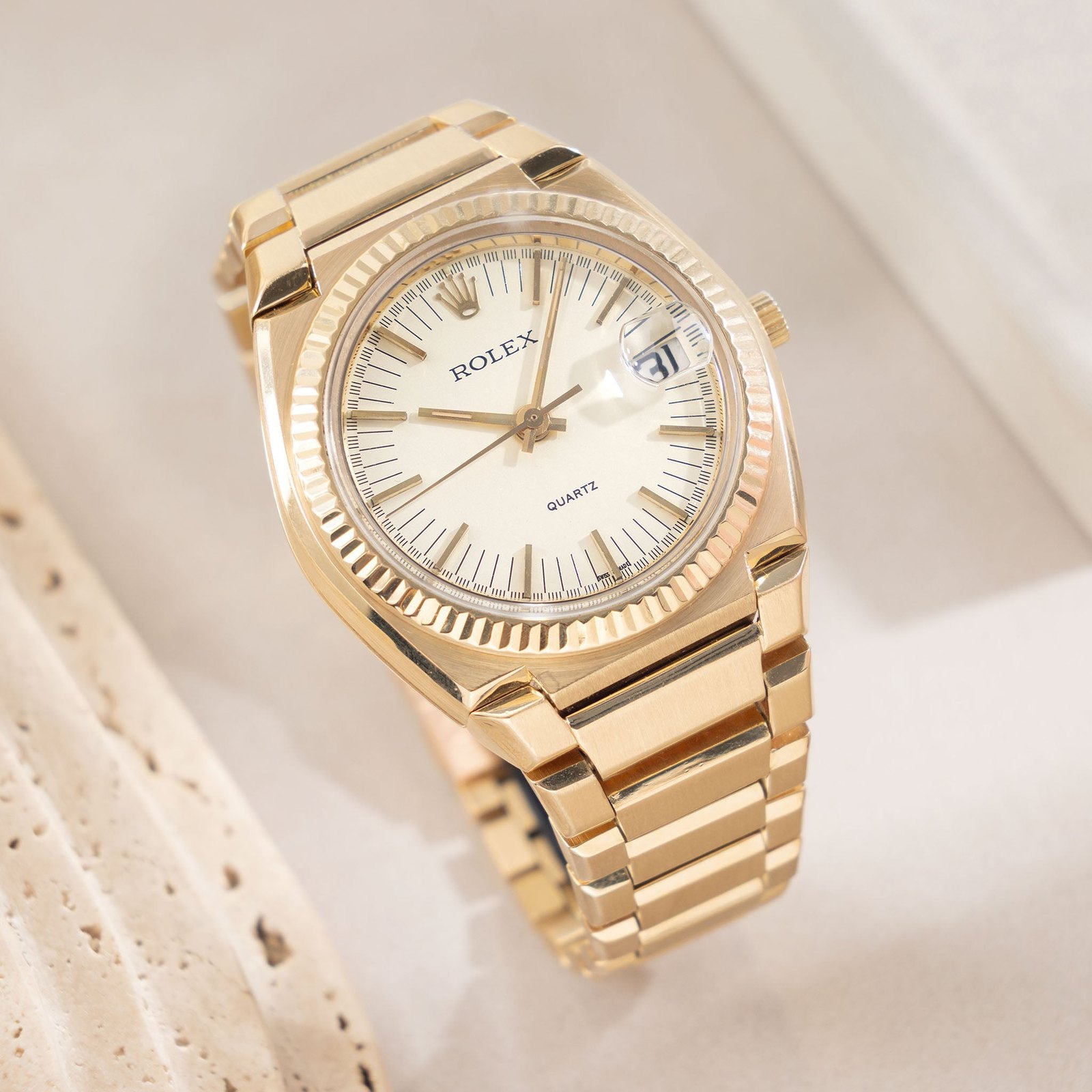
Rolex Beta 21 Il Texano Cream dial in 18k yellow gold ref 5100, 1970
- Maker / attribution
- Rolex (maker)
- Date
- 1970
- Historical period
- Quartz Revolution (1969 – 1990)
- Country of origin
- Switzerland
- Object type
- Wristwatch
- Materials / technique
- 18k yellow gold
- Dimensions
- Case 40 mm
- Stock no.
- W-3493
- Credit line
- Dealer listing, Bulang & Sons (W-3493)
- Catalogue title (original)
- Rolex Beta 21 Il Texano Cream dial in 18k yellow gold ref 5100 (English)
View the source record (dealer listing) ↗ (opens another website in a new tab)Suggest a correction
Record summary
Catalogued by Bulang & Sons (dealer), Copenhagen (stock number W-3493), this is a wristwatch by Rolex, made in Switzerland, dated 1970. The Atlas places it in the Quartz Revolution period (1969 – 1990) of its Wristwatches collection. Materials and techniques recorded by the source: 18k yellow gold. Recorded dimensions: Case 40 mm. The record is illustrated with 6 photographs.
Assembled from the source record's structured fields. Dates and attributions are given as the source states them; where a field is missing the Atlas leaves it blank rather than estimating.
Catalogue description
Dealer description — Bulang & Sons
While Rolex is celebrated for its legendary references and groundbreaking innovations that have defined modern watchmaking, there exist a few rare models known only to the most discerning collectors. Among them is the enigmatic Rolex 5100. Produced in very limited numbers between 1970 and 1972, the 5100 holds a special place in Rolex history as the brand’s first-ever quartz timepiece, arriving seven years before the better-known Oysterquartz. Even today, the Rolex 5100 stands apart as a fascinating anomaly within the brand’s lineage — an unconventional creation that captures a pivotal moment when tradition met technological ambition.. The story begins in 1962, when Japan and Switzerland were locked in a race to develop the world’s first quartz wristwatch — a technology seen at the time as the inevitable future of watchmaking. In response, twenty-one leading Swiss manufacturers, including Rolex, joined forces to form a consortium known as the Centre Electronique Horloger (CEH). Their mission was clear: confront the rise of quartz technology, guide the transition from purely mechanical to electronic watchmaking, and ensure that Switzerland remained at the forefront of innovation. The collaboration bore fruit in 1966 with the Beta-1, the first functional prototype, which eventually evolved into the production-ready Beta-21 movement introduced in 1969. Once the Beta-21 entered production, sixteen watchmakers incorporated the movement into specially designed models. Among them was Rolex, which in 1970 unveiled a strikingly unconventional creation: the reference 5100. At its debut, the Rolex 5100 represented the pinnacle of the brand’s technical innovation. Beyond being one of the first Swiss quartz wristwatches ever made, it was also the first Rolex to feature a sapphire crystal and the first to introduce a quickset date mechanism, allowing for faster and more convenient adjustment. In addition to being the most expensive watch ever offered in the Rolex catalogue, the 5100 was produced in an extremely limited run of just 1,000 pieces, divided into two versions: one in 18-carat yellow gold, and another in 18-carat yellow gold set with diamond hour markers. A very small number were also crafted in white gold, making them even more elusive. Visually, the 5100 stands out as one of the most distinctive designs ever created by Rolex. For the first time, the brand experimented with an integrated bracelet — a style that was at the height of fashion during that era. The result is a bold composition with substantial links and a striking 40mm case, giving the watch a presence unlike anything else in the Rolex lineup.. When the Rolex 5100 made its official debut at Baselworld in 1970, the response was immediate and overwhelming. All 1,000 planned pieces were sold directly from the catalogue even before the watch was publicly presented. Rolex took particular care in cultivating a sense of exclusivity around its owners, introducing what it called the “Rolex Quartz Club.” As Rolex described it at the time: “At our headquarters in Geneva, we have a guestbook — a Who’s Who of our clients who count a Rolex Quartz among their most prized possessions. They form the Rolex Quartz Club, one of the most exclusive clubs imaginable. Club members are always welcome at Rolex Geneva. On their first visit, they are invited to sign the Golden Register and enjoy a personal tour of our world headquarters.” Each buyer automatically became a member of this select group, enjoying access to private events organized by Rolex — beginning, fittingly, with an invitation to visit the manufacture itself. Despite its undeniable success, production of the 5100 was short-lived. Rolex, perhaps dissatisfied that the movement was not entirely of its own creation, soon redirected its efforts toward developing an in-house quartz caliber. In 1977, this pursuit culminated in the launch of the Oysterquartz line, a fully Rolex-engineered evolution that carried forward the spirit of innovation first seen in the 5100. Our watch at hand is an 18 k yellow gold version in lovely condition , with the integrated three link bracelet fitting wrists up to 17.5 cm .The original “sunray “setting crown is still attached .The cream dial has a bold applied Rolex coronet , black printed text and the lume plots have been relumed in the past . This Rolex has been fully serviced by our watch maker and a fresh battery has been fitted . Why this watch has the nick name “Texano “ is not cleared but we could imagine this might has something to do with “In Texas everything is bigger “ and this golden nugget is sure huge and heavy ! Specifications Rolex Reference 5100 40 mm 18 gold case, funky “Sunray” setting crown 3 row semi-integrated 18k gold Rolex bracelet No 9xx dating to the 1970’s “Betaquartz” movement Fully serviced by our watchmaker, fresh battery fitted
Historical context
Quartz Revolution (1969 – 1990)
Seiko's Astron begins mass quartz timekeeping; traditional industries contract sharply.
Quartz and digital watches transformed the market after 1969. Swiss employment collapsed, Japanese and Hong Kong production soared, and the Swatch (1983) helped the Swiss industry recover; mechanical watches survived as luxury goods.
Read the period in the timelineMore wristwatches from this periodEarlier: Modern Mechanical Horology
Atlas type guide
Quartz, digital and electronic watches
Electronic watches arrived in three steps. The Hamilton Electric 500 (1957) was the first battery-powered wristwatch, still with a balance; Bulova's Accutron (1960) used a tuning fork. On 25 December 1969 Seiko released the Astron 35SQ, the first quartz wristwatch, closely followed by the Swiss Beta 21 group. In 1972 Hamilton's Pulsar introduced the LED digital watch, and LCD displays soon made digital watches cheap.
The 'Quartz Crisis' that followed devastated the Swiss mechanical industry, which lost two-thirds of its workforce between 1970 and 1984 before recovering with the Swatch (1983) and the luxury mechanical revival. Solar, radio-controlled, kinetic and connected smartwatches continue the electronic line.
What to look for
- Battery hatch in the case back and calibre markings with 'Quartz' or a crystal frequency.
- Display technology: LED (red, push-button) versus LCD (always-on).
- Tuning-fork hum and a smoothly sweeping seconds hand on Accutrons.
- Model and reference numbers, often printed on the back.
Dating clues
- Electric balance watches: from 1957.
- Tuning-fork watches: 1960–c. 1977.
- Quartz analogue: from December 1969; LED digital: 1972–c. 1978; LCD from 1973.
General guidance written by the Atlas editors about this kind of object. It is not a statement about this particular piece; for that, rely on the source record above and on physical examination.
Read next:Seiko calibre 35A (Astron)
Related records

Movements & Components · c. 1970s
Rolex watch movement, c. 1970s
Antiquorum auction archive, Geneva

Pocket Watches · 1982
Fake Rolex watch, gold coloured metal, possibly made in Taiwan, 1982; part of a casual outfit, UK, 1982-84.
Victoria and Albert Museum, London

Wristwatches · c. 1920s
Rolex wristwatch, c. 1920s
Antiquorum auction archive, Geneva

Wristwatches · c. 1920s
Rolex wristwatch, ref. 6194, c. 1920s
Antiquorum auction archive, Geneva

Wristwatches · 1970
Wristwatch by Heno, Switzerland, 1970
Museum Rotterdam

Wristwatches · 1960–1986
'Tri-Compax' calendar chronograph wristwatch in gold case, by Universal, Geneva, Switzerland, 1960–1986.
Science Museum Group, London

Wristwatches · 1969–1970
Beta 21 Quartz wristwatch movement, made in Switzerland, 1970.
Science Museum Group, London

Wristwatches · c. 1969
Omega Speedmaster Moonwatch, ref. 145022-69st, c. 1969
Antiquorum auction archive, Geneva