
Wristwatches · Wristwatch
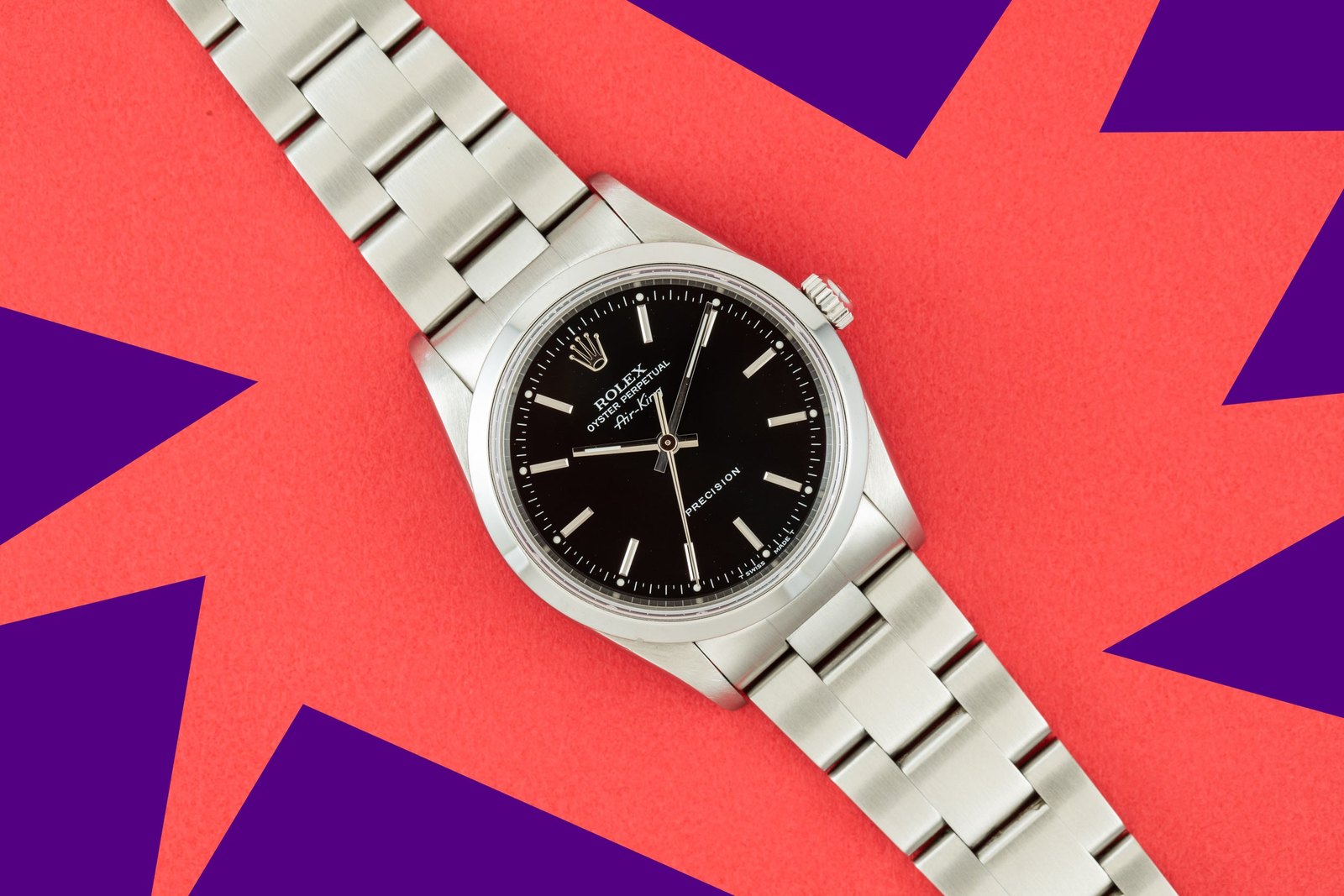
Rolex Air King, c. 1997
- Maker / attribution
- Rolex (maker)
- Date
- c. 1997
- Historical period
- Mechanical Renaissance (1990 – 2010)
- Country of origin
- Switzerland
- Object type
- Wristwatch
- Stock no.
- 40920083
- Credit line
- Dealer listing, Analog/Shift (40920083)
- Catalogue title (original)
- Rolex Air King (English)
View the source record (dealer listing) ↗ (opens another website in a new tab)Suggest a correction
Record summary
Catalogued by Analog/Shift (dealer), New York (stock number 40920083), this is a wristwatch by Rolex, made in Switzerland, dated c. 1997. The Atlas places it in the Mechanical Renaissance period (1990 – 2010) of its Wristwatches collection. The record is illustrated with 6 photographs.
Assembled from the source record's structured fields. Dates and attributions are given as the source states them; where a field is missing the Atlas leaves it blank rather than estimating.
Catalogue description
Dealer description — Analog/Shift
Why We Love It When it comes to "budget" Rolex, there are few watches more attractive than an Air King. The proportions are perfect, the movement robust and the styling timeless . It’s not hard to make the argument that the Air King is one of the most versatile time only watches on the market, as all it takes is a strap change to transform this watch go a tuxedo accoutrement to a field watch or BBQ grill timer. When you factor in that they have been made available in a broad variety of dial color configurations, the appeal grows even more. This U-Serial example dates to circa 1997 and features a crisp black Tritium sunburst dial with stick indices and an excellent case with matching solid link Oyster bracelet, not to mention original papers. If stainless steel and black is your jam, don't hesitate on this one - as black dialed Air Kings with Tritium dials simply don't grow on trees! The Oyster Perpetual Story In Rolex's impressive history, the brand has released a veritable arsenal of models that have become classics. Many of these bear the moniker "Oyster Perpetual." While this name is used on a particular model line, it also finds itself used widely across Rolex’s varied collections. This signifies two things: first, that the watch will have the trademark waterproof Rolex Oyster case. And secondly, that the movement beating inside that Oyster case will be one of Rolex's famed Perpetual (automatic winding) movements. Rolex first patented the Oyster case in 1925, but the quest for a waterproof and dust-proof case began shortly before the First World War. The cases of the Great War and the early 1920s came in two or three pieces with an inner case that shielded the movement (then a manual-wind movement) from the wet, dusty conditions on the battlefield. The Oyster case of 1925 represented the culmination of ten years of development. As with the Oyster case, the Perpetual movement saw many iterations before finally being perfected in the 1930s. Rolex's first automatic movement quietly debuted in 1931, and was met with some consternation from purists who decried the "extreme novelty" of a self-winding watch. Nevertheless, Rolex could see that the future lay in the Perpetual movement. They continued to develop and improve it over the years, establishing a line of dressier watches bearing the “Oyster Perpetual” nomenclature that would stand as an alternative to Rolex's sportier models. These models run the gamut of size, casing material and dial design, and offer a tremendous value for buyers. Meant to be worn every day, the Oyster Perpetual combines elegant looks with rugged dependability, and are very much the backbone of the Rolex brand.
Historical context
Mechanical Renaissance (1990 – 2010)
Mechanical watches return as cultural objects; independent watchmaking flourishes.
Mechanical watches returned as cultural and luxury objects. Complications, tourbillons and new materials proliferated; independent watchmakers such as George Daniels, F.P. Journe and Philippe Dufour revived artisanal watchmaking; collecting vintage watches became a major field.
Read the period in the timelineMore wristwatches from this periodEarlier: Quartz Revolution
Atlas type guide
Wristwatches
Bracelet watches were worn by women from the early nineteenth century — Breguet made one for Caroline Murat, Queen of Naples, in 1810–12 — but the wristwatch only became a man's instrument with military use and aviation in the early twentieth century. Between the World Wars it overtook the pocket watch; the 1920s and 1930s brought rectangular Art Deco cases, water-resistant cases and the first automatic winding systems.
After 1945 the wristwatch became a carrier of identity — dress watches, sports and dive watches, chronographs, calendars — produced by Swiss, American, Japanese, German, Soviet and Chinese industries. The quartz revolution after 1969 and the mechanical renaissance since the 1990s, including the rise of independent watchmakers, complete the story.
What to look for
- The reference number (between the lugs or inside the case back) and serial number, the starting point for dating.
- The calibre: its maker and number are often stamped under the dial or on the bridge.
- Originality of dial, hands and crown — refinished ('redial') dials are common.
- Case material marks: 18K/750, 14K/585, stainless steel, gold-filled, plated.
Dating clues
- Wire-lug cases: before c. 1925.
- Water-resistant screw-down cases: from 1926.
- Quartz movements: from 1969; sapphire crystals widespread after c. 1980.
General guidance written by the Atlas editors about this kind of object. It is not a statement about this particular piece; for that, rely on the source record above and on physical examination.
Related records

Movements & Components · c. 1970s
Rolex watch movement, c. 1970s
Antiquorum auction archive, Geneva

Pocket Watches · 1982
Fake Rolex watch, gold coloured metal, possibly made in Taiwan, 1982; part of a casual outfit, UK, 1982-84.
Victoria and Albert Museum, London

Wristwatches · c. 1920s
Rolex wristwatch, c. 1920s
Antiquorum auction archive, Geneva

Wristwatches · c. 1920s
Rolex wristwatch, ref. 6194, c. 1920s
Antiquorum auction archive, Geneva

Wristwatches · 2008
Wristwatch by Breitling?, 2008
Museum Rotterdam

Wristwatches · c. 1990s
Audemars Piguet Bamboo, c. 1990s
Antiquorum auction archive, Geneva

Wristwatches · c. 1990
Audemars Piguet Huitieme Perpetual Calendar, ref. 25696PT, c. 1990
Antiquorum auction archive, Geneva

Wristwatches · c. 1990
Breitling Chronomat, ref. b13050.1, c. 1990
Antiquorum auction archive, Geneva