
Wristwatches · Wristwatch
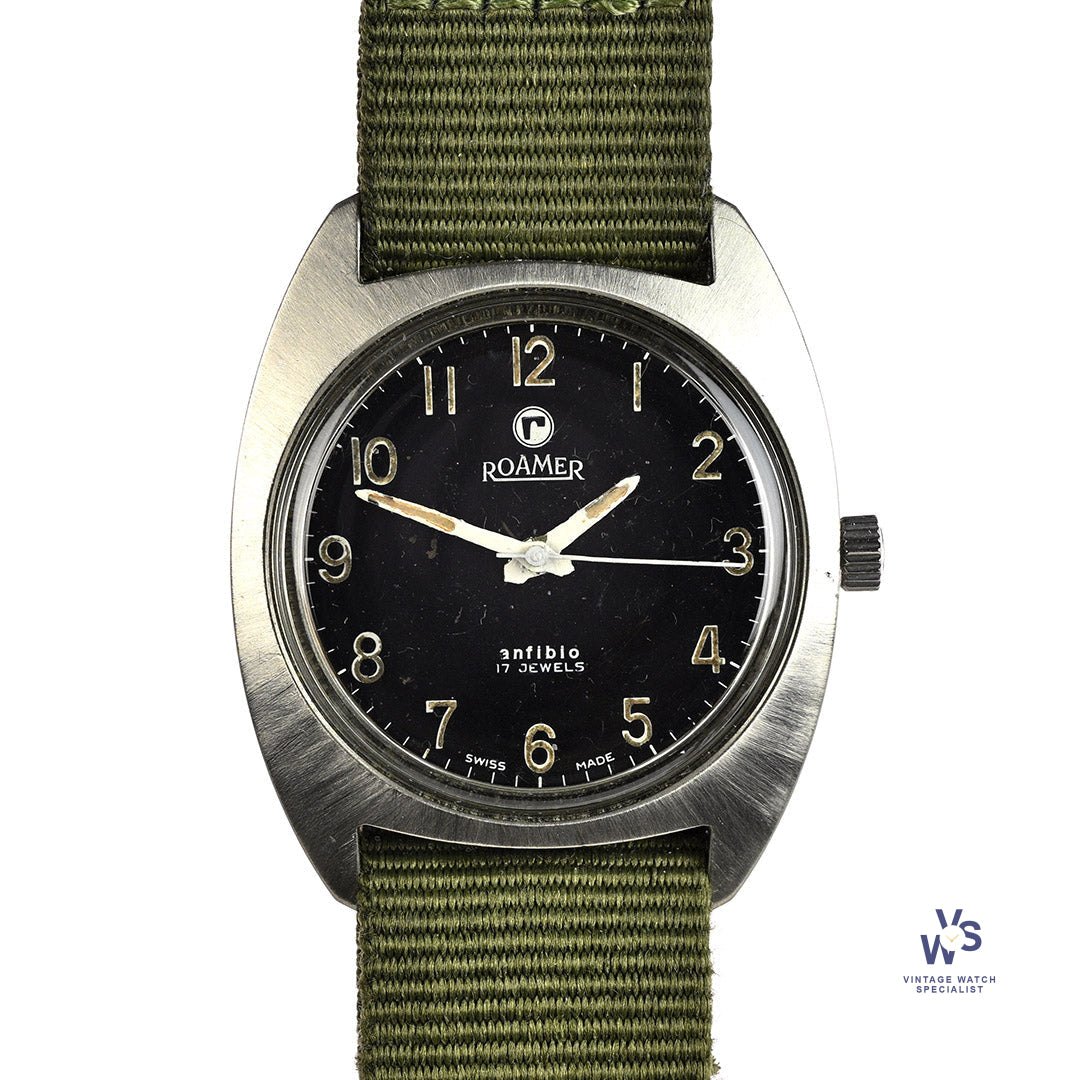
Roamer Anfibio Watch, Rhodesian Military Issued, ref. 520-1120.016, circa 1973
- Maker / attribution
- Roamer (maker)
- Date
- c. 1973
- Historical period
- Quartz Revolution (1969 – 1990)
- Country of origin
- Unrecorded in source
- Object type
- Wristwatch
- Stock no.
- vws4106
- Credit line
- Dealer listing, Vintage Watch Specialist (vws4106)
- Catalogue title (original)
- Roamer Anfibio Watch - Rhodesian Military Issued - Model Ref: 520-1120.016 - c.1973 (English)
View the source record (dealer listing) ↗ (opens another website in a new tab)Suggest a correction
Record summary
Catalogued by Vintage Watch Specialist (dealer), United Kingdom (stock number vws4106), this is a wristwatch by Roamer, dated c. 1973. The Atlas places it in the Quartz Revolution period (1969 – 1990) of its Wristwatches collection. The record is illustrated with 6 photographs.
Assembled from the source record's structured fields. Dates and attributions are given as the source states them; where a field is missing the Atlas leaves it blank rather than estimating.
Catalogue description
Dealer description — Vintage Watch Specialist
A Fantastic Example of the Roamer Anfibio Issued to the Rhodesian Military in c.1973, Very Well Preserved and extremely rare, in Original Condition with Nice Lume Roamer, founded in Switzerland in 1888, built its reputation on producing robust, dependable mechanical watches. That reliability led to military use beyond Europe, including service with forces in Rhodesia, now Zimbabwe. Issued to military personnel, Roamer watches were valued for their durability, legibility and straightforward functionality in demanding conditions. These Rhodesian-issued military timepieces reflect Roamer’s practical watchmaking heritage and stand today as distinctive artefacts of mid-20th-century military history. This issued watch from Roamer bears quite an interesting back story that involves the military and smuggling. During a civilian conflict also known as the Zimbabwe War of Liberation between 1964 & 1979, major sanctions were put on the country preventing the import of certain luxury goods such as watches to the open market. The military called on their South African allies to supply watches to them for them to use in combat situations. These Rhodesian issued military Roamers were engraved with Z, ZA, SFA, or RA markings, and here we have a Z marked watch (Z3319). What's on Offer This Roamer Anfibio is a well-preserved military-issued tool watch from the early 1970s, produced during the period of Rhodesian conflict. The Anfibio line was developed by Roamer as a robust, water-resistant watch designed for demanding environments, combining practical durability with clear, legible design. These qualities made it well suited to military and field use. The stainless steel case remains in excellent condition, showing only light, honest wear while retaining strong, purposeful lines. The caseback engravings are crisp and clearly legible, reinforcing the watch’s military provenance. The black dial is clean and functional, with bold Arabic numerals and original luminous material still present on the hands and numerals, adding authentic character. Protected beneath a Plexiglas crystal, the watch runs smoothly via its manually wound movement. Paired with a green NATO-style strap, this Anfibio wears comfortably and confidently. A highly wearable and increasingly collectible military timepiece with genuine historical significance. This is only the 3rd watch we have come across in 43 years of collecting watches!
Historical context
Quartz Revolution (1969 – 1990)
Seiko's Astron begins mass quartz timekeeping; traditional industries contract sharply.
Quartz and digital watches transformed the market after 1969. Swiss employment collapsed, Japanese and Hong Kong production soared, and the Swatch (1983) helped the Swiss industry recover; mechanical watches survived as luxury goods.
Read the period in the timelineMore wristwatches from this periodEarlier: Modern Mechanical Horology
Atlas type guide
Military, pilot and travel watches
The wristwatch owes much of its adoption by men to warfare and aviation. Wristlets — small pocket watches soldered with lugs and worn on a strap — were used in colonial campaigns and became standard equipment in the First World War, with protective grilles over the crystal ('shrapnel guards'). Louis Cartier's Santos (1904), designed for the aviator Alberto Santos-Dumont, is often cited as an early purpose-made pilot's watch.
In the Second World War governments specified watches in detail: the German B-Uhr observation watches, the American A-11, and the British 'W.W.W.' (the 'Dirty Dozen' set of 1945). After the war, jet travel brought GMT and world-time watches, which show two or more time zones at once — Louis Cottier's world-time mechanism and the Rolex GMT-Master (1955) are examples.
What to look for
- Military markings on the case back: broad arrow, issue numbers, 'W.W.W.', 'A.T.P.'
- High-legibility black dials with luminous Arabic numerals; oversized crowns for gloved hands.
- 24-hour hands and rotating 24-hour bezels or city rings on GMT/world-time watches.
- Wire lugs on early wristlets converted from pocket watches.
Dating clues
- Wire-lug wristlets: c. 1900–1925.
- Military specifications of the Second World War: 1939–1945.
- GMT and world-time wristwatches: mainly after 1950.
General guidance written by the Atlas editors about this kind of object. It is not a statement about this particular piece; for that, rely on the source record above and on physical examination.
Related records
Wristwatches · c. 1967
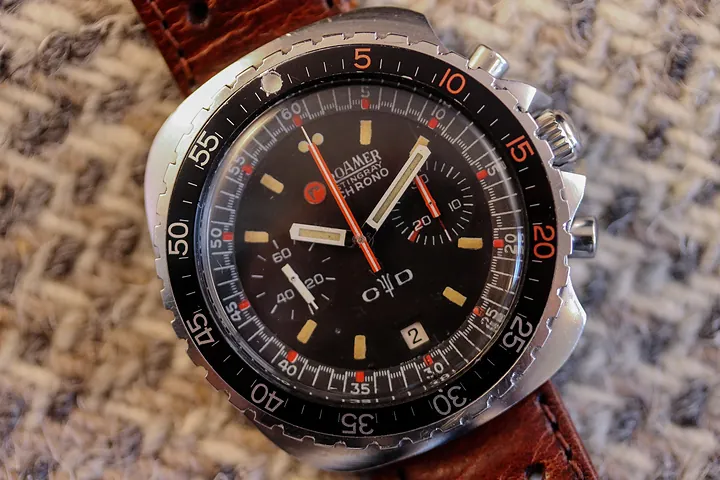
Roamer Stingray Chronograph, c. 1967
Analog/Shift (dealer), New York
Wristwatches · c. 1930s
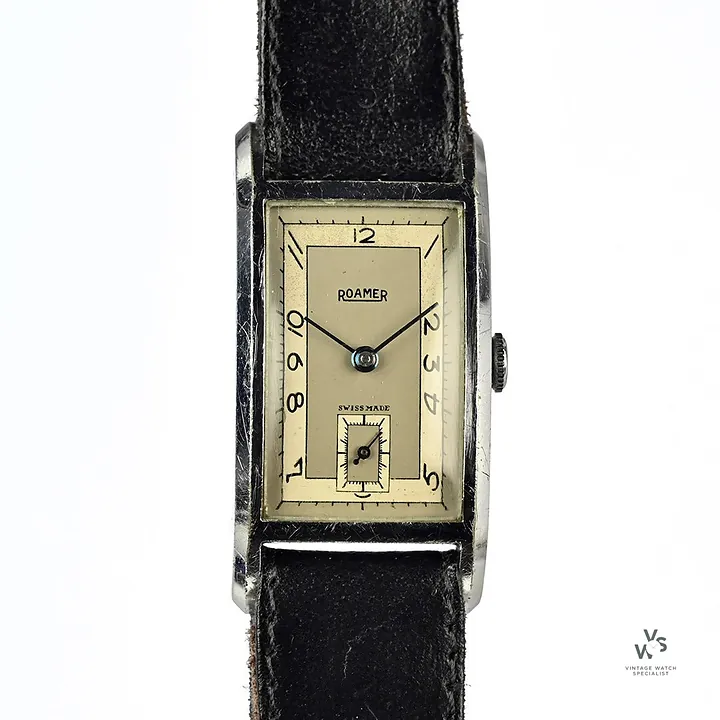
Roamer Art Deco Tank Case Watch, circa 1930s
Vintage Watch Specialist (dealer), United Kingdom
Wristwatches · c. 1970s
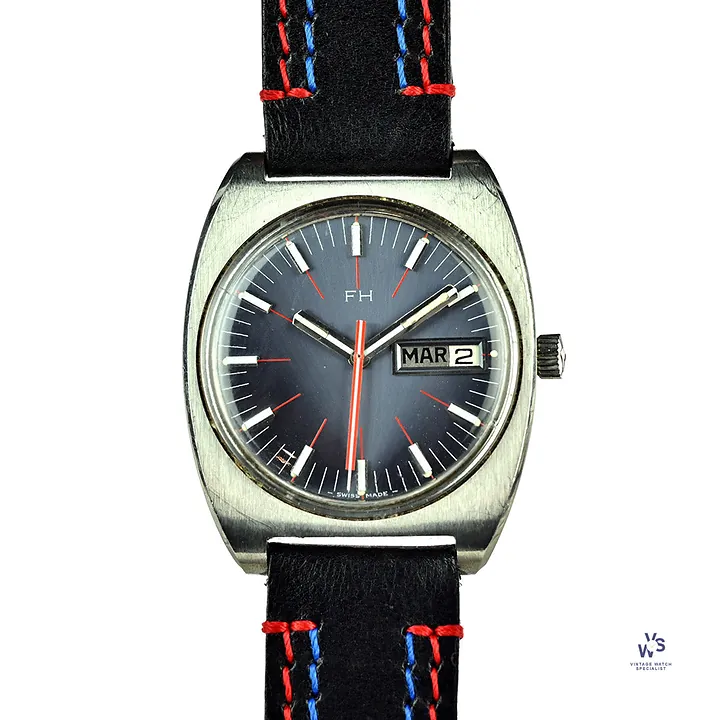
Roamer FH Dial (Federation Horology Assembled), Dial with Automatic Movement, Cushion Case, circa 1970s
Vintage Watch Specialist (dealer), United Kingdom
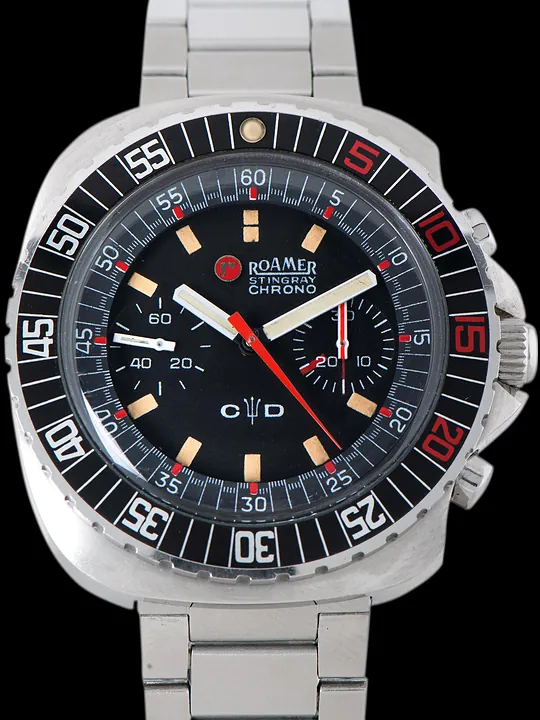
Wristwatches · 1970s
Roamer Stingray Chronograph (Ref. 023-912.900) "Valjoux 23", 1970s
Craft & Tailored (dealer), Los Angeles

Wristwatches · 1970
Wristwatch by Heno, Switzerland, 1970
Museum Rotterdam
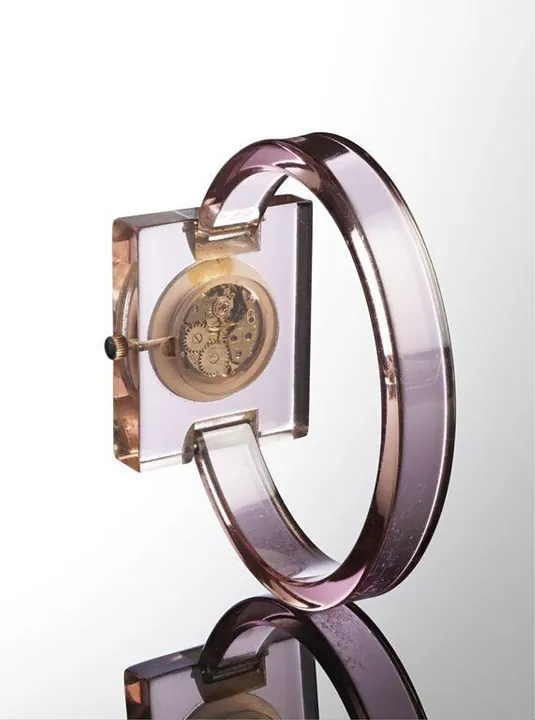
Wristwatches · 1970s
Wristwatch, plastic, by Gucci; Italy, 1970s.
Victoria and Albert Museum, London
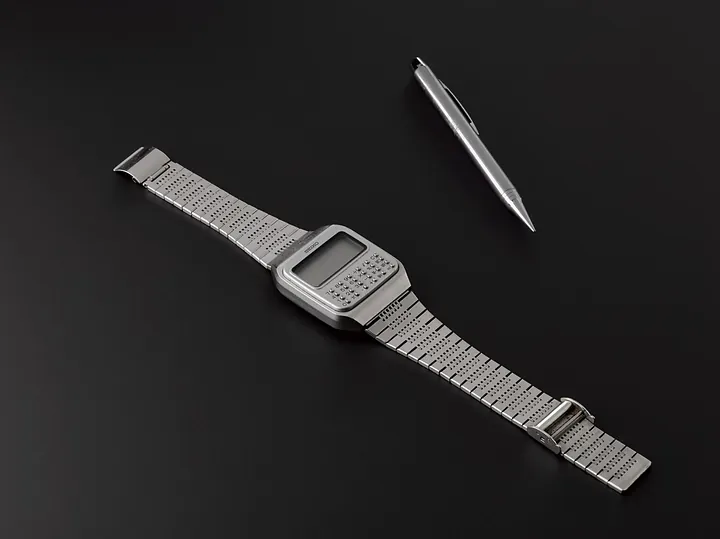
Wristwatches · 1978
Calculator wristwatch by Suwa Seikosha Co. Limited, Japan, 1978
Science Museum Group, London
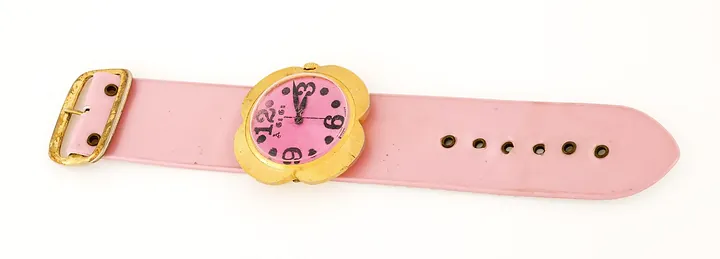
Wristwatches · 1980
Wristwatch, 1980 (no. 71413)
Museum Rotterdam