
Wristwatches · Wristwatch
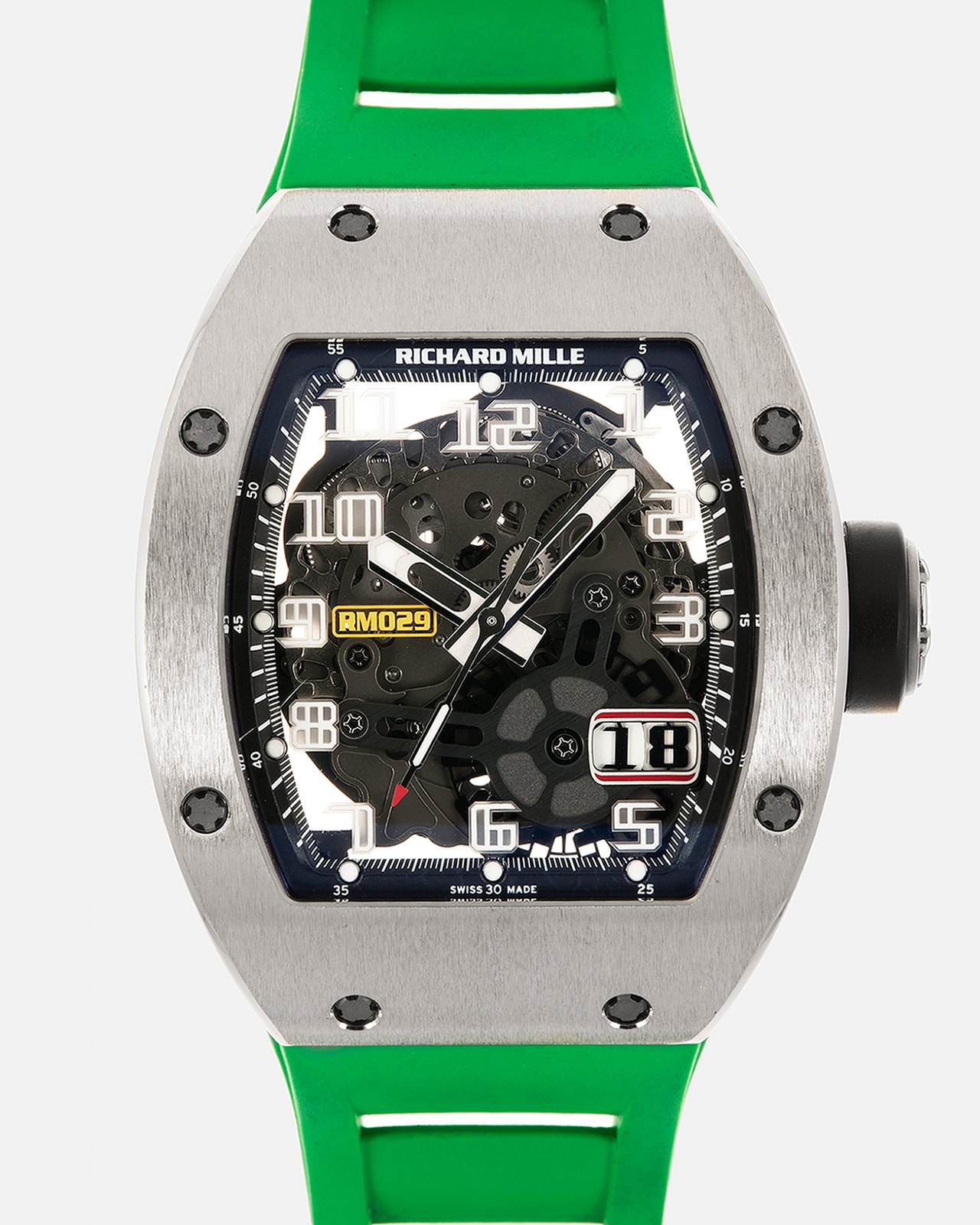
Richard Mille RM029 White Gold, 2014
- Maker / attribution
- Richard Mille (maker)
- Date
- 2014
- Historical period
- Contemporary Horology (2010 – Present)
- Country of origin
- Switzerland
- Object type
- Wristwatch
- Materials / technique
- white gold
- Dimensions
- Case 39.7 mm
- Stock no.
- Product 6991196520535
- Credit line
- Dealer listing, S.Song Watches (product 6991196520535)
- Catalogue title (original)
- Richard Mille RM029 White Gold (English)
View the source record (dealer listing) ↗ (opens another website in a new tab)Suggest a correction
Record summary
Catalogued by S.Song Watches (dealer), Seattle (stock number Product 6991196520535), this is a wristwatch by Richard Mille, made in Switzerland, dated 2014. The Atlas places it in the Contemporary Horology period (2010 – Present) of its Wristwatches collection. Materials and techniques recorded by the source: white gold. Recorded dimensions: Case 39.7 mm. The record is illustrated with 6 photographs.
Assembled from the source record's structured fields. Dates and attributions are given as the source states them; where a field is missing the Atlas leaves it blank rather than estimating.
Catalogue description
Dealer description — S.Song Watches
Prized for its ability to create some of the most jaw-dropping pieces of horological excellence around, Richard Mille has surged from being a relatively under-the-radar indie watchmaker into a blue-chip powerhouse that has joined the big boys with over a billion CHF a year in sales. Paramount to their success have been their distinctive designs, incredible watchmaking, and next-level engineering; all attributes that the RM029 wields in abundance. Constructed from 18-carat white gold, this amazing timepiece's signature design motif is its oversized date window and skeletonized dial that also provides a perfect view of the incredible Cal. RMAS7 found within. Machined from Grade 5 titanium with Titalyt® treatment, the bridges and main plate are rigid and provide excellent stability for the movement during use, no matter how strenuous the activity. Designed as the ultimate sports watch, the RM029 features a variable geometry rotor. This means its winding rotor can be set to wind the movement at different speeds according to the level of activity that its wearer is undertaking, and so the RM029 can be personalized to the lifestyle of its owner. With its 18-carat white gold tonneau-shaped case, luminous Arabic numerals, skeletonized dial, and multi-tonal movement underneath, the RM029 encapsulates everything that has come to signify Richard Mille and their avant-garde design language. Measuring 39.7mm x 48mm across, the RM029 spans the wrist comfortably while remaining narrow enough to wear like most sports watches on the market today. As someone with relatively small wrists, I was surprised at how wearable the RM029 is, as it hugs the wrist perfectly and doesn’t overextend at all. A state-of-the-art timepiece in just about every way possible, the RM029 represents the extreme high-end of the modern watchmaking industry and makes no reservations about it.
Historical context
Contemporary Horology (2010 – Present)
Silicon components, connected watches, optical-lattice research clocks and a thriving independent scene.
Smartwatches became the world's best-selling watches, while mechanical watchmaking focuses on craft, innovation (silicon components, new escapements) and independent makers.
Read the period in the timelineMore wristwatches from this periodEarlier: Mechanical Renaissance
Atlas type guide
Wristwatches
Bracelet watches were worn by women from the early nineteenth century — Breguet made one for Caroline Murat, Queen of Naples, in 1810–12 — but the wristwatch only became a man's instrument with military use and aviation in the early twentieth century. Between the World Wars it overtook the pocket watch; the 1920s and 1930s brought rectangular Art Deco cases, water-resistant cases and the first automatic winding systems.
After 1945 the wristwatch became a carrier of identity — dress watches, sports and dive watches, chronographs, calendars — produced by Swiss, American, Japanese, German, Soviet and Chinese industries. The quartz revolution after 1969 and the mechanical renaissance since the 1990s, including the rise of independent watchmakers, complete the story.
What to look for
- The reference number (between the lugs or inside the case back) and serial number, the starting point for dating.
- The calibre: its maker and number are often stamped under the dial or on the bridge.
- Originality of dial, hands and crown — refinished ('redial') dials are common.
- Case material marks: 18K/750, 14K/585, stainless steel, gold-filled, plated.
Dating clues
- Wire-lug cases: before c. 1925.
- Water-resistant screw-down cases: from 1926.
- Quartz movements: from 1969; sapphire crystals widespread after c. 1980.
General guidance written by the Atlas editors about this kind of object. It is not a statement about this particular piece; for that, rely on the source record above and on physical examination.
Related records
Wristwatches · 2022
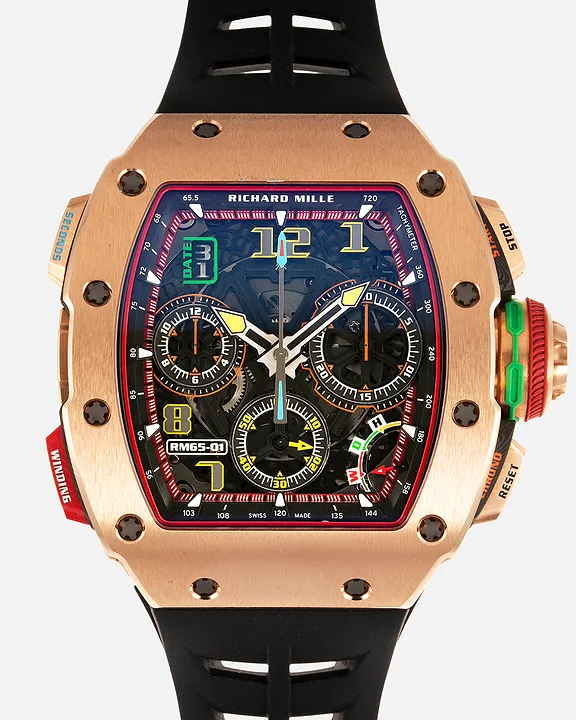
Richard Mille RM65-01 Split Seconds Full RG, 2022
S.Song Watches (dealer), Seattle
Wristwatches · 2022
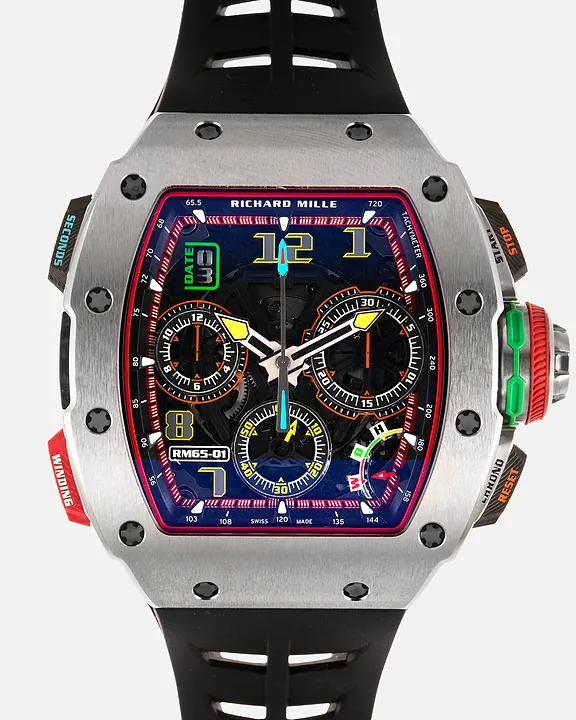
Richard Mille RM65-01 Split Seconds Titanium, 2022
S.Song Watches (dealer), Seattle
Wristwatches · 2019
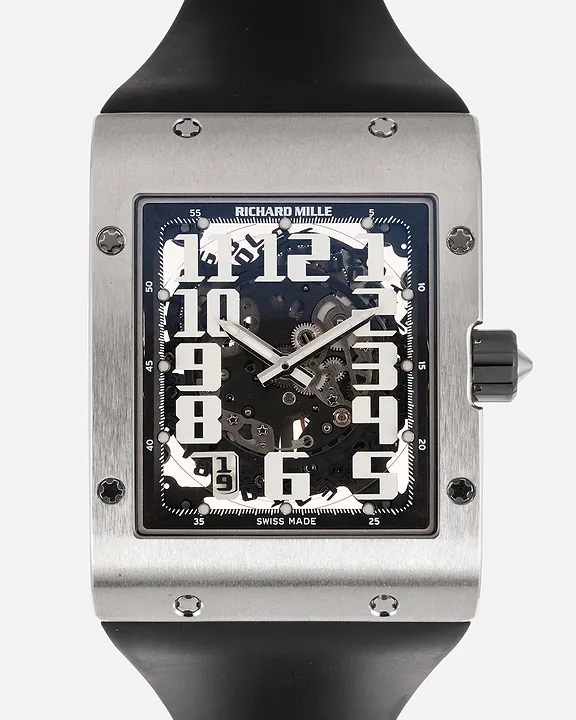
Richard Mille RM016 WG, 2019
S.Song Watches (dealer), Seattle
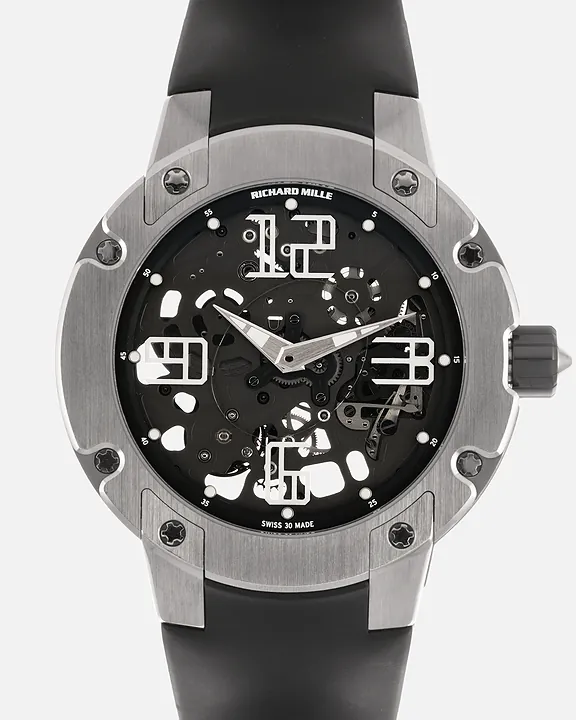
Wristwatches · 2015
Richard Mille RM033 Extra Flat Titanium, 2015
S.Song Watches (dealer), Seattle

Wristwatches · c. 2010s
Breguet Type XXI, ref. 3810, c. 2010s (Antiquorum Lot 381-24)
Antiquorum auction archive, Geneva

Wristwatches · c. 2010s
Breguet Type XXI, ref. 3810, c. 2010s (Antiquorum Lot 386-229)
Antiquorum auction archive, Geneva

Wristwatches · Sold in September 2010
Breitling Cosmonaute, ref. A 22322, Sold in September 2010
Antiquorum auction archive, Geneva

Wristwatches · c. 2010
Corum Bubble Chrono, ref. 396.150.20, c. 2010
Antiquorum auction archive, Geneva