
Wristwatches · Wristwatch
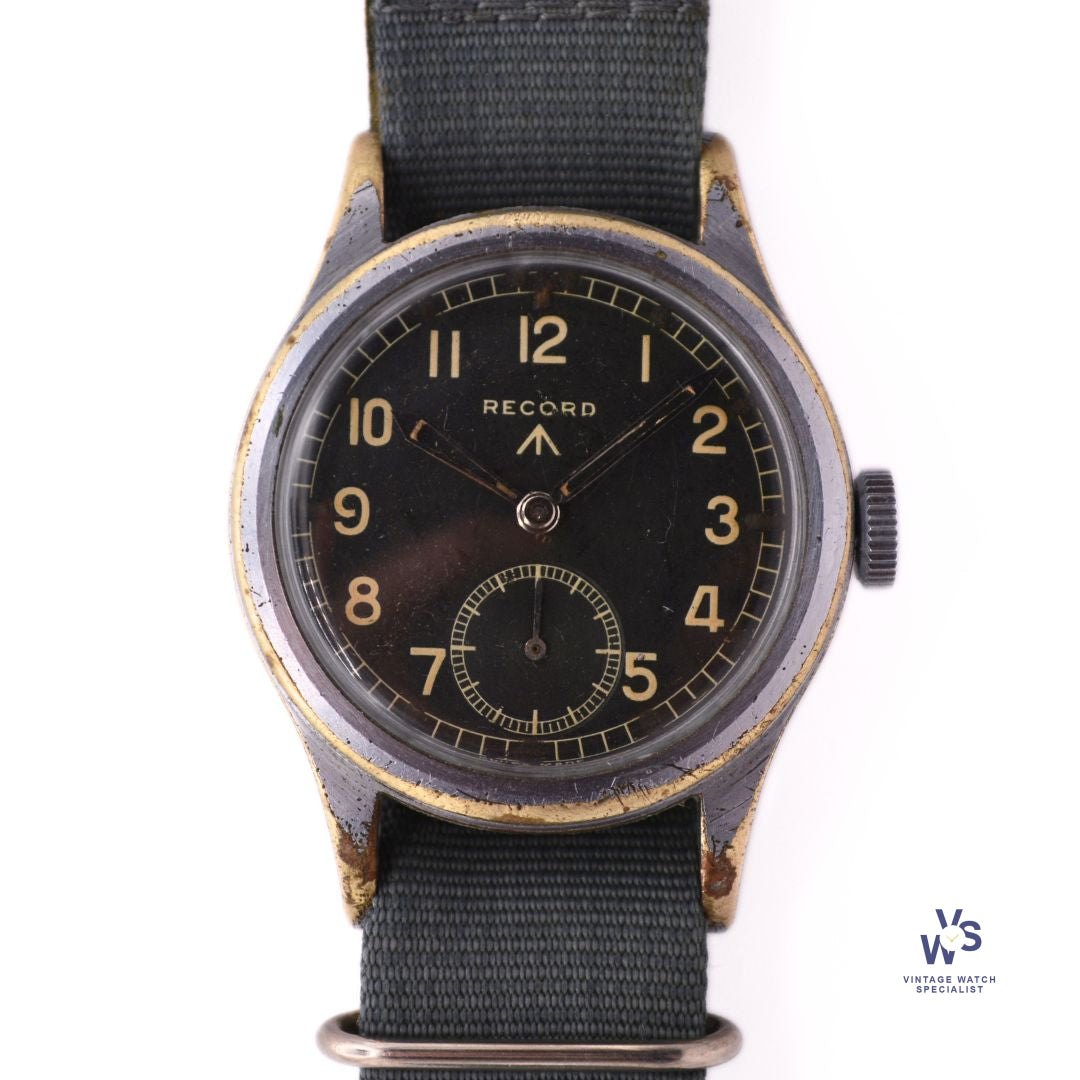
Record WWW, Military Dirty Dozen, Caseback ref. WWW L 34094, circa 1945
- Maker / attribution
- Record (maker)
- Date
- c. 1945
- Historical period
- Modern Mechanical Horology (1945 – 1969)
- Country of origin
- Unrecorded in source
- Object type
- Wristwatch
- Stock no.
- VWS2853cs
- Credit line
- Dealer listing, Vintage Watch Specialist (VWS2853cs)
- Catalogue title (original)
- Record WWW - Military Dirty Dozen - Caseback Ref: WWW L 34094 - c.1945 (English)
View the source record (dealer listing) ↗ (opens another website in a new tab)Suggest a correction
Record summary
Catalogued by Vintage Watch Specialist (dealer), United Kingdom (stock number VWS2853cs), this is a wristwatch by Record, dated c. 1945. The Atlas places it in the Modern Mechanical Horology period (1945 – 1969) of its Wristwatches collection. The record is illustrated with 6 photographs.
Assembled from the source record's structured fields. Dates and attributions are given as the source states them; where a field is missing the Atlas leaves it blank rather than estimating.
Catalogue description
Dealer description — Vintage Watch Specialist
Historic Record WWW Dirty Dozen With Caseback Engravings W.W.W L34094 551941 Good Condition The "Dirty Dozen" refers to a group of twelve Swiss watch manufacturers that produced military wristwatches for the British Army during World War II. These watches were commissioned by the British Ministry of Defence and were used by soldiers in various branches of the military. These watches were typically simple, time-only pieces with black dials, Arabic numerals, and luminous hands and hour markers for better readability in low-light conditions. They were produced between 1942 and 1945 and are highly sought after by collectors today due to their historical significance and rarity. Each of the Dirty Dozen manufacturers produced a specific quantity of watches, and the timepieces went through rigorous testing for accuracy and durability before being issued to military personnel. The Dirty Dozen watches played a crucial role during wartime and have become iconic in the world of military watch collecting. What’s on Offer Evaluating this vintage Record, we find it is a good example of one of the iconic Dirty Dozen watches made towards the end of WWII and has been preserved well over this long period. Placing it on the timeograph machine it is still keeping good time. These watches were made with the 022K calibre Record movement which has 17 jewels and a power reserve of 42 hours when new. When Looking at the case you can see that it has seen some wear around the case side profile, bezel ring, and lugs revealing the brass material underneath but on the whole most of the original plating is still present. These watch cases were manufactured with nickel chrome plated brass because it was a lot cheaper to use than stainless steel at the time. The Nickel plating took to wear much easier which caused it to fade away with rigorous conditions and long periods. When viewing the caseback the original Military issue engravings are very visible. Light scratches can be found around the outer of the caseback but is still in very good condition. This watch is currently fitted with a NATO-style strap because it is most fitting for this piece and also has fixed lug bars as standard from when it was first manufactured.
Historical context
Modern Mechanical Horology (1945 – 1969)
Tool watches for divers, pilots and astronauts; electric watches anticipate the electronic age.
The classic era of the mechanical wristwatch: dive watches, chronographs for motor racing and space flight, GMT watches for jet travel, slim dress watches, automatic calendars, and the rise of Japanese manufacturers alongside Swiss, American, German and Soviet industries.
Read the period in the timelineMore wristwatches from this periodEarlier: Golden Age of Mechanical Watchmaking
Atlas type guide
Military, pilot and travel watches
The wristwatch owes much of its adoption by men to warfare and aviation. Wristlets — small pocket watches soldered with lugs and worn on a strap — were used in colonial campaigns and became standard equipment in the First World War, with protective grilles over the crystal ('shrapnel guards'). Louis Cartier's Santos (1904), designed for the aviator Alberto Santos-Dumont, is often cited as an early purpose-made pilot's watch.
In the Second World War governments specified watches in detail: the German B-Uhr observation watches, the American A-11, and the British 'W.W.W.' (the 'Dirty Dozen' set of 1945). After the war, jet travel brought GMT and world-time watches, which show two or more time zones at once — Louis Cottier's world-time mechanism and the Rolex GMT-Master (1955) are examples.
What to look for
- Military markings on the case back: broad arrow, issue numbers, 'W.W.W.', 'A.T.P.'
- High-legibility black dials with luminous Arabic numerals; oversized crowns for gloved hands.
- 24-hour hands and rotating 24-hour bezels or city rings on GMT/world-time watches.
- Wire lugs on early wristlets converted from pocket watches.
Dating clues
- Wire-lug wristlets: c. 1900–1925.
- Military specifications of the Second World War: 1939–1945.
- GMT and world-time wristwatches: mainly after 1950.
General guidance written by the Atlas editors about this kind of object. It is not a statement about this particular piece; for that, rely on the source record above and on physical examination.
Related records
Wristwatches · c. 1950s
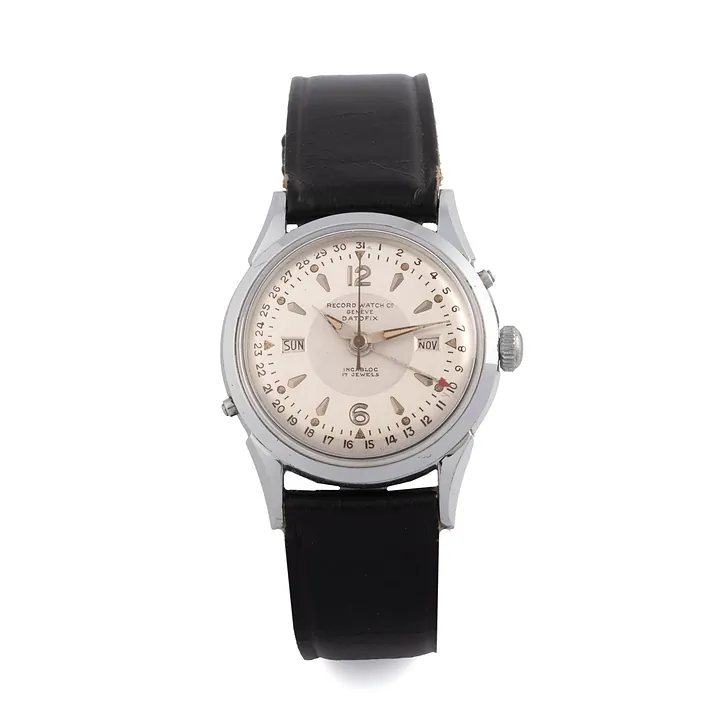
Record Datofix, c. 1950s
Antiquorum auction archive, Geneva
Wristwatches · c. 1960s
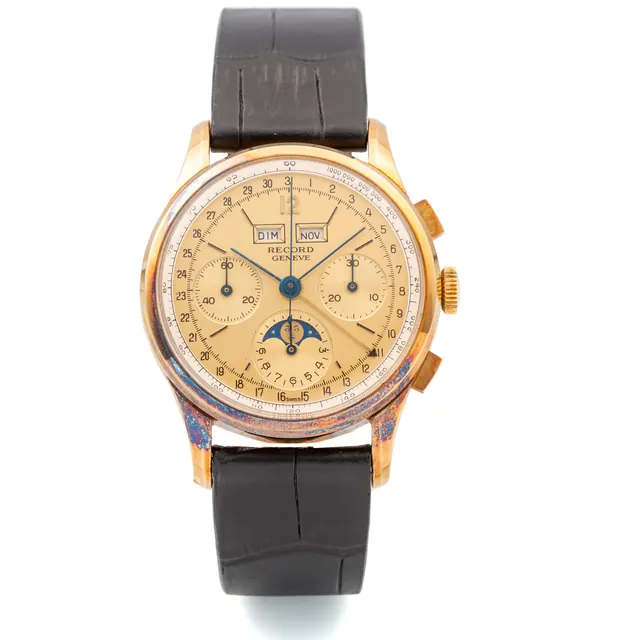
Record wristwatch, Oversize Triple Date Chronograph, circa 1960's
Antiquorum auction archive, Geneva
Wristwatches · c. 1950
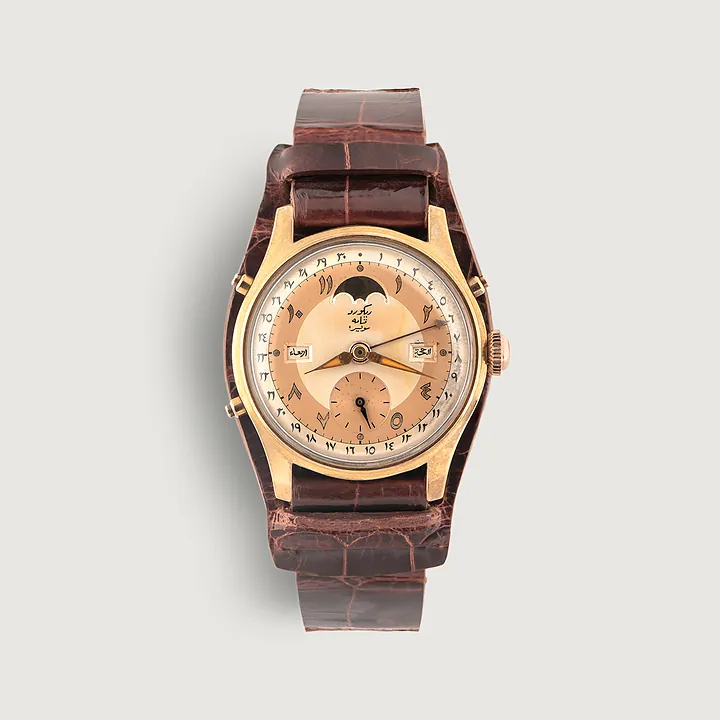
Record Datofix For The Middle East, circa 1950
Watches of Knightsbridge (dealer), London
Wristwatches · 1950s
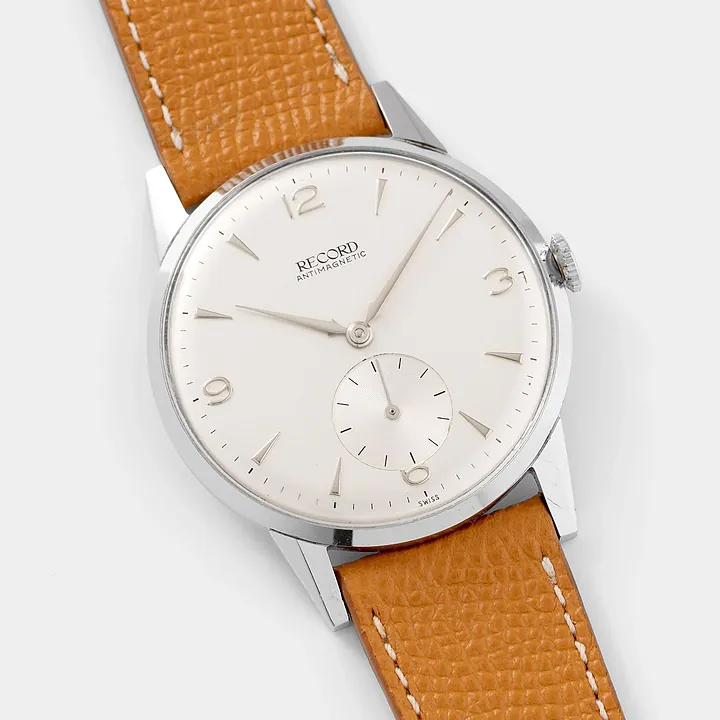
Record Oversize 1950s Large Case 38mm
Bulang & Sons (dealer), Copenhagen

Wristwatches · 1945
Wristwatch by Eterna, 1945
Museum Rotterdam

Wristwatches · c. 1945
Breitling Premier, ref. 790, c. 1945
Antiquorum auction archive, Geneva

Wristwatches · c. 1945
Universal Genève Uni-Compax, ref. 22492, c. 1945
Antiquorum auction archive, Geneva
Wristwatches · c. 1950s
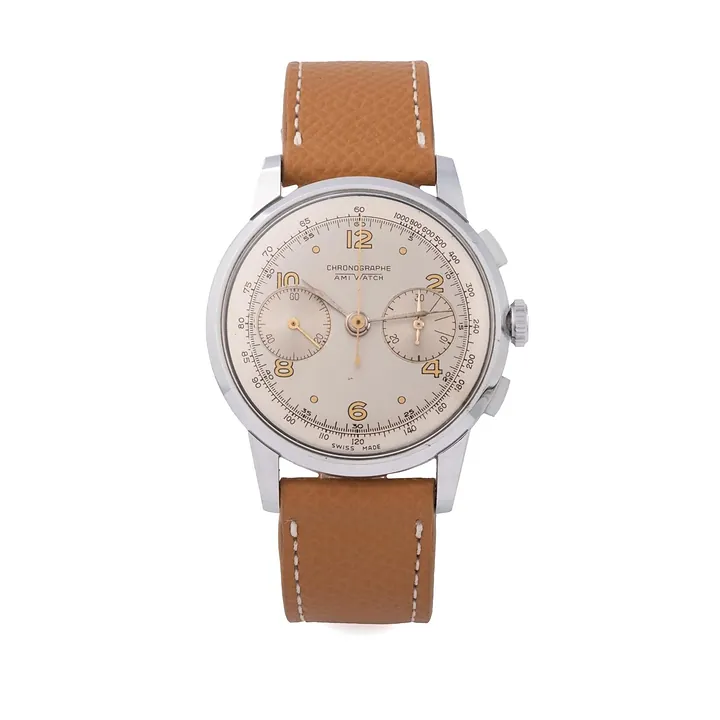
Ami Watch Chronographe, c. 1950s
Antiquorum auction archive, Geneva