
Wristwatches · Wristwatch
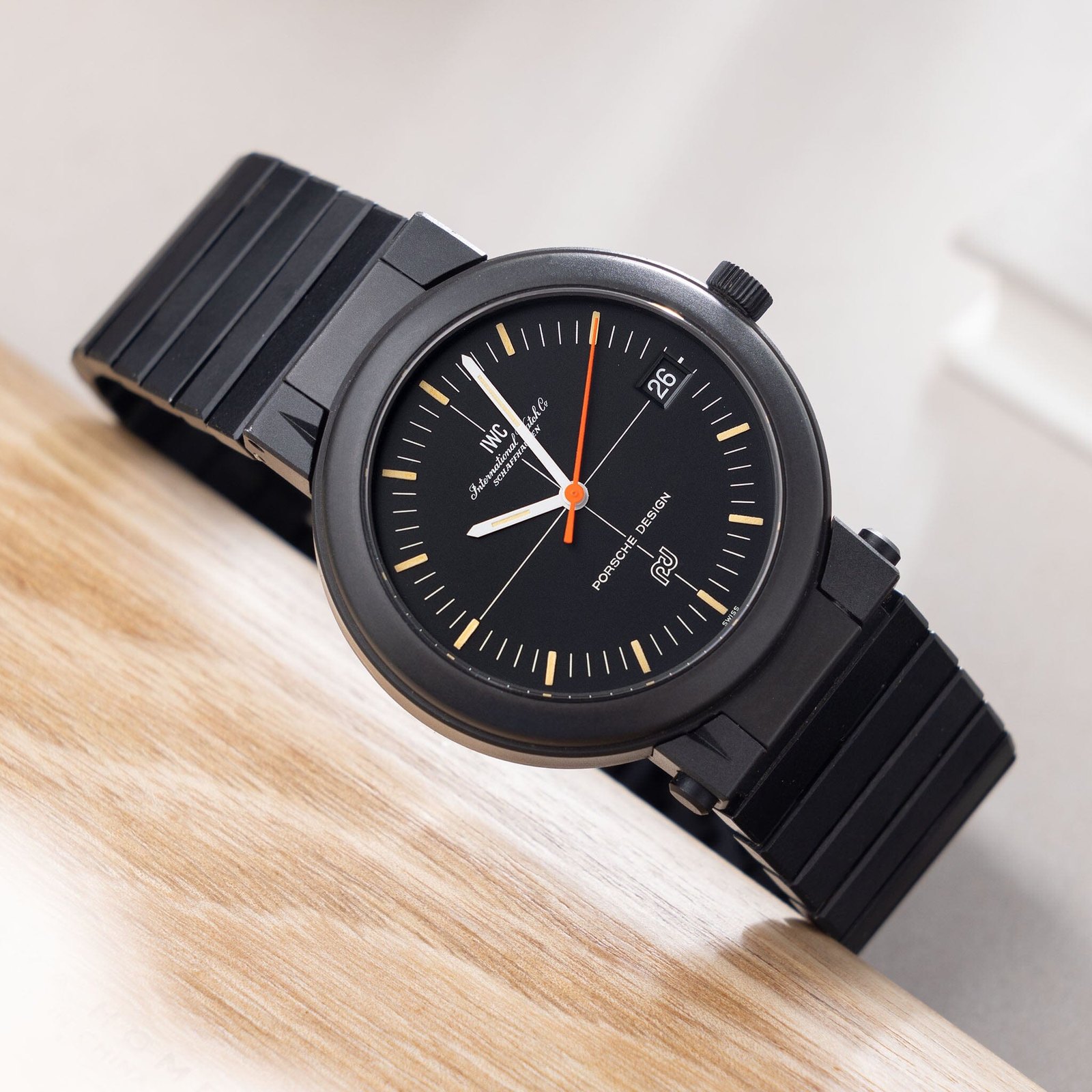
Porsche Design by IWC Compass Watch ref. 3510 Unworn, 1980s
- Maker / attribution
- IWC (maker)
- Date
- 1980s
- Historical period
- Quartz Revolution (1969 – 1990)
- Country of origin
- Switzerland
- Object type
- Wristwatch
- Dimensions
- Case 39 mm
- Stock no.
- W-2507
- Credit line
- Dealer listing, Bulang & Sons (W-2507)
- Catalogue title (original)
- Porsche Design by IWC Compass Watch ref. 3510 Unworn With Box (English)
View the source record (dealer listing) ↗ (opens another website in a new tab)Suggest a correction
Record summary
Catalogued by Bulang & Sons (dealer), Copenhagen (stock number W-2507), this is a wristwatch by IWC, made in Switzerland, dated 1980s. The Atlas places it in the Quartz Revolution period (1969 – 1990) of its Wristwatches collection. Recorded dimensions: Case 39 mm. The record is illustrated with 6 photographs.
Assembled from the source record's structured fields. Dates and attributions are given as the source states them; where a field is missing the Atlas leaves it blank rather than estimating.
Catalogue description
Dealer description — Bulang & Sons
Don’t get lost whilst telling the time guys! This is a very unusual and cool watch from, IWC- Porsche Design. In 1972, Prof. Ferdinand Alexander "Butzi" Porsche, the grandson of Porsche founder Ferdinand Porsche and the mind behind the Porsche 911, founded Porsche Design Studio. Conceived as a result of Butzi's passion for hunting and exploration, this watch was designed to be inconspicuous, considering the need for less shine to avoid startling prey, and practical for navigation in the absence of publicly available GPS technology. The dial features a cross-hair design, super nice aged yellow luminous markers, a red running seconds hand, and the classic International Watch Co. logo. The lightweight 39mm PVD-coated aluminum case is in fantastic condition( only the smallest marks from storage ) and has buttons on the 5 and 7 o'clock sides for flipping open the case, revealing a compass and a mirror, serving dual purposes for navigation and signaling, while the anti-magnetic movement ensures the compass's accuracy. The bracelet made from Delrin lightweight plastic with a titanium clasp links are exact 0.5 cm - there is “quick release “ buttons to open the bracelet - so one can flatten the watch on a map and can use it as a measuring devise.. To measure every half cm to calculate the distances , genius ! As this watch is in completely untouched condition, we have decided to not even open this time capsule. The watch is running fine, but for everyday wear a service is recommended in which we could assist ! This is a super cool light weight watch( 78 gramms !!) with a great look on the wrist. Let’s talk and do a deal! Specifications: - Reference 3510 - 38mm aluminium PVD-coated case - Serial 225xxxx dates to 1980s - Black dial signed IWC and Porsche Design - Automatic movement - Plastic bracelet with titanium clasp - Original box - Includes a handmade leather watch pouch
Historical context
Quartz Revolution (1969 – 1990)
Seiko's Astron begins mass quartz timekeeping; traditional industries contract sharply.
Quartz and digital watches transformed the market after 1969. Swiss employment collapsed, Japanese and Hong Kong production soared, and the Swatch (1983) helped the Swiss industry recover; mechanical watches survived as luxury goods.
Read the period in the timelineMore wristwatches from this periodEarlier: Modern Mechanical Horology
Atlas type guide
Wristwatches
Bracelet watches were worn by women from the early nineteenth century — Breguet made one for Caroline Murat, Queen of Naples, in 1810–12 — but the wristwatch only became a man's instrument with military use and aviation in the early twentieth century. Between the World Wars it overtook the pocket watch; the 1920s and 1930s brought rectangular Art Deco cases, water-resistant cases and the first automatic winding systems.
After 1945 the wristwatch became a carrier of identity — dress watches, sports and dive watches, chronographs, calendars — produced by Swiss, American, Japanese, German, Soviet and Chinese industries. The quartz revolution after 1969 and the mechanical renaissance since the 1990s, including the rise of independent watchmakers, complete the story.
What to look for
- The reference number (between the lugs or inside the case back) and serial number, the starting point for dating.
- The calibre: its maker and number are often stamped under the dial or on the bridge.
- Originality of dial, hands and crown — refinished ('redial') dials are common.
- Case material marks: 18K/750, 14K/585, stainless steel, gold-filled, plated.
Dating clues
- Wire-lug cases: before c. 1925.
- Water-resistant screw-down cases: from 1926.
- Quartz movements: from 1969; sapphire crystals widespread after c. 1980.
General guidance written by the Atlas editors about this kind of object. It is not a statement about this particular piece; for that, rely on the source record above and on physical examination.
Related records
Pocket Watches · c. 1950
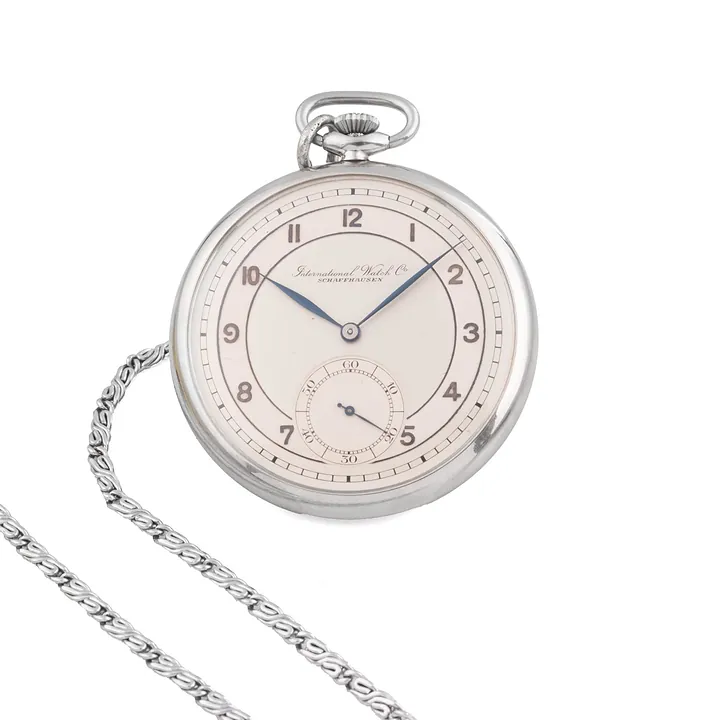
IWC Pocket Watch, c. 1950
Antiquorum auction archive, Geneva
Pocket Watches · c. 1980
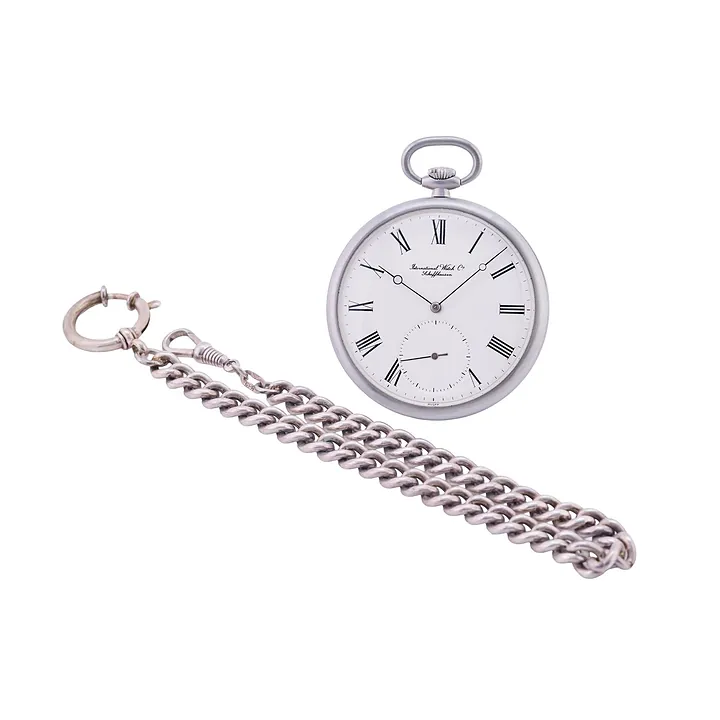
IWC pocket watch, ref. 5301, c. 1980
Antiquorum auction archive, Geneva
Wristwatches · originally sold in April 2016 (per the lot record)
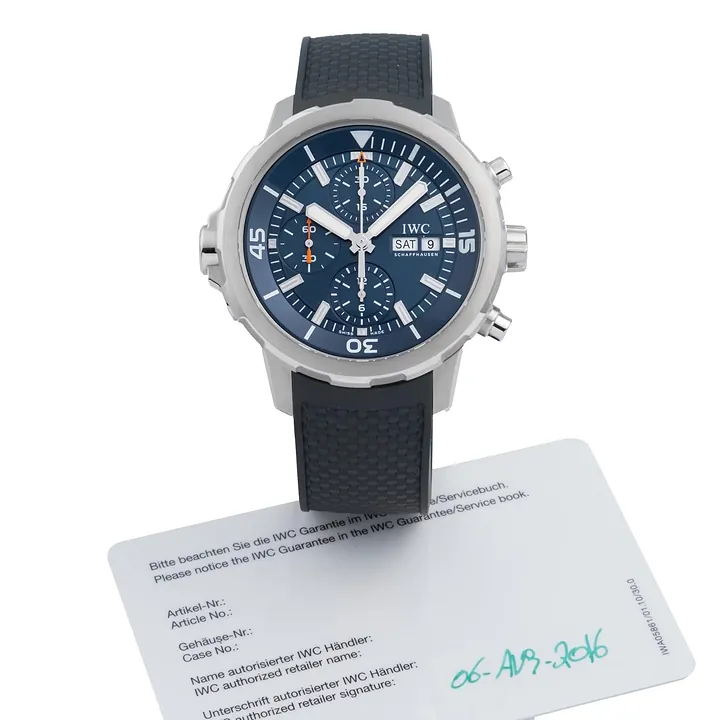
IWC Aquatimer Chronograph Cousteau, ref. IW3768, originally sold in April 2016
Antiquorum auction archive, Geneva
Wristwatches · c. 2010s
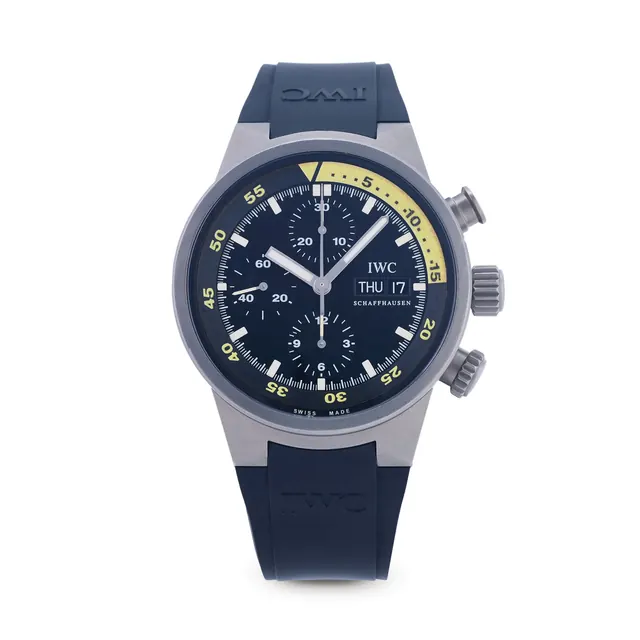
IWC wristwatch, ref. IW371918, Aquatimer, circa 2010s
Antiquorum auction archive, Geneva

Wristwatches · 1970
Wristwatch by Heno, Switzerland, 1970
Museum Rotterdam

Wristwatches · 1960–1986
'Tri-Compax' calendar chronograph wristwatch in gold case, by Universal, Geneva, Switzerland, 1960–1986.
Science Museum Group, London

Wristwatches · 1969–1970
Beta 21 Quartz wristwatch movement, made in Switzerland, 1970.
Science Museum Group, London

Wristwatches · c. 1969
Omega Speedmaster Moonwatch, ref. 145022-69st, c. 1969
Antiquorum auction archive, Geneva