
Movements & Components · Pocket watch
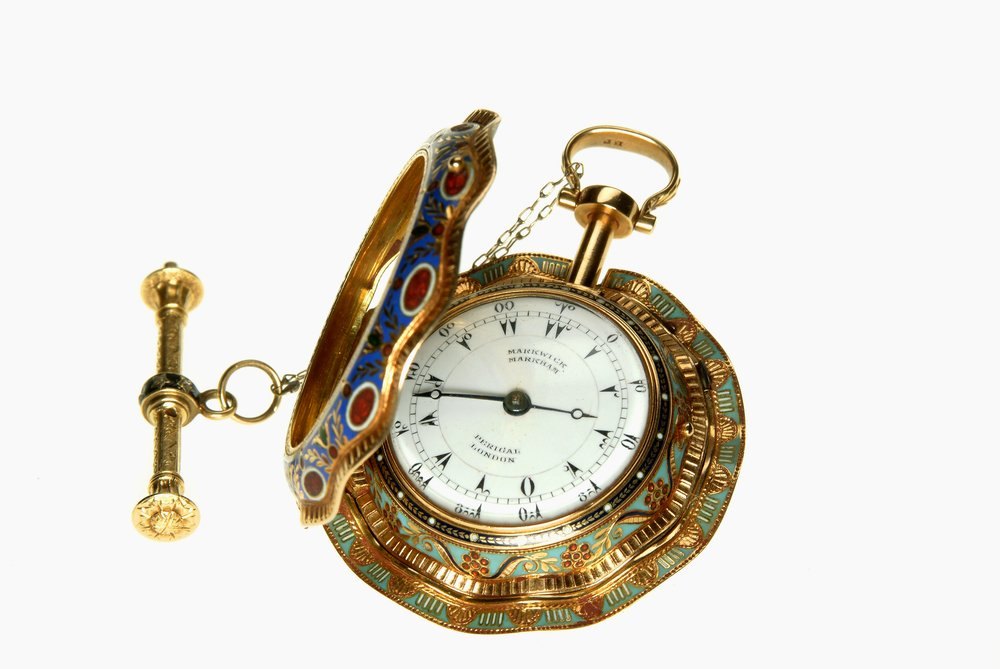
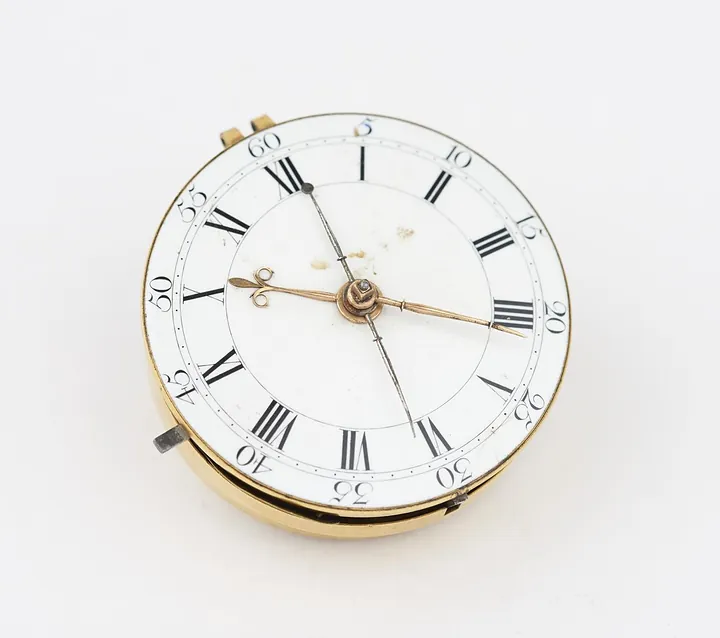
Pocket watch by Markham & Perigal Marwick, England, 1790
- Maker / attribution
- Markham & Perigal Marwick (Created); George Prior (Created)
- Date
- 1790
- Historical period
- Precision & Scientific Horology (1750 – 1850)
- Country of origin
- England
- Place
- London
- Object type
- Pocket watch
- Materials / technique
- Gold, graviert; Emaille (Champlevé); gebläuter Stahl; Glas; Metall, vergoldet, graviert; Diamant
- Dimensions
- Durchmesser (mit Bügel): 7 cm; Gewicht: 102,62 g
- Holding institution
- Kulturstiftung Sachsen-Anhalt - Museum Schloss Neuenburg
- Accession / object no.
- MSN-V 11621 H
- Credit line
- Kulturstiftung Sachsen-Anhalt - Museum Schloss Neuenburg
- Catalogue title (original)
- Goldemaille-Taschenuhr für den türkischen Markt (German)
View the source record ↗ (opens another website in a new tab)Suggest a correction
Record summary
Held and catalogued by Kulturstiftung Sachsen-Anhalt - Museum Schloss Neuenburg (object number MSN-V 11621 H), this is a pocket watch by Markham & Perigal Marwick, made in London, England, dated 1790. The Atlas places it in the Precision & Scientific Horology period (1750 – 1850) of its Movements & Components collection. Materials and techniques recorded by the source: Gold, graviert; Emaille (Champlevé); gebläuter Stahl; Glas; Metall, vergoldet, graviert; Diamant. Recorded dimensions: Durchmesser (mit Bügel): 7 cm; Gewicht: 102,62 g. The record is illustrated with 4 photographs.
Assembled from the source record's structured fields. Dates and attributions are given as the source states them; where a field is missing the Atlas leaves it blank rather than estimating.
Catalogue description
Catalogue description from Kulturstiftung Sachsen-Anhalt - Museum Schloss Neuenburg (German)
Die Englische Spindeltaschenuhr wurde um 1790 in London hergestellt. Das doppelte Gehäuse im orientalischen Stil fertigte der Englische Uhrmacher Georg Prior an. Er betrieb gemeinsam mit seinem Bruder Edward Prior in London eine Uhrenmanufaktur. Sie hatten sich auf Uhren für den Türkischen und Islamischen Markt spezialisiert und dafür zwei Auszeichnungen von der Royal Society of Arts erhalten. Die eigentliche Taschenuhr wurde ebenfalls in London von der Uhrenfabrik Marwick, Markham & Perigal gefertigt. Die Taschenuhr wird durch zwei aufwendig verzierte, äußere Gehäuse geschützt. Die goldenen Gehäuseränder des äußeren Gehäuses sind muschelartig geschwungen und mit einer Champlevé-Emailletechnik verziert. Dabei wurde blaues, rotes und grünes Emaille in einer floralen Ornamentik verarbeitet. Vorne ist das Außengehäuse offen und unverglast, sodass das Ziffernblatt durchgesteckt wird. Das mittlere Gehäuse ist auf der Vorderseite ebenfalls offen. Auf der Rückseite befindet sich ein Emaillemedaillon mit Wellenrand. Darin wurde ein farbenfrohes Stillleben aus Früchten und Blumen in feiner Emaillemalerei wiedergegeben. Das Medaillon ist mit einem türkisfarbenen Emaillerand mit goldenen Blüten umgeben. Die Ränder des Gehäuses sind auf die gleiche Art ausgeführt wie die des Außengehäuses, allerdings verkleinert und in schwarz-türkis-rot farbenem Emaille. Beide Gehäuse werden durch einen diamantbesetzten Druckverschluss geöffnet. Das Innengehäuse ist ein glattes unverziertes Goldgehäuse mit Ziffernblattverglasung. An der verzierten Krone ist mit einer Kette der dazugehörende Steckschlüssel befestigt. Seine Form erinnert an einen Marschallstab. Er wurde aus Gold gefertigt und mit einer Gravur verziert. Das weiße Emailleziffernblatt hat schwarze türkische Stunden- und Minutenzahlen sowie gebläute Stahlzeiger in Breguetform. Es wurde zudem mit dem Herstellernamen "MARKWICK MARKHAM PERIGAL LONDON" signiert. Das vergoldete Spindelhemmungswerk hat u.a. eine Kette und eine Schnecke sowie einen durchbrochenen und gravierten Spindelkolben, einen Diamant-Deckstein und eine silberne Regulierscheibe.
Shown in the original language of the source catalogue. An editor-reviewed English translation has not yet been published; we do not publish machine translations as authoritative text.
Provenance
Literature: Kordula Ebert, In:: Unsere Neuenburg 12. Mitteilungen des Vereins zur Rettung und Erhaltung der Neuenburg e.V. (2011)
Historical context
Precision & Scientific Horology (1750 – 1850)
Harrison solves longitude; Mudge invents the lever; Breguet's Paris workshop defines the modern watch.
The age of escapement invention: cylinder, duplex, lever, detent and many experimental escapements; compensation balances and fine finishing.
Read the period in the timelineMore movements & components from this periodEarlier: Early Modern Horology
Atlas type guide
Clock and watch movements
The movement is the mechanism of a clock or watch, without its case and dial. It consists of the power source (weight or mainspring in its barrel, sometimes with a fusee), the going train of wheels and pinions, the escapement and oscillator, the motion work that drives the hands, and in many cases additional trains for striking or complications.
From the eighteenth century watch movements were increasingly produced in stages: Swiss and French ébauche makers supplied rough movements that finishers, repasseurs and retailers completed and signed. Calibre numbers — first used systematically by American and Swiss factories in the nineteenth century — make it possible to identify movements, find spare parts and date watches.
What to look for
- Plate and bridge layout: full plate, three-quarter plate, Lépine bar calibre, bridges and cocks.
- Jewel count and whether jewels are set in chatons or rubbed in.
- Signatures, calibre and serial numbers on the plate or under the dial.
- Finishing: Geneva stripes (Côtes de Genève), perlage, bevelled edges, blued screws.
- Fusee and chain, going barrel, or electrical components.
Dating clues
- Full-plate English movements dominate before c. 1850; three-quarter plate and Lépine calibres after.
- Jewelled movements spread after Facio and Debaufre's patent of 1704, mainly in English work until c. 1800.
- Calibre numbers and factory serials allow close dating for industrial production after c. 1850.
General guidance written by the Atlas editors about this kind of object. It is not a statement about this particular piece; for that, rely on the source record above and on physical examination.
Read next:Detached lever escapement
Related records
Movements & Components · c. 1740–60
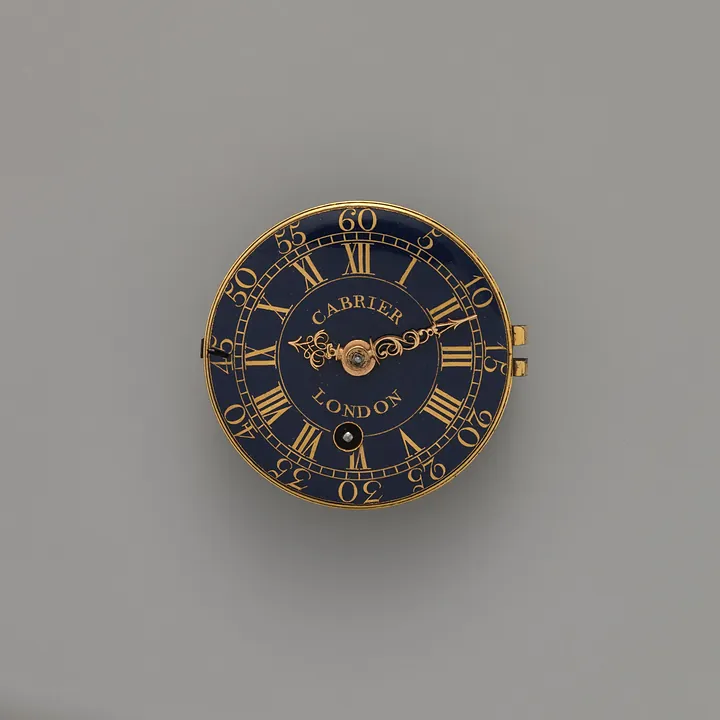
Watch movement by Charles Cabrier II, England, c. 1740–60
The Metropolitan Museum of Art, New York
Movements & Components · 1750
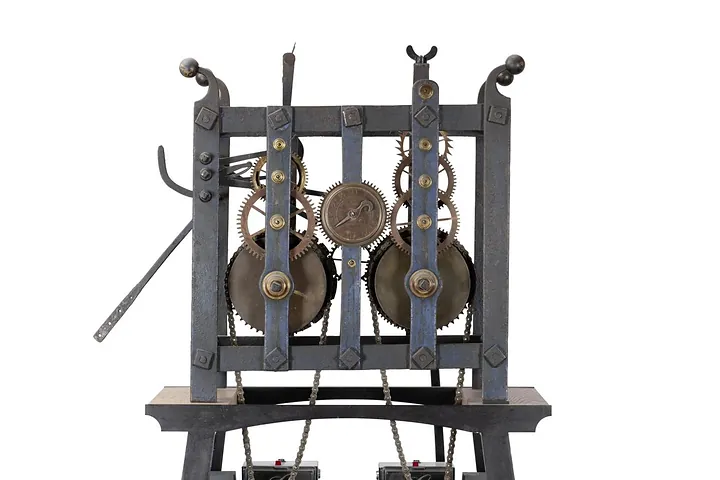
Clock movement by William Smith, England, 1750
Science Museum Group, London
Movements & Components · 1750–1775
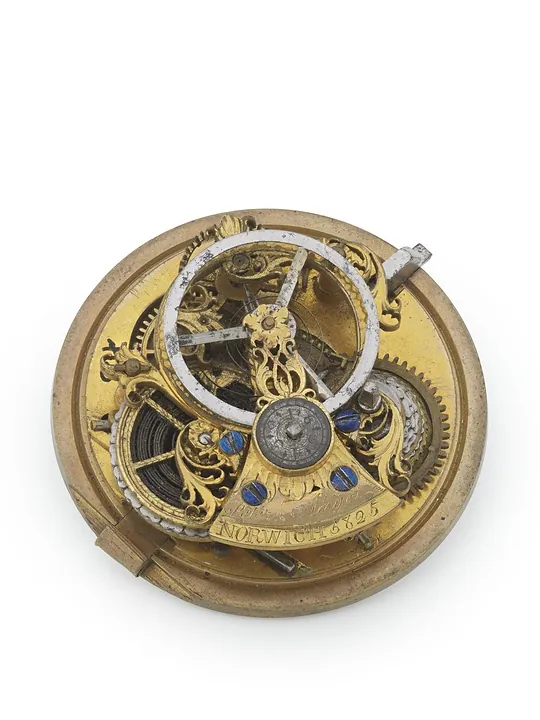
Watch movement by Peter Amyot, England, 1750–1775
Science Museum Group, London
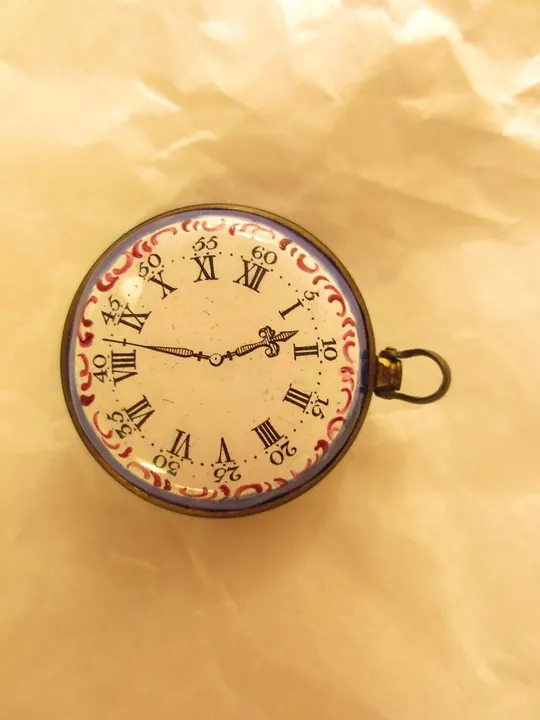
Movements & Components · late 18th century
Watch, Bilston enamel, England, late 18th century
Victoria and Albert Museum, London
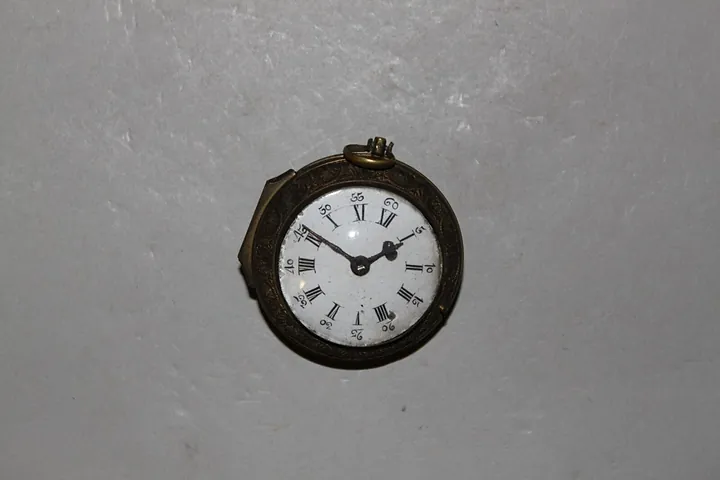
Movements & Components · late 18th century
Watch, cast brass and Bilston enamel, England, late 18th century (V&A 1664-1871)
Victoria and Albert Museum, London
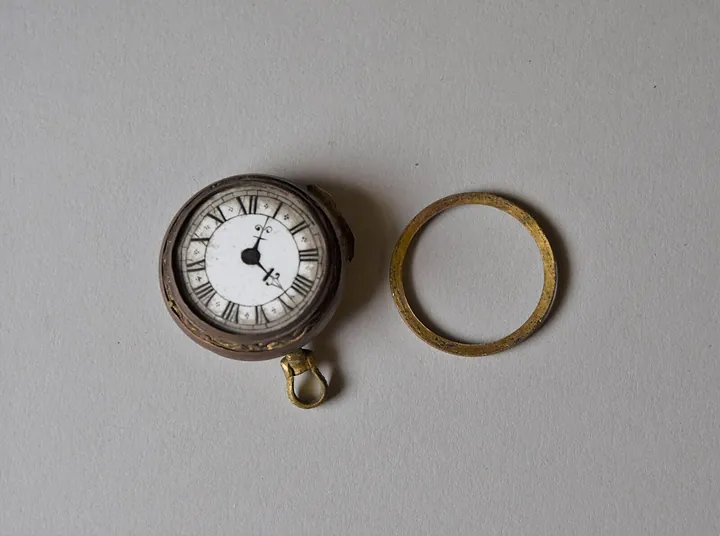
Movements & Components · late 18th century
Watch, cast brass and Bilston enamel, England, late 18th century (V&A 1665-1871)
Victoria and Albert Museum, London
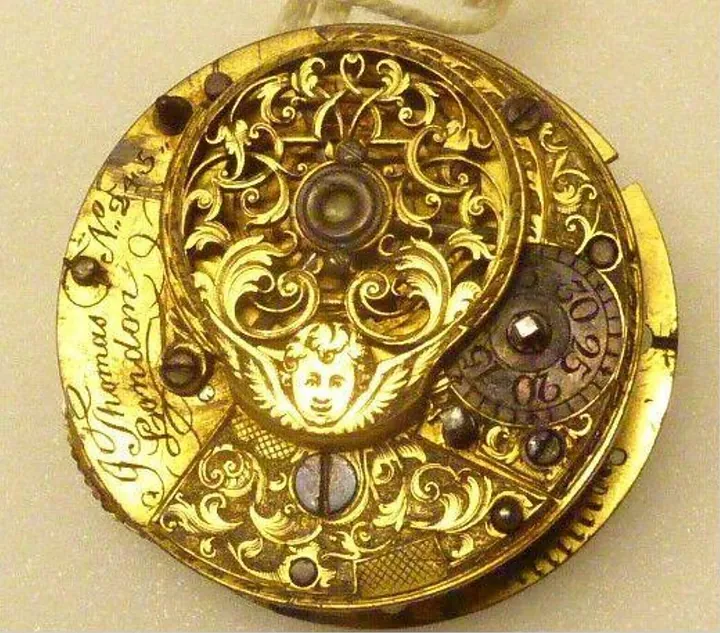
Movements & Components · 1770–1780
Brass, pierced and engraved, English (London), 1770–1780
Victoria and Albert Museum, London
Movements & Components · 1775
Cylinder escapement, by J. Davis, about 1775, England
Science Museum Group, London