
Wristwatches · Wristwatch
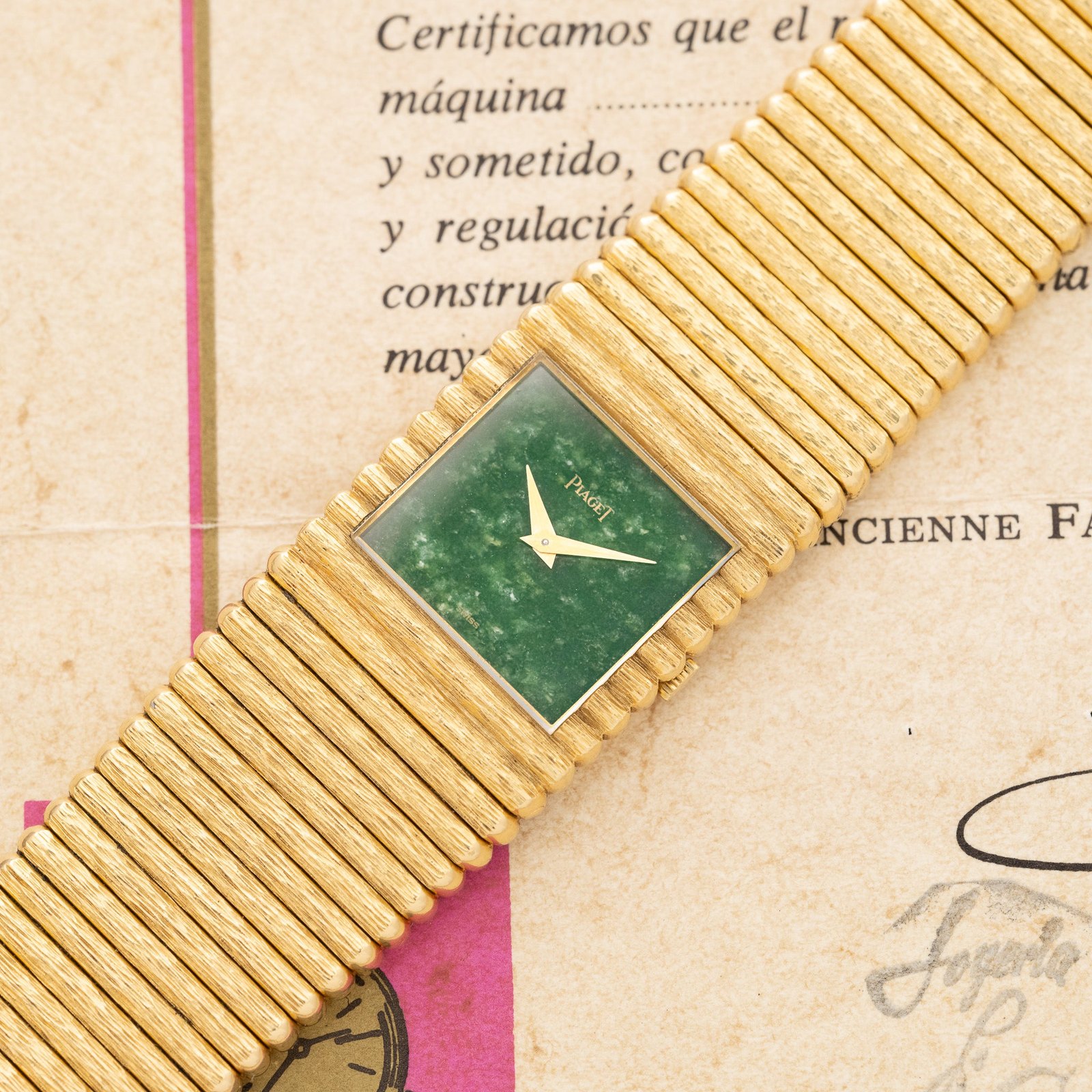
Piaget Jade Dial Emperador Ref. 9131 - Rare Cartier-Signed Papers, 1974
- Maker / attribution
- Piaget (maker)
- Date
- 1974
- Historical period
- Quartz Revolution (1969 – 1990)
- Country of origin
- Switzerland
- Object type
- Wristwatch
- Dimensions
- Case 25 mm
- Stock no.
- Product 7911437271223
- Credit line
- Dealer listing, Huntington Company (product 7911437271223)
- Catalogue title (original)
- 1974 Piaget Jade Dial Emperador Ref. 9131 - Unpolished - Complete Set - Rare Cartier-Signed Papers (English)
View the source record (dealer listing) ↗ (opens another website in a new tab)Suggest a correction
Record summary
Catalogued by Huntington Company (dealer) (stock number Product 7911437271223), this is a wristwatch by Piaget, made in Switzerland, dated 1974. The Atlas places it in the Quartz Revolution period (1969 – 1990) of its Wristwatches collection. Recorded dimensions: Case 25 mm. The record is illustrated with 6 photographs.
Assembled from the source record's structured fields. Dates and attributions are given as the source states them; where a field is missing the Atlas leaves it blank rather than estimating.
Catalogue description
Dealer description — Huntington Company
While collectors have latched onto the Piaget Polo, rightly placing it as a historically important design, the Emperador reigns at the top as the original “polo-style” Piaget. It is without a doubt one of the most important Piaget designs ever made. The Emperador was only produced for a short period beginning in the 1970’s, and paved the way to the rise of the Piaget Polo in the 1980’s. Today, collectors have recognized the important position that the Emperador holds in Piaget’s historical catalog of designs, and it has become one of the most highly sought after models. It is truly the king of all Piaget watches. The Piaget Polo was advertised by Piaget as an ultra-luxurious watch, and the Emperador takes opulence to the next level. This particular example features an unpolished fully linked bracelet, the totality of the watch weighing over 200 grams, which is just over 7 ounces of solid gold. In the 1970’s, the Emperador was a seldom produced uber-luxury watch in Piaget’s retail catalog. Several watch dealers that operated in the past decades have stated that these gold-heavy watches were often melted for scrap at a time when little value was placed on the designs, making the Emperador even rarer in the current market. On offer here is an Emperador made all the more special by three attributes. First, this Emperador features a flawless jade dial. This is the only Emperador that we are aware of that has a jade dial. While it is possible that there may be another jade dial Emperador out there somewhere in the world, it is our belief that since another one has not surfaced that this may be a unique piece that was specially ordered by the original owner. This belief is corroborated by the very special paperwork that accompanies this watch. Second, this is the reference 9131 Emperador, which houses the caliber 9P manual wind mechanical movement. The majority of Emperadors that have surfaced to the market are reference 7131, which denotes a quartz movement. The 9131 Emperador with mechanical movement is a relative rarity compared with the production of 7131 Emperadors and tells us that this is also an early Emperador that predates Piaget’s quartz era. Last, and certainly not least, this Emperador comes as a complete set with its original box and Piaget paperwork, which shows that this watch was retailed by Cartier. It is very rare to find any Piaget from this era with a complete set, but the fact that this example was retailed by Cartier makes it a true collecting paragon. In this era, watches sold by another retailer were often special order and so we believe this fact corroborates the notion that this may be a unique piece. As is often the case, the best, most desired examples of watches enter important collections and once there they may disappear for decades before resurfacing in the market. The present example is the Emperador of all Emperadors, and once sold, we may not see it again for a very long time. Specifications Model: Emperador Movement: Piaget Ultra-Thin Caliber 9P Year: 1974 Contents: Complete with the original box and rare Cartier-signed papers. Case: Unpolished 25mm 18K yellow gold case. Bracelet: A fully linked adjustable bracelet that contains many removable links. Total weight of the watch is over 200 grams, or 7 ounces of gold. Watch will fit a wrist up to 7.7 inches. Dial: Jade stone dial in flawless condition.
Historical context
Quartz Revolution (1969 – 1990)
Seiko's Astron begins mass quartz timekeeping; traditional industries contract sharply.
Quartz and digital watches transformed the market after 1969. Swiss employment collapsed, Japanese and Hong Kong production soared, and the Swatch (1983) helped the Swiss industry recover; mechanical watches survived as luxury goods.
Read the period in the timelineMore wristwatches from this periodEarlier: Modern Mechanical Horology
Atlas type guide
Wristwatches
Bracelet watches were worn by women from the early nineteenth century — Breguet made one for Caroline Murat, Queen of Naples, in 1810–12 — but the wristwatch only became a man's instrument with military use and aviation in the early twentieth century. Between the World Wars it overtook the pocket watch; the 1920s and 1930s brought rectangular Art Deco cases, water-resistant cases and the first automatic winding systems.
After 1945 the wristwatch became a carrier of identity — dress watches, sports and dive watches, chronographs, calendars — produced by Swiss, American, Japanese, German, Soviet and Chinese industries. The quartz revolution after 1969 and the mechanical renaissance since the 1990s, including the rise of independent watchmakers, complete the story.
What to look for
- The reference number (between the lugs or inside the case back) and serial number, the starting point for dating.
- The calibre: its maker and number are often stamped under the dial or on the bridge.
- Originality of dial, hands and crown — refinished ('redial') dials are common.
- Case material marks: 18K/750, 14K/585, stainless steel, gold-filled, plated.
Dating clues
- Wire-lug cases: before c. 1925.
- Water-resistant screw-down cases: from 1926.
- Quartz movements: from 1969; sapphire crystals widespread after c. 1980.
General guidance written by the Atlas editors about this kind of object. It is not a statement about this particular piece; for that, rely on the source record above and on physical examination.
Related records
Wristwatches · c. 1980
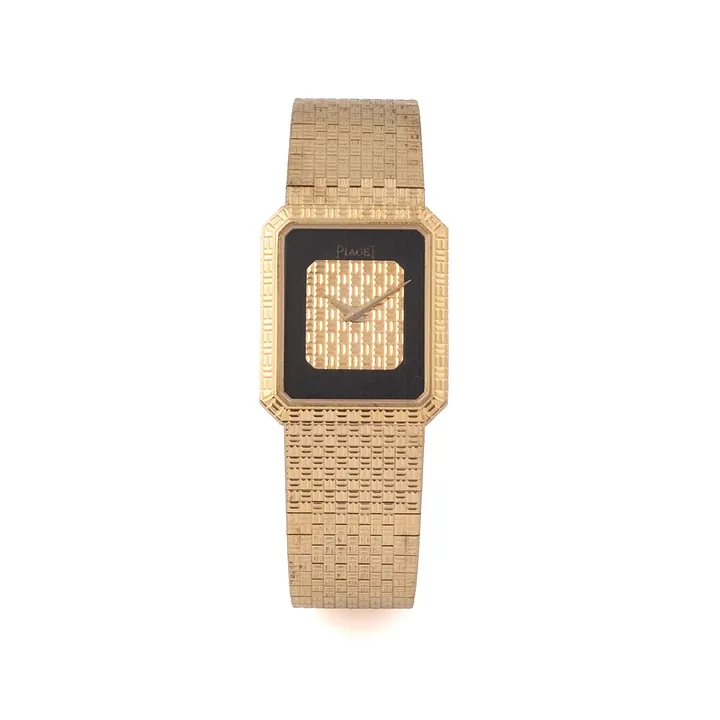
Piaget wristwatch, ref. 7141 C5, c. 1980
Antiquorum auction archive, Geneva
Wristwatches · c. 1984
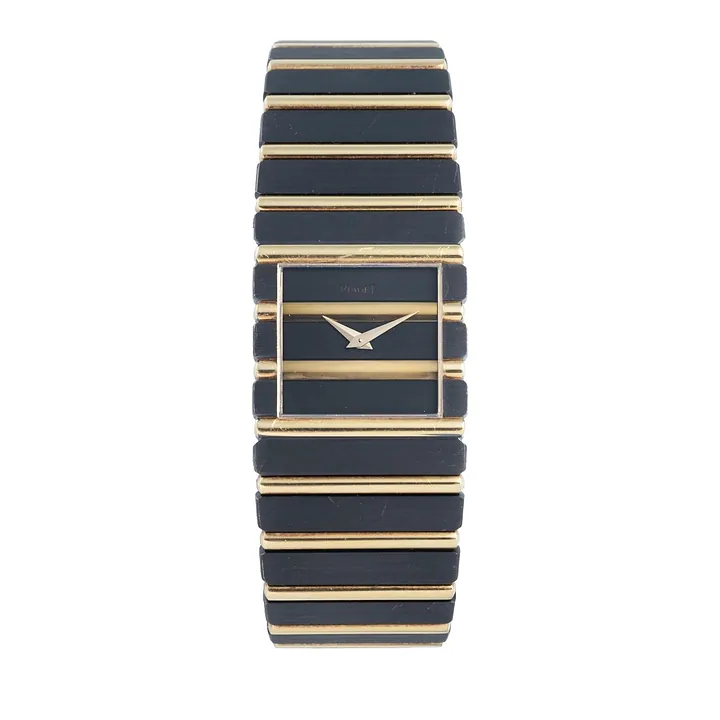
Piaget Polo Square ''zebra'', ref. 7131 C 701, c. 1984
Antiquorum auction archive, Geneva
Wristwatches · c. 1990
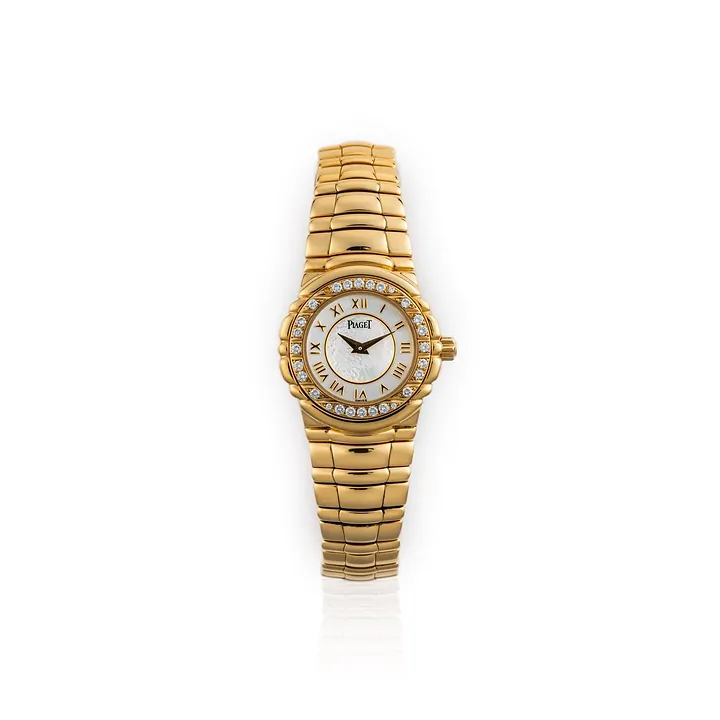
Piaget Lady Gold and Diamond Watch, ref. 16033, c. 1990
Antiquorum auction archive, Geneva
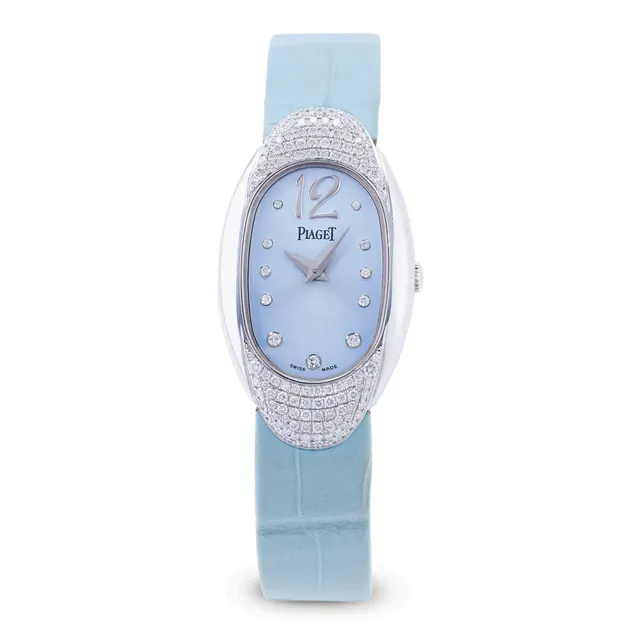
Wristwatches · c. 2000s
Piaget wristwatch, ref. PI0002, Limelight, circa 2000s
Antiquorum auction archive, Geneva

Wristwatches · 1970
Wristwatch by Heno, Switzerland, 1970
Museum Rotterdam

Wristwatches · 1960–1986
'Tri-Compax' calendar chronograph wristwatch in gold case, by Universal, Geneva, Switzerland, 1960–1986.
Science Museum Group, London

Wristwatches · 1969–1970
Beta 21 Quartz wristwatch movement, made in Switzerland, 1970.
Science Museum Group, London

Wristwatches · c. 1969
Omega Speedmaster Moonwatch, ref. 145022-69st, c. 1969
Antiquorum auction archive, Geneva