
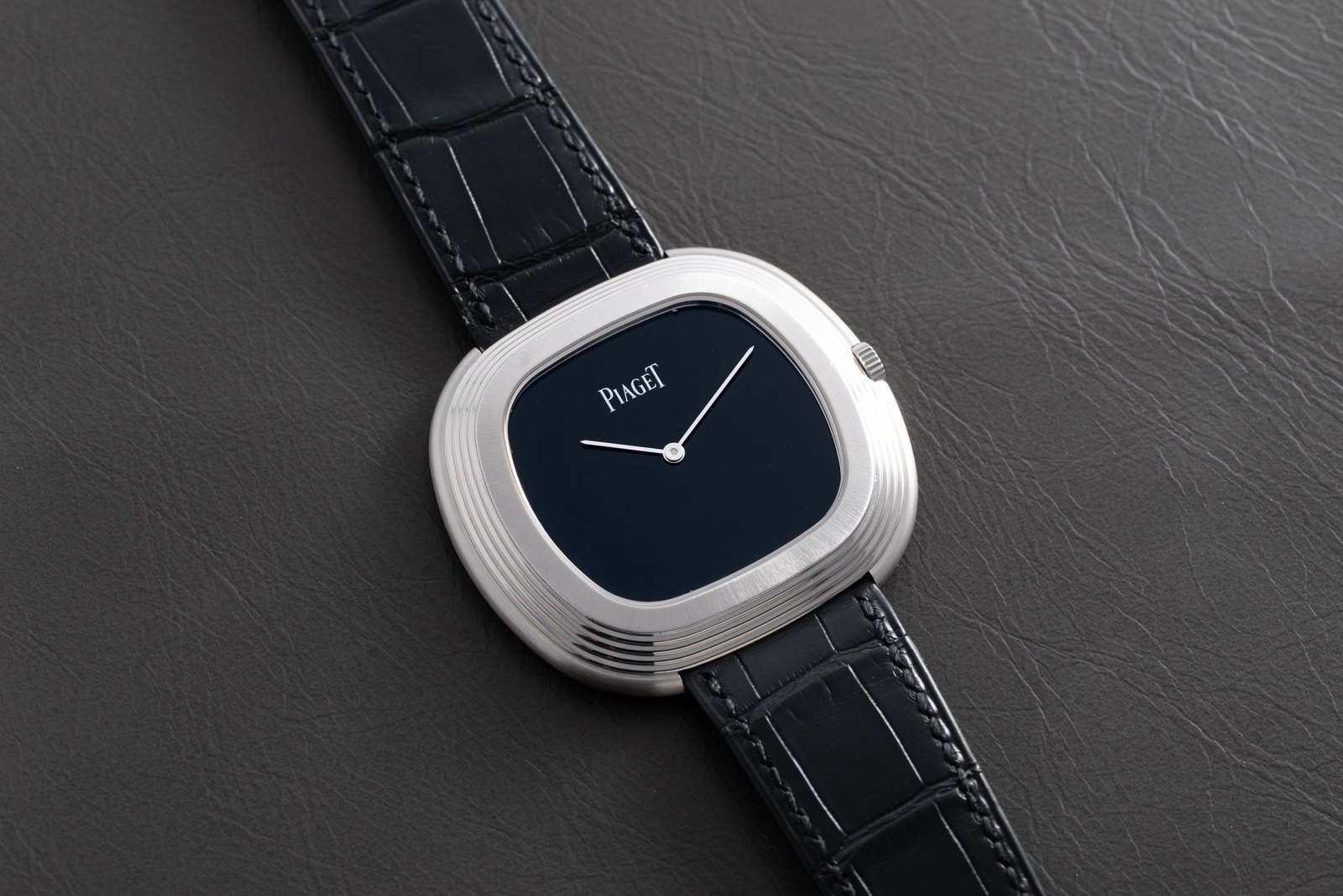
Wristwatches · Wristwatch
Piaget Black Tie 'Andy Warhol', 2015
- Maker / attribution
- Piaget (maker)
- Date
- 2015
- Historical period
- Contemporary Horology (2010 – Present)
- Country of origin
- Switzerland
- Object type
- Wristwatch
- Dimensions
- Case 45 mm
- Stock no.
- 40991847
- Credit line
- Dealer listing, Analog/Shift (40991847)
- Catalogue title (original)
- Piaget Black Tie 'Andy Warhol' (English)
View the source record (dealer listing) ↗ (opens another website in a new tab)Suggest a correction
Record summary
Catalogued by Analog/Shift (dealer), New York (stock number 40991847), this is a wristwatch by Piaget, made in Switzerland, dated 2015. The Atlas places it in the Contemporary Horology period (2010 – Present) of its Wristwatches collection. Recorded dimensions: Case 45 mm. The record is illustrated with 6 photographs.
Assembled from the source record's structured fields. Dates and attributions are given as the source states them; where a field is missing the Atlas leaves it blank rather than estimating.
Catalogue description
Dealer description — Analog/Shift
For most of its existence, Piaget operated quietly behind the proverbial horology curtain, producing some of the most mechanical movements in Switzerland. But when the name Piaget graced the dials of their watches, the brand embodied a distinguishable lavish style that became synonymous with a period of opulence, representative of the American dream in the 1960s and 70s, as well as those who wore it –– Roger Moore, Jacqueline Kennedy Onassis, Elvis Presley, and most notably, Andy Warhol. Warhol owned several Piaget timepieces, but it was his Piaget ‘Black Tie’, dressed in yellow gold with an anthracite dial powered by a Quartz Calibre Beta 21, that would come be associated with the renowned pop artist to this day. In 2015, Piaget introduced a recreation of the Beta 21 wristwatch drawing 'Vintage Inspiration' from the Black Tie's stepped case silhouette but with an enlarged case and mechanical movement. This example, a special limited edition and one of only 28 pieces produced, features a stunning 45mm 18k white gold case with a radially brushed bezel, sapphire crystal, individually numbered caseback and a signed recessed crown that doesn't disrupt its elegant case lines. The dial is true to black tie form, solely featuring the stylized Piaget wordmark at 12 o'clock with a minimalist stick handset set against a jet-black onyx stone dial. Powered by the Piaget Calibre 534P automatic movement, this piece comes fitted to a black alligator leather strap with a signed white gold pin buckle. Numbered 28/28 out of the original series produced in 2015, it remains in stunning condition throughout. An object of refinement and exclusivity, this special timepiece redefines the dress watch standard. Don’t let the ‘Black Tie’ moniker fool you either, this piece pairs great with a t-shirt and jeans, too!
Historical context
Contemporary Horology (2010 – Present)
Silicon components, connected watches, optical-lattice research clocks and a thriving independent scene.
Smartwatches became the world's best-selling watches, while mechanical watchmaking focuses on craft, innovation (silicon components, new escapements) and independent makers.
Read the period in the timelineMore wristwatches from this periodEarlier: Mechanical Renaissance
Atlas type guide
Wristwatches
Bracelet watches were worn by women from the early nineteenth century — Breguet made one for Caroline Murat, Queen of Naples, in 1810–12 — but the wristwatch only became a man's instrument with military use and aviation in the early twentieth century. Between the World Wars it overtook the pocket watch; the 1920s and 1930s brought rectangular Art Deco cases, water-resistant cases and the first automatic winding systems.
After 1945 the wristwatch became a carrier of identity — dress watches, sports and dive watches, chronographs, calendars — produced by Swiss, American, Japanese, German, Soviet and Chinese industries. The quartz revolution after 1969 and the mechanical renaissance since the 1990s, including the rise of independent watchmakers, complete the story.
What to look for
- The reference number (between the lugs or inside the case back) and serial number, the starting point for dating.
- The calibre: its maker and number are often stamped under the dial or on the bridge.
- Originality of dial, hands and crown — refinished ('redial') dials are common.
- Case material marks: 18K/750, 14K/585, stainless steel, gold-filled, plated.
Dating clues
- Wire-lug cases: before c. 1925.
- Water-resistant screw-down cases: from 1926.
- Quartz movements: from 1969; sapphire crystals widespread after c. 1980.
General guidance written by the Atlas editors about this kind of object. It is not a statement about this particular piece; for that, rely on the source record above and on physical examination.
Related records
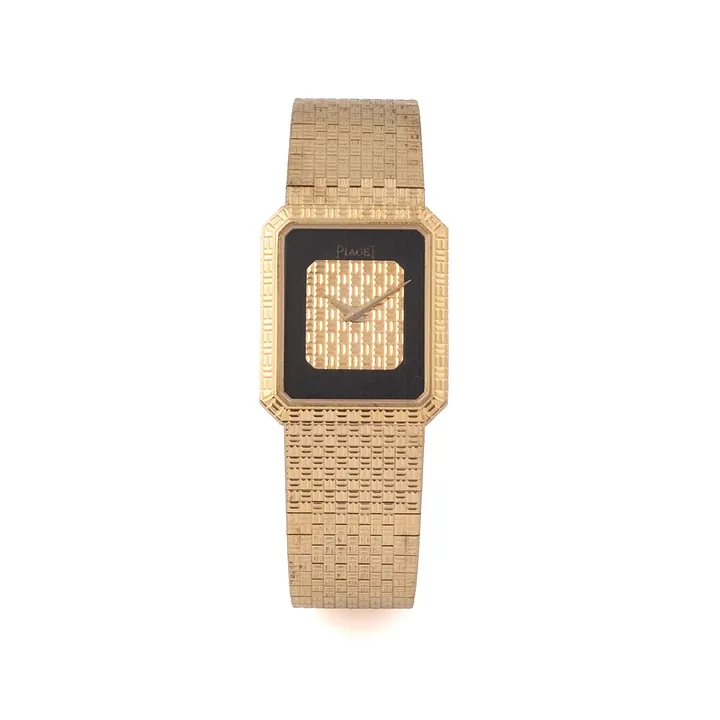
Wristwatches · c. 1980
Piaget wristwatch, ref. 7141 C5, c. 1980
Antiquorum auction archive, Geneva
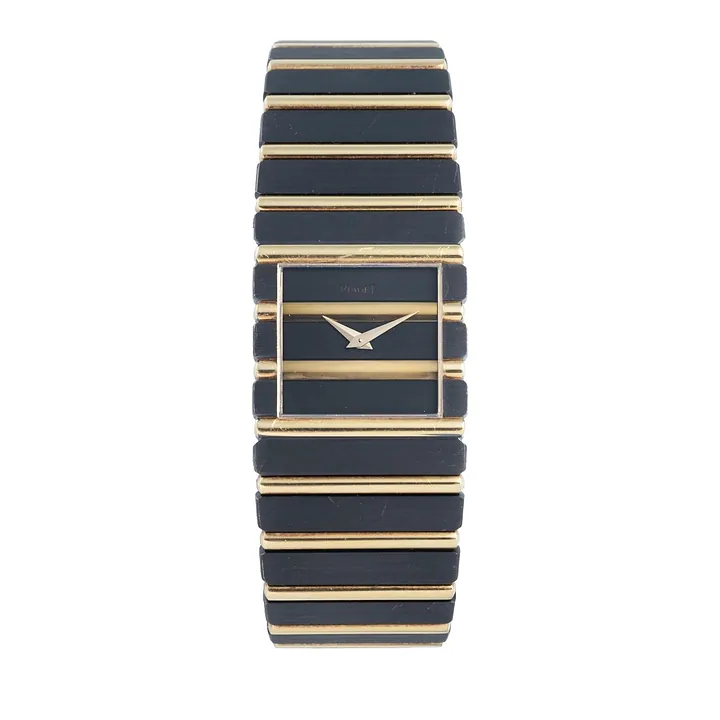
Wristwatches · c. 1984
Piaget Polo Square ''zebra'', ref. 7131 C 701, c. 1984
Antiquorum auction archive, Geneva
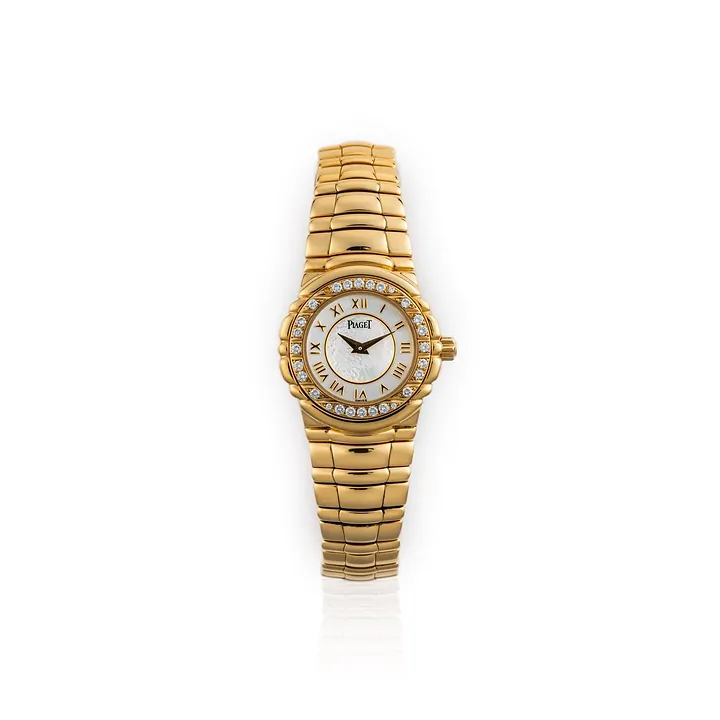
Wristwatches · c. 1990
Piaget Lady Gold and Diamond Watch, ref. 16033, c. 1990
Antiquorum auction archive, Geneva
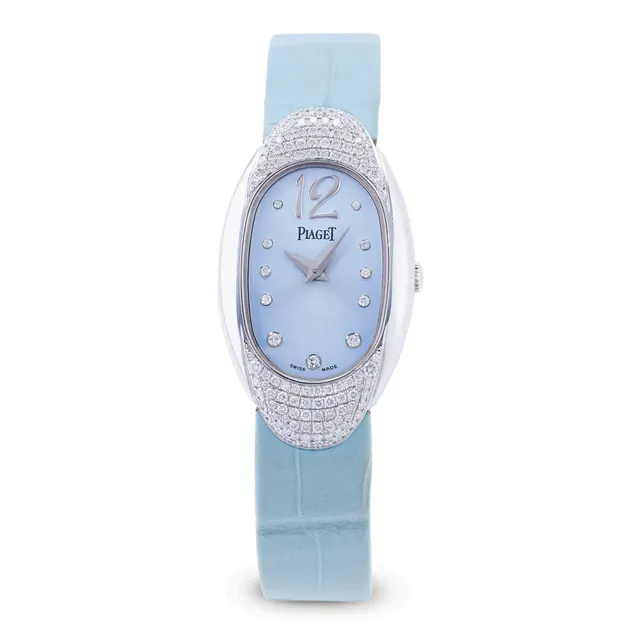
Wristwatches · c. 2000s
Piaget wristwatch, ref. PI0002, Limelight, circa 2000s
Antiquorum auction archive, Geneva

Wristwatches · c. 2010s
Breguet Type XXI, ref. 3810, c. 2010s (Antiquorum Lot 381-24)
Antiquorum auction archive, Geneva

Wristwatches · c. 2010s
Breguet Type XXI, ref. 3810, c. 2010s (Antiquorum Lot 386-229)
Antiquorum auction archive, Geneva

Wristwatches · Sold in September 2010
Breitling Cosmonaute, ref. A 22322, Sold in September 2010
Antiquorum auction archive, Geneva

Wristwatches · c. 2010
Corum Bubble Chrono, ref. 396.150.20, c. 2010
Antiquorum auction archive, Geneva