
Wristwatches · Wristwatch
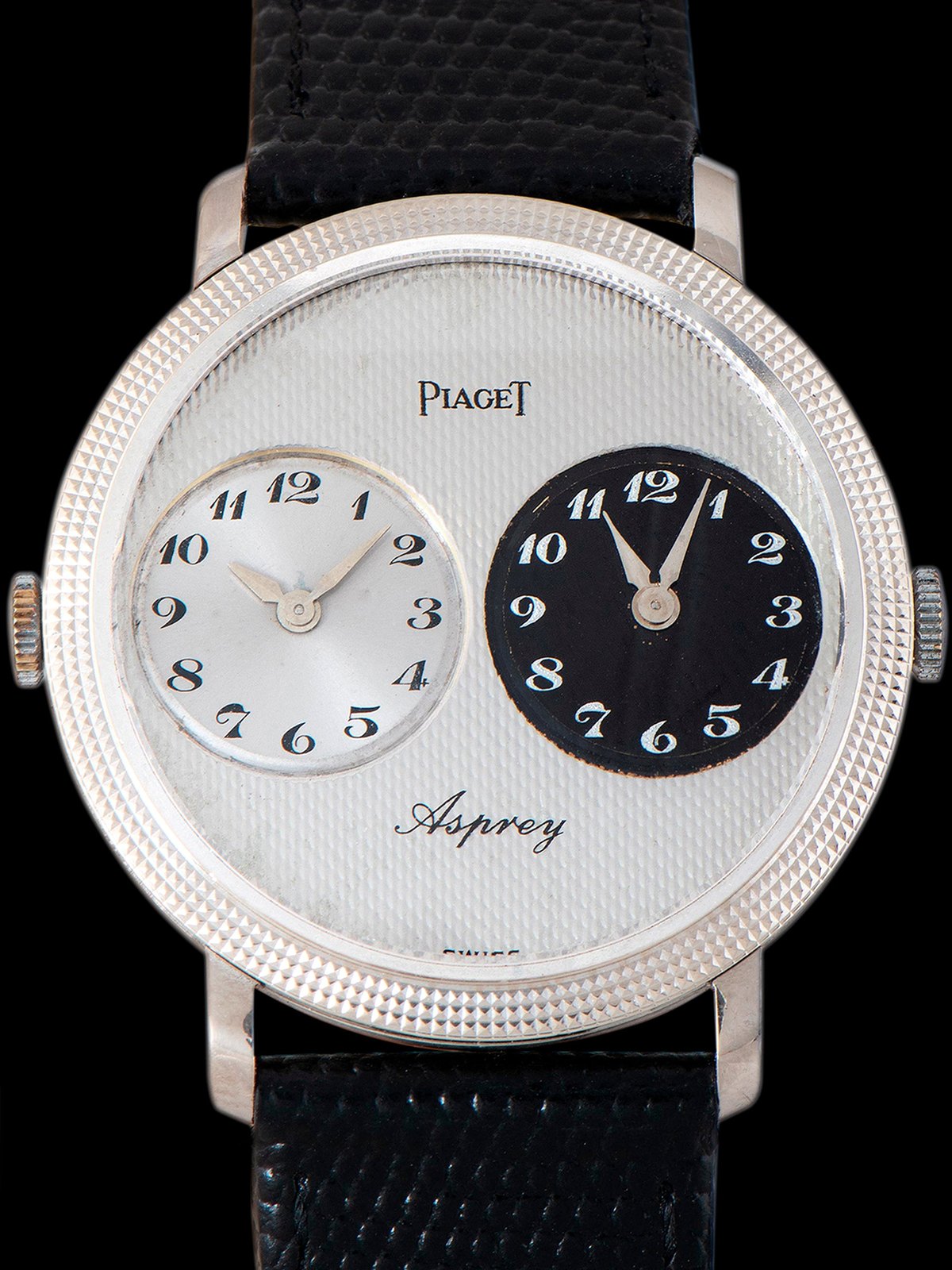
Piaget Altiplano Dual Time 18K WG (Ref. 612104) "Asprey" Guilloché dial, 1970s
- Maker / attribution
- Piaget (maker)
- Date
- 1970s
- Historical period
- Quartz Revolution (1969 – 1990)
- Country of origin
- Switzerland
- Object type
- Wristwatch
- Stock no.
- PGAT612104DT
- Credit line
- Dealer listing, Craft & Tailored (PGAT612104DT)
- Catalogue title (original)
- 1970s Piaget Altiplano Dual Time 18K WG (Ref. 612104) "Asprey" Guilloché dial (English)
View the source record (dealer listing) ↗ (opens another website in a new tab)Suggest a correction
Record summary
Catalogued by Craft & Tailored (dealer), Los Angeles (stock number PGAT612104DT), this is a wristwatch by Piaget, made in Switzerland, dated 1970s. The Atlas places it in the Quartz Revolution period (1969 – 1990) of its Wristwatches collection. The record is illustrated with 6 photographs.
Assembled from the source record's structured fields. Dates and attributions are given as the source states them; where a field is missing the Atlas leaves it blank rather than estimating.
Catalogue description
Dealer description — Craft & Tailored
Piaget is widely celebrated as one of the most creative and esoteric watchmakers, with a deep foundation in Swiss watchmaking, as the brand was established in 1874. The avant-garde approach to design isn't without a rigorous dedication to quality, which is expressed through the brand's inherent comprehension of what high luxury and fine watchmaking truly are. Dating to the late 1970s and executed in 18k white gold, this exceptional Piaget is a compelling expression of the brand’s refined craftsmanship and design philosophy. Its defining feature is an elegant dual-time display, achieved through opposing Cal. 6P1 movements and presented via contrasting silver and black sub-dials, each adorned with classic Breguet numerals and set within a finely executed guilloché dial. A crisp hobnail-patterned bezel frames the composition, incorporating two slim crowns at 3 and 9 o’clock for intuitive operation. Completing the dial is the Asprey signature at 6 o’clock, an enduring symbol of London luxury since 1847 and a storied retailer to royalty, celebrated for commissioning exceptional pieces from the world’s most prestigious watchmakers. This combination of an Asprey-signed guilloché dial, dual-time display, and elegant detailing results in a harmonious and highly collectible timepiece that is rooted in functionality. SPECS Stock # PGAT612104DT Brand Piaget Style Altiplano Dual Time Model 612104 Serial 28XXXX Size Men's / Unisex Material 18K White Gold Dial Silver Guilloché "Asprey" Millimeters 34 Strap 2pc Lizard Leather Strap CASE & BRACELET The 18k white gold case, highlighted by its crisp hobnail bezel, remains in exceptional condition, showing only light, honest wear and nominal evidence of prior polishing. Deep hallmarks and well-preserved factory finishing are present throughout. The twin unsigned crowns at 3 and 9 o’clock are original to the watch and remain in excellent condition, exhibiting only slight fading to the original rhodium finish. The case back retains strong factory finishing with deeply stamped reference and serial number engravings. The watch is fitted with a two-piece black lizard leather strap. DIAL & HANDS The original silver guilloché dial, co-signed by Asprey, remains a true work of art and is preserved in exceptional condition, showing no damage and only minimal, age-appropriate patina. The opposing 12-hour sub-dials, each independently driven by its own Cal. 6P1 movement and featuring Breguet numerals, exhibit only faint signs of aging that are negligible to the naked eye. The original alpha-style hands are equally well preserved and remain in excellent condition. ACCESSORIES None.
Historical context
Quartz Revolution (1969 – 1990)
Seiko's Astron begins mass quartz timekeeping; traditional industries contract sharply.
Quartz and digital watches transformed the market after 1969. Swiss employment collapsed, Japanese and Hong Kong production soared, and the Swatch (1983) helped the Swiss industry recover; mechanical watches survived as luxury goods.
Read the period in the timelineMore wristwatches from this periodEarlier: Modern Mechanical Horology
Atlas type guide
Military, pilot and travel watches
The wristwatch owes much of its adoption by men to warfare and aviation. Wristlets — small pocket watches soldered with lugs and worn on a strap — were used in colonial campaigns and became standard equipment in the First World War, with protective grilles over the crystal ('shrapnel guards'). Louis Cartier's Santos (1904), designed for the aviator Alberto Santos-Dumont, is often cited as an early purpose-made pilot's watch.
In the Second World War governments specified watches in detail: the German B-Uhr observation watches, the American A-11, and the British 'W.W.W.' (the 'Dirty Dozen' set of 1945). After the war, jet travel brought GMT and world-time watches, which show two or more time zones at once — Louis Cottier's world-time mechanism and the Rolex GMT-Master (1955) are examples.
What to look for
- Military markings on the case back: broad arrow, issue numbers, 'W.W.W.', 'A.T.P.'
- High-legibility black dials with luminous Arabic numerals; oversized crowns for gloved hands.
- 24-hour hands and rotating 24-hour bezels or city rings on GMT/world-time watches.
- Wire lugs on early wristlets converted from pocket watches.
Dating clues
- Wire-lug wristlets: c. 1900–1925.
- Military specifications of the Second World War: 1939–1945.
- GMT and world-time wristwatches: mainly after 1950.
General guidance written by the Atlas editors about this kind of object. It is not a statement about this particular piece; for that, rely on the source record above and on physical examination.
Related records
Wristwatches · c. 1980
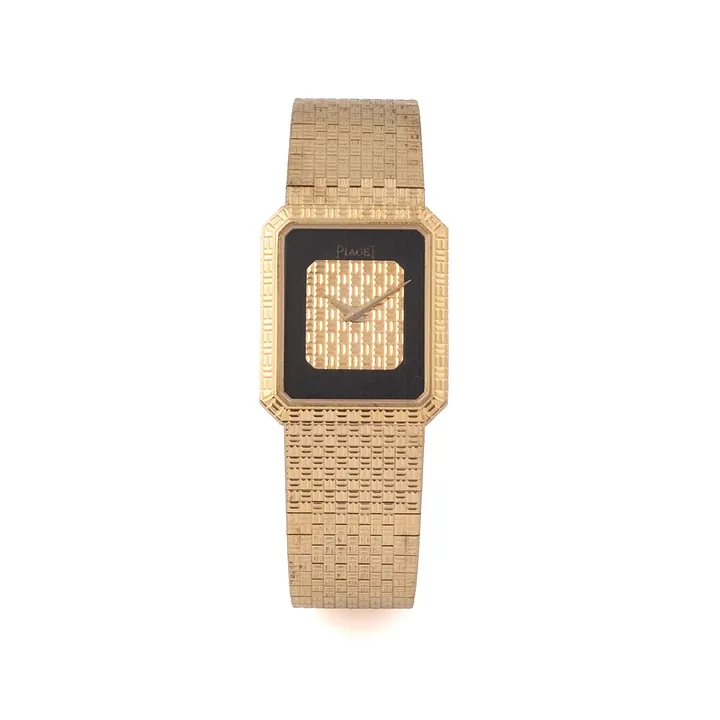
Piaget wristwatch, ref. 7141 C5, c. 1980
Antiquorum auction archive, Geneva
Wristwatches · c. 1984
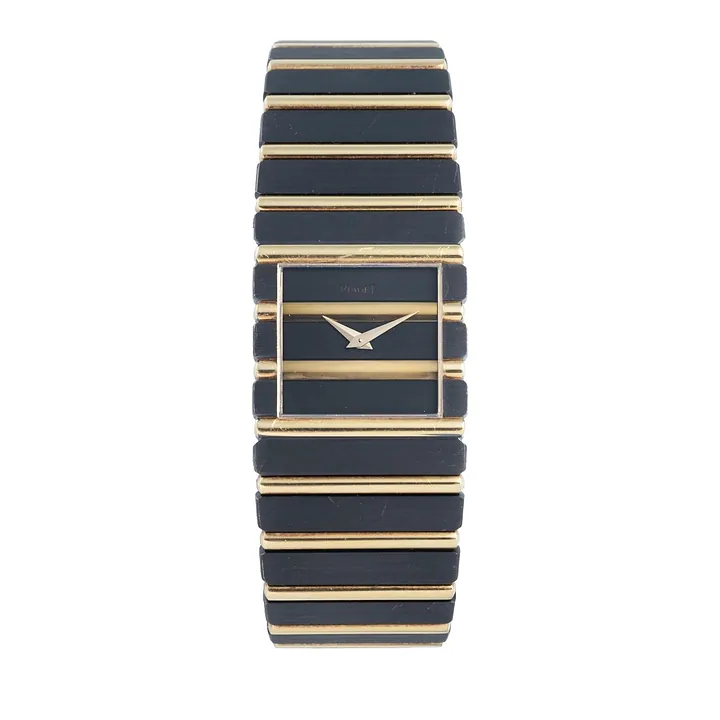
Piaget Polo Square ''zebra'', ref. 7131 C 701, c. 1984
Antiquorum auction archive, Geneva
Wristwatches · c. 1990
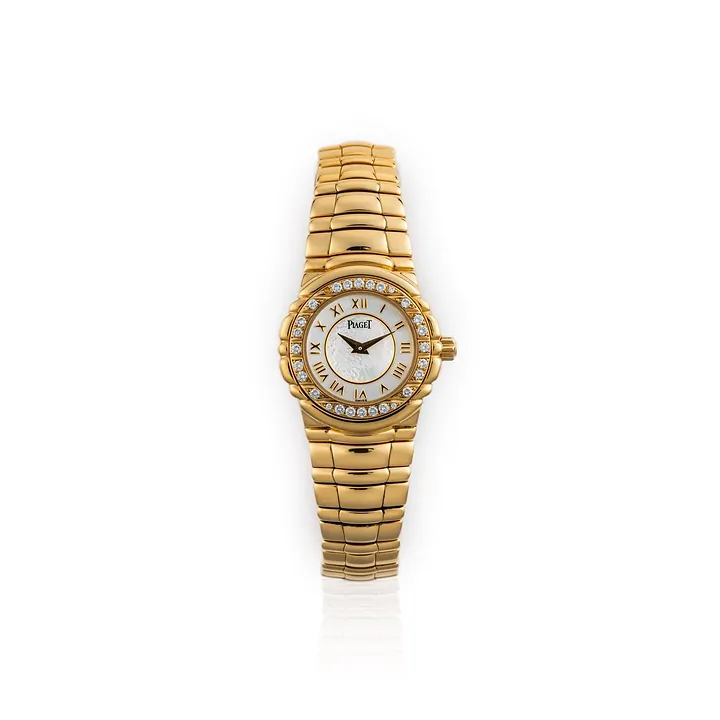
Piaget Lady Gold and Diamond Watch, ref. 16033, c. 1990
Antiquorum auction archive, Geneva
Wristwatches · c. 2000s
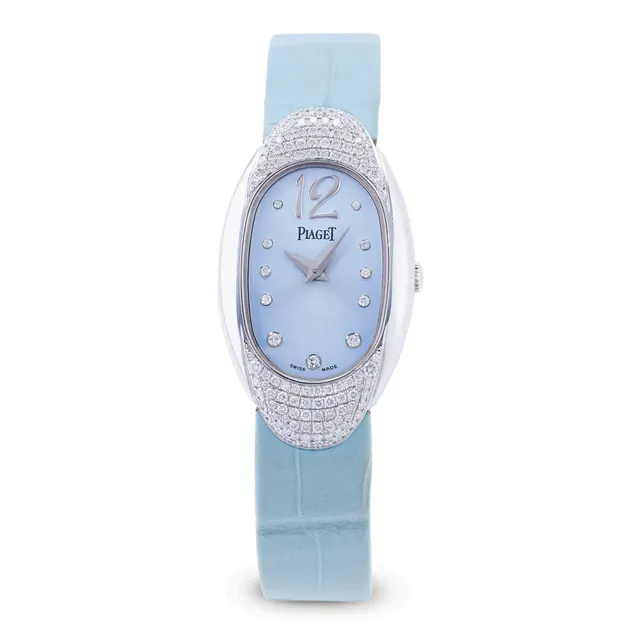
Piaget wristwatch, ref. PI0002, Limelight, circa 2000s
Antiquorum auction archive, Geneva

Wristwatches · 1970
Wristwatch by Heno, Switzerland, 1970
Museum Rotterdam

Wristwatches · 1960–1986
'Tri-Compax' calendar chronograph wristwatch in gold case, by Universal, Geneva, Switzerland, 1960–1986.
Science Museum Group, London

Wristwatches · 1969–1970
Beta 21 Quartz wristwatch movement, made in Switzerland, 1970.
Science Museum Group, London

Wristwatches · c. 1969
Omega Speedmaster Moonwatch, ref. 145022-69st, c. 1969
Antiquorum auction archive, Geneva