
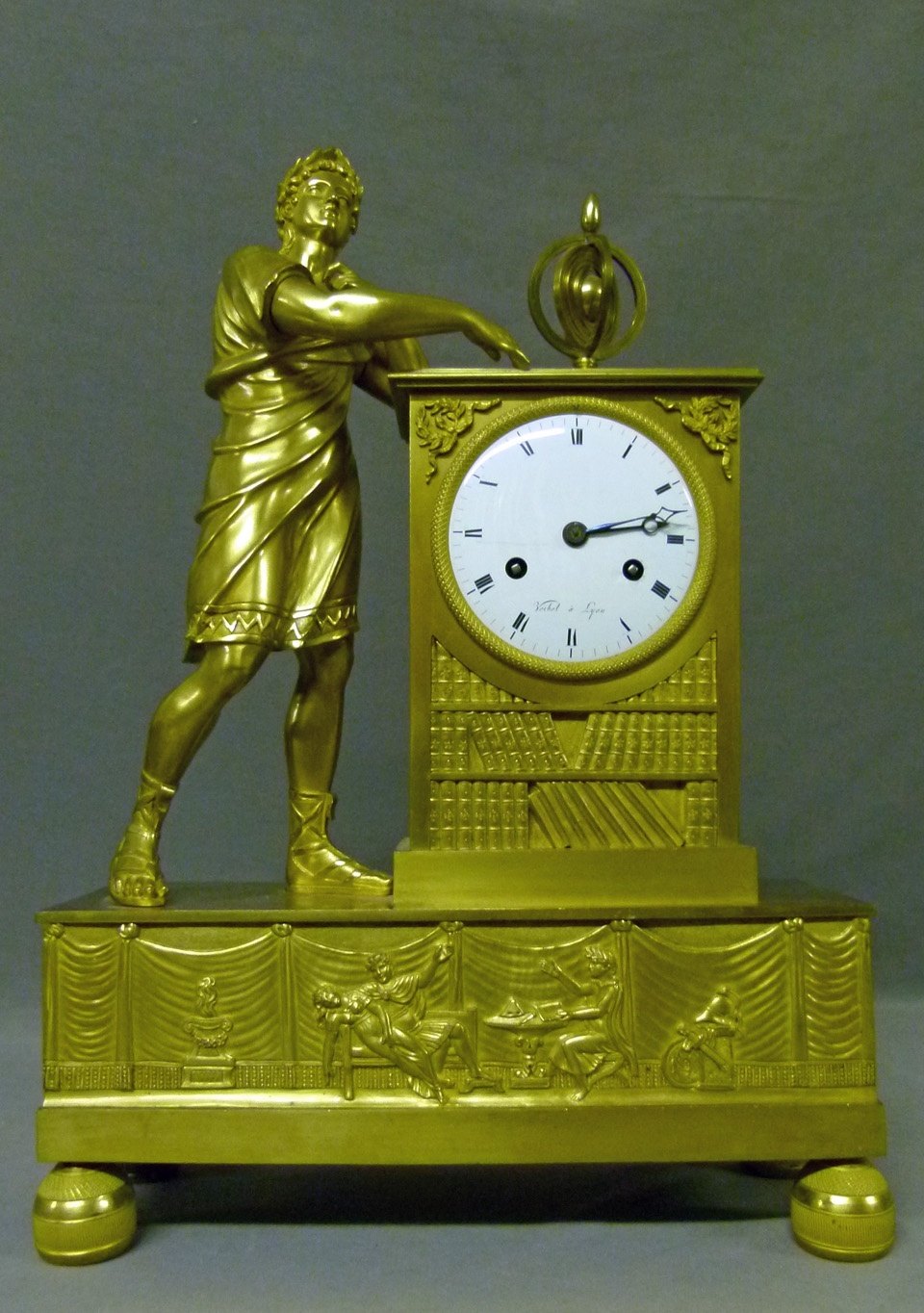
Instruments · Pendule
Pendule by Veibel, France, 1800
- Maker / attribution
- Veibel (manufacturer)
- Date
- 1800
- Historical period
- Precision & Scientific Horology (1750 – 1850)
- Country of origin
- France
- Place
- Lyon
- Object type
- Pendule
- Materials / technique
- Vergoldete Bronze
- Dimensions
- Höhe 45,2 cm, Breite 31,9 cm, Tiefe 12,4 cm
- Holding institution
- Stadtmuseum Simeonstift Trier
- Accession / object no.
- X 1309
- Credit line
- Stadtmuseum Simeonstift Trier
- Catalogue title (original)
- Französische Pendule mit einer allegorischen Darstellung der Astronomie (German)
View the source record ↗ (opens another website in a new tab)Suggest a correction
Record summary
Held and catalogued by Stadtmuseum Simeonstift Trier (object number X 1309), this is a pendule by Veibel, made in Lyon, France, dated 1800. The Atlas places it in the Precision & Scientific Horology period (1750 – 1850) of its Instruments collection. Materials and techniques recorded by the source: Vergoldete Bronze. Recorded dimensions: Höhe 45,2 cm, Breite 31,9 cm, Tiefe 12,4 cm. The record is illustrated with 1 photograph.
Assembled from the source record's structured fields. Dates and attributions are given as the source states them; where a field is missing the Atlas leaves it blank rather than estimating.
Catalogue description
Catalogue description from Stadtmuseum Simeonstift Trier (German)
Die französische Pendule, eine vergoldete Bronzeuhr, hat ein Emailzifferblatt mit römischen Ziffern. Die Uhr und das Zifferblatt sind nicht in der Mittelachse, sondern etwas nach rechts versetzt, auf einem rechteckigen Sockel montiert. Der Sockel ist mit einer antikisierenden Szene verziert. Die Pendule hat eine Allegorie der Astronomie zum Thema. Das Zifferblatt ist in ein Regal mit Büchern integriert. Auf dem Bücherregal steht ein Modell des Sonnensystems, bis ins 19. Jahrhundert auch als Planetarium bezeichnet. Neben dem Zifferblatt steht ein antikisierend gekleideter Mann in einer Tunika mit einem Lorbeerkranz bekrönt. Eine Hand auf das Bücherregal gestützt, die andere in Denkerpose an den Hals gelegt, die Beine als Stand- und Spielbein gestaltet, blickt er gedankenverloren nach oben, scheinbar zu den Sternen und Planeten in den Himmel.
Shown in the original language of the source catalogue. An editor-reviewed English translation has not yet been published; we do not publish machine translations as authoritative text.
Provenance
Literature: Schulte, Bärbel: Amor im Feuer. Die Pendulen der Schenkung Lambert Dahm (2014)
Historical context
Precision & Scientific Horology (1750 – 1850)
Harrison solves longitude; Mudge invents the lever; Breguet's Paris workshop defines the modern watch.
The longitude problem was solved by the marine chronometer and lunar distance methods; dividing engines made precision scales possible, and observatories set time by transit instruments.
Read the period in the timelineMore instruments from this periodEarlier: Early Modern Horology
Atlas type guide
Scientific and navigational instruments
Timekeeping has always been tied to astronomy, navigation and measurement. Observatories used transit instruments to determine the exact moment a star crossed the meridian, and set their regulators by it; navigators combined sextant observations with chronometers to find longitude; surveyors, engineers and physicians used counters, pedometers and timers derived from watch and clock technology.
Instruments in this collection show how time measurement supported science and everyday technical life. Their makers were often the same workshops that produced clocks and watches, and their scales and dials document changing units and standards.
What to look for
- Engraved scales and verniers; the units used (degrees, hours, decimal divisions).
- Makers' signatures and town names, often on the main plate or limb.
- Accessories and fitted cases that indicate the intended use.
- Inventory or institutional marks from observatories, navies or schools.
Dating clues
- Vernier scales spread after the seventeenth century; dividing engines after Ramsden (1770s) made fine scales common.
- Mass-produced instruments with patent numbers belong mostly to the nineteenth and twentieth centuries.
General guidance written by the Atlas editors about this kind of object. It is not a statement about this particular piece; for that, rely on the source record above and on physical examination.
Related records
Instruments · 1751–1850
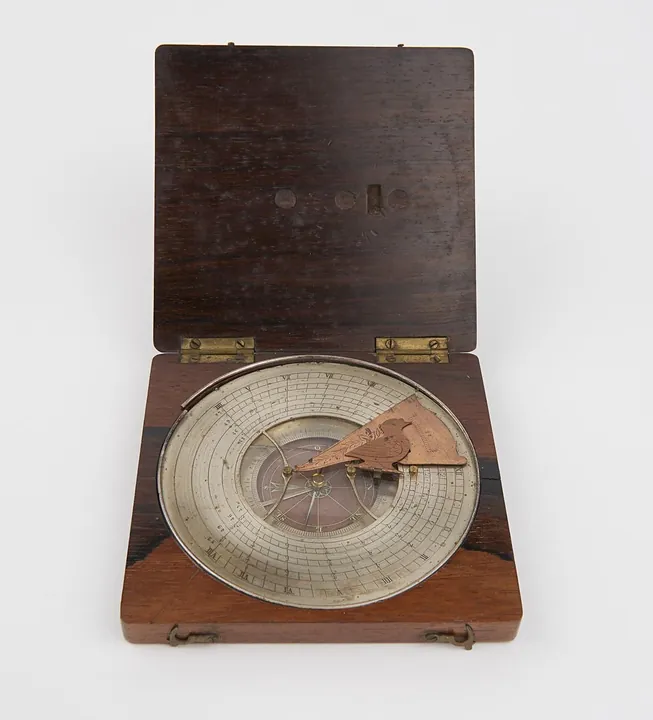
Horizontal compass sundial for latitudes 43 degrees, 46 degrees, 49 degrees, 52 degrees, in rosewood case French, c.1800 Cover glass cracked.
Science Museum Group, London
Instruments · 1751–1850
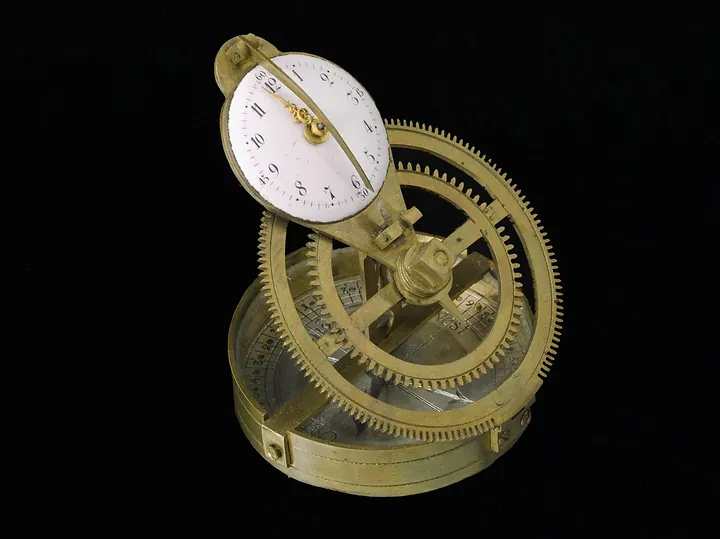
Mechanical equinoctial sundial for latitude 52 degrees, in original card case, one sight missing. French, c.1800
Science Museum Group, London
Instruments · last quarter 18th century
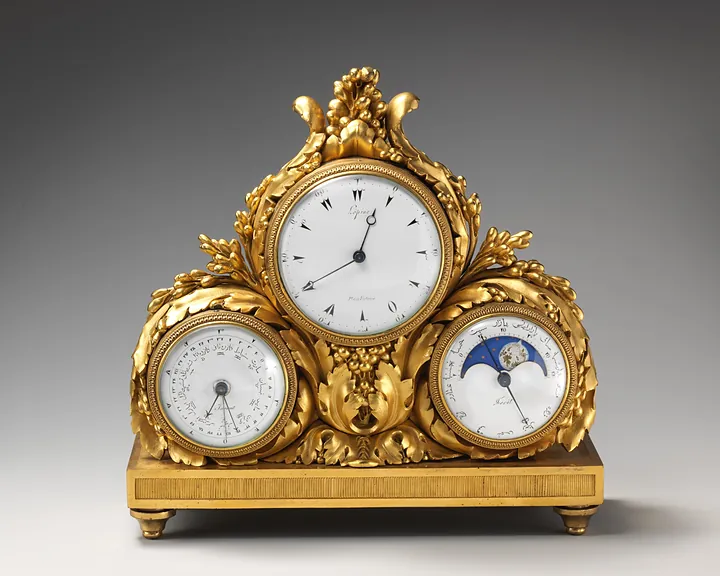
Clock by Jean Antoine Lépine, France, last quarter 18th century
The Metropolitan Museum of Art, New York
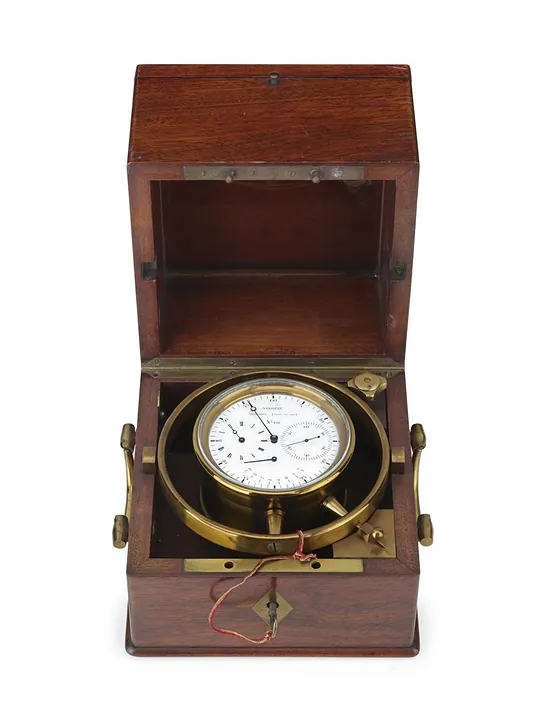
Instruments · 1780–1799
Marine chronometer by Vissière, France, 1780–1799
Science Museum Group, London
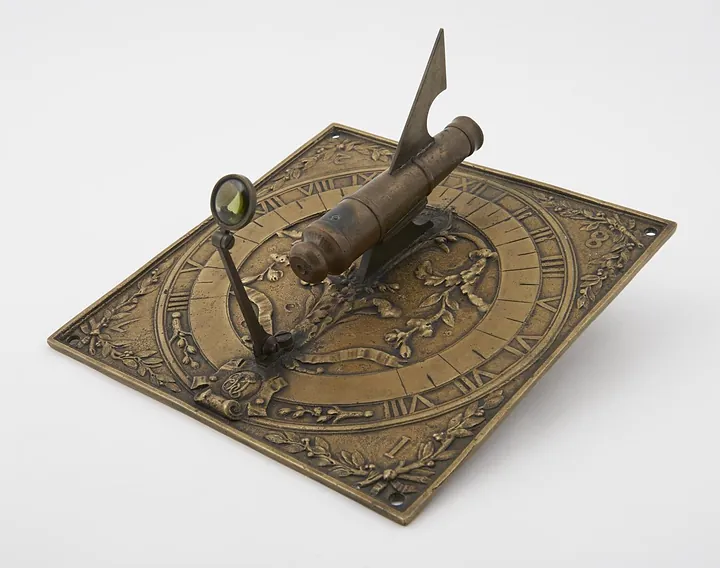
Instruments · 1782
Sundial, gnomon fixed on a cannon over touch hole of which a lens is fixed on a square base, unsigned, French, 1782
Science Museum Group, London
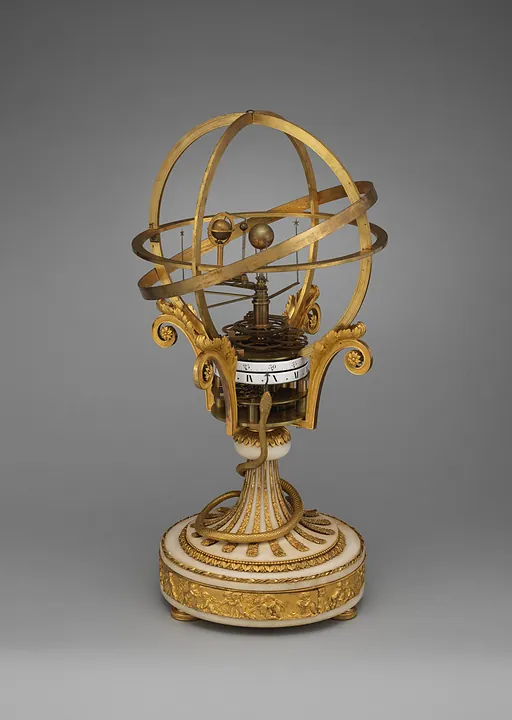
Instruments · 1790
Orrery clock by Louis Thouverez, France, 1790
The Metropolitan Museum of Art, New York
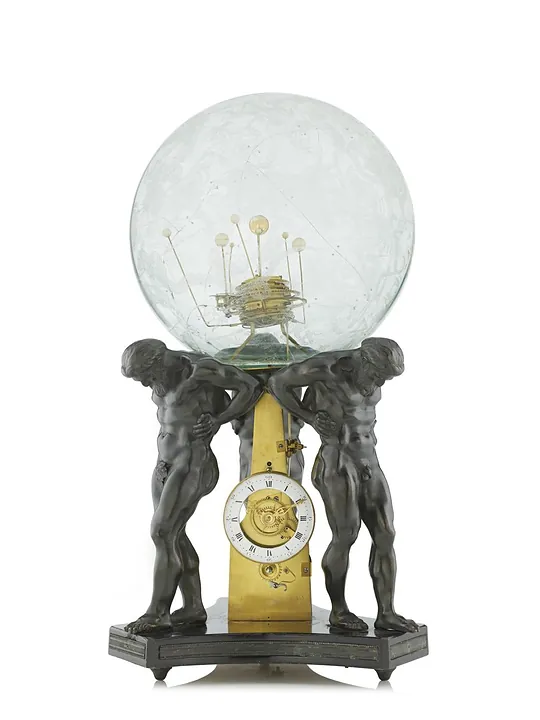
Instruments · 1795–1805
Armillary / astronomical instrument, France, 1795–1805
Science Museum Group, London
Instruments · 1800
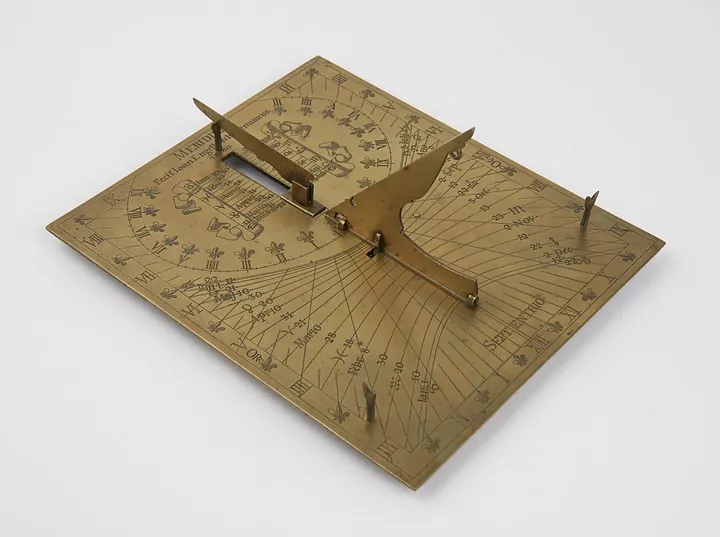
Horizontal and analemmatic sundial, "Engelbrecht, 1800" (plummet missing)
Science Museum Group, London