
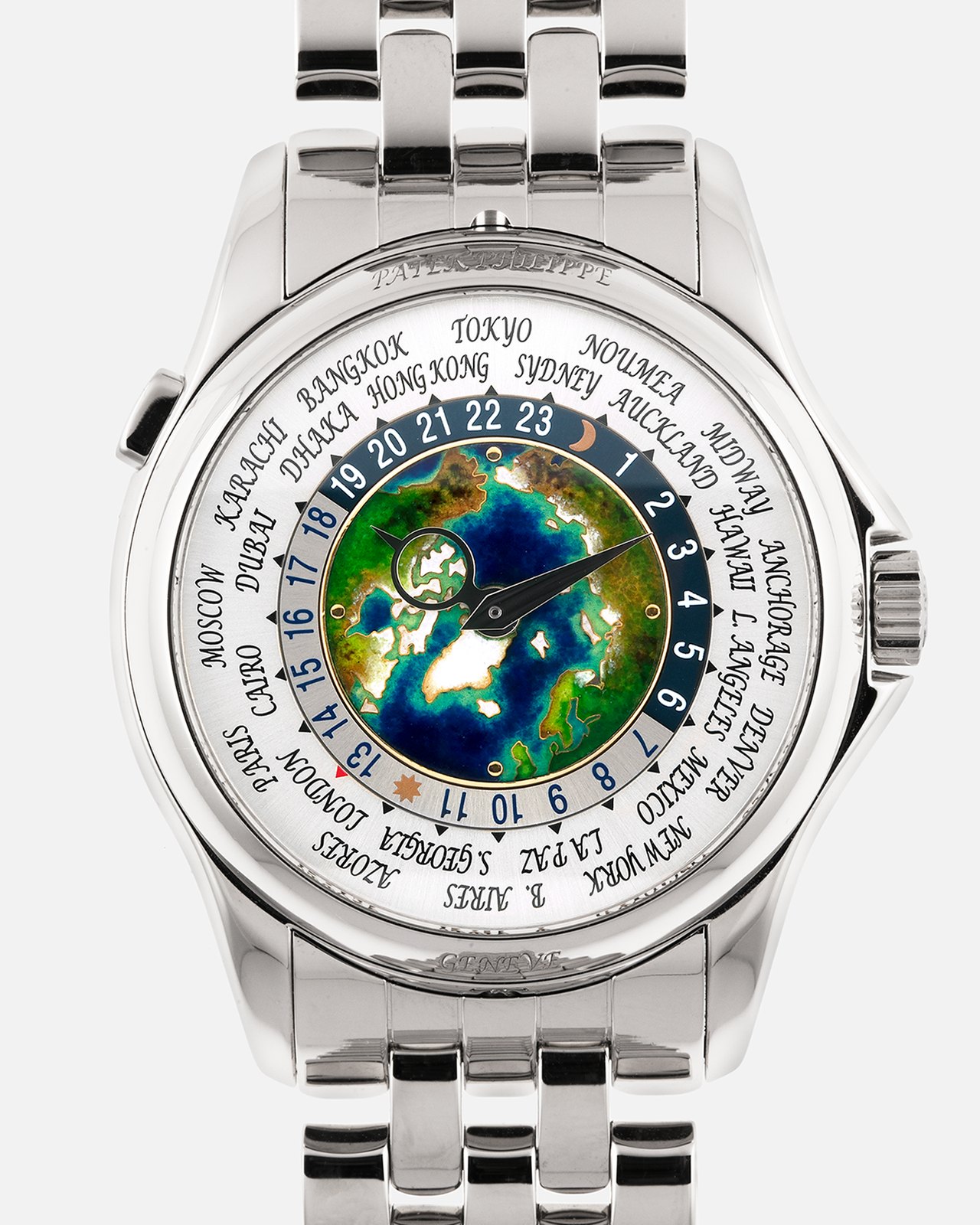
Wristwatches · Wristwatch
Patek Philippe World Time Cloisonné 5131P, 2021
- Maker / attribution
- Patek Philippe (maker)
- Date
- 2021
- Historical period
- Contemporary Horology (2010 – Present)
- Country of origin
- Switzerland
- Object type
- Wristwatch
- Dimensions
- Case 39.5 mm
- Stock no.
- Product 7748209115223
- Credit line
- Dealer listing, S.Song Watches (product 7748209115223)
- Catalogue title (original)
- Patek Philippe World Time Cloisonné 5131P (English)
View the source record (dealer listing) ↗ (opens another website in a new tab)Suggest a correction
Record summary
Catalogued by S.Song Watches (dealer), Seattle (stock number Product 7748209115223), this is a wristwatch by Patek Philippe, made in Switzerland, dated 2021. The Atlas places it in the Contemporary Horology period (2010 – Present) of its Wristwatches collection. Recorded dimensions: Case 39.5 mm. The record is illustrated with 6 photographs.
Assembled from the source record's structured fields. Dates and attributions are given as the source states them; where a field is missing the Atlas leaves it blank rather than estimating.
Catalogue description
Dealer description — S.Song Watches
Few complications are as closely associated with Patek Philippe as the World Time. Its story began in the 1930s with Louis Cottier, the brilliant Geneva watchmaker who developed a mechanism capable of displaying the time across the world's time zones simultaneously. Patek Philippe quickly recognised its potential, and Cottier's invention would go on to form the basis of some of the manufacture's most important watches, including the legendary references 1415 and 2523. Nearly a century later, the World Time remains an indispensable pillar of Patek Philippe's catalogue. There is something wonderfully romantic about the complication. In an age where our phones can instantly tell us the time anywhere in the world, the World Time is almost completely unnecessary, yet perhaps that is exactly why it remains so appealing. Few watches evoke the golden age of international travel quite like it. What we have here is one of the ultimate modern expressions of Patek Philippe's World Time, the Ref. 5131P. The 5131 was first introduced in yellow gold in 2008, followed by white gold, pink gold and finally platinum in 2017. Each metal was paired with a different cloisonné enamel depiction of the world, with the platinum version receiving perhaps the most striking of them all, a view of the Earth centred around the North Pole. More importantly, the platinum 5131 was delivered as standard on a full platinum bracelet. This is an important distinction. The preceding gold versions were predominantly delivered on leather straps, with matching precious-metal bracelets available only by special order. The 5131P therefore feels like a very different watch on the wrist. At 39.5mm across and just 10.6mm thick, its dimensions are actually rather restrained. Pick it up, however, and the experience is anything but. There is a density and heft to platinum that is difficult to convey in photographs, and with the substantial 'brick' style bracelet also constructed entirely from platinum, the 5131P feels extraordinarily substantial in the hand and on the wrist. It is almost surprising the first time you handle one. For a watch with such elegant proportions, it has an incredible physical presence, and that contrast between refinement and sheer weight is one of my favourite things about it. The case itself blends different finishes with an understated elegance, featuring a brushed caseback, polished mid-case and gently rounded bezel. As with the other 5131s, Patek Philippe moved its signature away from the already complicated dial, instead engraving 'PATEK PHILIPPE' at 12 o'clock and 'GENEVE' at 6 o'clock directly onto the bezel. Being platinum, there is also the obligatory diamond discreetly set into the case at 6 o'clock, with the bracelet's end link specially shaped to accommodate it. Of course, the centrepiece is its cloisonné enamel dial. Viewed from the North Pole, the map depicts much of the Northern Hemisphere in muted shades of brown, green and blue, surrounded by the cities and 24-hour rings of the World Time mechanism. Against the cold white tone of the platinum case and bracelet, the colours of the enamel work particularly well. Creating a cloisonné enamel dial like this is an extraordinarily painstaking process. Fine gold wires are first bent by hand to trace the outlines of the continents, creating individual partitions known as cloisons. These are then painstakingly filled with different coloured enamel and fired repeatedly in a kiln, gradually building the colours and depth of the finished dial. The process is both incredibly labour-intensive and unforgiving, and because each dial is created individually by hand, no two examples are ever completely identical. This is perhaps what makes the 5131 so special. At its heart is a genuinely useful mechanical complication, but the dial transforms the watch into something closer to a miniature work of art. The subtle variations in colour, the gold outlines of the continents and even the way the blues surrounding the coastlines seem to bleed into different shades give each dial a character that simply cannot be replicated by industrial production. Surrounding the enamel map are two independently rotating rings, one displaying 24 reference cities and another indicating the corresponding 24-hour scale with day and night indication. The entire system is wonderfully intuitive to operate. A pusher at 10 o'clock advances the local time by one-hour increments while simultaneously adjusting the city and 24-hour discs, allowing the wearer to change time zones without disturbing the watch's timekeeping. Powering it all is Patek Philippe's self-winding Calibre 240 HU, with HU standing for 'Heures Universelles'. Based on the legendary ultra-thin Calibre 240 architecture, the movement uses a recessed 22-carat gold micro-rotor, allowing the calibre to remain exceptionally thin despite the additional World Time mechanism. Visible through the sapphire caseback, it is everything you would expect from Patek Philippe, with beautiful Geneva striping, polished bevels and meticulous finishing throughout. There is also something significant about where the 5131P sits within the lineage. Introduced in 2017, it was the final regular-production metal variation of the 5131 and effectively served as the reference's last hurrah. By this point, the standard World Time had already moved on to the Ref. 5230, making the platinum 5131 something of a bridge between two generations of Patek Philippe World Times. The 5131P is a fascinating watch because it brings together several things Patek Philippe does exceptionally well. There is the lineage of Louis Cottier's World Time mechanism, the traditional rare-handcraft technique of cloisonné enamel, the wonderful Calibre 240 architecture and then, almost extravagantly, an entire case and bracelet rendered in platinum. On paper, it is an elegant 39.5mm World Time. On the wrist, however, it is something else entirely. The enormous heft of the platinum bracele
Historical context
Contemporary Horology (2010 – Present)
Silicon components, connected watches, optical-lattice research clocks and a thriving independent scene.
Smartwatches became the world's best-selling watches, while mechanical watchmaking focuses on craft, innovation (silicon components, new escapements) and independent makers.
Read the period in the timelineMore wristwatches from this periodEarlier: Mechanical Renaissance
Atlas type guide
Military, pilot and travel watches
The wristwatch owes much of its adoption by men to warfare and aviation. Wristlets — small pocket watches soldered with lugs and worn on a strap — were used in colonial campaigns and became standard equipment in the First World War, with protective grilles over the crystal ('shrapnel guards'). Louis Cartier's Santos (1904), designed for the aviator Alberto Santos-Dumont, is often cited as an early purpose-made pilot's watch.
In the Second World War governments specified watches in detail: the German B-Uhr observation watches, the American A-11, and the British 'W.W.W.' (the 'Dirty Dozen' set of 1945). After the war, jet travel brought GMT and world-time watches, which show two or more time zones at once — Louis Cottier's world-time mechanism and the Rolex GMT-Master (1955) are examples.
What to look for
- Military markings on the case back: broad arrow, issue numbers, 'W.W.W.', 'A.T.P.'
- High-legibility black dials with luminous Arabic numerals; oversized crowns for gloved hands.
- 24-hour hands and rotating 24-hour bezels or city rings on GMT/world-time watches.
- Wire lugs on early wristlets converted from pocket watches.
Dating clues
- Wire-lug wristlets: c. 1900–1925.
- Military specifications of the Second World War: 1939–1945.
- GMT and world-time wristwatches: mainly after 1950.
General guidance written by the Atlas editors about this kind of object. It is not a statement about this particular piece; for that, rely on the source record above and on physical examination.
Related records
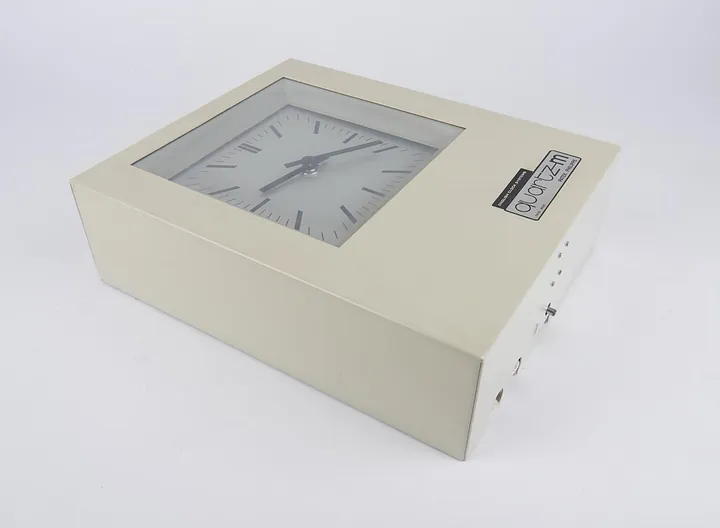
Clocks · 1965–1975
Quartz master clock QM 1, with movement by Patek Phillippe, Switzerland, 1965–1975. Supplied by English Clock Systems.
Science Museum Group, London
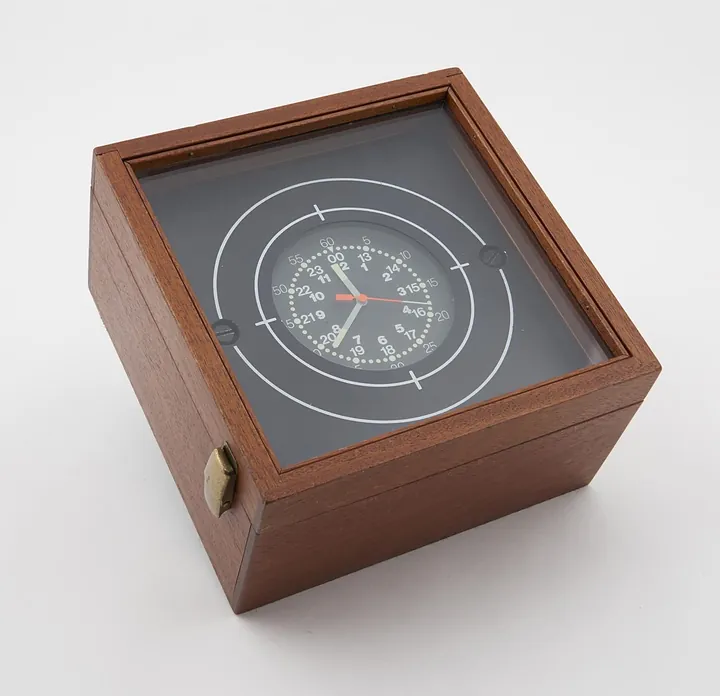
Instruments · 1965–1984
Chronometer by Patek Philippe and Kelvin Hughes, England, 1965–1984
Science Museum Group, London
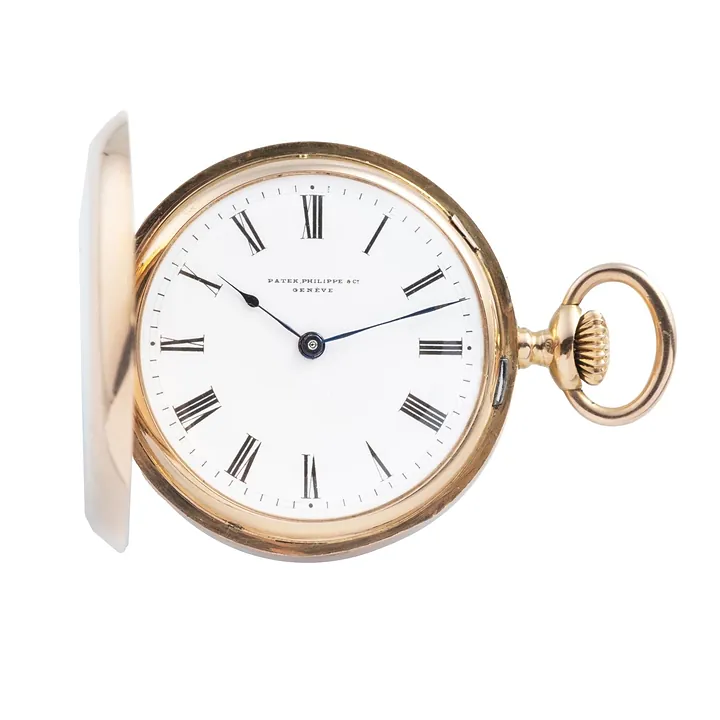
Pocket Watches · c. 1895
Patek Philippe pocket watch, c. 1895
Antiquorum auction archive, Geneva

Pocket Watches · c. 1900
Patek Philippe Chronometro Gondolo, c. 1900
Antiquorum auction archive, Geneva

Wristwatches · c. 2010s
Breguet Type XXI, ref. 3810, c. 2010s (Antiquorum Lot 381-24)
Antiquorum auction archive, Geneva

Wristwatches · c. 2010s
Breguet Type XXI, ref. 3810, c. 2010s (Antiquorum Lot 386-229)
Antiquorum auction archive, Geneva

Wristwatches · Sold in September 2010
Breitling Cosmonaute, ref. A 22322, Sold in September 2010
Antiquorum auction archive, Geneva

Wristwatches · c. 2010
Corum Bubble Chrono, ref. 396.150.20, c. 2010
Antiquorum auction archive, Geneva