
Wristwatches · Wristwatch
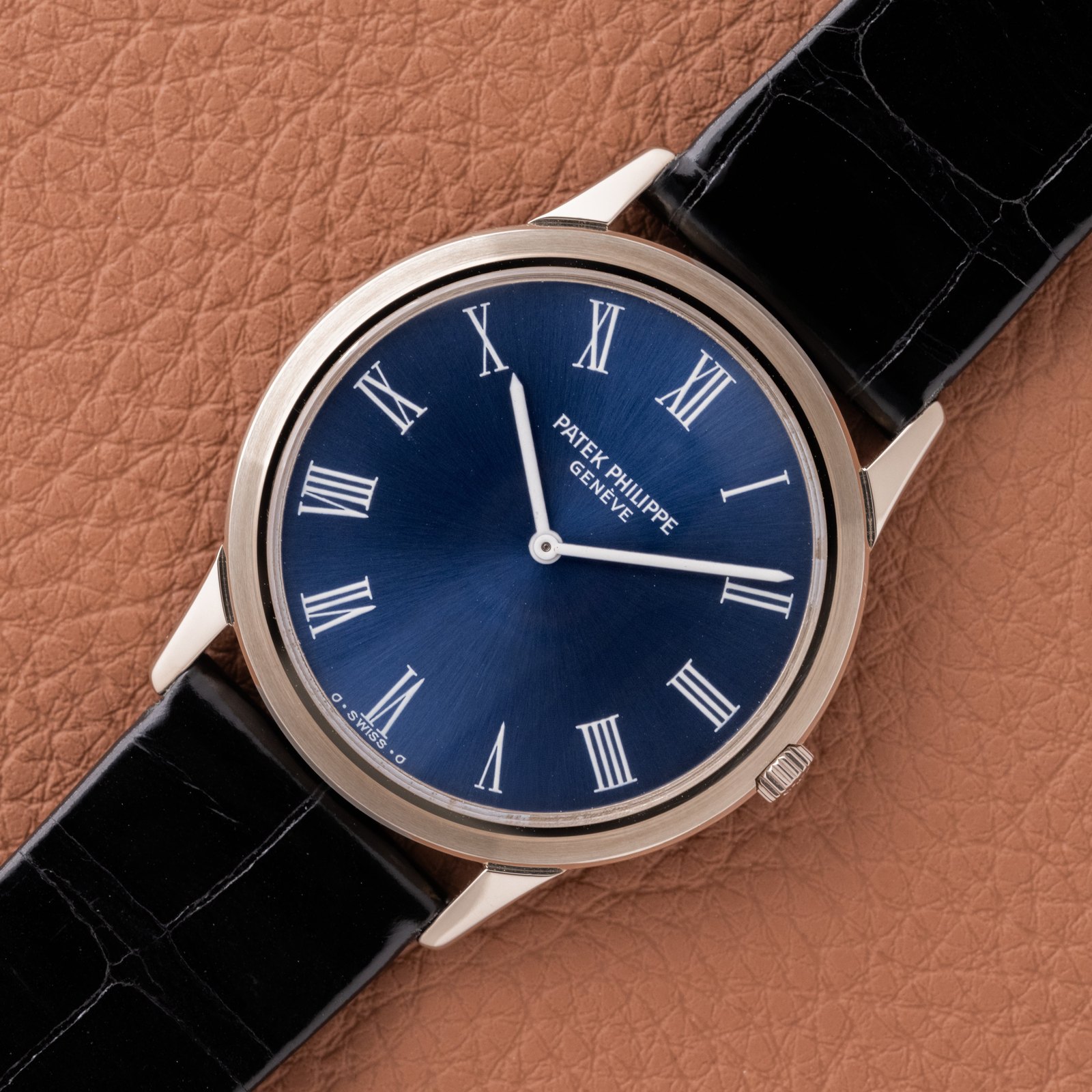
Patek Philippe White Gold Blue Dial Automatic Calatrava (Ref. 3591), 1970s
- Maker / attribution
- Patek Philippe (maker)
- Date
- 1970s
- Historical period
- Quartz Revolution (1969 – 1990)
- Country of origin
- Switzerland
- Object type
- Wristwatch
- Materials / technique
- white gold
- Dimensions
- Case 33 mm
- Stock no.
- Product 8834774696119
- Credit line
- Dealer listing, Huntington Company (product 8834774696119)
- Catalogue title (original)
- 1970s Patek Philippe White Gold Blue Dial Automatic Calatrava (Ref. 3591) (English)
View the source record (dealer listing) ↗ (opens another website in a new tab)Suggest a correction
Record summary
Catalogued by Huntington Company (dealer) (stock number Product 8834774696119), this is a wristwatch by Patek Philippe, made in Switzerland, dated 1970s. The Atlas places it in the Quartz Revolution period (1969 – 1990) of its Wristwatches collection. Materials and techniques recorded by the source: white gold. Recorded dimensions: Case 33 mm. The record is illustrated with 6 photographs.
Assembled from the source record's structured fields. Dates and attributions are given as the source states them; where a field is missing the Atlas leaves it blank rather than estimating.
Catalogue description
Dealer description — Huntington Company
History and Significance Patek Philippe's dress watches from the 1970s represent a particularly interesting chapter in the manufacturer's history. While the decade is often remembered for the introduction of the Nautilus and the growing popularity of luxury sports watches, Patek Philippe continued producing an extraordinary variety of elegant, mechanically sophisticated dress watches. Many of these references explored increasingly slender cases, unusual dial configurations, and more contemporary design elements while maintaining the traditional craftsmanship associated with the manufacture. The reference 3591 belongs to this fascinating period, combining the refinement of a classical Calatrava with the technical achievement of an ultra-thin automatic movement. It is an uncommon reference that demonstrates how much creativity existed within Patek Philippe's dress watch collection during the decade. Ultra-thin automatic watchmaking was one of the more impressive mechanical achievements of the mid-twentieth century. Unlike manually wound movements, automatic calibers require an additional winding mechanism, creating significant challenges when attempting to reduce the overall thickness of the movement. Patek Philippe was among the prestigious Swiss manufacturers that devoted considerable attention to this pursuit, developing remarkably slender automatic calibers that could be housed within elegant dress watches. The introduction of micro-rotor movements during the 1950s was particularly important, allowing automatic winding systems to be incorporated without the additional height associated with conventional central rotors. These developments helped establish an entirely new category of refined automatic dress watches, combining the convenience of self-winding movements with the proportions traditionally associated with manual-winding timepieces. The use of sigma dials is another fascinating detail associated with Swiss watchmaking during the 1970s. Sigma markings, typically appearing as small Greek sigma symbols surrounding the Swiss designation at the bottom of a dial, were used by participating manufacturers to indicate the presence of precious metal components on the dial. These markings became particularly associated with prestigious Swiss brands during the decade, appearing on a variety of important vintage references. Today, sigma dials are appreciated by collectors as distinctive period details that help connect a watch to a specific era of production. Their presence on the reference 3591 adds another interesting element to an already unusual Patek Philippe. Blue sunburst dials occupy a special place in vintage watch collecting, particularly when paired with precious metal cases. Unlike conventional matte finishes, sunburst dials incorporate fine radial brushing that creates dramatic changes in appearance depending on the direction and intensity of the light. The surface can shift between deep navy and brighter shades of blue, giving the dial a remarkable sense of depth and movement. During the 1970s, blue dials became increasingly popular among prestigious Swiss manufacturers, reflecting a broader movement toward more expressive colors and contemporary styling. The combination of a blue sunburst finish and white Roman numerals gives the reference 3591 a particularly distinctive appearance, balancing the elegance of traditional Patek Philippe design with the visual character of the decade. Writer’s Thoughts The blue dial is what makes this particular Patek Philippe reference 3591 so extraordinary. There are plenty of beautiful vintage Calatravas with silver, champagne, and white dials, but finding an example with such a rich blue sunburst finish is an entirely different experience. The contrast between the deep blue surface and crisp white Roman numerals gives the watch an almost graphic quality, while the white gold case provides a wonderfully understated frame. It is an unusual combination that feels unmistakably connected to the 1970s without sacrificing the elegance expected from a traditional Patek Philippe. The pristine condition of the dial makes the entire watch even more compelling. The ultra-thin automatic construction is another reason the reference 3591 deserves attention. Vintage automatic dress watches often carry additional thickness compared with their manually wound counterparts, making exceptionally slender automatic references particularly interesting. The reference 3591 offers the convenience of automatic winding within the elegant proportions associated with Patek Philippe's finest dress watches. Combined with the uncommon dial configuration, the result is a watch that feels considerably more distinctive than a conventional vintage Calatrava. The preservation of the original Patek Philippe strap and buckle adds another attractive detail to an already exceptional example. Our Promise Every watch is thoroughly vetted, carefully described with complete transparency, and guaranteed authentic. Each piece is offered in honest condition, ensuring collectors receive a timepiece that reflects both originality and integrity. Specifications Brand: Patek Philippe Model: Calatrava Reference: 3591 Year: 1970s Case Material: 18k White Gold Case Size: 33mm Dial: Blue Sunburst Sigma Dial with White Roman Numerals Movement: Ultra-Thin Automatic Mechanical Movement Strap/Buckle: Original Patek Philippe Leather Strap Buckle/Clasp: Original Patek Philippe Gold Buckle Contents: Watch only Condition Case: White gold case is in excellent condition with minimal signs of wear. The case retains its attractive original shape. Dial: Original blue sunburst sigma dial is in exceptional condition, with a beautifully preserved finish and crisp white Roman numerals. Hands: Hands are in excellent condition with minimal signs of aging. Crystal: Crystal is in excellent condition with no scratches or damage. Strap/Buckle: Original Patek Philippe leather strap is in excellent condition with minimal s
Historical context
Quartz Revolution (1969 – 1990)
Seiko's Astron begins mass quartz timekeeping; traditional industries contract sharply.
Quartz and digital watches transformed the market after 1969. Swiss employment collapsed, Japanese and Hong Kong production soared, and the Swatch (1983) helped the Swiss industry recover; mechanical watches survived as luxury goods.
Read the period in the timelineMore wristwatches from this periodEarlier: Modern Mechanical Horology
Atlas type guide
Automatic (self-winding) watches
Self-winding watches use the wearer's motion to wind the mainspring. Abraham-Louis Perrelet and Breguet made 'perpétuelle' pocket watches with oscillating weights in the late eighteenth century, but the principle only became practical in the wristwatch. John Harwood patented a bumper automatic in 1923; Rolex's Perpetual rotor (1931) winding in one direction, and later bidirectional rotors (Eterna, Felsa Bidynator), established the modern form. Micro-rotors (Universal Genève, Buren) and peripheral rotors made automatic watches thinner.
What to look for
- A semicircular rotor turning 360° over the movement, or a 'bumper' weight that rebounds between springs.
- 'Automatic', 'Perpetual' or 'Self-winding' on the dial.
- A sealed screw-back case, since automatic watches are wound less often by the crown.
Dating clues
- Bumper automatics: 1923–c. 1955.
- Full rotors: from 1931 (Rolex); widespread after c. 1950.
- Micro-rotors: from 1954–1958.
General guidance written by the Atlas editors about this kind of object. It is not a statement about this particular piece; for that, rely on the source record above and on physical examination.
Related records
Clocks · 1965–1975
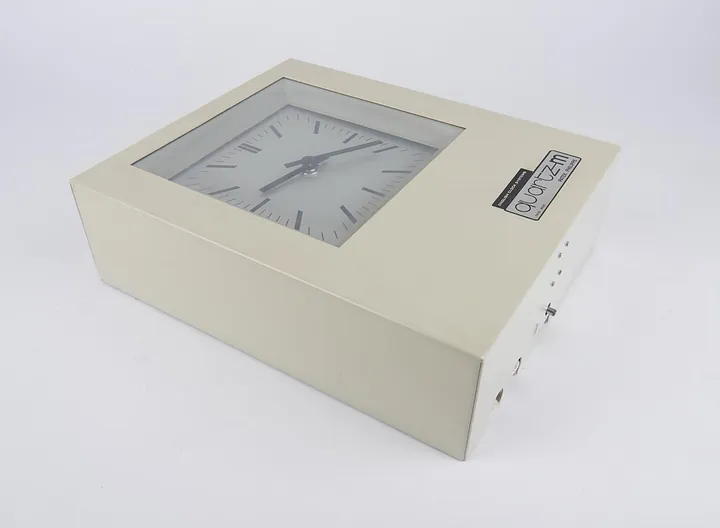
Quartz master clock QM 1, with movement by Patek Phillippe, Switzerland, 1965–1975. Supplied by English Clock Systems.
Science Museum Group, London
Instruments · 1965–1984
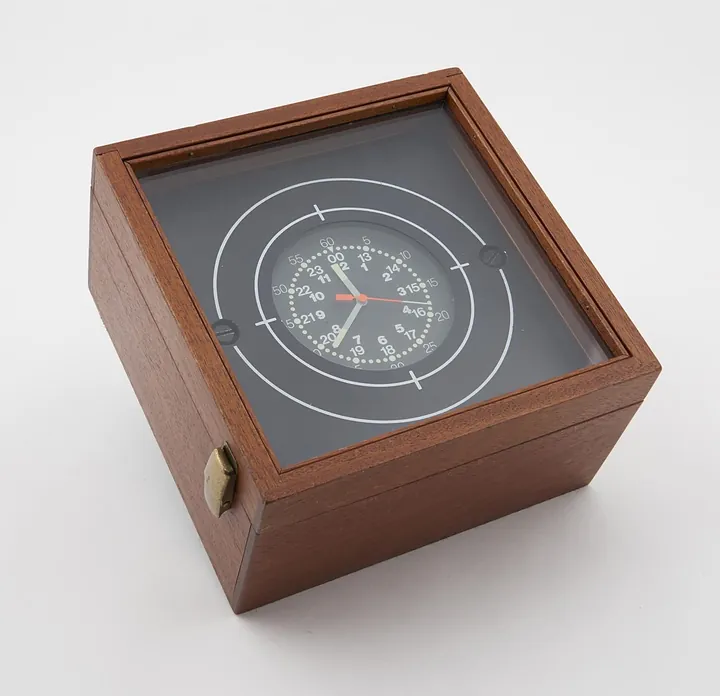
Chronometer by Patek Philippe and Kelvin Hughes, England, 1965–1984
Science Museum Group, London
Pocket Watches · c. 1895
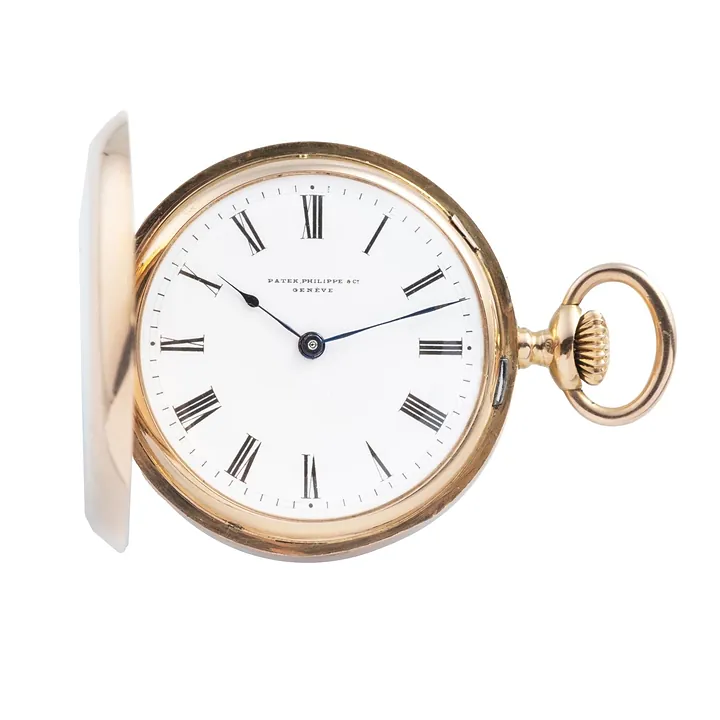
Patek Philippe pocket watch, c. 1895
Antiquorum auction archive, Geneva
Pocket Watches · c. 1900
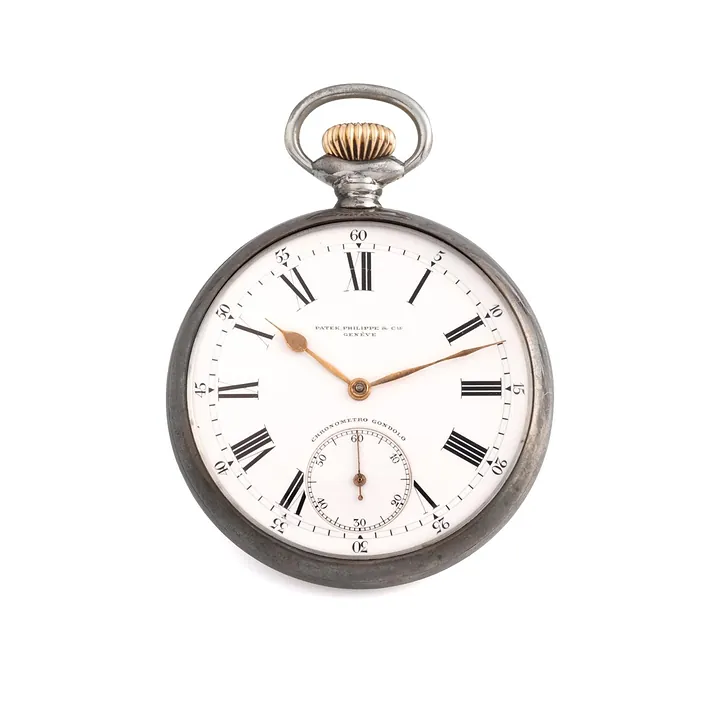
Patek Philippe Chronometro Gondolo, c. 1900
Antiquorum auction archive, Geneva

Wristwatches · 1970
Wristwatch by Heno, Switzerland, 1970
Museum Rotterdam

Wristwatches · 1960–1986
'Tri-Compax' calendar chronograph wristwatch in gold case, by Universal, Geneva, Switzerland, 1960–1986.
Science Museum Group, London

Wristwatches · 1969–1970
Beta 21 Quartz wristwatch movement, made in Switzerland, 1970.
Science Museum Group, London

Wristwatches · c. 1969
Omega Speedmaster Moonwatch, ref. 145022-69st, c. 1969
Antiquorum auction archive, Geneva