
Wristwatches · Wristwatch
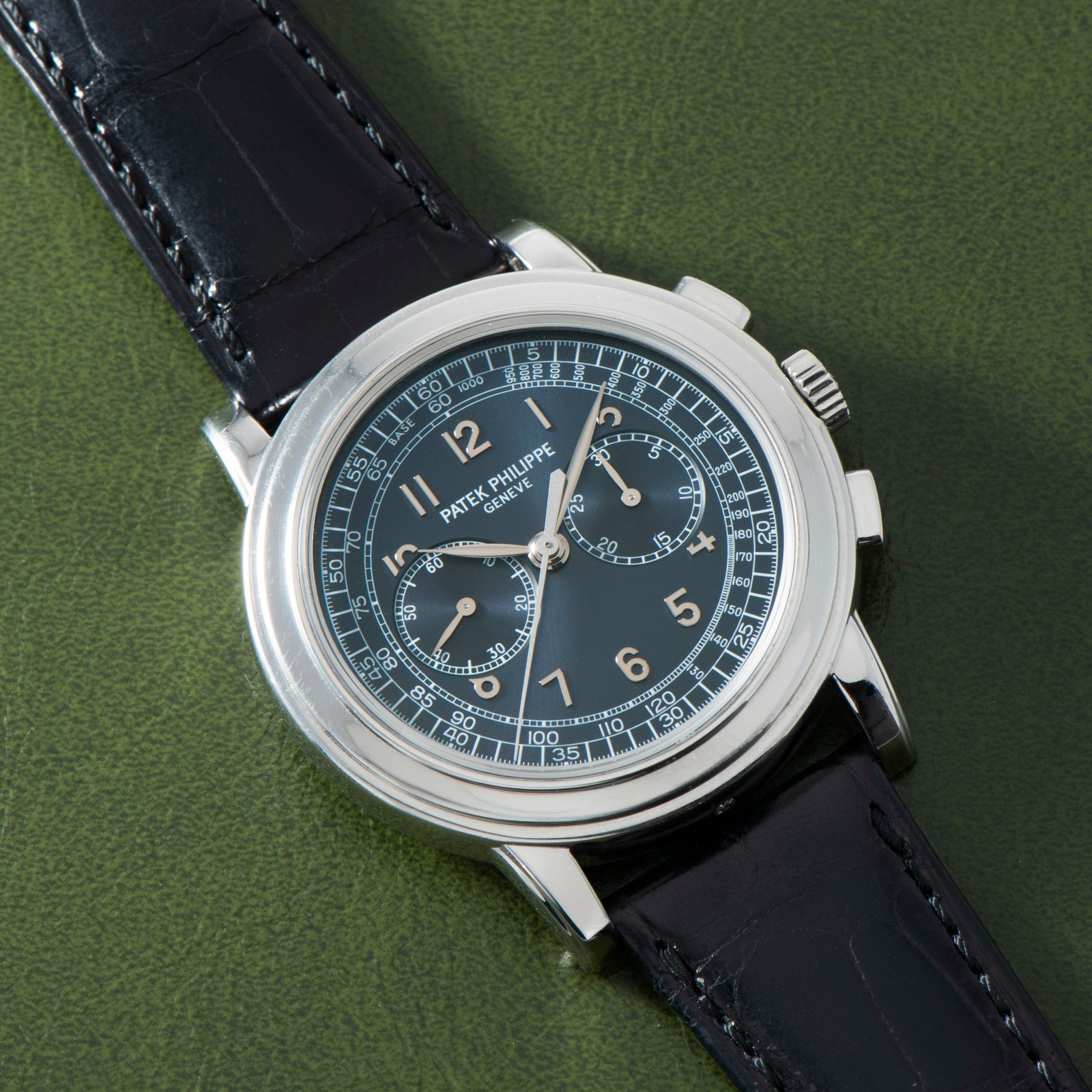
Patek Philippe Chronograph, 2008
- Maker / attribution
- Patek Philippe (maker)
- Date
- 2008
- Historical period
- Mechanical Renaissance (1990 – 2010)
- Country of origin
- Switzerland
- Object type
- Wristwatch
- Dimensions
- Case 42 mm
- Stock no.
- 40930708
- Credit line
- Dealer listing, Analog/Shift (40930708)
- Catalogue title (original)
- Patek Philippe Chronograph (English)
View the source record (dealer listing) ↗ (opens another website in a new tab)Suggest a correction
Record summary
Catalogued by Analog/Shift (dealer), New York (stock number 40930708), this is a wristwatch by Patek Philippe, made in Switzerland, dated 2008. The Atlas places it in the Mechanical Renaissance period (1990 – 2010) of its Wristwatches collection. Recorded dimensions: Case 42 mm. The record is illustrated with 6 photographs.
Assembled from the source record's structured fields. Dates and attributions are given as the source states them; where a field is missing the Atlas leaves it blank rather than estimating.
Catalogue description
Dealer description — Analog/Shift
Patek Philippe has sat atop the horological mountain for going on two centuries, having earned near-universal acclaim for their proficiencies in designing, engineering, and manufacturing some of the most exquisite timepieces the world has ever seen. The celebrated maison has a tradition of creating watches that transcend mere trends and changing tastes. Leaning on the pillars of timeless design, refinement, and mechanical ingenuity, there’s arguably no other manufacture that does it better. One of the most legendary of complications for Patek Philippe is the manually-wound chronograph. Following the discontinuation of the Ref. 1463 in the mid-20th century, Patek had no manually-wound chronograph in its collection. Then, in 1998, the brand presented the Reference 5070. Featuring modern 42mm proportions and utilizing a much smaller movement based upon the Lemania 2310 ébauche, Patek filled the extra dial space with added scales around its perimeter. The 5070 was bold in its proportions, and the market didn’t initially fall for it. Over time, however, its small production numbers, high quality, and vintage-inspired aesthetics saw it enjoy one of the most legendary collecting statuses in the neo-vintage Patek marketplace. This particular 5070 from circa 2008 is emblematic of all that makes the Ref. 5070 such a highly desired piece: Housed in a 42mm platinum case with 'paddle' pushers, a signed crown, an elegant stepped bezel, and a sapphire crystal, it features a sunray blue dial with a white-printed 1/5th-seconds track, tachymeter scale, and 'railroad' minute track; applied white gold 'Arabic' indices; a dual-register chronograph with 30-minute counter; and an elegant 'feuille' handset. Powered by the Patek Philippe Calibre CH 27-70 hand-wound movement with a beat rate of 18,000 vph and a power reserve of 58 hours, it comes paired to a blue alligator strap with tone-on-tone top stitching and a signed deployant clasp. Accompanied by its box set as well as an Extract from the Archives dating to 2008, this gorgeous, vintage-inspired Patek is ready for the wrist of its next owner.
Historical context
Mechanical Renaissance (1990 – 2010)
Mechanical watches return as cultural objects; independent watchmaking flourishes.
Mechanical watches returned as cultural and luxury objects. Complications, tourbillons and new materials proliferated; independent watchmakers such as George Daniels, F.P. Journe and Philippe Dufour revived artisanal watchmaking; collecting vintage watches became a major field.
Read the period in the timelineMore wristwatches from this periodEarlier: Quartz Revolution
Atlas type guide
Chronographs and split-seconds watches
A chronograph is a watch with an additional seconds hand that can be started, stopped and returned to zero independently of the timekeeping. Louis Moinet built an early example in 1816 and Nicolas Rieussec a recording 'chronographe' in 1821; Adolphe Nicole's heart-shaped reset cam (patented 1862) made the modern return-to-zero possible. Split-seconds (rattrapante) chronographs add a second hand that can be stopped for intermediate times; flyback chronographs restart instantly.
Chronographs were essential tools for doctors (pulsometer scales), artillery (telemeter), engineers and sport. In wristwatches, Valjoux, Venus, Lemania and later the automatic chronographs of 1969 (Zenith El Primero, the Chronomatic Calibre 11 group and Seiko 6139) are milestones.
What to look for
- Push-pieces on the case band or a single button in the crown (monopusher).
- Subsidiary registers for minutes and hours; tachymeter, telemeter or pulsometer scales.
- Column wheel versus cam control visible in the movement.
- Calibre markings of specialist makers (Valjoux, Lemania, Venus, Landeron).
Dating clues
- Pocket chronographs with heart cam reset: after 1862.
- Wrist chronographs: from c. 1910; two-button designs from the 1930s.
- Automatic chronographs: from 1969.
General guidance written by the Atlas editors about this kind of object. It is not a statement about this particular piece; for that, rely on the source record above and on physical examination.
Read next:Flyback chronographChronograph
Related records

Clocks · 1965–1975
Quartz master clock QM 1, with movement by Patek Phillippe, Switzerland, 1965–1975. Supplied by English Clock Systems.
Science Museum Group, London

Instruments · 1965–1984
Chronometer by Patek Philippe and Kelvin Hughes, England, 1965–1984
Science Museum Group, London

Pocket Watches · c. 1895
Patek Philippe pocket watch, c. 1895
Antiquorum auction archive, Geneva

Pocket Watches · c. 1900
Patek Philippe Chronometro Gondolo, c. 1900
Antiquorum auction archive, Geneva

Wristwatches · 2008
Wristwatch by Breitling?, 2008
Museum Rotterdam

Wristwatches · c. 1990s
Audemars Piguet Bamboo, c. 1990s
Antiquorum auction archive, Geneva

Wristwatches · c. 1990
Audemars Piguet Huitieme Perpetual Calendar, ref. 25696PT, c. 1990
Antiquorum auction archive, Geneva

Wristwatches · c. 1990
Breitling Chronomat, ref. b13050.1, c. 1990
Antiquorum auction archive, Geneva