
Wristwatches · Wristwatch
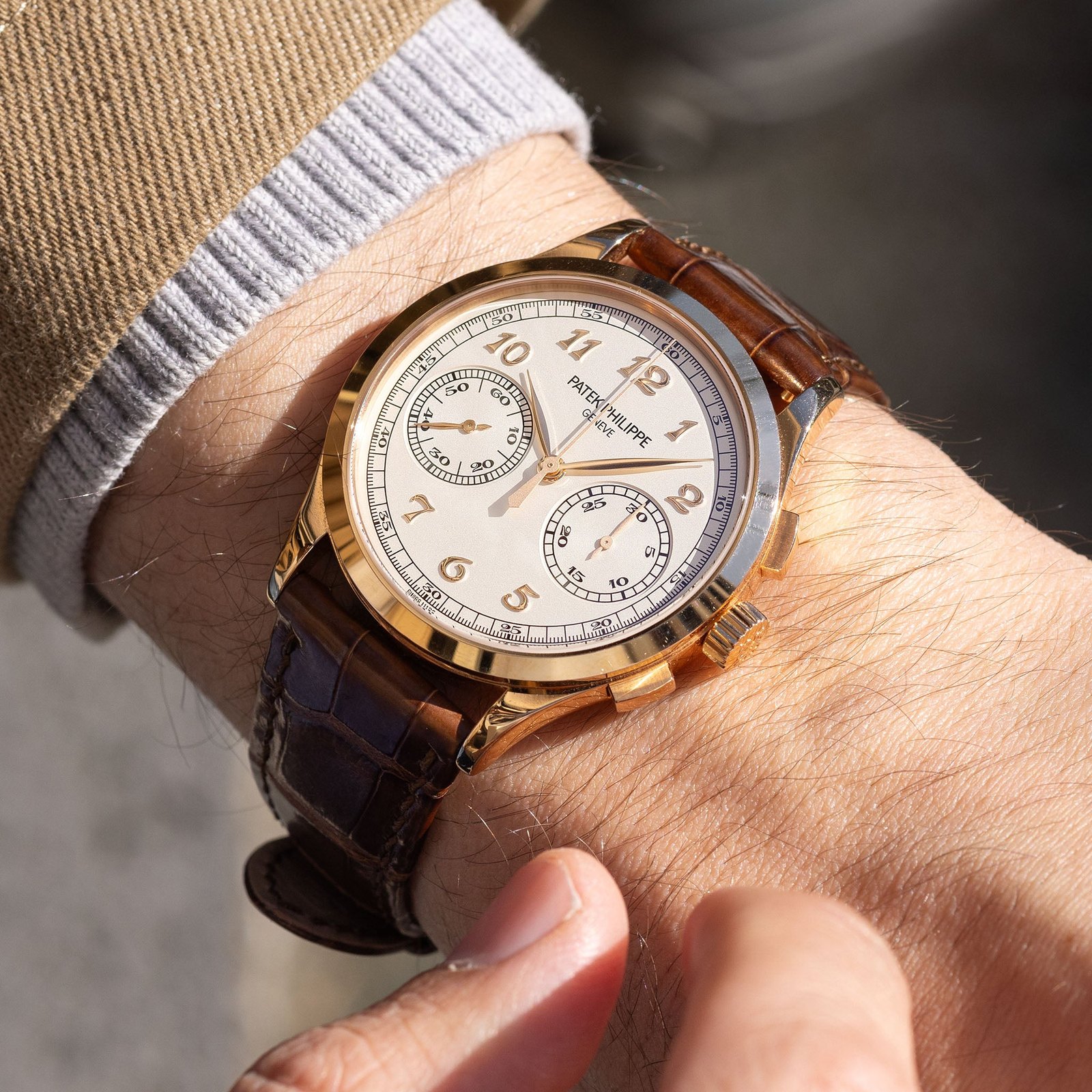
Patek Philippe Chronograph 5170-001R “Breguet Numerals” in 18K Rose Gold Box and Paper Set, 2016
- Maker / attribution
- Patek Philippe (maker)
- Date
- 2016
- Historical period
- Contemporary Horology (2010 – Present)
- Country of origin
- Switzerland
- Object type
- Wristwatch
- Materials / technique
- 18k rose gold
- Dimensions
- Case 39.5 mm
- Stock no.
- W-3211
- Credit line
- Dealer listing, Bulang & Sons (W-3211)
- Catalogue title (original)
- Patek Philippe Chronograph 5170-001R “Breguet Numerals” in 18K Rose Gold Box and Paper Set (English)
View the source record (dealer listing) ↗ (opens another website in a new tab)Suggest a correction
Record summary
Catalogued by Bulang & Sons (dealer), Copenhagen (stock number W-3211), this is a wristwatch by Patek Philippe, made in Switzerland, dated 2016. The Atlas places it in the Contemporary Horology period (2010 – Present) of its Wristwatches collection. Materials and techniques recorded by the source: 18k rose gold. Recorded dimensions: Case 39.5 mm. The record is illustrated with 6 photographs.
Assembled from the source record's structured fields. Dates and attributions are given as the source states them; where a field is missing the Atlas leaves it blank rather than estimating.
Catalogue description
Dealer description — Bulang & Sons
At Patek Philippe, chronographs are approached with a level of reverence akin to a sacred duty. From the highly intricate split-seconds or perpetual calendar models—sometimes combining both features—to the more straightforward iterations, every variation is held in immense regard and highly coveted. At hand, we have a Ref. 5170, introduced in 2010, with its first evolution in 2013, followed by a more significant enhancement in 2015. This is one of the later generations, a rose gold variation introduced in 2016. The silvery opaline dial is extremely easy to read, as it "only" has one scale—opposed to earlier versions with a "multi-scale" layout—along with two sub-dials for the chronograph function and the coveted applied Breguet numerals. The 39.5mm case is in mint condition, featuring bold square pushers, a display sapphire case back offering a view of the manual-wound Cal. CH 29-535 PS, and an original Patek Philippe leather strap with slight wear, attached with an 18K rose gold folding clasp. And YES, the movement! Throughout the earlier stages of its long and fascinating history, Patek Philippe collaborated with renowned chronograph manufacturers like Victorin Piguet, Valjoux, and Lemania. In particular, the Lemania caliber 2310, or CH 27-70, served as one of the most dependable foundations upon which Patek Philippe built many of its most iconic chronograph models. The caliber 2310 was introduced by Lemania in the 1940s and became part of Patek Philippe's legacy in the 1980s, under the designation CH 27-70. It made its first appearance in 1985 in the Ref. 3970 perpetual calendar chronograph and later in 1998 in the chronograph-only Ref. 5070. Although the Lemania-based chronographs met—and even exceeded—many of Patek Philippe's exacting standards, one goal remained unachieved: the ability to call these chronographs truly and undeniably their own. This led to the commencement of research and development in 2004 for an in-house, integrated chronograph movement, signaling a bold new direction for Patek Philippe—one that would also empower the brand to pursue even more ambitious objectives with its timepieces. That movement, as all Patek Philippe enthusiasts are aware, is the caliber CH 29-535 PS! This fine chronograph comes as a full kit, with the inner and outer boxes, leather paper holder, booklets, and the certificate of origin stating a sale in Germany in 2016. We love this combination of the “opaline” dial, rose gold, and Breguet numerals. If you share our enthusiasm, get in touch! Specifications: - Patek Philippe 5170-001R Chronograph - 18K rose gold case in 39.5mm - Movement no. 612xxxx, case no. 595xxxx, dating to 2016 - Opaline silver dial with two sub-dials and applied Breguet numerals - Inner/outer boxes, leather paper holder, booklets, and certificate of origin stating sale in 2016 - Manual-wound in-house Patek CH 29-535 PS movement - Patek Philippe leather strap with 18K rose gold folding buckle - Fully checked by our watchmaker
Historical context
Contemporary Horology (2010 – Present)
Silicon components, connected watches, optical-lattice research clocks and a thriving independent scene.
Smartwatches became the world's best-selling watches, while mechanical watchmaking focuses on craft, innovation (silicon components, new escapements) and independent makers.
Read the period in the timelineMore wristwatches from this periodEarlier: Mechanical Renaissance
Atlas type guide
Chronographs and split-seconds watches
A chronograph is a watch with an additional seconds hand that can be started, stopped and returned to zero independently of the timekeeping. Louis Moinet built an early example in 1816 and Nicolas Rieussec a recording 'chronographe' in 1821; Adolphe Nicole's heart-shaped reset cam (patented 1862) made the modern return-to-zero possible. Split-seconds (rattrapante) chronographs add a second hand that can be stopped for intermediate times; flyback chronographs restart instantly.
Chronographs were essential tools for doctors (pulsometer scales), artillery (telemeter), engineers and sport. In wristwatches, Valjoux, Venus, Lemania and later the automatic chronographs of 1969 (Zenith El Primero, the Chronomatic Calibre 11 group and Seiko 6139) are milestones.
What to look for
- Push-pieces on the case band or a single button in the crown (monopusher).
- Subsidiary registers for minutes and hours; tachymeter, telemeter or pulsometer scales.
- Column wheel versus cam control visible in the movement.
- Calibre markings of specialist makers (Valjoux, Lemania, Venus, Landeron).
Dating clues
- Pocket chronographs with heart cam reset: after 1862.
- Wrist chronographs: from c. 1910; two-button designs from the 1930s.
- Automatic chronographs: from 1969.
General guidance written by the Atlas editors about this kind of object. It is not a statement about this particular piece; for that, rely on the source record above and on physical examination.
Read next:Flyback chronographChronograph
Related records
Clocks · 1965–1975
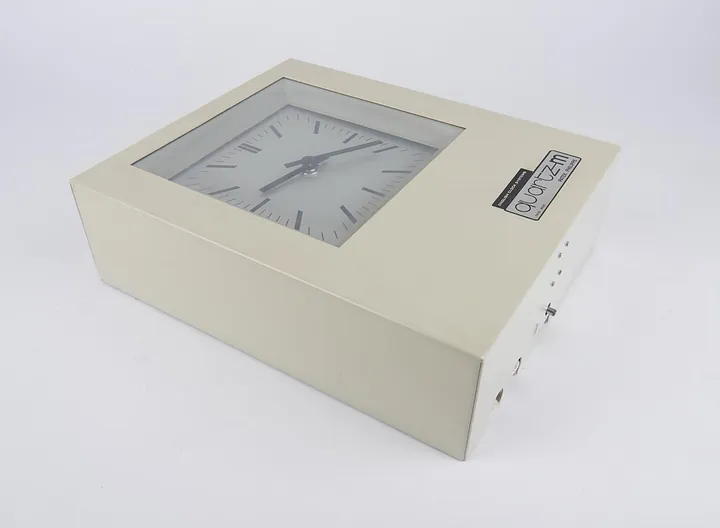
Quartz master clock QM 1, with movement by Patek Phillippe, Switzerland, 1965–1975. Supplied by English Clock Systems.
Science Museum Group, London
Instruments · 1965–1984
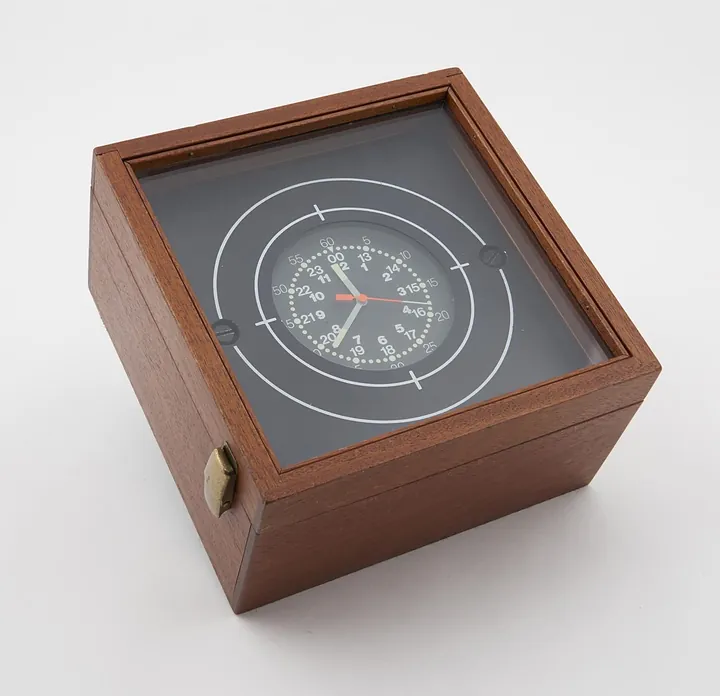
Chronometer by Patek Philippe and Kelvin Hughes, England, 1965–1984
Science Museum Group, London
Pocket Watches · c. 1895
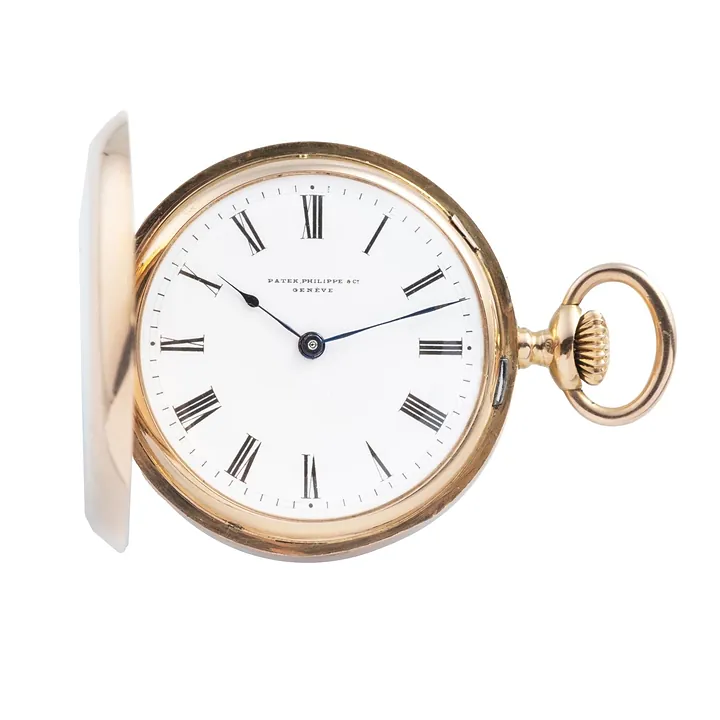
Patek Philippe pocket watch, c. 1895
Antiquorum auction archive, Geneva
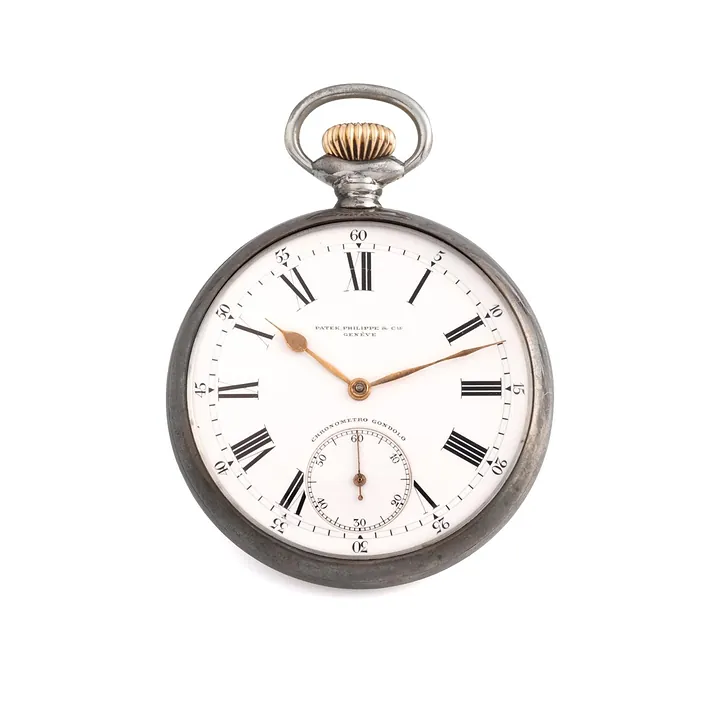
Pocket Watches · c. 1900
Patek Philippe Chronometro Gondolo, c. 1900
Antiquorum auction archive, Geneva

Wristwatches · c. 2010s
Breguet Type XXI, ref. 3810, c. 2010s (Antiquorum Lot 381-24)
Antiquorum auction archive, Geneva

Wristwatches · c. 2010s
Breguet Type XXI, ref. 3810, c. 2010s (Antiquorum Lot 386-229)
Antiquorum auction archive, Geneva

Wristwatches · Sold in September 2010
Breitling Cosmonaute, ref. A 22322, Sold in September 2010
Antiquorum auction archive, Geneva

Wristwatches · c. 2010
Corum Bubble Chrono, ref. 396.150.20, c. 2010
Antiquorum auction archive, Geneva