
Wristwatches · Wristwatch
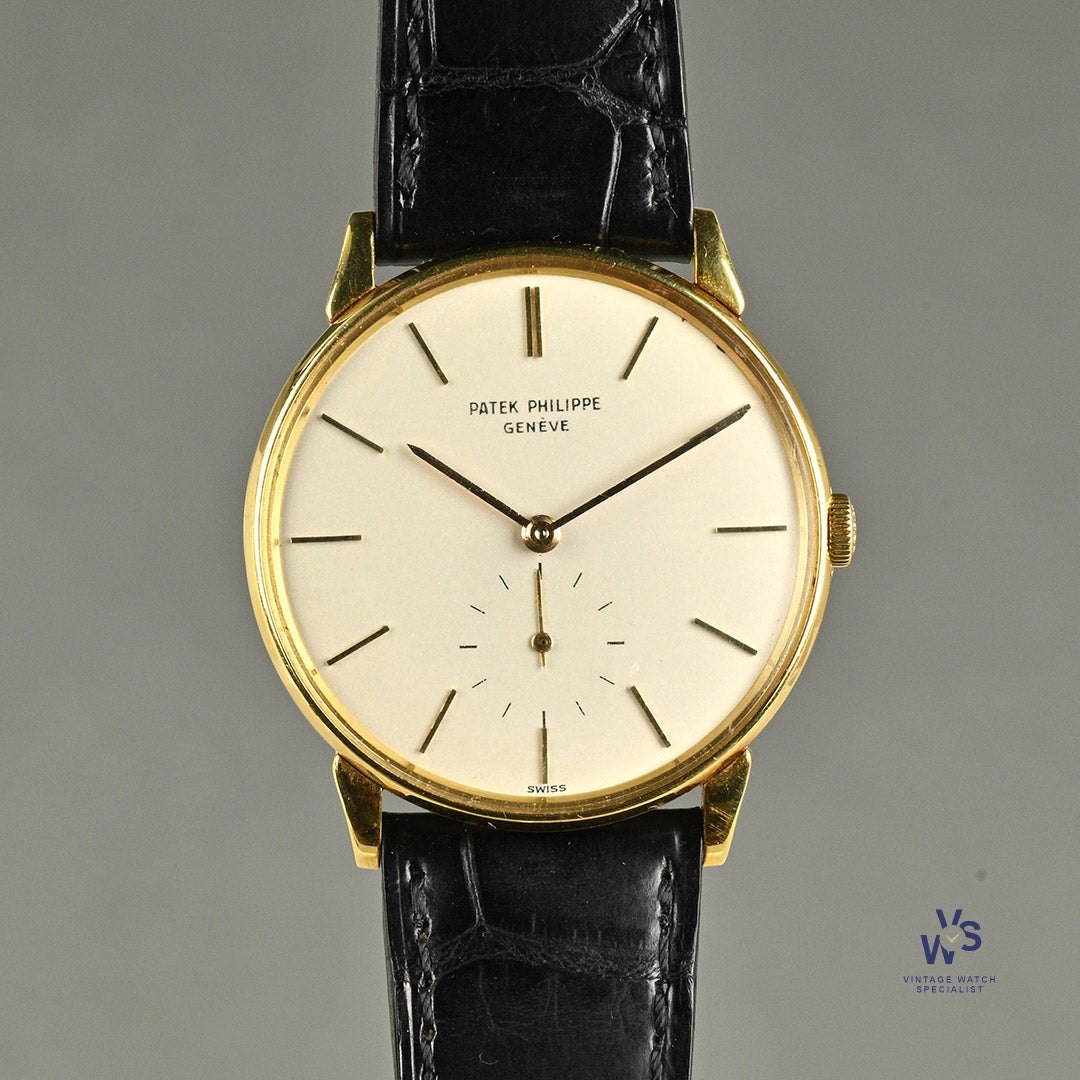
Patek Philippe Calatrava, ref. 2573/2, 18ct Gold, Extract from the Archives, 1970
- Maker / attribution
- Patek Philippe (maker)
- Date
- 1970
- Historical period
- Quartz Revolution (1969 – 1990)
- Country of origin
- Switzerland
- Object type
- Wristwatch
- Materials / technique
- gold
- Dimensions
- Case 33 mm
- Stock no.
- vws4450cs
- Credit line
- Dealer listing, Vintage Watch Specialist (vws4450cs)
- Catalogue title (original)
- Patek Philippe Calatrava - Reference: 2573/2 – 18ct Gold - Extract from the Archives - 1970 (English)
View the source record (dealer listing) ↗ (opens another website in a new tab)Suggest a correction
Record summary
Catalogued by Vintage Watch Specialist (dealer), United Kingdom (stock number vws4450cs), this is a wristwatch by Patek Philippe, made in Switzerland, dated 1970. The Atlas places it in the Quartz Revolution period (1969 – 1990) of its Wristwatches collection. Materials and techniques recorded by the source: gold. Recorded dimensions: Case 33 mm. The record is illustrated with 6 photographs.
Assembled from the source record's structured fields. Dates and attributions are given as the source states them; where a field is missing the Atlas leaves it blank rather than estimating.
Catalogue description
Dealer description — Vintage Watch Specialist
Few watch designs have become as closely associated with Patek Philippe as the Calatrava. Introduced in the early 1930s, the collection established a design language centred on proportion, restraint and clarity — principles that have allowed the Calatrava to remain remarkably timeless. By the post-war decades, Patek Philippe was producing some exceptionally refined manually wound dress watches. Cases became increasingly slim and elegant, dials were deliberately uncluttered and the emphasis remained firmly on the quality of the movement and finishing rather than unnecessary complication. The calibre 23-300 belongs firmly to this period. Introduced during the 1950s, it was one of Patek Philippe's highly regarded hand-wound movements and was used across a number of the manufacture's elegant dress watches. Its relatively slim construction made it particularly well suited to the understated cases for which Patek Philippe became renowned. Reference 2573 is a wonderful expression of that philosophy: classically proportioned, beautifully simple and unmistakably Patek Philippe without needing to shout about it. What’s On Offer Here we have a particularly elegant Patek Philippe Calatrava reference 2573/2 in 18ct yellow gold, with the accompanying Extract from the Archives confirming a date of June 1970. The beautifully restrained and very original white dial is signed Patek Philippe Genève and features slim applied gold baton hour markers, matched by equally slender gold hands. Small seconds are positioned traditionally at 6 o'clock, with the pared-back subsidiary dial marked by fine individual indices rather than a heavy chapter ring. At 33mm across and approximately 37mm lug-to-lug, this is a wonderfully refined vintage dress watch. The 18ct yellow-gold case has a slim polished bezel and particularly attractive sculpted lugs which give the watch considerably more character when viewed from an angle than its minimalist dial might initially suggest. The watch is powered by Patek Philippe's manually wound calibre 23-300, an 18-jewel movement adjusted to five positions, heat and cold. Importantly, it has a pretty much unworn original Patek Philippe black leather strap together with its Patek Philippe 18ct gold pin buckle — details which make a considerable difference to the completeness of a vintage watch of this calibre. It is also accompanied by its Patek Philippe Extract from the Archives and a Patek Philippe travel/service box, which was obtained at the same time the watch was serviced at Patek, but unfortunately the invoice for this work was lost as it was some time ago, but the watch has not been worn very much since this service a few years ago! There are age-related marks to the gold case and case back, as the photographs clearly show, but these are entirely in keeping with a watch of this age and the soft nature of high-quality gold. Macro photography inevitably magnifies these considerably, and they appear far more pronounced under the lens than they do when the watch is viewed normally on the wrist. A beautifully understated vintage Patek Philippe, and a particularly complete example with its original strap and 18ct gold buckle, archive documentation and Patek Philippe box.
Historical context
Quartz Revolution (1969 – 1990)
Seiko's Astron begins mass quartz timekeeping; traditional industries contract sharply.
Quartz and digital watches transformed the market after 1969. Swiss employment collapsed, Japanese and Hong Kong production soared, and the Swatch (1983) helped the Swiss industry recover; mechanical watches survived as luxury goods.
Read the period in the timelineMore wristwatches from this periodEarlier: Modern Mechanical Horology
Atlas type guide
Wristwatches
Bracelet watches were worn by women from the early nineteenth century — Breguet made one for Caroline Murat, Queen of Naples, in 1810–12 — but the wristwatch only became a man's instrument with military use and aviation in the early twentieth century. Between the World Wars it overtook the pocket watch; the 1920s and 1930s brought rectangular Art Deco cases, water-resistant cases and the first automatic winding systems.
After 1945 the wristwatch became a carrier of identity — dress watches, sports and dive watches, chronographs, calendars — produced by Swiss, American, Japanese, German, Soviet and Chinese industries. The quartz revolution after 1969 and the mechanical renaissance since the 1990s, including the rise of independent watchmakers, complete the story.
What to look for
- The reference number (between the lugs or inside the case back) and serial number, the starting point for dating.
- The calibre: its maker and number are often stamped under the dial or on the bridge.
- Originality of dial, hands and crown — refinished ('redial') dials are common.
- Case material marks: 18K/750, 14K/585, stainless steel, gold-filled, plated.
Dating clues
- Wire-lug cases: before c. 1925.
- Water-resistant screw-down cases: from 1926.
- Quartz movements: from 1969; sapphire crystals widespread after c. 1980.
General guidance written by the Atlas editors about this kind of object. It is not a statement about this particular piece; for that, rely on the source record above and on physical examination.
Related records

Clocks · 1965–1975
Quartz master clock QM 1, with movement by Patek Phillippe, Switzerland, 1965–1975. Supplied by English Clock Systems.
Science Museum Group, London

Instruments · 1965–1984
Chronometer by Patek Philippe and Kelvin Hughes, England, 1965–1984
Science Museum Group, London

Pocket Watches · c. 1895
Patek Philippe pocket watch, c. 1895
Antiquorum auction archive, Geneva

Pocket Watches · c. 1900
Patek Philippe Chronometro Gondolo, c. 1900
Antiquorum auction archive, Geneva

Wristwatches · 1970
Wristwatch by Heno, Switzerland, 1970
Museum Rotterdam

Wristwatches · 1960–1986
'Tri-Compax' calendar chronograph wristwatch in gold case, by Universal, Geneva, Switzerland, 1960–1986.
Science Museum Group, London

Wristwatches · 1969–1970
Beta 21 Quartz wristwatch movement, made in Switzerland, 1970.
Science Museum Group, London

Wristwatches · c. 1969
Omega Speedmaster Moonwatch, ref. 145022-69st, c. 1969
Antiquorum auction archive, Geneva