
Wristwatches · Wristwatch
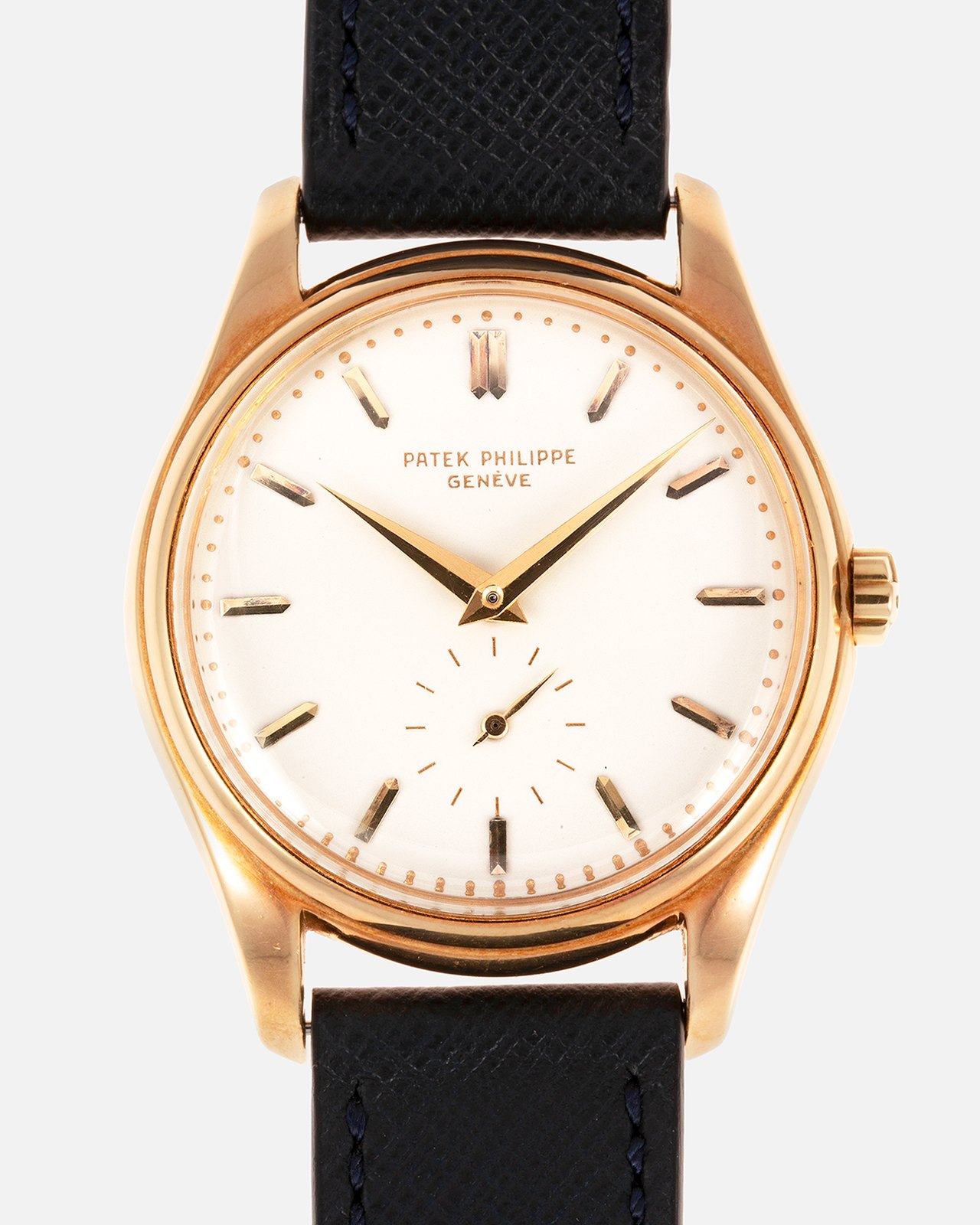
Patek Philippe Calatrava 2526 Enamel 'First Series', 1950s
- Maker / attribution
- Patek Philippe (maker)
- Date
- 1950s
- Historical period
- Modern Mechanical Horology (1945 – 1969)
- Country of origin
- Switzerland
- Object type
- Wristwatch
- Dimensions
- Case 36 mm
- Stock no.
- Product 6785315569751
- Credit line
- Dealer listing, S.Song Watches (product 6785315569751)
- Catalogue title (original)
- Patek Philippe Calatrava 2526 Enamel 'First Series' (English)
View the source record (dealer listing) ↗ (opens another website in a new tab)Suggest a correction
Record summary
Catalogued by S.Song Watches (dealer), Seattle (stock number Product 6785315569751), this is a wristwatch by Patek Philippe, made in Switzerland, dated 1950s. The Atlas places it in the Modern Mechanical Horology period (1945 – 1969) of its Wristwatches collection. Recorded dimensions: Case 36 mm. The record is illustrated with 6 photographs.
Assembled from the source record's structured fields. Dates and attributions are given as the source states them; where a field is missing the Atlas leaves it blank rather than estimating.
Catalogue description
Dealer description — S.Song Watches
Enthusiasts and collectors are probably no stranger to the Patek Philippe ref. 2526 - a highly revered reference that is arguably one of the most refined time-only watches ever made, and possibly one of the best value vintage Patek Phillipe references to collect. At this point, some of you may be asking, why is this specific reference so adored and respected by watch collectors? Well, since today we have on offer here a beautiful first series 2526 in yellow gold, let’s talk about it. The Ref. 2526 was first introduced in 1953 but phased out in the early 60 and scholarship estimates that there are approximately 2500 pieces to have ever been made in yellow, rose and white gold as well as in platinum. That number itself would go on to suggest that this 2526 is a particularly rare reference, and to find one from the first series, no less, in this condition would be even more so. In my opinion, the Ref. 2526 signifies the first crossover between horological art, modern technology, and innovation in the world of watchmaking. As I have mentioned earlier, the Ref. 2526 we have here hails from the first series, which includes some very intriguing features. As far as technical specifications go, the Ref. 2526 comes in a conservative and classically sized 36mm case which is powered by the venerable in-house Cal. 12-600AT movement. This 12-ligne, 6mm, self-winding caliber is significant in horological history because it was Patek Phillipe’s very first self-winding caliber and to this day still considered one of the finest automatic calibers ever made. It also features Patek Phillipe’s Gyromax balance wheel, which is an adjustable inertia balance and it still remains one of the manufacture’s trademark innovations. Beneath the solid caseback, the Cal. 12-600AT is not only technically advanced but aesthetically beautiful. It has an 18-carat gold rotor featuring a stunning engine-turned motif, which is possibly the very first decorated rotor in watchmaking history. What is amazing, is that t he Ref. 2526 was introduced in a time period where exhibition case backs did not exist, and for Patek Philippe to still finish their movements to a standard like this shows what many modern brands lack today- a real passion for quality irrespective of any publicity. Of course, the usage of the Cal. 12-600AT made the Ref. 2526 great, but there is still a lot more that adds to the charm of this reference, one of which is the double-baked enamel dial. Enamel dials are, to this day, a very uncommon component because it is delicate, costly, and difficult to produce – it's somewhat purely an ornate element to any watch at this point, but Patek chose to use enamel on the Ref. 2526 for a different reason; it was much more durable and was meant to last forever. Now because this particular example is a first-series reference, its enamel dial possesses a very special trait compared to the subsequent serial batches; the hour markers are actually carefully set onto the dial using pins (and a lot of patience and precision in hand-eye coordination), this results in a soft, dimple like appearance on the edge of each marker baton when viewed from a certain angle. Due to the difficulty and problems that arose from this process, Patek Philippe quickly abandoned this practice and as a result, all later dials have their marker batons glued to a solid enamel surface instead. Another notable detail on the Ref. 2526 was the unique crown which bore a “PP” (or “double P”) logo. This is the first time this distinctive logo was used on the crown. While it is not solely unique to this reference, it is probably most associated with it. This crown is simply beautiful and adds a nice touch to the already gorgeous 2526, it catches your attention when the watch is seen from a certain angle. What can I say? I absolutely love the Ref. 2526, if you haven’t been able to tell after reading all of the above. The Ref. 2526 possesses all the hallmarks that make mid-century Patek Phillipe special, charming, and appealing to collectors. From afar you would think that the Ref. 2526 looks like a mere simple dress watch, but it is one of those watches that require a closer look to understand why it is so adored and collectible. There is just something about the watch and the way it was crafted that gives the watch so much warmth and character, so much so that I had a hard time taking my eyes off it. The over-engineered and beautifully decorated Cal. 12-600AT, the rich and gorgeous double-baked enamel dial, and the signature double-P crown- these little touches and technical attributes contributed to the world-renowned adoration and collectability of this reference . It is with no doubt, in my mind, an absolutely charming reference, and for many good, compelling reasons. I would go as far as to say that the Ref. 2526 remains today as one of the most beautiful time-only watches ever produced by Patek Phillipe, at least in my eyes, and I hope after reading this description, you will agree, too.
Historical context
Modern Mechanical Horology (1945 – 1969)
Tool watches for divers, pilots and astronauts; electric watches anticipate the electronic age.
The classic era of the mechanical wristwatch: dive watches, chronographs for motor racing and space flight, GMT watches for jet travel, slim dress watches, automatic calendars, and the rise of Japanese manufacturers alongside Swiss, American, German and Soviet industries.
Read the period in the timelineMore wristwatches from this periodEarlier: Golden Age of Mechanical Watchmaking
Atlas type guide
Wristwatches
Bracelet watches were worn by women from the early nineteenth century — Breguet made one for Caroline Murat, Queen of Naples, in 1810–12 — but the wristwatch only became a man's instrument with military use and aviation in the early twentieth century. Between the World Wars it overtook the pocket watch; the 1920s and 1930s brought rectangular Art Deco cases, water-resistant cases and the first automatic winding systems.
After 1945 the wristwatch became a carrier of identity — dress watches, sports and dive watches, chronographs, calendars — produced by Swiss, American, Japanese, German, Soviet and Chinese industries. The quartz revolution after 1969 and the mechanical renaissance since the 1990s, including the rise of independent watchmakers, complete the story.
What to look for
- The reference number (between the lugs or inside the case back) and serial number, the starting point for dating.
- The calibre: its maker and number are often stamped under the dial or on the bridge.
- Originality of dial, hands and crown — refinished ('redial') dials are common.
- Case material marks: 18K/750, 14K/585, stainless steel, gold-filled, plated.
Dating clues
- Wire-lug cases: before c. 1925.
- Water-resistant screw-down cases: from 1926.
- Quartz movements: from 1969; sapphire crystals widespread after c. 1980.
General guidance written by the Atlas editors about this kind of object. It is not a statement about this particular piece; for that, rely on the source record above and on physical examination.
Related records
Clocks · 1965–1975
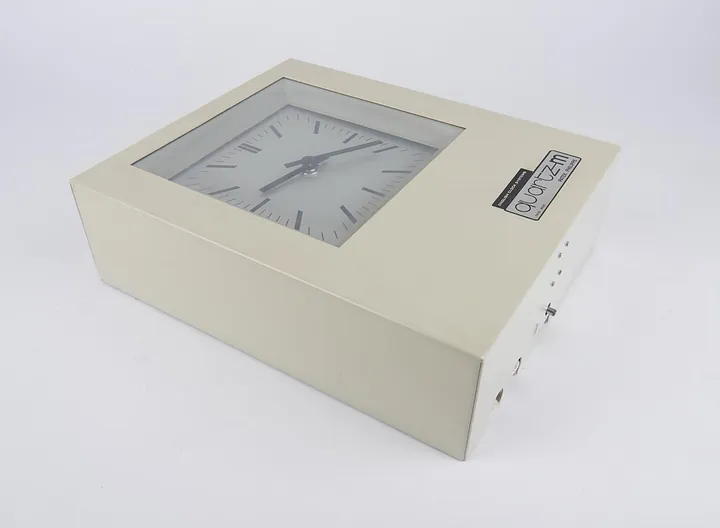
Quartz master clock QM 1, with movement by Patek Phillippe, Switzerland, 1965–1975. Supplied by English Clock Systems.
Science Museum Group, London
Instruments · 1965–1984
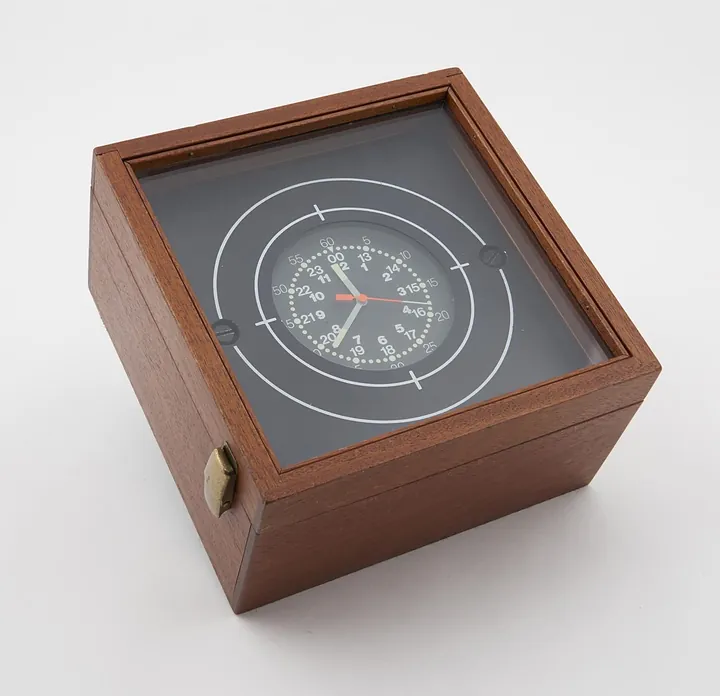
Chronometer by Patek Philippe and Kelvin Hughes, England, 1965–1984
Science Museum Group, London
Pocket Watches · c. 1895
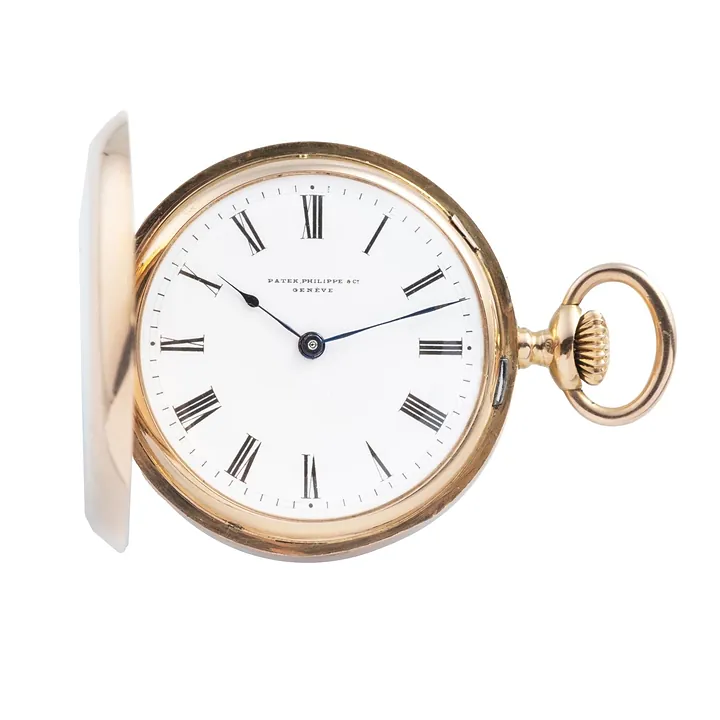
Patek Philippe pocket watch, c. 1895
Antiquorum auction archive, Geneva

Pocket Watches · c. 1900
Patek Philippe Chronometro Gondolo, c. 1900
Antiquorum auction archive, Geneva

Wristwatches · 1945
Wristwatch by Eterna, 1945
Museum Rotterdam

Wristwatches · c. 1945
Breitling Premier, ref. 790, c. 1945
Antiquorum auction archive, Geneva

Wristwatches · c. 1945
Universal Genève Uni-Compax, ref. 22492, c. 1945
Antiquorum auction archive, Geneva

Wristwatches · c. 1950s
Baume & Mercier wristwatch, c. 1950s
Antiquorum auction archive, Geneva