
Wristwatches · Wristwatch
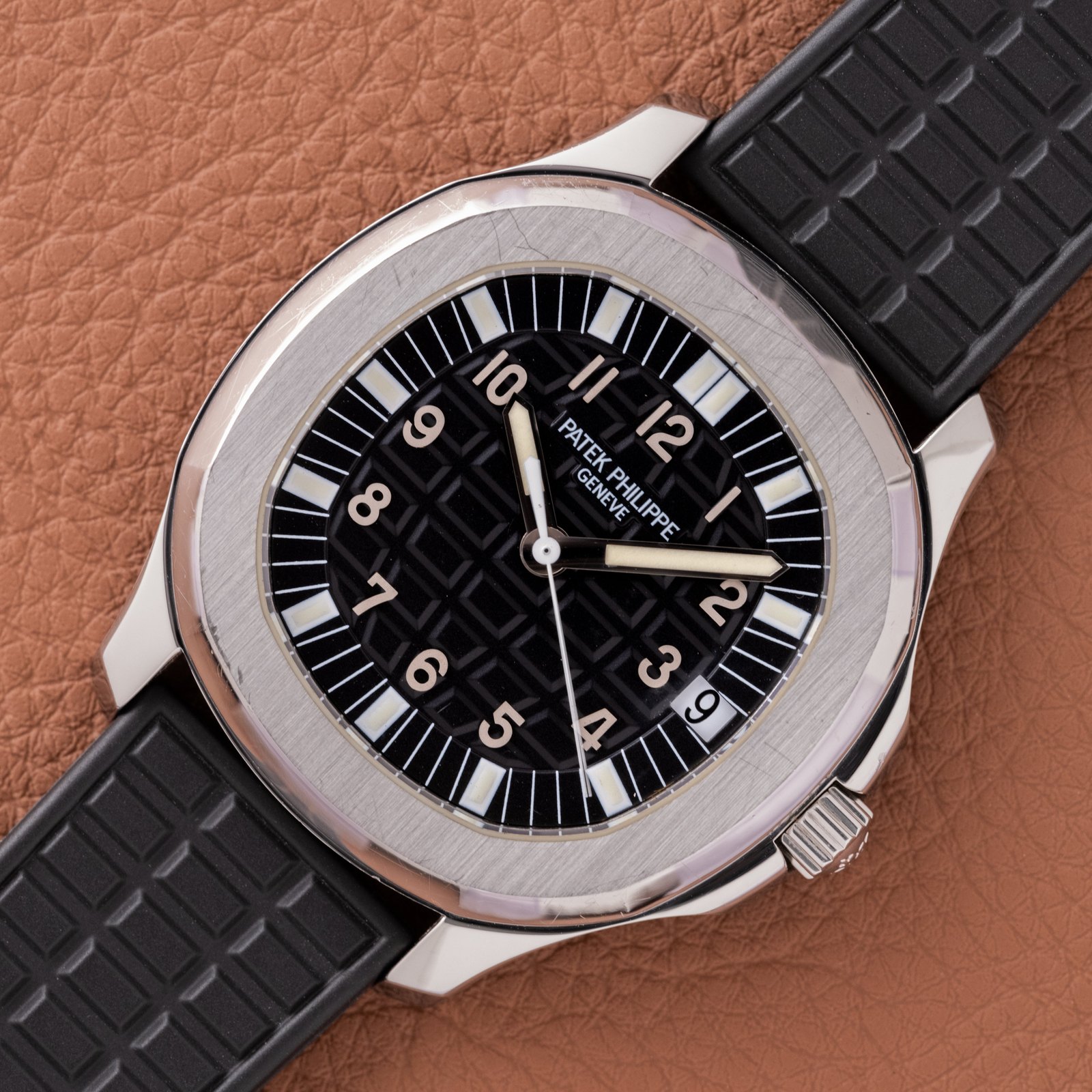
Patek Philippe Aquanaut Unpolished - Archive Papers (Ref. 5065), 2006
- Maker / attribution
- Patek Philippe (maker)
- Date
- 2006
- Historical period
- Mechanical Renaissance (1990 – 2010)
- Country of origin
- Switzerland
- Object type
- Wristwatch
- Dimensions
- Case 38 mm
- Stock no.
- Product 15887223750839
- Credit line
- Dealer listing, Huntington Company (product 15887223750839)
- Catalogue title (original)
- 2006 Patek Philippe Aquanaut Unpolished - Archive Papers (Ref. 5065) (English)
View the source record (dealer listing) ↗ (opens another website in a new tab)Suggest a correction
Record summary
Catalogued by Huntington Company (dealer) (stock number Product 15887223750839), this is a wristwatch by Patek Philippe, made in Switzerland, dated 2006. The Atlas places it in the Mechanical Renaissance period (1990 – 2010) of its Wristwatches collection. Recorded dimensions: Case 38 mm. The record is illustrated with 6 photographs.
Assembled from the source record's structured fields. Dates and attributions are given as the source states them; where a field is missing the Atlas leaves it blank rather than estimating.
Catalogue description
Dealer description — Huntington Company
History and Significance The introduction of the Aquanaut in 1997 marked an important shift in Patek Philippe's approach to contemporary watchmaking. Although the Nautilus had already established the manufacturer's presence in the luxury sports watch category, the Aquanaut introduced something considerably more casual. Its rubber composite strap, embossed dial, and distinctive rounded octagonal case represented a departure from the traditional materials and design principles associated with Patek Philippe. The collection was intended to appeal to a younger audience, offering a mechanical watch that retained the manufacturer's reputation for exceptional craftsmanship while embracing a more relaxed approach to luxury. The reference 5065 became one of the defining early models of the Aquanaut collection. Following the original reference 5060, it introduced larger proportions while preserving the unusual design language that made the first Aquanaut so distinctive. The case retained its rounded octagonal bezel, with broad polished surfaces and gently curved sides that created a softer appearance than the sharper geometry of the Nautilus. At 38mm, the reference 5065 occupies an interesting position between traditional vintage sports watch proportions and the larger dimensions that would eventually become common throughout the luxury watch industry. Its size is particularly appealing because the integrated strap and broad bezel give the watch a more substantial presence than the measurement might suggest. The embossed black dial is perhaps the most recognizable feature of the early Aquanaut. Its repeating geometric pattern creates an unusual sense of depth, giving the surface a textured appearance that immediately distinguishes it from the horizontally embossed dials of the Nautilus. Large applied Arabic numerals reinforce the watch's sporty character, while luminous hands and hour markers maintain excellent legibility. The date aperture at three o'clock provides a practical addition without interrupting the simplicity of the design. These elements established an aesthetic that has remained remarkably consistent throughout the Aquanaut's history, demonstrating just how successful the original concept was. Unpolished examples of early luxury sports watches have become particularly interesting within the vintage and neo-vintage collecting world. Polishing can alter the relationship between the different surfaces of a case, gradually softening edges and changing the proportions established by the original design. This is especially relevant to watches such as the Aquanaut, where the contrast between polished surfaces and the geometry of the bezel plays an important role in the overall appearance. An unpolished case preserves the original architecture of the watch, including the relationship between its edges, surfaces, and proportions. For collectors interested in the historical integrity of an early Aquanaut, these details can be particularly meaningful. The reference 5065 also represents a period before the Aquanaut became one of the most recognizable luxury sports watches in the world. Early examples were produced when the collection was still establishing its identity, making them an interesting reflection of Patek Philippe's evolving approach to contemporary design. The accompanying Extract from the Archives provides an additional connection to the watch's history, documenting information retained in the manufacturer's records. Together with its unpolished case, this example offers an attractive opportunity to appreciate the early Aquanaut in a form that remains closely connected to its original design. Writer’s Thoughts An unpolished reference 5065 has a particular appeal because so much of the Aquanaut's character comes from the shape of its case. The broad bezel, softly rounded corners, and relationship between the polished surfaces are fundamental to the design. Preserving those details allows the watch to retain the proportions that made the original Aquanaut so successful. Light signs of age and use can be considerably more attractive than a case that has been repeatedly refinished, particularly when the original architecture remains intact. The reference 5065 is a watch where those small details make a meaningful difference. There is also something especially enjoyable about the simplicity of these early Aquanauts. The black embossed dial, luminous Arabic numerals, and rubber strap create a design that feels entirely different from Patek Philippe's traditional dress watches, yet the quality of the construction remains unmistakable. At 38mm, the reference 5065 offers a wonderful balance between vintage proportions and modern practicality. The unpolished condition and accompanying archives make this example particularly appealing for collectors who value originality and the history of the manufacturer's early sports watch designs. Our Promise Every watch is thoroughly vetted, carefully described with complete transparency, and guaranteed authentic. Each piece is offered in honest condition, ensuring collectors receive a timepiece that reflects both originality and integrity. Specifications Brand: Patek Philippe Model: Aquanaut Reference: 5065 Year: NA Case Material: Stainless Steel Case Size: 38mm Dial: Black Embossed Dial with Applied Arabic Numerals and Date Display Movement: Automatic Mechanical Movement Strap/Buckle: Black Rubber Strap Buckle/Clasp: Stainless Steel Aquanaut Folding Clasp Contents: Watch and Patek Philippe Extract from the Archives Condition Case: Unpolished stainless steel case shows light surface scratches and wear consistent with age and use. The case retains its original shape and well-defined bezel. Dial: Black embossed dial remains in excellent condition with well-preserved texture, applied Arabic numerals, and clear printing. Hands: Luminous hands remain in excellent condition with clean finishing and well-preserved luminous material. Crystal: Sapphire crystal
Historical context
Mechanical Renaissance (1990 – 2010)
Mechanical watches return as cultural objects; independent watchmaking flourishes.
Mechanical watches returned as cultural and luxury objects. Complications, tourbillons and new materials proliferated; independent watchmakers such as George Daniels, F.P. Journe and Philippe Dufour revived artisanal watchmaking; collecting vintage watches became a major field.
Read the period in the timelineMore wristwatches from this periodEarlier: Quartz Revolution
Atlas type guide
Wristwatches
Bracelet watches were worn by women from the early nineteenth century — Breguet made one for Caroline Murat, Queen of Naples, in 1810–12 — but the wristwatch only became a man's instrument with military use and aviation in the early twentieth century. Between the World Wars it overtook the pocket watch; the 1920s and 1930s brought rectangular Art Deco cases, water-resistant cases and the first automatic winding systems.
After 1945 the wristwatch became a carrier of identity — dress watches, sports and dive watches, chronographs, calendars — produced by Swiss, American, Japanese, German, Soviet and Chinese industries. The quartz revolution after 1969 and the mechanical renaissance since the 1990s, including the rise of independent watchmakers, complete the story.
What to look for
- The reference number (between the lugs or inside the case back) and serial number, the starting point for dating.
- The calibre: its maker and number are often stamped under the dial or on the bridge.
- Originality of dial, hands and crown — refinished ('redial') dials are common.
- Case material marks: 18K/750, 14K/585, stainless steel, gold-filled, plated.
Dating clues
- Wire-lug cases: before c. 1925.
- Water-resistant screw-down cases: from 1926.
- Quartz movements: from 1969; sapphire crystals widespread after c. 1980.
General guidance written by the Atlas editors about this kind of object. It is not a statement about this particular piece; for that, rely on the source record above and on physical examination.
Related records

Clocks · 1965–1975
Quartz master clock QM 1, with movement by Patek Phillippe, Switzerland, 1965–1975. Supplied by English Clock Systems.
Science Museum Group, London

Instruments · 1965–1984
Chronometer by Patek Philippe and Kelvin Hughes, England, 1965–1984
Science Museum Group, London

Pocket Watches · c. 1895
Patek Philippe pocket watch, c. 1895
Antiquorum auction archive, Geneva

Pocket Watches · c. 1900
Patek Philippe Chronometro Gondolo, c. 1900
Antiquorum auction archive, Geneva

Wristwatches · 2008
Wristwatch by Breitling?, 2008
Museum Rotterdam

Wristwatches · c. 1990s
Audemars Piguet Bamboo, c. 1990s
Antiquorum auction archive, Geneva

Wristwatches · c. 1990
Audemars Piguet Huitieme Perpetual Calendar, ref. 25696PT, c. 1990
Antiquorum auction archive, Geneva

Wristwatches · c. 1990
Breitling Chronomat, ref. b13050.1, c. 1990
Antiquorum auction archive, Geneva