
Wristwatches · Wristwatch
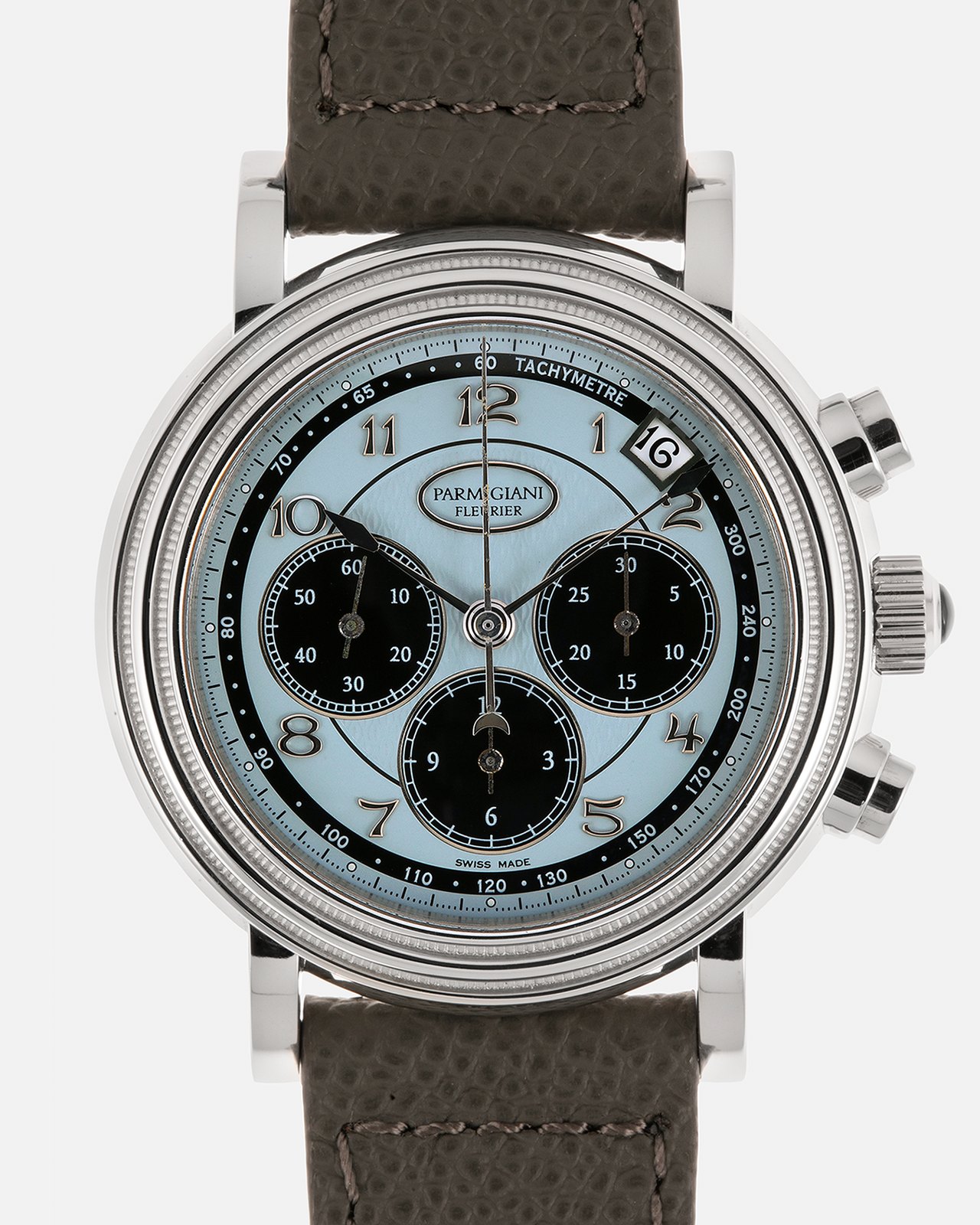
Parmigiani Fleurier Toric Chronograph PF006783 Light Blue Dial Platinum, 2003
- Maker / attribution
- Parmigiani Fleurier (maker)
- Date
- 2003
- Historical period
- Mechanical Renaissance (1990 – 2010)
- Country of origin
- Switzerland
- Object type
- Wristwatch
- Materials / technique
- platinum
- Dimensions
- Case 40 mm
- Stock no.
- Product 7643653472343
- Credit line
- Dealer listing, S.Song Watches (product 7643653472343)
- Catalogue title (original)
- Parmigiani Fleurier Toric Chronograph PF006783 Light Blue Dial Platinum (English)
View the source record (dealer listing) ↗ (opens another website in a new tab)Suggest a correction
Record summary
Catalogued by S.Song Watches (dealer), Seattle (stock number Product 7643653472343), this is a wristwatch by Parmigiani Fleurier, made in Switzerland, dated 2003. The Atlas places it in the Mechanical Renaissance period (1990 – 2010) of its Wristwatches collection. Materials and techniques recorded by the source: platinum. Recorded dimensions: Case 40 mm. The record is illustrated with 6 photographs.
Assembled from the source record's structured fields. Dates and attributions are given as the source states them; where a field is missing the Atlas leaves it blank rather than estimating.
Catalogue description
Dealer description — S.Song Watches
Parmigiani Fleurier is an independent brand that can be described as a manufacturer that goes beyond surface appearances. Often only talked about within enthusiast circles, the brand has built a reputation as somewhat of an underdog in the realm of independent watchmaking. Before its eventual establishment in 1996, Michel Parmigiani operated a small Mesure et Art du Temps (restoration workshop) in Couvet, Switzerland, where he was renowned for his expertise in the art of timepiece restoration. Over time, Michel began crafting unique watches for clients, and the Parmigiani restoration workshop became a training ground for some of the most accomplished and highly regarded independent watchmakers who have since made their mark in the industry. Most notably, Kari Voutilainen, Stepan Sarpaneva and Raúl Pagès. Today, Parmigiani Fleurier has garnered recognition as one of the most vertically integrated watch manufacturers globally. Its facilities have assumed a crucial role within the Swiss watch industry's supply chain due to its extensive involvement in the production of various essential components for watch manufacturing/production, including balance springs, movements and more. Additionally, the brand's expertise extends to the restoration of historically significant clocks and timepieces from around the world. These are a few of Michel Parmigiani’s many achievements, which have contributed to his credentials as one of the pioneers of the industry, earning him the moniker of one of the "fathers" of independent watchmaking. Offered here is a Toric Chronograph PF006783 from the early 2000s, a period where Parmigiani Fleurier was still defining its identity through design and execution rather than scale. The reference builds directly on the blueprint of the renowned Toric Memory Time, the brand’s first wristwatch, which introduced the Toric-style case and its hallmark visual blueprint. The PF006783 begins with a 40mm case crafted in platinum and features several signature elements that embody the essence of the brand's design philosophy. These include the hand-knurled, double-stepped bezel, prominent welded lugs that flow seamlessly from the mid-case, and elegantly stepped chronograph pushers. As a whole, the case has a clear architectural quality, often likened to the look and proportions of Greek Doric columns, reflecting Michel Parmigiani’s classical design sensibilities first established in the Toric Memory Time. Encased within is a dial presented in a serene light blue tone, with three contrasting black sub-dials. The 30-minute counter sits at 3:00, the 12-hour counter at 6:00, and running seconds at 9:00. A guilloché centre adds a touch of texture, while a graduated minute track along the periphery keeps the layout grounded. A black tachymeter ring frames the dial, and is complemented by an unconventionally placed date window aperture at 1:30. Completing the dial are nine applied numerals and a set of refined javelin-style hands with a crescent counterweight, and an oval ring at 12:00 displaying the Parmigiani Fleurier brand signature. Powering the PF006783 from within is the Cal. PF400Z, which is based on the Zenith El Primero. As expected of Parmigiani, the movement is further elevated through finishing, featuring a lustrous solid gold rotor with intricate guilloché decoration, and a ‘PF’ signature at its centre. While later Parmigiani pieces would lean further into full vertical integration, early models such as this reflect a transitional period—where strong external calibres were chosen and further refined to meet the brand’s standards. It is also worth noting that the double-knurled, Doric-inspired motif on the front extends to the caseback, a detail seemingly reserved for the wearer or those who take the time to admire it up close, reflecting a finishing approach that is thorough and considered. In terms of wearability, the PF006783 carries more presence than its dimensions suggest. Not in size, but in weight and detail, owing to its solid platinum construction and light blue dial, which shifts subtly under different lighting conditions and complements the ice-cool tone of the hefty metal. It’s one of those watches that needs to be seen in person to be fully appreciated, as the finishing of the case and the nuance in the dial reveal far more than photographs capture. As a whole, the PF006783 is less about complication and more about execution. It builds on the design language of the Toric Memory Time, without losing the proportion and balance that define the collection. The result is a quietly confident and charming dressy chronograph. This balance of classical influence and modern nuance reflects Michel Parmigiani’s design ethos and has even found its way onto the wrist of King Charles III, who has been seen recently wearing a similar example with a silver guilloché dial and Roman numerals.
Historical context
Mechanical Renaissance (1990 – 2010)
Mechanical watches return as cultural objects; independent watchmaking flourishes.
Mechanical watches returned as cultural and luxury objects. Complications, tourbillons and new materials proliferated; independent watchmakers such as George Daniels, F.P. Journe and Philippe Dufour revived artisanal watchmaking; collecting vintage watches became a major field.
Read the period in the timelineMore wristwatches from this periodEarlier: Quartz Revolution
Atlas type guide
Chronographs and split-seconds watches
A chronograph is a watch with an additional seconds hand that can be started, stopped and returned to zero independently of the timekeeping. Louis Moinet built an early example in 1816 and Nicolas Rieussec a recording 'chronographe' in 1821; Adolphe Nicole's heart-shaped reset cam (patented 1862) made the modern return-to-zero possible. Split-seconds (rattrapante) chronographs add a second hand that can be stopped for intermediate times; flyback chronographs restart instantly.
Chronographs were essential tools for doctors (pulsometer scales), artillery (telemeter), engineers and sport. In wristwatches, Valjoux, Venus, Lemania and later the automatic chronographs of 1969 (Zenith El Primero, the Chronomatic Calibre 11 group and Seiko 6139) are milestones.
What to look for
- Push-pieces on the case band or a single button in the crown (monopusher).
- Subsidiary registers for minutes and hours; tachymeter, telemeter or pulsometer scales.
- Column wheel versus cam control visible in the movement.
- Calibre markings of specialist makers (Valjoux, Lemania, Venus, Landeron).
Dating clues
- Pocket chronographs with heart cam reset: after 1862.
- Wrist chronographs: from c. 1910; two-button designs from the 1930s.
- Automatic chronographs: from 1969.
General guidance written by the Atlas editors about this kind of object. It is not a statement about this particular piece; for that, rely on the source record above and on physical examination.
Read next:Flyback chronographChronograph
Related records
Wristwatches · c. 2000s
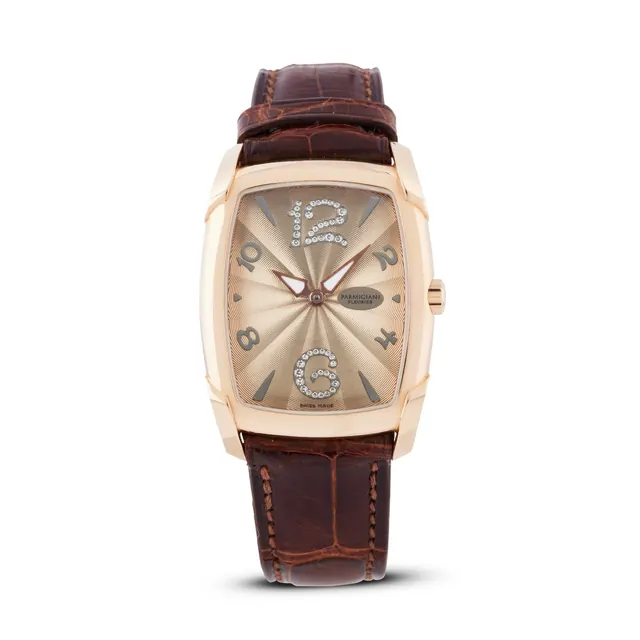
Parmigiani Fleurier wristwatch, Kalpa, circa 2000s
Antiquorum auction archive, Geneva
Wristwatches · c. 2010s
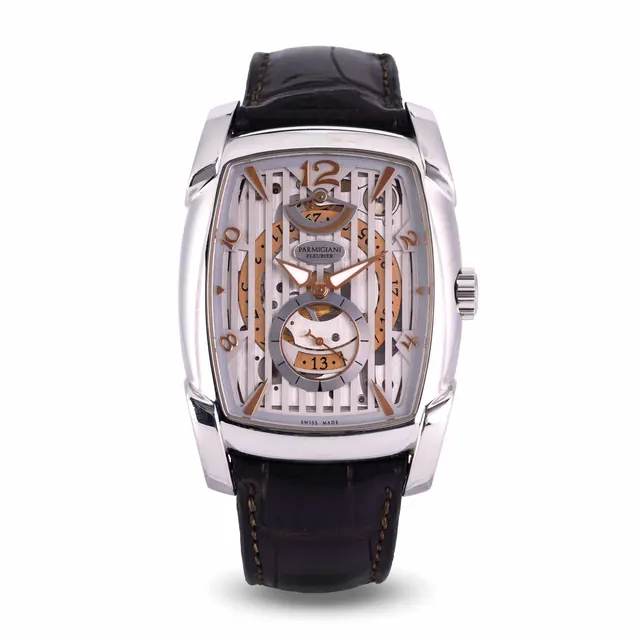
Parmigiani Fleurier wristwatch, Kalpa Xl Hebdomadaire, circa 2010s
Antiquorum auction archive, Geneva
Wristwatches · 2025
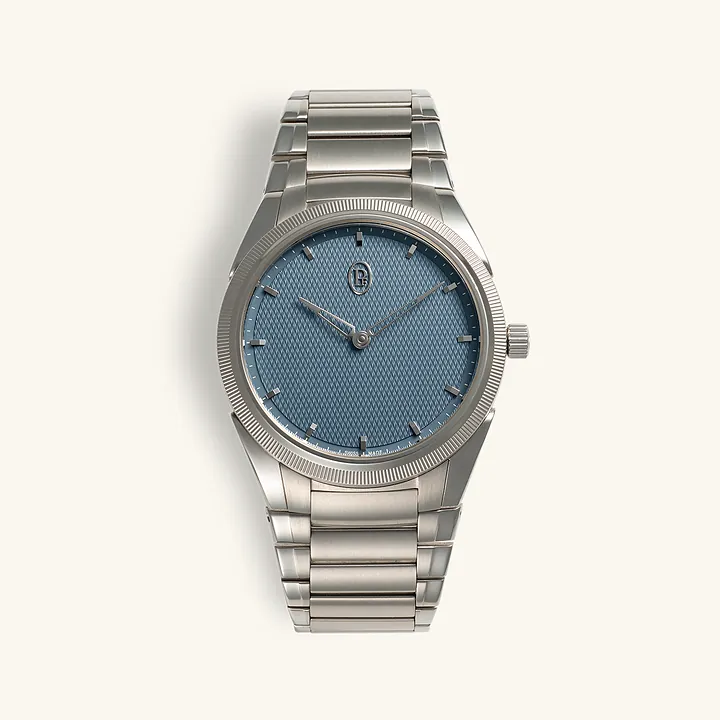
Parmigiani Fleurier Tonda PF 36mm Stone Blue, 2025
Watches of Knightsbridge (dealer), London
Wristwatches · 2023
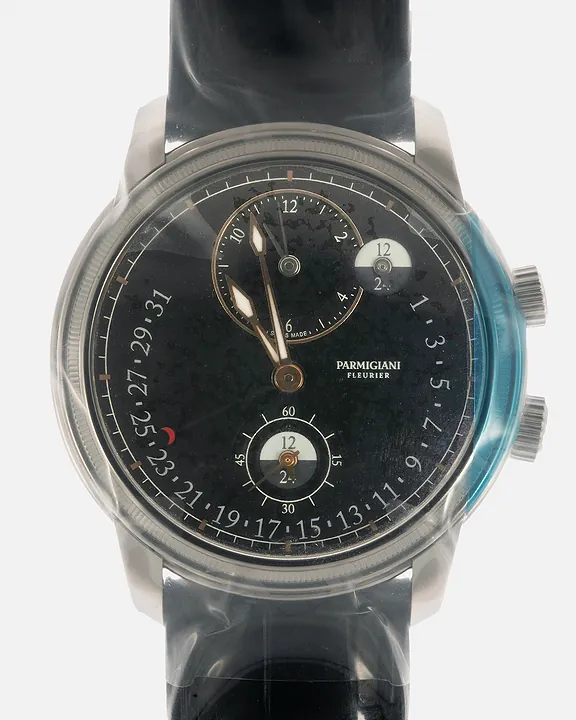
Parmigiani Fleurier Toric Hemisphères Rétrograde Steel Sealed, 2023
S.Song Watches (dealer), Seattle

Wristwatches · 2008
Wristwatch by Breitling?, 2008
Museum Rotterdam

Wristwatches · c. 1990s
Audemars Piguet Bamboo, c. 1990s
Antiquorum auction archive, Geneva

Wristwatches · c. 1990
Audemars Piguet Huitieme Perpetual Calendar, ref. 25696PT, c. 1990
Antiquorum auction archive, Geneva

Wristwatches · c. 1990
Breitling Chronomat, ref. b13050.1, c. 1990
Antiquorum auction archive, Geneva