
Wristwatches · Wristwatch
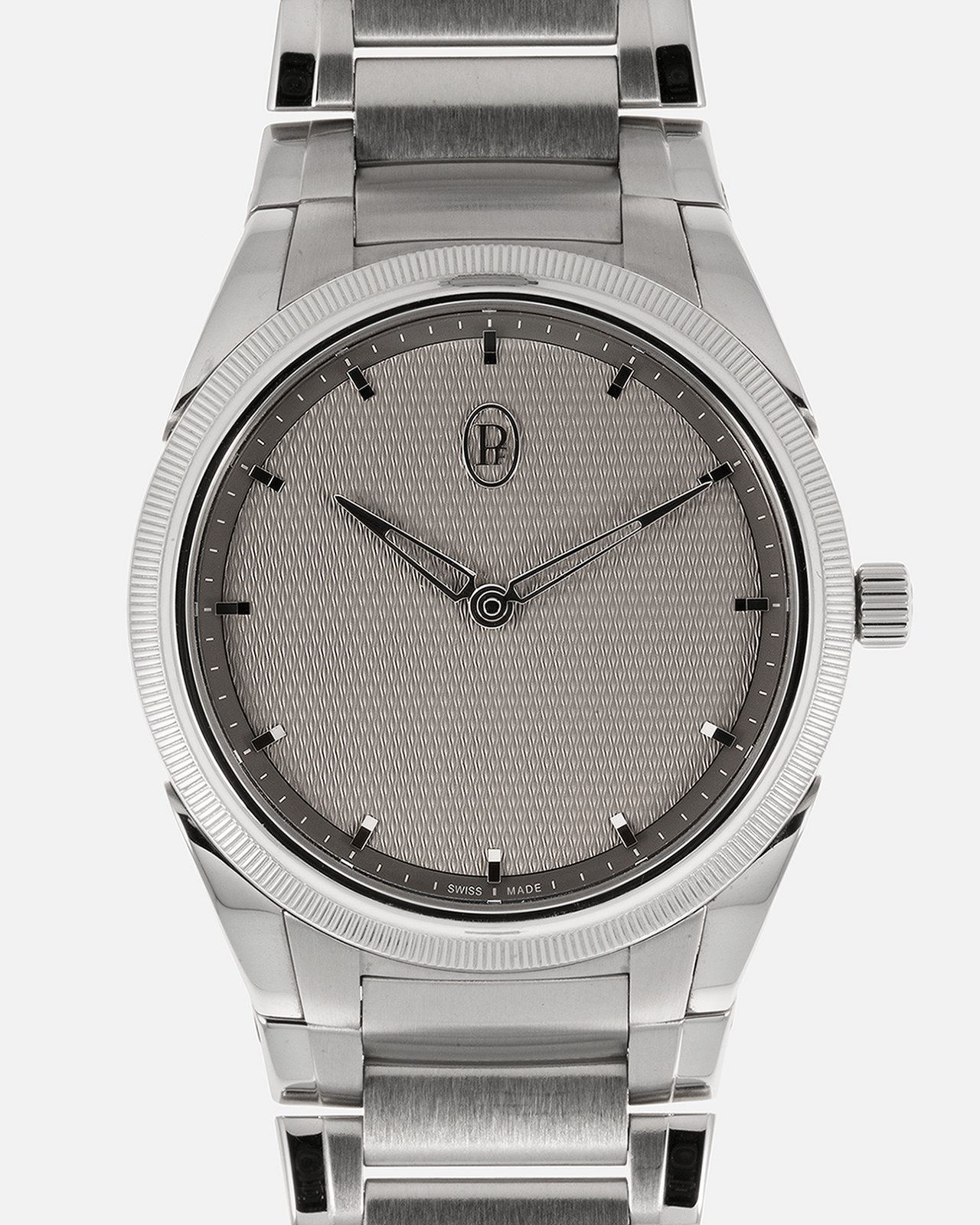
Parmigiani Fleurier Tonda PF Mid Size 'Silver Sand', 2023
- Maker / attribution
- Parmigiani Fleurier (maker)
- Date
- 2023
- Historical period
- Contemporary Horology (2010 – Present)
- Country of origin
- Switzerland
- Object type
- Wristwatch
- Materials / technique
- silver
- Dimensions
- Case 36 mm
- Stock no.
- Product 6978752479319
- Credit line
- Dealer listing, S.Song Watches (product 6978752479319)
- Catalogue title (original)
- Parmigiani Fleurier Tonda PF Mid Size 'Silver Sand' (English)
View the source record (dealer listing) ↗ (opens another website in a new tab)Suggest a correction
Record summary
Catalogued by S.Song Watches (dealer), Seattle (stock number Product 6978752479319), this is a wristwatch by Parmigiani Fleurier, made in Switzerland, dated 2023. The Atlas places it in the Contemporary Horology period (2010 – Present) of its Wristwatches collection. Materials and techniques recorded by the source: silver. Recorded dimensions: Case 36 mm. The record is illustrated with 6 photographs.
Assembled from the source record's structured fields. Dates and attributions are given as the source states them; where a field is missing the Atlas leaves it blank rather than estimating.
Catalogue description
Dealer description — S.Song Watches
Parmigiani Fleurier is an independent brand that has, in recent years, gained its status as an underdog in the world of watchmaking. They occupy a very interesting space within the world of Swiss watch brands. In my mind, Parmigiani Fleurier is a “more than meets the eye” kind of manufacturer. In other words, ‘understatement’ is their design mantra. They are also a brand that draws most of its watchmaking expertise from the art of restoration. For that reason, Parmigiani Fleurier is not a brand you typically hear watch collectors often rave about, but what makes the manufacture so special is the fact they have produced some absolutely stunning watches over the past two decades. Pure lines, a refined case profile, ergonomically-correct proportions, a classic-looking appearance with an understated aesthetic - these are the physical attributes that ultimately make up the Parmigiani Fleurier Tonda collection. Today, we present the Tonda PF Silver Sand in a 36mm size, and it holds a special place among my list of preferred "understated luxury" watches. What captivates me is how it flawlessly captures the essence and design philosophy of Parmigiani Fleurier while maintaining a subtle and unassuming look. Despite its discreet appearance, this timepiece manages to earn the admiration of even the most discerning collectors and enthusiasts. Beginning with its elegant 36mm stainless steel case, the Tonda PF is small enough to appear flat when viewed from a distance, but upon closer inspection, one could easily tell that there is more to this than meets the eye. It exhibits many of the distinct stylistic elements that Parmigiani Fleurier had so deftly established for its predecessors: a meticulously hand-knurled bezel, seamless tear-drop lugs, and in this case, a well-made integrated bracelet with alternating finishing on the links that catches the light wonderfully. Moving over to the dial, you will find an oval ‘PF’ cartouche at 12 o ‘clock, a set of open-worked hands, as well as a refined hand-guilloché grain d’orge (barleycorn) motif on the dial – which is, one of the finest forms of guilloché finishing in modern watchmaking today. Breathing life into this Tonda PF is Parmigiani Fleurier’s new in-house, 179-part, 29-jeweled, self-winding Cal. PF 770 beating away methodically at 28,800 vph. It features impeccable Côtes de Genève finishing and bevelling on its bridges as well as a beautifully skeletonized 22-carat gold oscillating rotor when viewed from the exhibition caseback. Furthermore, this Tonda PF is also endowed with a respectable power reserve of 60-hours. I cannot stress enough how genuinely impressed I am with the impeccable fit and comfort of the Tonda PF. As depicted in the photographs, the Tonda PF effortlessly complements my wrist, exuding a sense of perfect harmony. The meticulous fusion of subtle design elements beautifully highlights the exceptional craftsmanship and technical mastery of Parmigiani Fleurier. It is truly a sight to behold when examined up close, revealing a timepiece that has the power to astonish anyone, despite its understated and refined aesthetics. In my opinion, the Tonda PF collection is overall a very interesting collection because it represents the essence of Parmigiani Fleurier’s styling and design ethos. Watches from this collection are generally quite refined, slender, ergonomic, and balanced in design. There is a very subtle touch of softness on the watch that is very pleasing to see and feel, which I think contributes to how well it wears on the wrist and slides under the cuff. It goes on to show the level of attention to detail by Parmigiani Fleurier although this is in essence, a mere time-only watch. For all of the reasons I have elaborated above, this particular Tonda PF Silver Sand right here is, in my mind, a compelling masterpiece of a modern sport watch that can effortlessly complement any collector’s watch box and daily rotation.
Historical context
Contemporary Horology (2010 – Present)
Silicon components, connected watches, optical-lattice research clocks and a thriving independent scene.
Smartwatches became the world's best-selling watches, while mechanical watchmaking focuses on craft, innovation (silicon components, new escapements) and independent makers.
Read the period in the timelineMore wristwatches from this periodEarlier: Mechanical Renaissance
Atlas type guide
Wristwatches
Bracelet watches were worn by women from the early nineteenth century — Breguet made one for Caroline Murat, Queen of Naples, in 1810–12 — but the wristwatch only became a man's instrument with military use and aviation in the early twentieth century. Between the World Wars it overtook the pocket watch; the 1920s and 1930s brought rectangular Art Deco cases, water-resistant cases and the first automatic winding systems.
After 1945 the wristwatch became a carrier of identity — dress watches, sports and dive watches, chronographs, calendars — produced by Swiss, American, Japanese, German, Soviet and Chinese industries. The quartz revolution after 1969 and the mechanical renaissance since the 1990s, including the rise of independent watchmakers, complete the story.
What to look for
- The reference number (between the lugs or inside the case back) and serial number, the starting point for dating.
- The calibre: its maker and number are often stamped under the dial or on the bridge.
- Originality of dial, hands and crown — refinished ('redial') dials are common.
- Case material marks: 18K/750, 14K/585, stainless steel, gold-filled, plated.
Dating clues
- Wire-lug cases: before c. 1925.
- Water-resistant screw-down cases: from 1926.
- Quartz movements: from 1969; sapphire crystals widespread after c. 1980.
General guidance written by the Atlas editors about this kind of object. It is not a statement about this particular piece; for that, rely on the source record above and on physical examination.
Related records
Wristwatches · c. 2000s
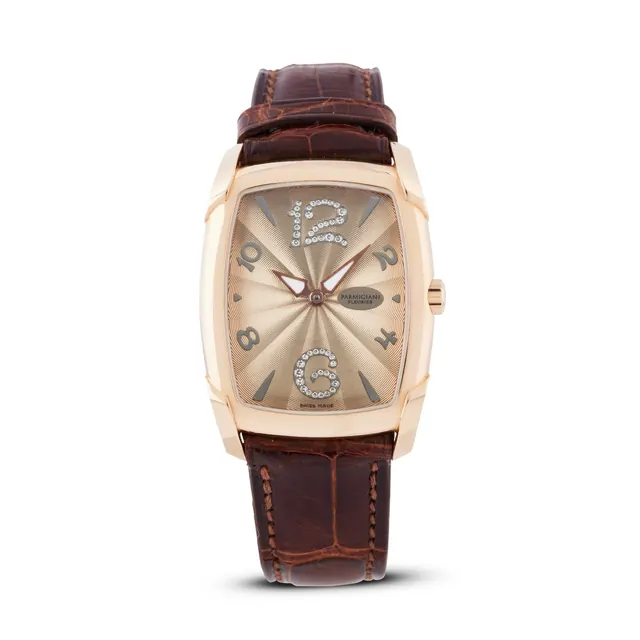
Parmigiani Fleurier wristwatch, Kalpa, circa 2000s
Antiquorum auction archive, Geneva
Wristwatches · c. 2010s
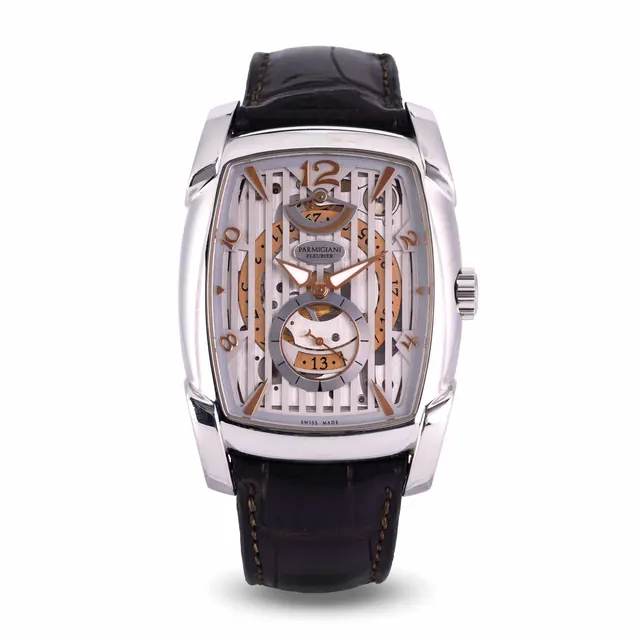
Parmigiani Fleurier wristwatch, Kalpa Xl Hebdomadaire, circa 2010s
Antiquorum auction archive, Geneva
Wristwatches · 2025
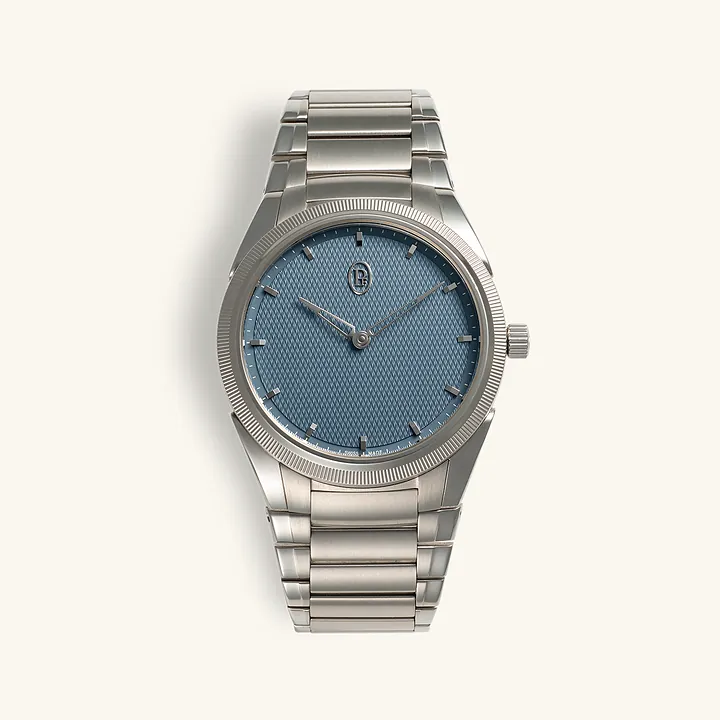
Parmigiani Fleurier Tonda PF 36mm Stone Blue, 2025
Watches of Knightsbridge (dealer), London
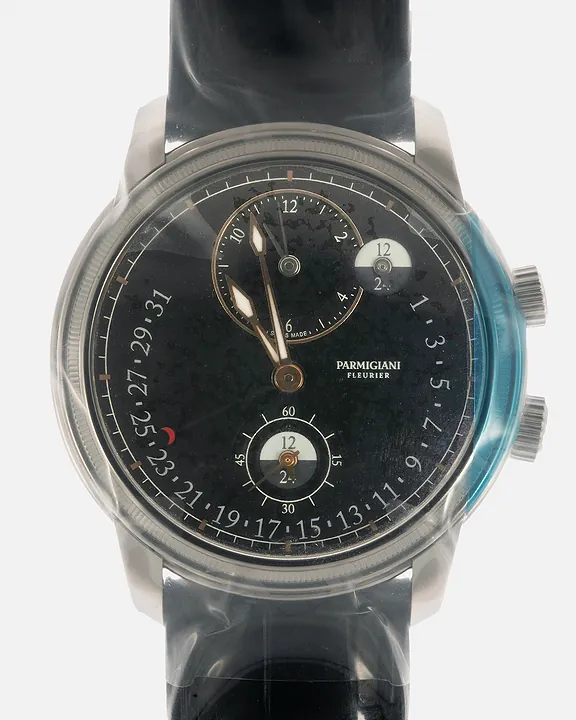
Wristwatches · 2023
Parmigiani Fleurier Toric Hemisphères Rétrograde Steel Sealed, 2023
S.Song Watches (dealer), Seattle

Wristwatches · c. 2010s
Breguet Type XXI, ref. 3810, c. 2010s (Antiquorum Lot 381-24)
Antiquorum auction archive, Geneva

Wristwatches · c. 2010s
Breguet Type XXI, ref. 3810, c. 2010s (Antiquorum Lot 386-229)
Antiquorum auction archive, Geneva

Wristwatches · Sold in September 2010
Breitling Cosmonaute, ref. A 22322, Sold in September 2010
Antiquorum auction archive, Geneva

Wristwatches · c. 2010
Corum Bubble Chrono, ref. 396.150.20, c. 2010
Antiquorum auction archive, Geneva