
Wristwatches · Wristwatch
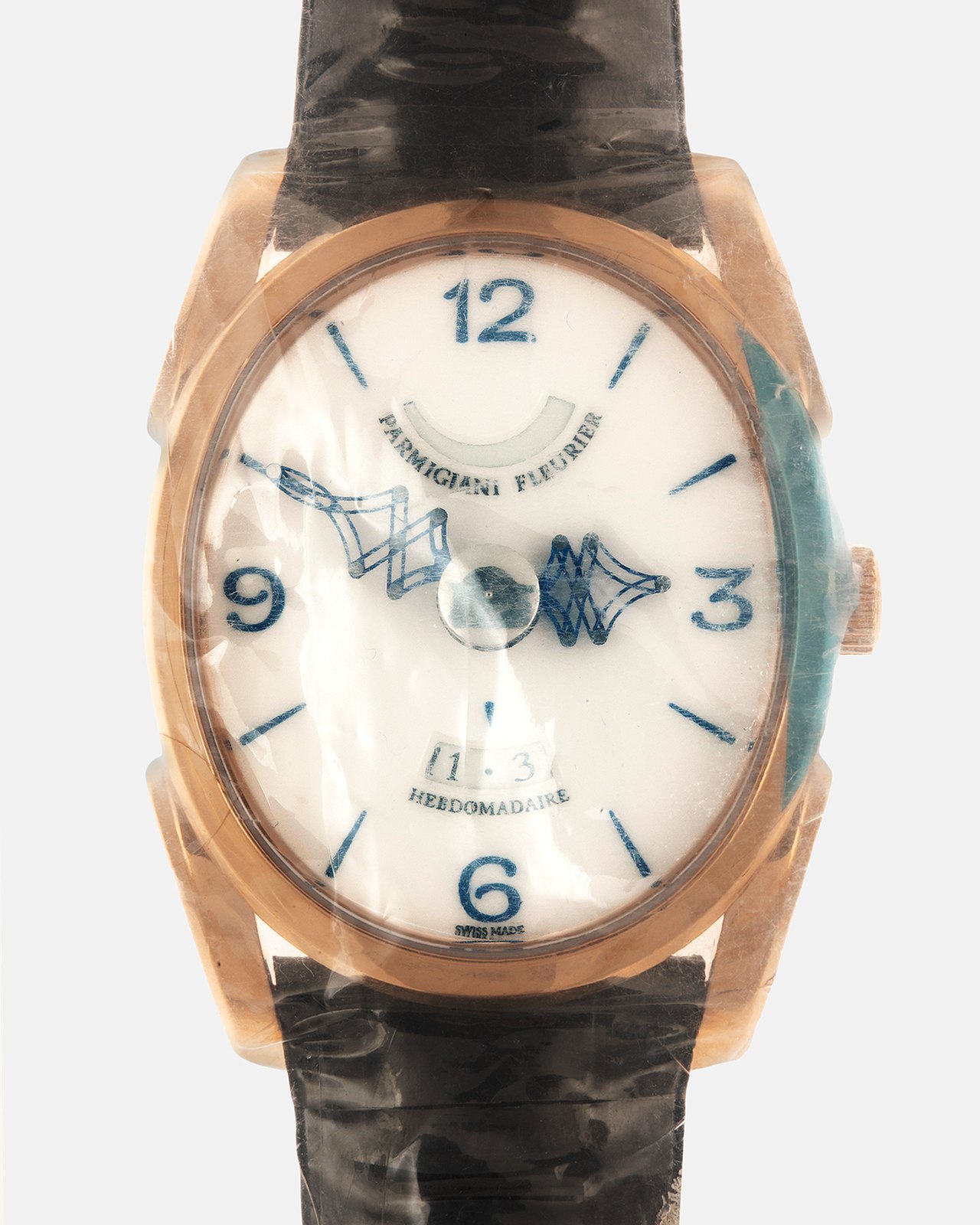
Parmigiani Fleurier Ovale Pantographe Sealed, 2021
- Maker / attribution
- Parmigiani Fleurier (maker)
- Date
- 2021
- Historical period
- Contemporary Horology (2010 – Present)
- Country of origin
- Switzerland
- Object type
- Wristwatch
- Stock no.
- Product 7113151676503
- Credit line
- Dealer listing, S.Song Watches (product 7113151676503)
- Catalogue title (original)
- Parmigiani Fleurier Ovale Pantographe Sealed (English)
View the source record (dealer listing) ↗ (opens another website in a new tab)Suggest a correction
Record summary
Catalogued by S.Song Watches (dealer), Seattle (stock number Product 7113151676503), this is a wristwatch by Parmigiani Fleurier, made in Switzerland, dated 2021. The Atlas places it in the Contemporary Horology period (2010 – Present) of its Wristwatches collection. The record is illustrated with 6 photographs.
Assembled from the source record's structured fields. Dates and attributions are given as the source states them; where a field is missing the Atlas leaves it blank rather than estimating.
Catalogue description
Dealer description — S.Song Watches
Parmigiani Fleurier is an independent brand that has, in recent years, gained its status as an underdog in the world of watchmaking. They occupy a very interesting space within the realm of Swiss watch brands. In my mind, Parmigiani Fleurier is a “more than meets the eye” kind of manufacturer. In other words, ‘understatement’ is their design mantra. They are also a brand that draws most of its watchmaking expertise from the art of restoration. For that reason, Parmigiani Fleurier is not a brand you typically hear watch collectors often rave about, but what makes the manufacture so special is the fact they have produced some absolutely stunning watches over the past two decades. Before we begin, I must say that the Parmigiani Fleurier Ovale Pantographe is undeniably one of the most unusual and unique watches I've come across so far. Its allure is both divisive and magnetic, to say the least. Upon first seeing the watch, I couldn't quite put a finger on its aesthetic combination of an oval-shaped case and such quirky-looking hands. It has a certain uniqueness to its design and aesthetic that defies conventional norms, making it quite fascinating to look at. In typical Parmigiani Fleurier fashion, the Ovale Pantographe may seem straightforward in its design - a pure white enamel dial, a date window, a power reserve indicator, and a pair of distinctive blued-aluminium telescopic hands. However, this watch is anything but simple. How so, you might wonder? You see, in the realm of watch design, many tend to overlook the technical and geometrical challenges involved in crafting a non-traditional round case shape (consider the Cartier Crash, or the Tank Asymétrique, for instance). One specific challenge concerns the fixed length of the hands, which can appear visually disproportionate depending on their position on the dial, potentially disrupting the overall visual balance. Addressing this challenge was the initial driving force behind the Ovale Pantographe, as Parmigiani Fleurier embarked on a journey back in 2011 to find a solution to this dilemma. For historical context, the Ovale Pantographe was inspired by an oval-shaped pocket watch from the 1800s made by English watchmakers Vardon and Stedman, which also featured a set of telescopic hands. Its name, derived from the pantograph drafting tool, is characterized by its cross-linked mechanical arms used in resizing maps, engineering drawings, and guiding cutting tools along complex paths. This tool’s operational concept is mirrored in the Ovale Pantographe’s telescopic hands, which retract accordingly in length as they traverse across the contours of the Ovale Pantographe’s oval-shaped dial to retain its overall visual balance as time passes. A central cam embedded within the movement governs this mechanism which determines their length and replicates it across all sections of the hands. Although not apparent in real-time, this captivating mechanism becomes much more perceptible when setting the time, offering a fascinating glimpse into its inner workings. Moving on to its movement, if you turn the Ovale Pantographe over on its back, you’ll be greeted with an unconventional-looking exhibition caseback which offers a glimpse of Parmigiani Fleurier’s in-house, manual-winding Cal. PF111. This tonneau-shaped movement features a retracting hand module, a double mainspring barrel configuration, and is adorned with three large, beautifully finished bridges featuring chamfered semi-circular edges. As far as power reserve goes, thanks to its double mainspring barrels, it can hold an impressive charge of up to 192 hours (8 days) on a full wind. It is also worth mentioning that the Cal. PF111 is based on the very first Parmigiani Fleurier movement ever made – the Cal. PF110, which debuted during the late 1990s when such extended power reserves were not as common. Parmigiani Fleurier, true to its reputation, is a watch manufacturer that delves deeper than mere surface appearances. Sure, the Ovale Pantographe's aesthetics may not resonate universally with everyone, but I think that is precisely what makes the watch so intriguing. It demands a certain kind of connoisseur with a profound appreciation for haute horlogerie and a nuanced understanding of watch design intricacies. For seasoned collectors who have seen and explored almost everything the world of watch collecting has to offer, but still find themselves unsatiated and craving a certain sense of novelty, I’d say the Ovale Pantographe stands out as a compelling choice to consider adding to their watch box.
Historical context
Contemporary Horology (2010 – Present)
Silicon components, connected watches, optical-lattice research clocks and a thriving independent scene.
Smartwatches became the world's best-selling watches, while mechanical watchmaking focuses on craft, innovation (silicon components, new escapements) and independent makers.
Read the period in the timelineMore wristwatches from this periodEarlier: Mechanical Renaissance
Atlas type guide
Wristwatches
Bracelet watches were worn by women from the early nineteenth century — Breguet made one for Caroline Murat, Queen of Naples, in 1810–12 — but the wristwatch only became a man's instrument with military use and aviation in the early twentieth century. Between the World Wars it overtook the pocket watch; the 1920s and 1930s brought rectangular Art Deco cases, water-resistant cases and the first automatic winding systems.
After 1945 the wristwatch became a carrier of identity — dress watches, sports and dive watches, chronographs, calendars — produced by Swiss, American, Japanese, German, Soviet and Chinese industries. The quartz revolution after 1969 and the mechanical renaissance since the 1990s, including the rise of independent watchmakers, complete the story.
What to look for
- The reference number (between the lugs or inside the case back) and serial number, the starting point for dating.
- The calibre: its maker and number are often stamped under the dial or on the bridge.
- Originality of dial, hands and crown — refinished ('redial') dials are common.
- Case material marks: 18K/750, 14K/585, stainless steel, gold-filled, plated.
Dating clues
- Wire-lug cases: before c. 1925.
- Water-resistant screw-down cases: from 1926.
- Quartz movements: from 1969; sapphire crystals widespread after c. 1980.
General guidance written by the Atlas editors about this kind of object. It is not a statement about this particular piece; for that, rely on the source record above and on physical examination.
Related records
Wristwatches · c. 2000s
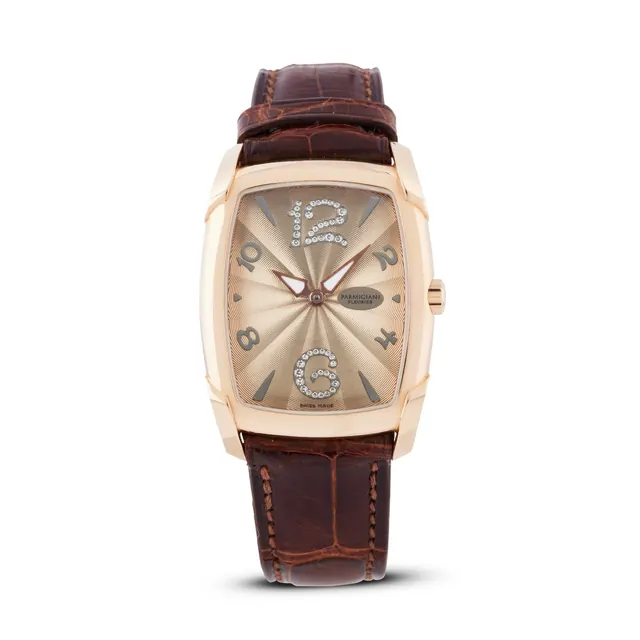
Parmigiani Fleurier wristwatch, Kalpa, circa 2000s
Antiquorum auction archive, Geneva
Wristwatches · c. 2010s
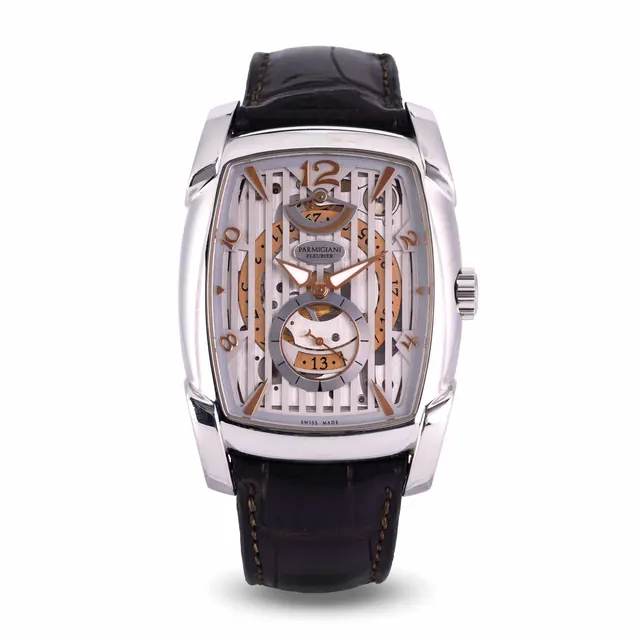
Parmigiani Fleurier wristwatch, Kalpa Xl Hebdomadaire, circa 2010s
Antiquorum auction archive, Geneva
Wristwatches · 2025
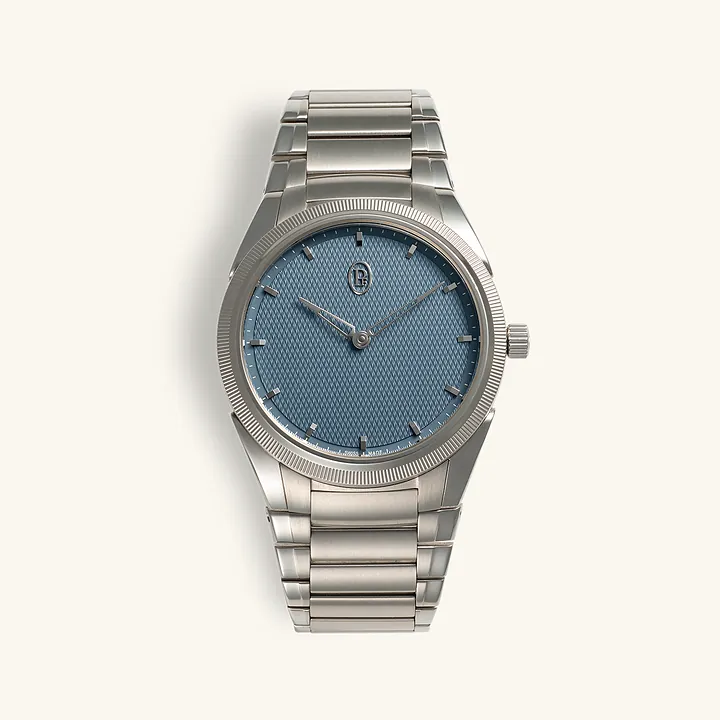
Parmigiani Fleurier Tonda PF 36mm Stone Blue, 2025
Watches of Knightsbridge (dealer), London
Wristwatches · 2023
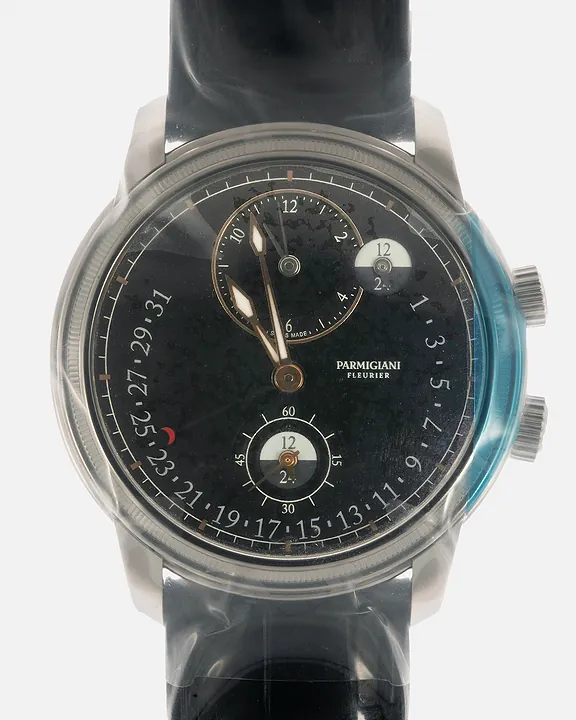
Parmigiani Fleurier Toric Hemisphères Rétrograde Steel Sealed, 2023
S.Song Watches (dealer), Seattle

Wristwatches · c. 2010s
Breguet Type XXI, ref. 3810, c. 2010s (Antiquorum Lot 381-24)
Antiquorum auction archive, Geneva

Wristwatches · c. 2010s
Breguet Type XXI, ref. 3810, c. 2010s (Antiquorum Lot 386-229)
Antiquorum auction archive, Geneva

Wristwatches · Sold in September 2010
Breitling Cosmonaute, ref. A 22322, Sold in September 2010
Antiquorum auction archive, Geneva

Wristwatches · c. 2010
Corum Bubble Chrono, ref. 396.150.20, c. 2010
Antiquorum auction archive, Geneva