
Wristwatches · Wristwatch
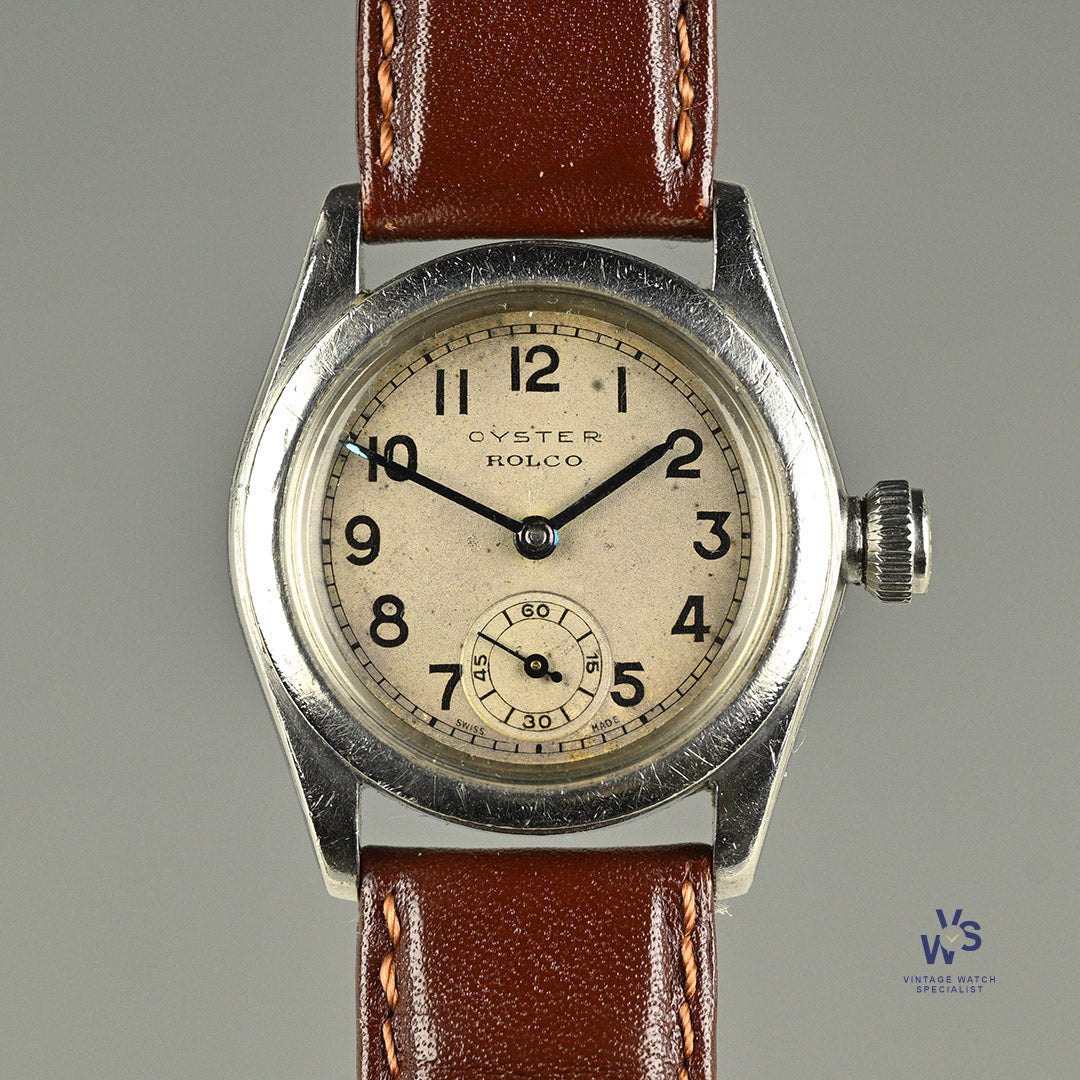
Oyster Rolco by Rolex, Manual Wind Watch, ref. 74569, Calibre 59, circa 1938
- Maker / attribution
- Unrecorded in source
- Date
- c. 1938
- Historical period
- Golden Age of Mechanical Watchmaking (1900 – 1945)
- Country of origin
- Unrecorded in source
- Object type
- Wristwatch
- Dimensions
- Case 30 mm
- Stock no.
- vws4364cs
- Credit line
- Dealer listing, Vintage Watch Specialist (vws4364cs)
- Catalogue title (original)
- Oyster Rolco by Rolex - Manual Wind Watch - Reference 74569 - Calibre 59 - c.1938 (English)
View the source record (dealer listing) ↗ (opens another website in a new tab)Suggest a correction
Record summary
Catalogued by Vintage Watch Specialist (dealer), United Kingdom (stock number vws4364cs), this is a wristwatch, dated c. 1938. The Atlas places it in the Golden Age of Mechanical Watchmaking period (1900 – 1945) of its Wristwatches collection. Recorded dimensions: Case 30 mm. The record is illustrated with 6 photographs.
Assembled from the source record's structured fields. Dates and attributions are given as the source states them; where a field is missing the Atlas leaves it blank rather than estimating.
Catalogue description
Dealer description — Vintage Watch Specialist
Rolco belongs to a fascinating chapter in the early history of the Rolex Watch Company. Registered during the late 1920s, the name was one of several employed by Hans Wilsdorf alongside the developing Oyster concept. Watches combining the Rolco and Oyster names are particularly interesting today, capturing a period when Wilsdorf was using different identities while continuing to develop the robust, practical wristwatches upon which his reputation would ultimately be built. What’s On Offer Dating to circa 1938 , this Oyster Rolco Ref. 74569 is a wonderfully evocative pre-war wristwatch, combining compact period proportions with a dial that has acquired almost ninety years of genuine vintage character. The 30mm stainless steel case has the familiar rounded Oyster form, with gently shaped lugs, a substantial winding crown and the characteristic finely fluted edge to the screw-down caseback. The case shows honest signs of use throughout, including scratches and surface marks, but these sit comfortably with the age of the watch and it has retained plenty of definition rather than appearing excessively refinished. The reference 74569 is clearly stamped externally on the caseback. The real attraction, though, is that dial. Originally white, it has mellowed considerably with age to a warm cream/off-white colour, with attractive spotting and patination across its surface. Large black Arabic numerals give the watch excellent legibility, surrounded by a neat segmented outer minute track. A recessed subsidiary seconds dial at six o’clock provides the only complication and balances the dial beautifully. The black hour and minute hands are simple and purposeful, while the small seconds hand adds another distinctly period detail. Inside sits the 15-jewel manually wound Calibre 59 , a movement used in Oyster-family watches of the era and offering approximately 40–44 hours of power reserve when fully wound. At 30mm wide and 35mm lug-to-lug , this is naturally a small watch by modern standards, but that is very much part of its appeal. The large numerals, relatively open dial and slim bezel give it considerably more presence than the dimensions might suggest, while the reddish-brown leather strap works particularly well against the warmth of the aged dial. This is a very appealing example for anyone interested not only in early Oyster watches, but in the wider and rather more complicated history of the Rolex Watch Company before the Rolex name became quite as dominant as it is today.
Historical context
Golden Age of Mechanical Watchmaking (1900 – 1945)
The wristwatch displaces the pocket watch; waterproof cases, self-winding and grand complications.
The wristwatch overtook the pocket watch. Military use in the First World War, aviation, water-resistant cases (1926), automatic winding (1923–31), rectangular Art Deco designs and early chronographs and calendars defined the period.
Read the period in the timelineMore wristwatches from this periodEarlier: Industrial Revolution
Atlas type guide
Dive and water-resistant watches
Keeping water and dust out of a wristwatch was a long-standing challenge. Rolex's screw-down Oyster case (1926) and Omega's Marine (1932) were landmarks; in the early 1950s Blancpain's Fifty Fathoms and Rolex's Submariner defined the professional dive watch with rotating bezels for timing dives, luminous dials and high water resistance. The ISO 6425 standard (1982) later codified what a 'diver's watch' must do.
Dive watches became icons of post-war design and exploration, and their evolution — helium escape valves, ceramic bezels, saturation-diving depth ratings — records the history of underwater work.
What to look for
- Unidirectional or bidirectional rotating bezel with minute markings.
- Screw-down crown and case back; depth rating printed on the dial.
- Luminous hands and markers (radium before c. 1960, tritium c. 1960–1998, then Super-LumiNova).
- Reference numbers on the case between the lugs or inside the back.
Dating clues
- Screw-down Oyster cases: from 1926.
- Professional dive watches: from 1953.
- Tritium 'T' marks on dials: c. 1960–1998.
General guidance written by the Atlas editors about this kind of object. It is not a statement about this particular piece; for that, rely on the source record above and on physical examination.
Related records
Wristwatches · 1900–1999
Wristwatch by Mercury, 1900–1999
Modemuseum Hasselt
Wristwatches · 1900–1999
Wristwatch by Nutrix, 1900–1999
Modemuseum Hasselt

Wristwatches · 1920
Wristwatch, 1920
Modemuseum Hasselt

Wristwatches · 1931
Rolex 'Oyster Perpetual' rotor self-winding wrist-watch, lever escapement, in steel case with glass in back, Montres Rolex SA, Geneva, Switzerland, 1931
Science Museum Group, London
Wristwatches · c. 1936
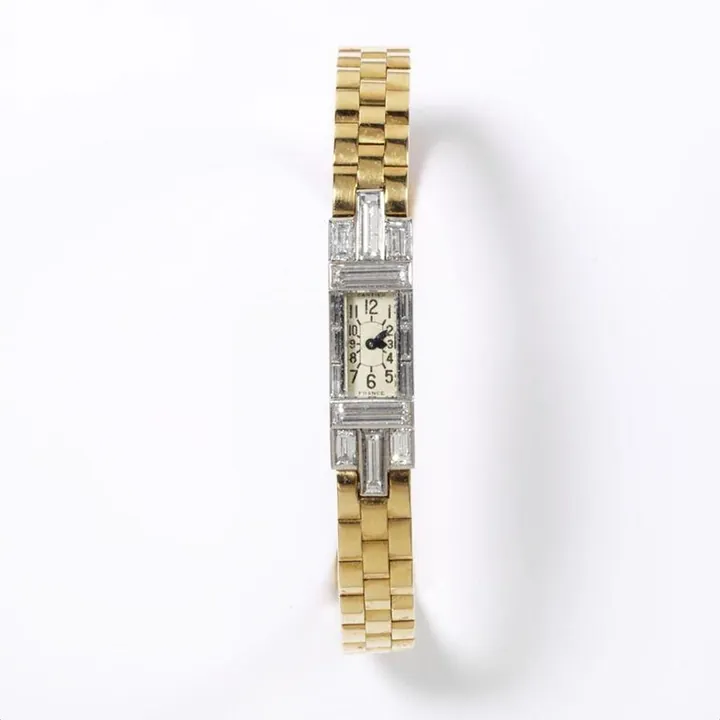
Watch with diamond-set platinum case and gold link bracelet, Cartier, Paris, c. 1936.
Victoria and Albert Museum, London
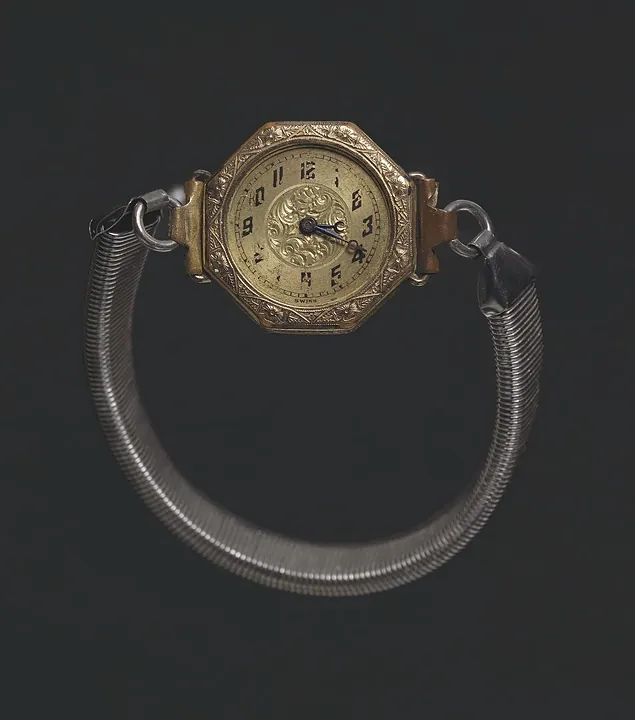
Wristwatches · early to mid 20th century
Woman's wristwatch worn by Harriette Vyda Simms Moore, early to mid 20th century
National Museum of African American History and Culture, Smithsonian Institution, Washington DC

Wristwatches · 1900–1999
Wristwatch by Certina, Switzerland, 1900–1999
Nordic Museum Foundation
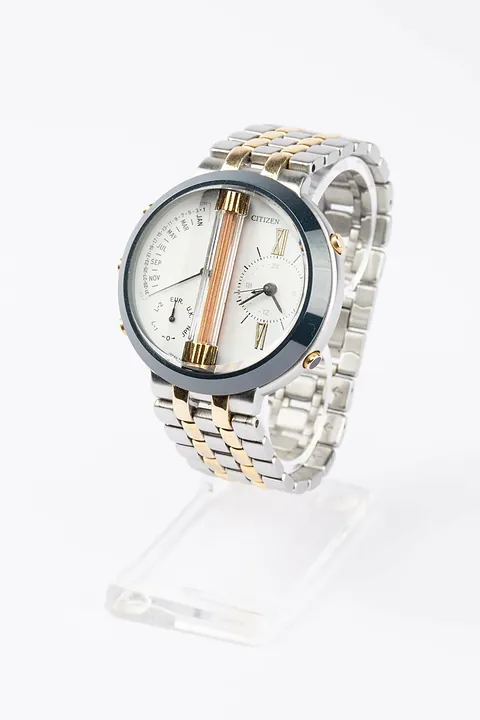
Wristwatches · 1900–1999
Wristwatch by Citizen, Japan, 1900–1999
German Clock Museum