
Wristwatches · Wristwatch
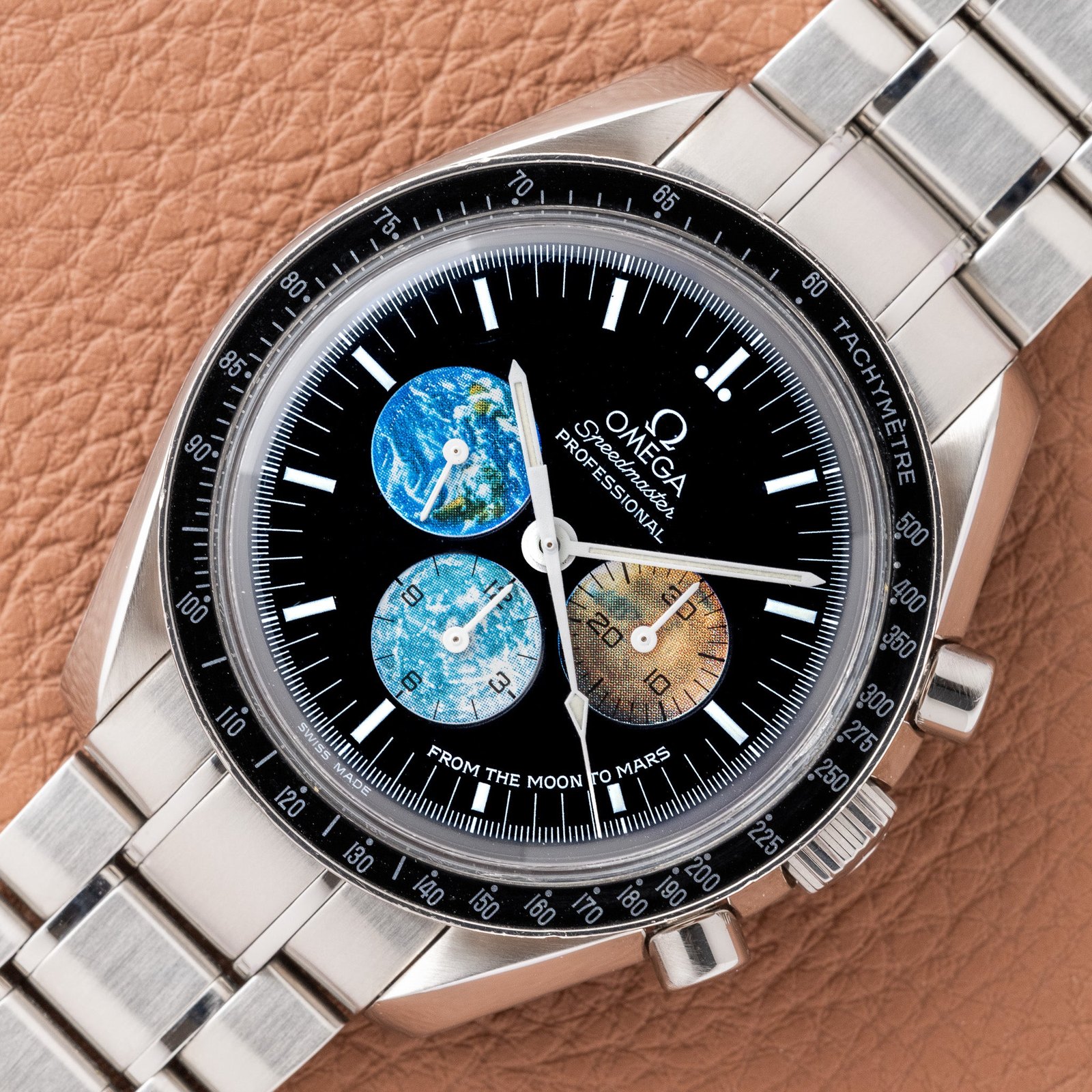
Omega Speedmaster Professional Moon to Mars (3577.50), 2000
- Maker / attribution
- Omega (maker)
- Date
- 2000
- Historical period
- Mechanical Renaissance (1990 – 2010)
- Country of origin
- Switzerland
- Object type
- Wristwatch
- Dimensions
- Case 42 mm
- Stock no.
- Product 8364500091063
- Credit line
- Dealer listing, Huntington Company (product 8364500091063)
- Catalogue title (original)
- 2000 Omega Speedmaster Professional Moon to Mars (3577.50) (English)
View the source record (dealer listing) ↗ (opens another website in a new tab)Suggest a correction
Record summary
Catalogued by Huntington Company (dealer) (stock number Product 8364500091063), this is a wristwatch by Omega, made in Switzerland, dated 2000. The Atlas places it in the Mechanical Renaissance period (1990 – 2010) of its Wristwatches collection. Recorded dimensions: Case 42 mm. The record is illustrated with 6 photographs.
Assembled from the source record's structured fields. Dates and attributions are given as the source states them; where a field is missing the Atlas leaves it blank rather than estimating.
Catalogue description
Dealer description — Huntington Company
History and Significance This Speedmaster belongs to one of Omega’s most playful and concept-driven modern Speedmaster releases, the “Moon to Mars” edition. Introduced as a limited production run, the watch reinterprets the classic Speedmaster Professional by replacing the traditional monochrome subdials with vivid planetary imagery representing Earth and Mars. While unmistakably modern in execution, it remains mechanically and dimensionally faithful to the Speedmaster that has defined Omega’s chronograph identity since the 1960s. At its core, this watch is still a Moonwatch. It uses the hand-wound calibre 1861 architecture, a direct descendant of the movement that powered NASA-qualified Speedmasters worn during Apollo missions. The familiar 42mm asymmetrical case, black tachymeter bezel, hesalite crystal, and manually wound chronograph layout are all present, ensuring continuity with the historic Speedmaster Professional lineage. What sets this reference apart is its dial. The Earth and Mars subdials introduce color and texture without compromising legibility or balance. The execution is precise and deliberate rather than novelty driven, and the result is a Speedmaster that remains serious in construction while offering a distinct visual identity. For collectors, this reference represents a modern Omega experiment done correctly, grounded in genuine Speedmaster DNA rather than superficial design changes. Writer’s Thoughts This is one of the few modern Speedmasters that feels both fun and legitimately collectible. It wears exactly like a traditional Moonwatch, but the dial gives it personality without crossing into gimmick territory. For someone who already owns a standard Speedmaster, this is a compelling alternative that still feels correct on the wrist. Our Promise Every watch we offer is carefully inspected and verified for authenticity. We stand behind the integrity of each piece and represent it accurately and transparently. Our goal is to ensure complete confidence when purchasing from Huntington Company. Specifications Brand: Omega Model: Speedmaster Professional Moon to Mars (Ref. 31130423001001) Year: 2000 Case Material: Stainless steel Case Size: 42mm Bezel: Black aluminum tachymeter bezel Dial: Black dial with Earth and Mars subdials Crystal: Hesalite Movement: Omega calibre 1861 hand-wound chronograph Strap/Bracelet: Stainless steel bracelet Buckle/Clasp: Omega folding clasp Contents: Watch only Condition Case: Stainless steel case shows light surface wear consistent with careful use. Brushed surfaces remain even with minor contact marks visible under close inspection, primarily along the case sides and lug edges. No evidence of aggressive refinishing observed. Bezel: Tachymeter bezel is clean with light hairline wear and fully legible printing throughout. Crystal: Hesalite crystal shows faint surface marks consistent with normal wear, with no chips or cracks. Dial: Dial is in perfect condition with no signs of wear. Hands: Original hands are clean with intact luminous material and no visible degradation. Strap/Bracelet: Stainless steel bracelet shows light wear on clasp and links consistent with use, with no structural issues. Buckle/Clasp: Omega clasp shows light surface wear and functions properly.
Historical context
Mechanical Renaissance (1990 – 2010)
Mechanical watches return as cultural objects; independent watchmaking flourishes.
Mechanical watches returned as cultural and luxury objects. Complications, tourbillons and new materials proliferated; independent watchmakers such as George Daniels, F.P. Journe and Philippe Dufour revived artisanal watchmaking; collecting vintage watches became a major field.
Read the period in the timelineMore wristwatches from this periodEarlier: Quartz Revolution
Atlas type guide
Wristwatches
Bracelet watches were worn by women from the early nineteenth century — Breguet made one for Caroline Murat, Queen of Naples, in 1810–12 — but the wristwatch only became a man's instrument with military use and aviation in the early twentieth century. Between the World Wars it overtook the pocket watch; the 1920s and 1930s brought rectangular Art Deco cases, water-resistant cases and the first automatic winding systems.
After 1945 the wristwatch became a carrier of identity — dress watches, sports and dive watches, chronographs, calendars — produced by Swiss, American, Japanese, German, Soviet and Chinese industries. The quartz revolution after 1969 and the mechanical renaissance since the 1990s, including the rise of independent watchmakers, complete the story.
What to look for
- The reference number (between the lugs or inside the case back) and serial number, the starting point for dating.
- The calibre: its maker and number are often stamped under the dial or on the bridge.
- Originality of dial, hands and crown — refinished ('redial') dials are common.
- Case material marks: 18K/750, 14K/585, stainless steel, gold-filled, plated.
Dating clues
- Wire-lug cases: before c. 1925.
- Water-resistant screw-down cases: from 1926.
- Quartz movements: from 1969; sapphire crystals widespread after c. 1980.
General guidance written by the Atlas editors about this kind of object. It is not a statement about this particular piece; for that, rely on the source record above and on physical examination.
Related records

Instruments · 1950–1976
Omega Megaquartz 2400 marine chronometer, 1950–1976
Science Museum Group, London

Instruments · 1960–1979
Stopwatch / timer by Omega, 1960–1979
Science Museum Group, London

Instruments · 1960–1979
Stopwatch / timer by Omega, Switzerland, 1960–1979
Science Museum Group, London

Instruments · 1960–1979
Stopwatch by Omega, Swiss made, single-button type reading 0 - 60 seconds in fifths and 0 - 5 minutes in minutes on subsidiary dial, 1960-79.
Science Museum Group, London

Wristwatches · 2008
Wristwatch by Breitling?, 2008
Museum Rotterdam

Wristwatches · c. 1990s
Audemars Piguet Bamboo, c. 1990s
Antiquorum auction archive, Geneva

Wristwatches · c. 1990
Audemars Piguet Huitieme Perpetual Calendar, ref. 25696PT, c. 1990
Antiquorum auction archive, Geneva

Wristwatches · c. 1990
Breitling Chronomat, ref. b13050.1, c. 1990
Antiquorum auction archive, Geneva