
Wristwatches · Wristwatch
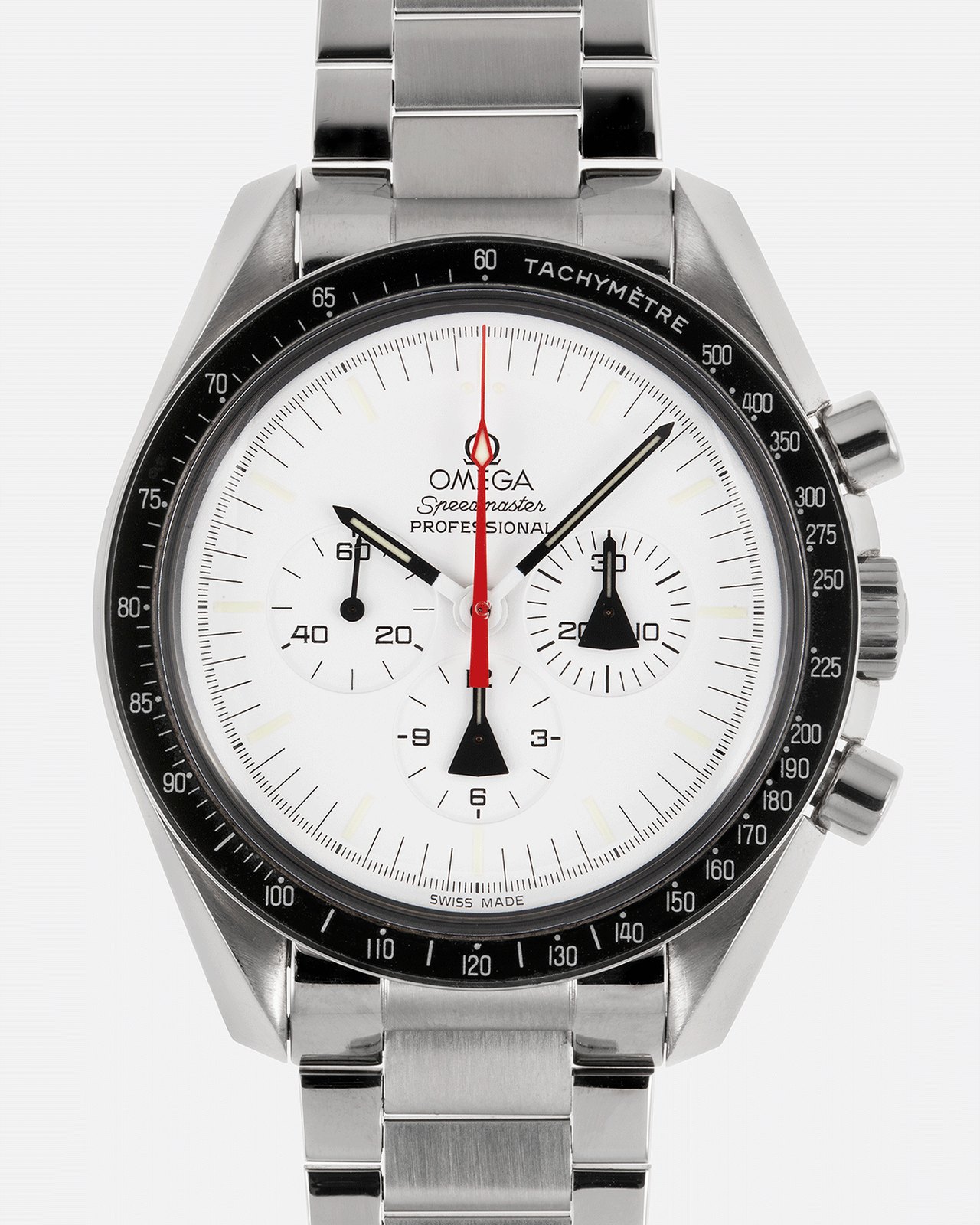
Omega Speedmaster Professional Alaska Project, 2009
- Maker / attribution
- Omega (maker)
- Date
- 2009
- Historical period
- Mechanical Renaissance (1990 – 2010)
- Country of origin
- Switzerland
- Object type
- Wristwatch
- Dimensions
- Case 42 mm
- Stock no.
- Product 6586479935575
- Credit line
- Dealer listing, S.Song Watches (product 6586479935575)
- Catalogue title (original)
- Omega Speedmaster Professional Alaska Project (English)
View the source record (dealer listing) ↗ (opens another website in a new tab)Suggest a correction
Record summary
Catalogued by S.Song Watches (dealer), Seattle (stock number Product 6586479935575), this is a wristwatch by Omega, made in Switzerland, dated 2009. The Atlas places it in the Mechanical Renaissance period (1990 – 2010) of its Wristwatches collection. Recorded dimensions: Case 42 mm. The record is illustrated with 6 photographs.
Assembled from the source record's structured fields. Dates and attributions are given as the source states them; where a field is missing the Atlas leaves it blank rather than estimating.
Catalogue description
Dealer description — S.Song Watches
Of all the watches in the world, the Omega Speedmaster is amongst the most well understood and iconic regarding its own history and role as an influential piece of history. Famed for being the first watch worn on the Moon, the Omega and the Speedmaster have shared close links with NASA and the exploration of space, a mission in which the Speedmaster Alaska Project was designed with both its aesthetics and functional aspects fine-tuned for the unknown. While NASA had already famously selected the Speedmaster as the official watch of their space program, Omega's engineers were set on building a watch specifically designed for space travel and the unique circumstances in which it would need to perform. Albeit, the Speedmaster had performed admirably in space in the past - as confirmed by Omega's Snoopy Award. Nicknamed the Alaska Project, Omega created several watches to perform in space, and in 2008, they decided to pay homage to the Alaska II prototype with the Speedmaster Alaska Project as part of a limited edition run with 1970 pieces. Immediately distinctive in its unique design, the Alaska Project features a modified polar white dial with baton hands for the time and rocket-shaped hands within the sunken chronograph subdials as a reminder of the Alaska Project's raison d’être. Of course, given the harsh sub-freezing temperatures in space, the Alaska Project features perhaps the most distinguishable design feature on any Omega timepiece, a bright red anodized aluminum "thermal shield" that houses the Speedmaster as we know it within. Protecting the hesalite crystal from damage and inscribed with numerals to improve the chronograph's legibility, the thermal shield is functional beyond just keeping the movement at a temperature that it can operate at. So good at its job. the thermal shield enables the Alaska Project to operate in lunar or spatial atmospheres, ranging from a mind-numbing -148C to a rather steamy +260C. Powered by the Speedmaster's legendary manual-winding cal. 1861 movement, the Speedmaster Alaska Project is a Speedmaster as we know and love it with the same 42mm case design and stainless steel construction, which collectors still adore today. With all the Speedmaster's years of service to NASA and the wider watchmaking industry, the Alaska Project serves to highlight its iconic story and continue to push the boundaries, just like those historical moon-landings in 1969. Furthermore, as a testament to the success of this limited edition, the Speedmaster Alaska project remains one of the most desirable and unique-looking Speedmaster’s on the market today.
Historical context
Mechanical Renaissance (1990 – 2010)
Mechanical watches return as cultural objects; independent watchmaking flourishes.
Mechanical watches returned as cultural and luxury objects. Complications, tourbillons and new materials proliferated; independent watchmakers such as George Daniels, F.P. Journe and Philippe Dufour revived artisanal watchmaking; collecting vintage watches became a major field.
Read the period in the timelineMore wristwatches from this periodEarlier: Quartz Revolution
Atlas type guide
Wristwatches
Bracelet watches were worn by women from the early nineteenth century — Breguet made one for Caroline Murat, Queen of Naples, in 1810–12 — but the wristwatch only became a man's instrument with military use and aviation in the early twentieth century. Between the World Wars it overtook the pocket watch; the 1920s and 1930s brought rectangular Art Deco cases, water-resistant cases and the first automatic winding systems.
After 1945 the wristwatch became a carrier of identity — dress watches, sports and dive watches, chronographs, calendars — produced by Swiss, American, Japanese, German, Soviet and Chinese industries. The quartz revolution after 1969 and the mechanical renaissance since the 1990s, including the rise of independent watchmakers, complete the story.
What to look for
- The reference number (between the lugs or inside the case back) and serial number, the starting point for dating.
- The calibre: its maker and number are often stamped under the dial or on the bridge.
- Originality of dial, hands and crown — refinished ('redial') dials are common.
- Case material marks: 18K/750, 14K/585, stainless steel, gold-filled, plated.
Dating clues
- Wire-lug cases: before c. 1925.
- Water-resistant screw-down cases: from 1926.
- Quartz movements: from 1969; sapphire crystals widespread after c. 1980.
General guidance written by the Atlas editors about this kind of object. It is not a statement about this particular piece; for that, rely on the source record above and on physical examination.
Related records

Instruments · 1950–1976
Omega Megaquartz 2400 marine chronometer, 1950–1976
Science Museum Group, London

Instruments · 1960–1979
Stopwatch / timer by Omega, 1960–1979
Science Museum Group, London

Instruments · 1960–1979
Stopwatch / timer by Omega, Switzerland, 1960–1979
Science Museum Group, London

Instruments · 1960–1979
Stopwatch by Omega, Swiss made, single-button type reading 0 - 60 seconds in fifths and 0 - 5 minutes in minutes on subsidiary dial, 1960-79.
Science Museum Group, London

Wristwatches · 2008
Wristwatch by Breitling?, 2008
Museum Rotterdam

Wristwatches · c. 1990s
Audemars Piguet Bamboo, c. 1990s
Antiquorum auction archive, Geneva

Wristwatches · c. 1990
Audemars Piguet Huitieme Perpetual Calendar, ref. 25696PT, c. 1990
Antiquorum auction archive, Geneva

Wristwatches · c. 1990
Breitling Chronomat, ref. b13050.1, c. 1990
Antiquorum auction archive, Geneva