
Wristwatches · Wristwatch
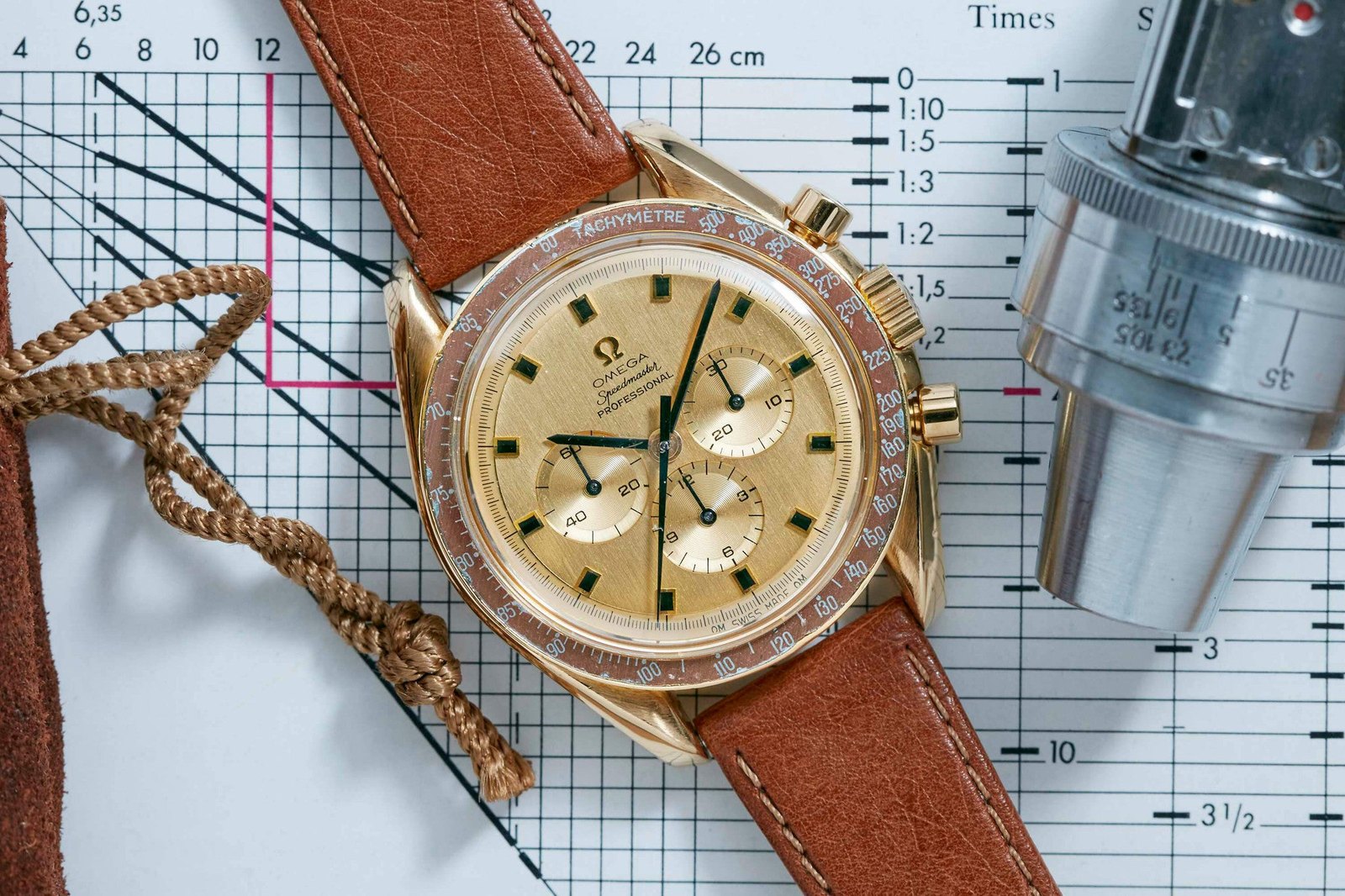
Omega Speedmaster Professional 18k Gold, 1969
- Maker / attribution
- Omega (maker)
- Date
- 1969
- Historical period
- Quartz Revolution (1969 – 1990)
- Country of origin
- Switzerland
- Object type
- Wristwatch
- Materials / technique
- gold
- Stock no.
- Product 6347314625
- Credit line
- Dealer listing, Analog/Shift (product 6347314625)
- Catalogue title (original)
- Omega Speedmaster Professional 18k Gold (English)
View the source record (dealer listing) ↗ (opens another website in a new tab)Suggest a correction
Record summary
Catalogued by Analog/Shift (dealer), New York (stock number Product 6347314625), this is a wristwatch by Omega, made in Switzerland, dated 1969. The Atlas places it in the Quartz Revolution period (1969 – 1990) of its Wristwatches collection. Materials and techniques recorded by the source: gold. The record is illustrated with 6 photographs.
Assembled from the source record's structured fields. Dates and attributions are given as the source states them; where a field is missing the Atlas leaves it blank rather than estimating.
Catalogue description
Dealer description — Analog/Shift
The Omega Speedmaster has set benchmarks that, in our opinion, are pretty hard to surpass. It was the first timepiece to be flight-qualified by NASA for manned space missions and the first watch to be worn by an American astronaut during a space walk. Perhaps most importantly, it was the first watch to be worn on the moon. Despite this extraterrestrial heritage, in the beginning the Speedmaster was only intended for terrestrial pursuits. Omega released the Speedmaster in 1957, in the midst of a craze for racing chronographs. The name "Speedmaster" followed the naming trend set by the Seamaster and Railmaster models, and was also a subtle nod to the innovative brushed stainless steel tachymeter bezel. The first reference of Speedmaster, the CK 2915, contained the Lemania Calibre .321 movement, developed by famed movement-maker Albert Piguet in 1946. Over the next few years, the Speedmaster saw multiple changes in dial and hand configurations, but at its heart retained the design elements that would be carried down through the decades: the triple-register layout, domed Hesalite crystal, and of course, the tachymeter bezel, signifying Omega's intention for the Speedmaster to be used in automotive sports. Who knows - had NASA not pinpointed the Speedmaster for use in manned spaceflight, perhaps it would only be regarded among the great racing chronographs like the Heuer Autavia or the Rolex Daytona? The fact that the Speedmaster came to be used by NASA is somewhat serendipitous. Since the dawn of military aviation, pilots had used chronographs to time their flights. When NASA developed their space program, the first astronauts were, as one can imagine, military fighter pilots. The Speedmaster was already known to NASA for its personal use by the astronauts: Wally Schirra wore his own Speedmaster, a reference CK2998, aboard the Mercury-Atlas 8 in 1962. In 1965, NASA sent formal bids to twelve different brands whose chronographs the astronauts preferred for their own personal use. Chronographs from Breitling (already by then well-established for use in aviation), Rolex, and even a pocket watch by Hamilton were considered by NASA. Ultimately a Rolex, a Wittnauer (either the ref. 242T or the ref. 235T ), and an Omega made the final cut, but the Speedmaster won out by a significant margin and was found to be the most durable and suitable of the bunch for use in the Apollo missions. The Speedmaster was one of the few pieces of equipment not made specifically for NASA , but given the watch’s outstanding quality, a custom model was deemed unnecessary, and Buzz Aldrin went on to famously wear his on the surface of the moon on the Apollo 11 mission. The Speedy that we have here, the rare Reference BA 145.022, dates from 1969, the year of the successful Apollo 11 moon landing. It's considered the first special edition Speedmaster, released in solid 18K yellow gold to commemorate that momentous achievement. Only 1014 of these special watches were made, and the those numbered 3 to 28 were presented to the astronauts and NASA executives at a banquet in Houston on November 25, 1969 (#1 and #2 went to President Richard Nixon and Vice President Spiro Agnew respectively). The remaining 981 pieces were released for sale to the general public. The case back bears the inscription "Apollo XI 1969, The First Watch Worn On The Moon." Unlike the Speedmasters worn by the astronauts of the early Apollo missions, it contains the later Calibre .861. This movement also designed by Albert Piguet, was Lemania's perfection of the earlier caliber and utilized a cam mechanism rather than a column wheel, and increased the beat rate from 18000 to 216000 beats per hour. Although Omega has subsequently released a bevy of Special Edition Speedmasters (including a number of solid gold offerings), the BA 145.022 is a true rarity. This watch is an icon amongst icons - arguably the truest commemoration of one of our proudest achievements. This beautiful example deserves to go with its wearer to frontiers unseen by mankind, don't miss it!
Historical context
Quartz Revolution (1969 – 1990)
Seiko's Astron begins mass quartz timekeeping; traditional industries contract sharply.
Quartz and digital watches transformed the market after 1969. Swiss employment collapsed, Japanese and Hong Kong production soared, and the Swatch (1983) helped the Swiss industry recover; mechanical watches survived as luxury goods.
Read the period in the timelineMore wristwatches from this periodEarlier: Modern Mechanical Horology
Atlas type guide
Wristwatches
Bracelet watches were worn by women from the early nineteenth century — Breguet made one for Caroline Murat, Queen of Naples, in 1810–12 — but the wristwatch only became a man's instrument with military use and aviation in the early twentieth century. Between the World Wars it overtook the pocket watch; the 1920s and 1930s brought rectangular Art Deco cases, water-resistant cases and the first automatic winding systems.
After 1945 the wristwatch became a carrier of identity — dress watches, sports and dive watches, chronographs, calendars — produced by Swiss, American, Japanese, German, Soviet and Chinese industries. The quartz revolution after 1969 and the mechanical renaissance since the 1990s, including the rise of independent watchmakers, complete the story.
What to look for
- The reference number (between the lugs or inside the case back) and serial number, the starting point for dating.
- The calibre: its maker and number are often stamped under the dial or on the bridge.
- Originality of dial, hands and crown — refinished ('redial') dials are common.
- Case material marks: 18K/750, 14K/585, stainless steel, gold-filled, plated.
Dating clues
- Wire-lug cases: before c. 1925.
- Water-resistant screw-down cases: from 1926.
- Quartz movements: from 1969; sapphire crystals widespread after c. 1980.
General guidance written by the Atlas editors about this kind of object. It is not a statement about this particular piece; for that, rely on the source record above and on physical examination.
Related records

Instruments · 1950–1976
Omega Megaquartz 2400 marine chronometer, 1950–1976
Science Museum Group, London

Instruments · 1960–1979
Stopwatch / timer by Omega, 1960–1979
Science Museum Group, London

Instruments · 1960–1979
Stopwatch / timer by Omega, Switzerland, 1960–1979
Science Museum Group, London

Instruments · 1960–1979
Stopwatch by Omega, Swiss made, single-button type reading 0 - 60 seconds in fifths and 0 - 5 minutes in minutes on subsidiary dial, 1960-79.
Science Museum Group, London

Wristwatches · 1970
Wristwatch by Heno, Switzerland, 1970
Museum Rotterdam

Wristwatches · 1960–1986
'Tri-Compax' calendar chronograph wristwatch in gold case, by Universal, Geneva, Switzerland, 1960–1986.
Science Museum Group, London

Wristwatches · 1969–1970
Beta 21 Quartz wristwatch movement, made in Switzerland, 1970.
Science Museum Group, London

Wristwatches · c. 1969
Omega Speedmaster Moonwatch, ref. 145022-69st, c. 1969
Antiquorum auction archive, Geneva