
Wristwatches · Wristwatch
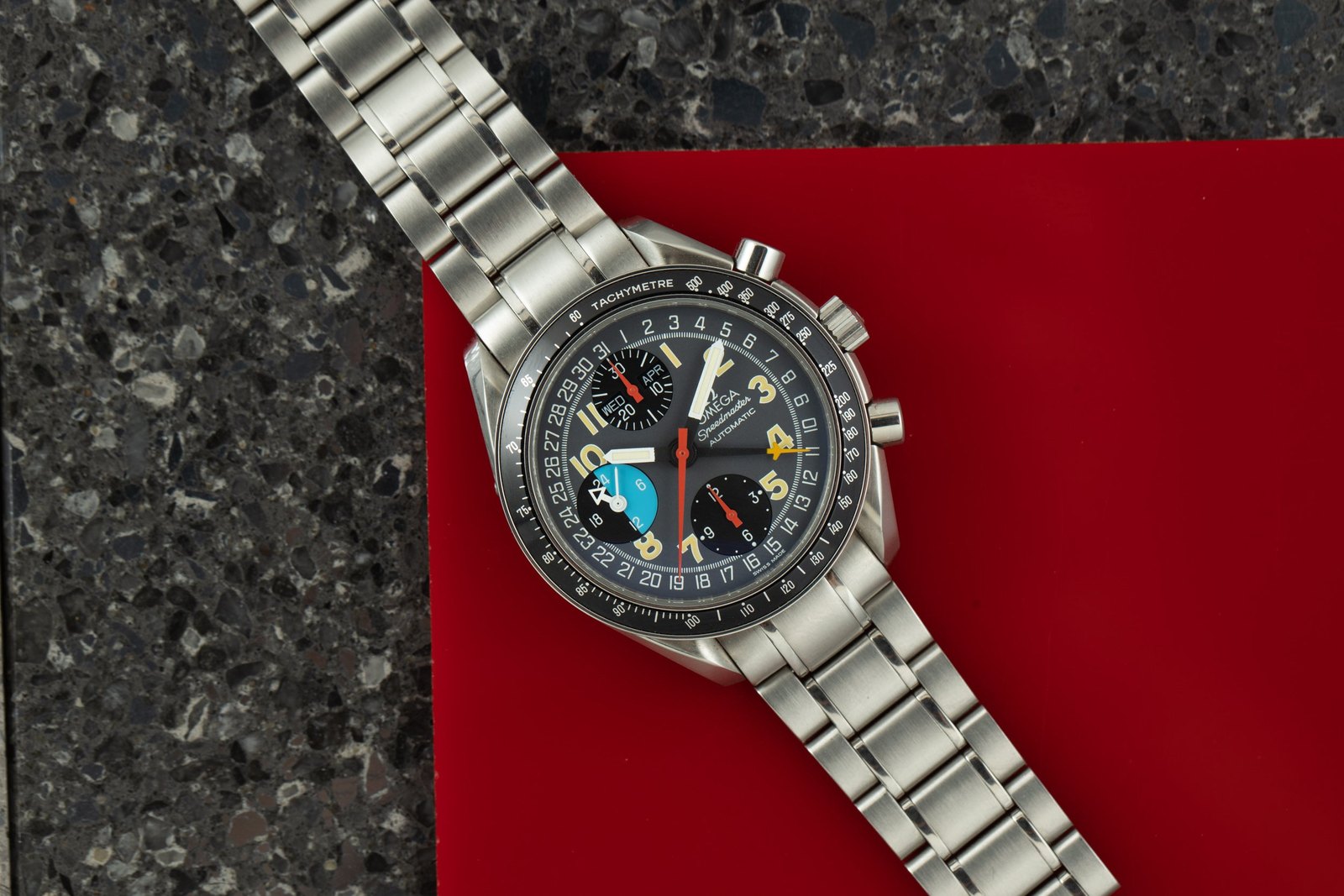
Omega Speedmaster 'MK40' Triple Calendar Automatic, c. 1999
- Maker / attribution
- Omega (maker)
- Date
- c. 1999
- Historical period
- Mechanical Renaissance (1990 – 2010)
- Country of origin
- Switzerland
- Object type
- Wristwatch
- Dimensions
- Case 39 mm
- Stock no.
- Product 4617975988311
- Credit line
- Dealer listing, Analog/Shift (product 4617975988311)
- Catalogue title (original)
- Omega Speedmaster 'MK40' Triple Calendar Automatic (English)
View the source record (dealer listing) ↗ (opens another website in a new tab)Suggest a correction
Record summary
Catalogued by Analog/Shift (dealer), New York (stock number Product 4617975988311), this is a wristwatch by Omega, made in Switzerland, dated c. 1999. The Atlas places it in the Mechanical Renaissance period (1990 – 2010) of its Wristwatches collection. Recorded dimensions: Case 39 mm. The record is illustrated with 6 photographs.
Assembled from the source record's structured fields. Dates and attributions are given as the source states them; where a field is missing the Atlas leaves it blank rather than estimating.
Catalogue description
Dealer description — Analog/Shift
Why We Love It Our love of Omega Speedmasters should be pretty apparent - with lengthy descriptions and stories recounting the tales of the original rocket men and their magnificent machines regularly gracing these electronic pages. With that said, the majority of our attention on Speedmasters has been focused on the Professional and Pre-Professional line, which has been a disservice to the other facets of the Speedmaster collection, which are numerous. From the earliest attempts to create automatic variants to their more recent Co-Axial models, there's a lot to love in the collection - and its easy to see why some collectors focus entirely on Speedmasters! This particular model, a Reference 3820.53 Speedmaster Automatic Triple Date - better known as the Mark 40 - was introduced around 1996 and produced into the early 2000s. The model features a 39mm 'Reduced' size case with automatic Calibre 1152 movement with a litany of complications including day, date, and month indicators alongside a 24 hour day/night indicator alongside a chronograph mechanism with center seconds, 30-minute counter, and 12-hour register. In short, everything and the kitchen sink! This example dates to circa 1999 and is in outstanding condition throughout with an untouched case and flawless dial with vibrant luminous material and no fade. Popularized recently by a tribute model offered by Hodinkee, the MK40's colorful dial and functionality stands out in a crowd, and the genuine article offers a tremendous value amongst collectable Speedmaster models in particular! The Speedmaster Story "Contact Light." After touching the lander down on the lunar surface, Buzz Aldrin transmitted to Houston control these words, nary more than a whisper, the first communication between human beings not concurrently on the same planet. When Neil Armstrong set foot on the moon for the first time, his Omega Speedmaster was in the module serving as a backup for its electric timer that had malfunctioned. It was Aldrin who, following Armstrong to become the second human to walk on the moon, introduced the Speedmaster to the lunar surface. Today, Omega has become synonymous with the Apollo missions, the moon landing and space exploration in general. The provenance of the brand, driven by the incredible reliability and functionality of the watches that they produced throughout the space era is second to none. But at the heart of the moon missions, at the core of their objective, was the intrinsic human desire to explore, to crest the horizon and, undaunted, step forth into the unknown. NASA approved the Speedmaster for its space missions because it was the best, most accurate timepiece they could find, and testing revealed that it needed no modification in order to remain functional under the duress of space flight. NASA was concerned with accuracy, durability and usability; they didn't care about Omega's history, they needed a tool that could accompany humans on a mission to the moon and help them get back safely. They exposed the Speedmaster to high and low temperatures, blasted it with vibrations, challenged it with g-force extremes and submitted it to high and low pressure. Through it all, the Speedmaster ticked on, proving that it could go where no watch had ever gone before. Today the Omega Speedmaster is often regarded by collectors and enthusiasts to be the single most important wristwatch ever made, if for no other reason than that it accompanied us on mankind’s greatest feat – touching down on and exploring a heavenly body. While most of the Omega Speedmasters in circulation haven’t left Earth’s atmosphere, we can all take a certain amount of pride in knowing that they could – and would continue to perform just as they would down here on the ground. When you stop and think about all that entails, that’s really saying something.
Historical context
Mechanical Renaissance (1990 – 2010)
Mechanical watches return as cultural objects; independent watchmaking flourishes.
Mechanical watches returned as cultural and luxury objects. Complications, tourbillons and new materials proliferated; independent watchmakers such as George Daniels, F.P. Journe and Philippe Dufour revived artisanal watchmaking; collecting vintage watches became a major field.
Read the period in the timelineMore wristwatches from this periodEarlier: Quartz Revolution
Atlas type guide
Calendar, moon-phase and perpetual calendar watches
Calendar complications range from a simple date to the perpetual calendar, which automatically allows for months of different lengths and leap years until 2100. Pocket watches with perpetual calendars were made in the eighteenth and nineteenth centuries; Patek Philippe made the first perpetual calendar wristwatch in 1925, and series production followed in 1941. The annual calendar (Patek Philippe, 1996) needs correction only once a year.
Moon-phase displays use a disc with two moons and 59 teeth advanced daily, approximating the 29.5-day lunation; more precise trains reduce the error to one day in over a century.
What to look for
- Apertures or subsidiary dials for day, date, month and leap year.
- Moon disc under a 'bosom' shaped aperture.
- Recessed correctors on the case band for setting the calendar.
Dating clues
- Triple-date wristwatches: popular c. 1940–1955.
- Perpetual calendar wristwatches: from 1925 (unique) and 1941 (series).
General guidance written by the Atlas editors about this kind of object. It is not a statement about this particular piece; for that, rely on the source record above and on physical examination.
Related records

Instruments · 1950–1976
Omega Megaquartz 2400 marine chronometer, 1950–1976
Science Museum Group, London

Instruments · 1960–1979
Stopwatch / timer by Omega, 1960–1979
Science Museum Group, London

Instruments · 1960–1979
Stopwatch / timer by Omega, Switzerland, 1960–1979
Science Museum Group, London

Instruments · 1960–1979
Stopwatch by Omega, Swiss made, single-button type reading 0 - 60 seconds in fifths and 0 - 5 minutes in minutes on subsidiary dial, 1960-79.
Science Museum Group, London

Wristwatches · 2008
Wristwatch by Breitling?, 2008
Museum Rotterdam

Wristwatches · c. 1990s
Audemars Piguet Bamboo, c. 1990s
Antiquorum auction archive, Geneva

Wristwatches · c. 1990
Audemars Piguet Huitieme Perpetual Calendar, ref. 25696PT, c. 1990
Antiquorum auction archive, Geneva

Wristwatches · c. 1990
Breitling Chronomat, ref. b13050.1, c. 1990
Antiquorum auction archive, Geneva