
Wristwatches · Wristwatch
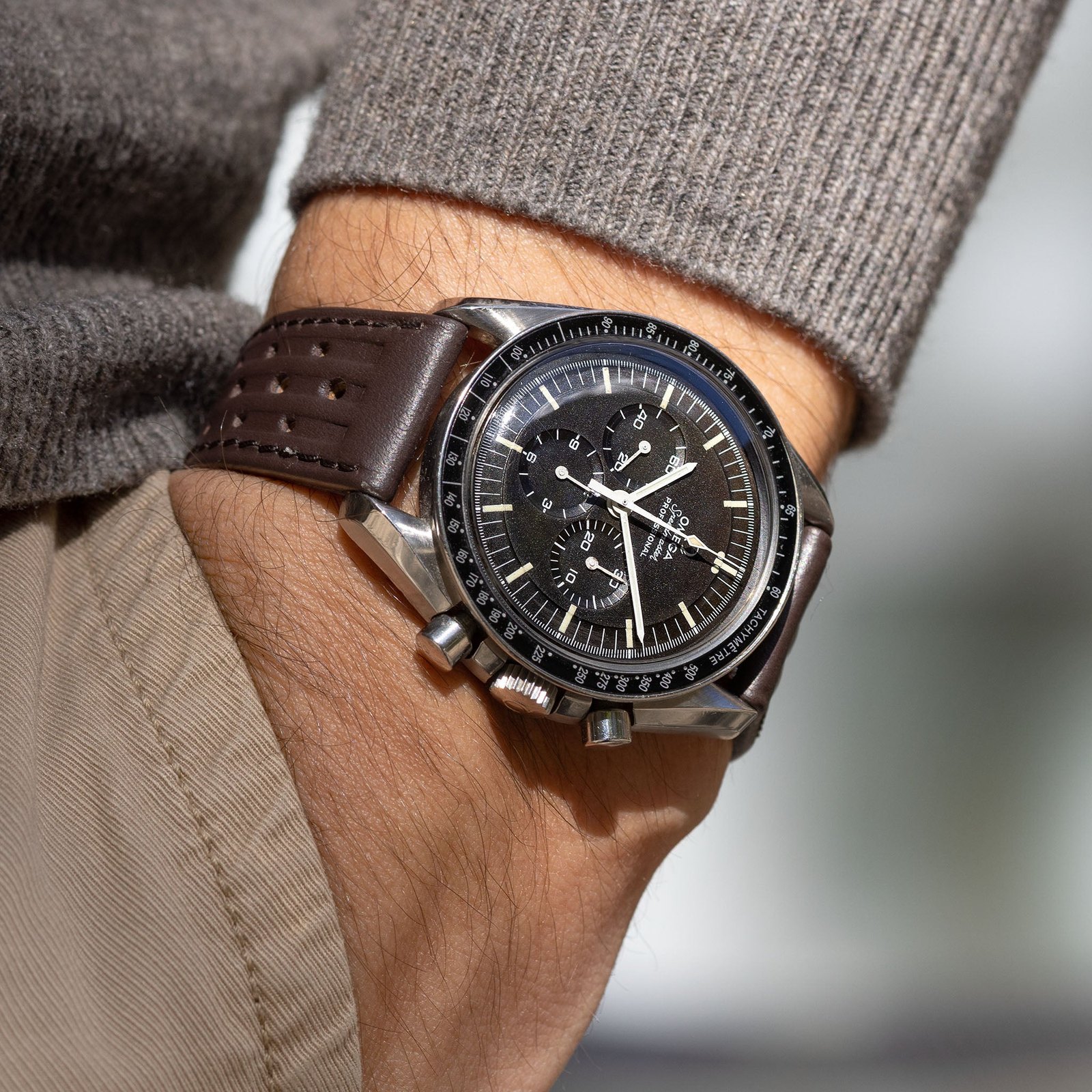
Omega Speedmaster 145.022-69st Tropical Dial, 1969
- Maker / attribution
- Omega (maker)
- Date
- 1969
- Historical period
- Quartz Revolution (1969 – 1990)
- Country of origin
- Switzerland
- Object type
- Wristwatch
- Dimensions
- Case 39 mm
- Stock no.
- W-3418
- Credit line
- Dealer listing, Bulang & Sons (W-3418)
- Catalogue title (original)
- Omega Speedmaster 145.022-69st Tropical Dial (English)
View the source record (dealer listing) ↗ (opens another website in a new tab)Suggest a correction
Record summary
Catalogued by Bulang & Sons (dealer), Copenhagen (stock number W-3418), this is a wristwatch by Omega, made in Switzerland, dated 1969. The Atlas places it in the Quartz Revolution period (1969 – 1990) of its Wristwatches collection. Recorded dimensions: Case 39 mm. The record is illustrated with 6 photographs.
Assembled from the source record's structured fields. Dates and attributions are given as the source states them; where a field is missing the Atlas leaves it blank rather than estimating.
Catalogue description
Dealer description — Bulang & Sons
We all know the stories about Speedmasters, right? So we’re not going to bore you with tales about it being the first watch on the moon and all that... But this lovely 1969 model has a fantastic case, with the case back featuring the iconic Hippocampus still in great condition. And since we promised not to go on about the moon landing, we’ll tell you the story behind that odd little creature on Omega case backs instead: In the 1950s, an engraver named Jean-Pierre Borle was working at Omega He was the artisan behind the iconic “Observatory” emblem found on the caseback of the Omega Constellation, which features an observatory surrounded by eight stars. The design symbolizes the locations of chronometer trials (observatories), while the eight stars represent the number of chronometric records OMEGA broke in 1931. During a trip to Venice, Borle noticed the hippocampi (yes— 1 hippocampus, 2 hippocampi ... finally, our Latin lessons come in handy)—mythical seahorse-like figures—adorning the sides of gondolas. Inspired by these elegant forms, he created a new engraving. In 1958, the hippocampus became the official symbol of the Omega Seamaster, representing the watch’s water-resistant capabilities. So, there you go! Back to this Speedy: the Tachymètre bezel is in lovely condition, and as this is the so-called “dot next to 90” version, we believe it’s a slightly later replacement than the watch itself. The real star of this Speedy is the beautiful milk-chocolate brown step dial, accented with warm, yellow-colored lume—a super warm combination. The watch is paired with our Racing Dark Brown Speedy strap, which we think is a truly perfect match. It’s powered by the hand-wound Caliber 861, fully serviced by our watchmaker. Whether you're chasing moon landings, craving chocolate, or just love a good tropical dial, this Speedy ticks all the boxes. Don't wait for another orbit—scoop it up before someone else launches it into their collection( ba -dum tssss). Specifications: Omega Reference 145.022-69st Speedmaster 39mm steel case Cal 861 hand-wound movement Movement 2911xxxx Serial dating to 1969 Tritium dial with yellow lume, milk chocolate brown Black ‘Dot Next to 90’ bezel Bulang and sons Racing Dark brown speedystrap Fully serviced by our watchmaker
Historical context
Quartz Revolution (1969 – 1990)
Seiko's Astron begins mass quartz timekeeping; traditional industries contract sharply.
Quartz and digital watches transformed the market after 1969. Swiss employment collapsed, Japanese and Hong Kong production soared, and the Swatch (1983) helped the Swiss industry recover; mechanical watches survived as luxury goods.
Read the period in the timelineMore wristwatches from this periodEarlier: Modern Mechanical Horology
Atlas type guide
Wristwatches
Bracelet watches were worn by women from the early nineteenth century — Breguet made one for Caroline Murat, Queen of Naples, in 1810–12 — but the wristwatch only became a man's instrument with military use and aviation in the early twentieth century. Between the World Wars it overtook the pocket watch; the 1920s and 1930s brought rectangular Art Deco cases, water-resistant cases and the first automatic winding systems.
After 1945 the wristwatch became a carrier of identity — dress watches, sports and dive watches, chronographs, calendars — produced by Swiss, American, Japanese, German, Soviet and Chinese industries. The quartz revolution after 1969 and the mechanical renaissance since the 1990s, including the rise of independent watchmakers, complete the story.
What to look for
- The reference number (between the lugs or inside the case back) and serial number, the starting point for dating.
- The calibre: its maker and number are often stamped under the dial or on the bridge.
- Originality of dial, hands and crown — refinished ('redial') dials are common.
- Case material marks: 18K/750, 14K/585, stainless steel, gold-filled, plated.
Dating clues
- Wire-lug cases: before c. 1925.
- Water-resistant screw-down cases: from 1926.
- Quartz movements: from 1969; sapphire crystals widespread after c. 1980.
General guidance written by the Atlas editors about this kind of object. It is not a statement about this particular piece; for that, rely on the source record above and on physical examination.
Related records

Instruments · 1950–1976
Omega Megaquartz 2400 marine chronometer, 1950–1976
Science Museum Group, London

Instruments · 1960–1979
Stopwatch / timer by Omega, 1960–1979
Science Museum Group, London

Instruments · 1960–1979
Stopwatch / timer by Omega, Switzerland, 1960–1979
Science Museum Group, London

Instruments · 1960–1979
Stopwatch by Omega, Swiss made, single-button type reading 0 - 60 seconds in fifths and 0 - 5 minutes in minutes on subsidiary dial, 1960-79.
Science Museum Group, London

Wristwatches · 1970
Wristwatch by Heno, Switzerland, 1970
Museum Rotterdam

Wristwatches · 1960–1986
'Tri-Compax' calendar chronograph wristwatch in gold case, by Universal, Geneva, Switzerland, 1960–1986.
Science Museum Group, London

Wristwatches · 1969–1970
Beta 21 Quartz wristwatch movement, made in Switzerland, 1970.
Science Museum Group, London

Wristwatches · c. 1969
Omega Speedmaster Moonwatch, ref. 145022-69st, c. 1969
Antiquorum auction archive, Geneva