
Wristwatches · Wristwatch
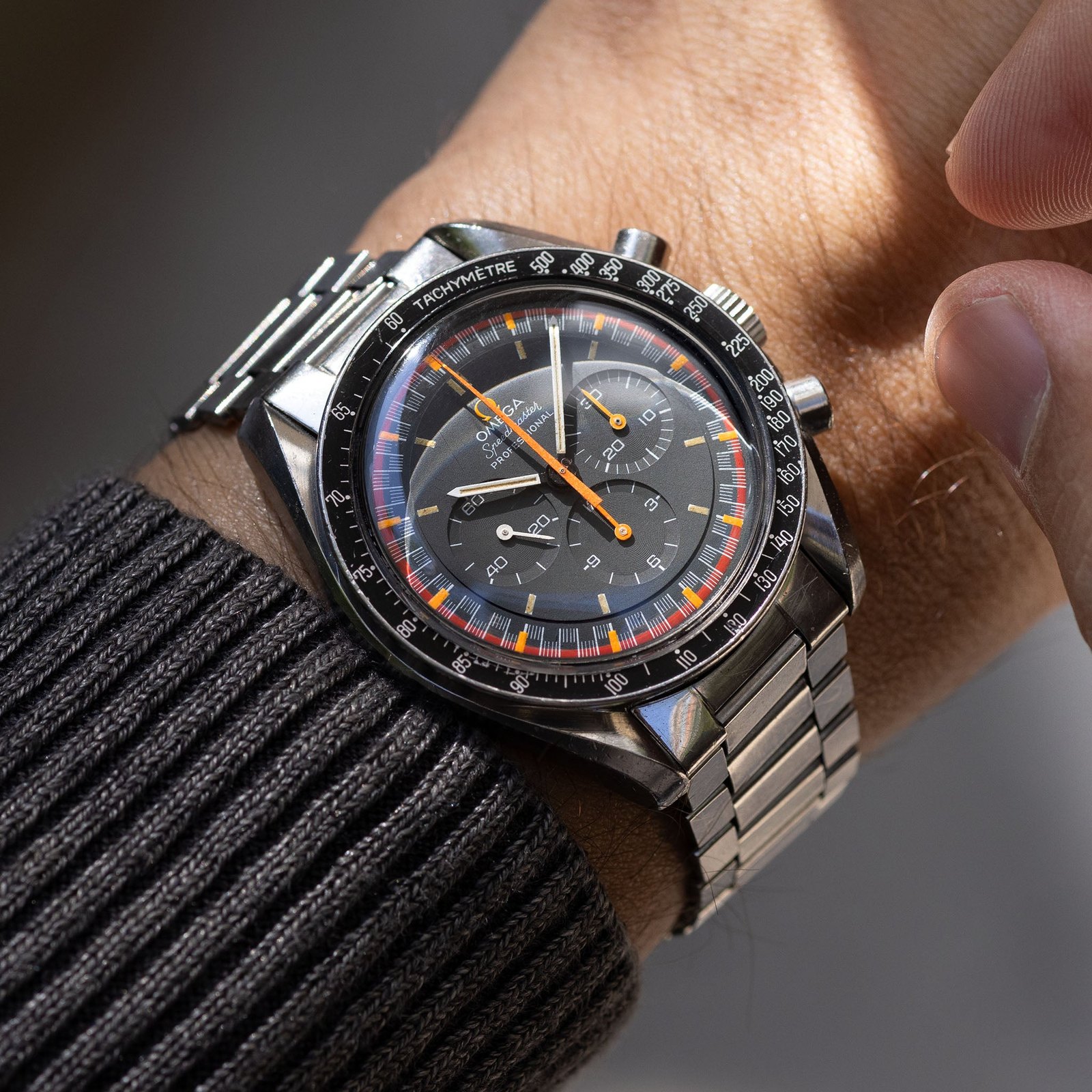
Omega Speedmaster 145.022-69 Grey Racing dial with Original Box and Booklet, 1969
- Maker / attribution
- Omega (maker)
- Date
- 1969
- Historical period
- Quartz Revolution (1969 – 1990)
- Country of origin
- Switzerland
- Object type
- Wristwatch
- Dimensions
- Case 42 mm
- Stock no.
- W-3895
- Credit line
- Dealer listing, Bulang & Sons (W-3895)
- Catalogue title (original)
- Omega Speedmaster 145.022-69 Grey Racing dial with Original Box and Booklet (English)
View the source record (dealer listing) ↗ (opens another website in a new tab)Suggest a correction
Record summary
Catalogued by Bulang & Sons (dealer), Copenhagen (stock number W-3895), this is a wristwatch by Omega, made in Switzerland, dated 1969. The Atlas places it in the Quartz Revolution period (1969 – 1990) of its Wristwatches collection. Recorded dimensions: Case 42 mm. The record is illustrated with 6 photographs.
Assembled from the source record's structured fields. Dates and attributions are given as the source states them; where a field is missing the Atlas leaves it blank rather than estimating.
Catalogue description
Dealer description — Bulang & Sons
The Omega Speedmaster is one of the world's most iconic chronographs, originally launched in 1957 as a racing and sports watch. It was the first chronograph to feature a tachymeter scale on the external bezel rather than the dial, improving readability for racing drivers. In the early 1960s, NASA secretly acquired chronographs from several manufacturers to determine which would be suitable for its astronauts. After surviving a series of brutal qualification tests—including extreme temperatures, violent shocks, vibrations, acceleration, and decompression—the Speedmaster was the only watch to pass. In 1965, NASA officially certified it for all manned space missions . Its most legendary moment came on July 21, 1969 (UTC), when astronaut Buzz Aldrin stepped onto the lunar surface during the Apollo 11 mission while wearing his Speedmaster. This historic achievement forever cemented the watch's place in history and earned it its enduring nickname: the "Moonwatch." If you are looking for a truly rare and historically significant Omega Speedmaster, look no further. Produced in a limited run of approximately 150 pieces, this reference is widely regarded as Omega's first limited-production Speedmaster, making it one of the most collectible vintage Speedmasters ever produced. Although the Speedmaster Mark II is best known for its colourful "Racing Dial," it remains something of a mystery why Omega produced a small batch of these dials for the reference 145.022. Whether it was a market test, an experiment to gauge demand, or an attempt to appeal to motorsport enthusiasts, no official explanation has ever surfaced. Whatever the reason, it is estimated that only around 150 examples were cased, making this one of the rarest and most desirable Speedmasters in existence. The classic asymmetrical 42 mm stainless steel case is in wonderful condition. The case back retains a well-defined hippocampus medallion, and we have deliberately chosen to leave the watch untouched, as we found no evidence that it has ever been polished. The original tachymeter bezel remains in very nice condition and features the coveted "Dot Over Ninety" (DON) configuration, while the original Omega-signed hesalite crystal is still fitted. The distinctive grey "Racing Dial" immediately catches the eye with its vivid orange accents, matching orange hands, and soft red outer minute track. These vibrant colours give the watch tremendous wrist presence—we've even included a photograph taken under UV light, where the dial truly comes alive. The watch is fitted with the correct Omega reference 1039 flat-link bracelet with 516 end links and a clasp stamped 2/70. Inside beats the legendary hand-wound calibre 861, fully checked and regulated and bearing a movement number within the correct range documented for the other known Racing Dial Speedmasters. Whether these watches were intended as a limited-production experiment or simply a bold exploration of a more colourful Speedmaster, we may never know. What is certain is that they have become one of the most sought-after and fascinating chapters in Speedmaster history. The watch comes with its original Omega inner and outer boxes and an Omega booklet. A true collector's Speedmaster in every sense of the word. Combining the legendary calibre 861, the coveted Racing Dial, and an estimated production of only 150 pieces, this is an opportunity to acquire one of the rarest and most fascinating Speedmasters ever made. Let us get you this wrapped around your wrist! Specifications Omega Speedmaster Reference 145-022-69 Rare grey racing dial Dot over Ninety (DON) tachymeter bezel Movement no. 2960xxxx Dating to 1969 Calibre 861 movement, hand wound Inner and Outer Omega boxes, Omega booklet Reference 1039 bracelet with 516 end links Fully serviced by our watchmaker
Historical context
Quartz Revolution (1969 – 1990)
Seiko's Astron begins mass quartz timekeeping; traditional industries contract sharply.
Quartz and digital watches transformed the market after 1969. Swiss employment collapsed, Japanese and Hong Kong production soared, and the Swatch (1983) helped the Swiss industry recover; mechanical watches survived as luxury goods.
Read the period in the timelineMore wristwatches from this periodEarlier: Modern Mechanical Horology
Atlas type guide
Wristwatches
Bracelet watches were worn by women from the early nineteenth century — Breguet made one for Caroline Murat, Queen of Naples, in 1810–12 — but the wristwatch only became a man's instrument with military use and aviation in the early twentieth century. Between the World Wars it overtook the pocket watch; the 1920s and 1930s brought rectangular Art Deco cases, water-resistant cases and the first automatic winding systems.
After 1945 the wristwatch became a carrier of identity — dress watches, sports and dive watches, chronographs, calendars — produced by Swiss, American, Japanese, German, Soviet and Chinese industries. The quartz revolution after 1969 and the mechanical renaissance since the 1990s, including the rise of independent watchmakers, complete the story.
What to look for
- The reference number (between the lugs or inside the case back) and serial number, the starting point for dating.
- The calibre: its maker and number are often stamped under the dial or on the bridge.
- Originality of dial, hands and crown — refinished ('redial') dials are common.
- Case material marks: 18K/750, 14K/585, stainless steel, gold-filled, plated.
Dating clues
- Wire-lug cases: before c. 1925.
- Water-resistant screw-down cases: from 1926.
- Quartz movements: from 1969; sapphire crystals widespread after c. 1980.
General guidance written by the Atlas editors about this kind of object. It is not a statement about this particular piece; for that, rely on the source record above and on physical examination.
Related records

Instruments · 1950–1976
Omega Megaquartz 2400 marine chronometer, 1950–1976
Science Museum Group, London

Instruments · 1960–1979
Stopwatch / timer by Omega, 1960–1979
Science Museum Group, London

Instruments · 1960–1979
Stopwatch / timer by Omega, Switzerland, 1960–1979
Science Museum Group, London

Instruments · 1960–1979
Stopwatch by Omega, Swiss made, single-button type reading 0 - 60 seconds in fifths and 0 - 5 minutes in minutes on subsidiary dial, 1960-79.
Science Museum Group, London

Wristwatches · 1970
Wristwatch by Heno, Switzerland, 1970
Museum Rotterdam

Wristwatches · 1960–1986
'Tri-Compax' calendar chronograph wristwatch in gold case, by Universal, Geneva, Switzerland, 1960–1986.
Science Museum Group, London

Wristwatches · 1969–1970
Beta 21 Quartz wristwatch movement, made in Switzerland, 1970.
Science Museum Group, London

Wristwatches · c. 1969
Omega Speedmaster Moonwatch, ref. 145022-69st, c. 1969
Antiquorum auction archive, Geneva