
Wristwatches · Self-winding wristwatch
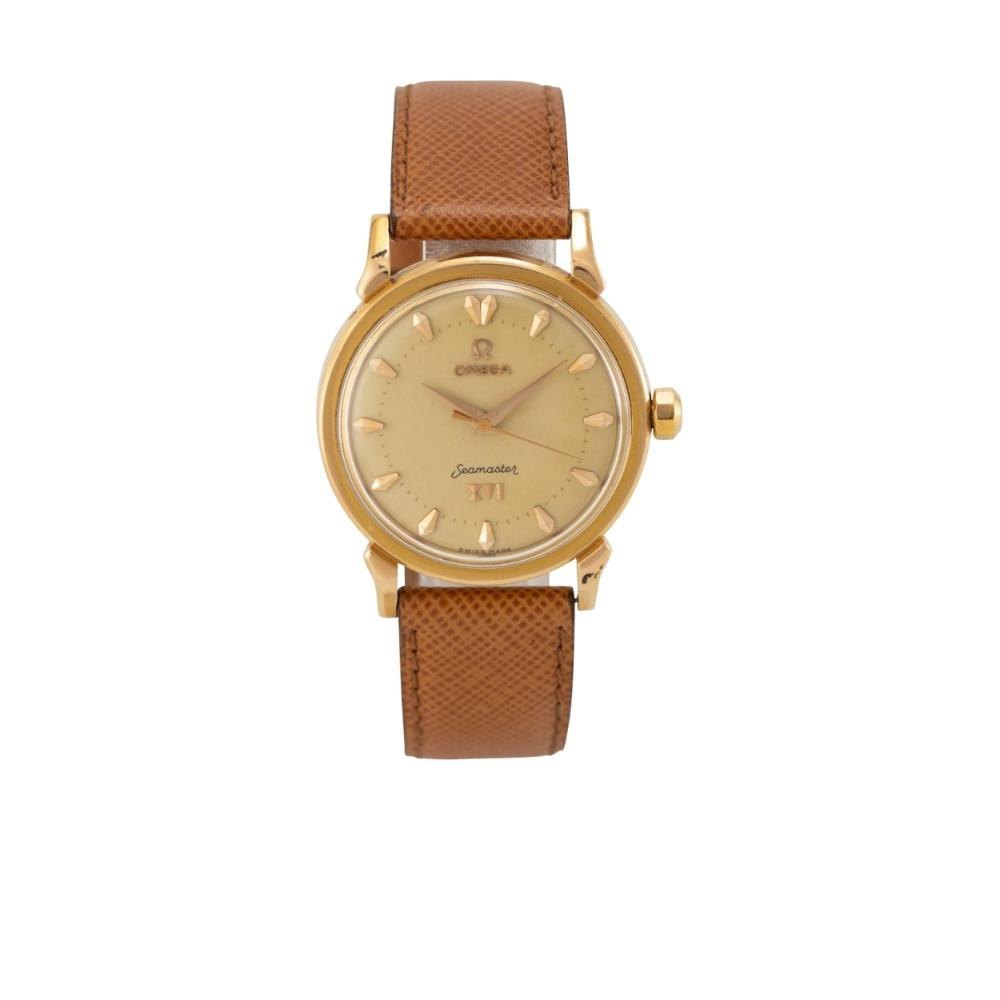
Omega Seamaster XVI Melbourne Olympic Games Wristwatch
- Maker / attribution
- Omega (source attribution)
- Date
- c. 1954
- Historical period
- Modern Mechanical Horology (1945 – 1969)
- Country of origin
- Switzerland
- Object type
- Self-winding wristwatch
- Materials / technique
- 18 K pink gold
- Dimensions
- 34 mm
- Auction house
- Auktionen Dr. Crott
- Lot
- 342
- Credit line
- Auktionen Dr. Crott
- Catalogue title (original)
- At Auction: Omega - Melbourne Olympic Games (English)
View the source record (auction lot) ↗ (opens another website in a new tab)Suggest a correction
Record summary
Catalogued by Auktionen Dr. Crott (lot 342), this is a self-winding wristwatch attributed to Omega, made in Switzerland, dated c. 1954. The Atlas places it in the Modern Mechanical Horology period (1945 – 1969) of its Wristwatches collection. Materials and techniques recorded by the source: 18 K pink gold. Recorded dimensions: 34 mm. The record is illustrated with 1 photograph.
Assembled from the source record's structured fields. Dates and attributions are given as the source states them; where a field is missing the Atlas leaves it blank rather than estimating.
Catalogue description
Original object description
Catalogued as reference 2850 SC and dating to circa 1954, this 18-karat pink gold Omega Seamaster XVI wristwatch was created to commemorate the 1956 Melbourne Olympic Games and mark the manufacturer's 25 years as official Olympic timekeeper. Production is estimated at roughly 100 examples. The 34 mm case (stamped 11423005) is detailed with downturned lugs, a faceted winding crown, and a snap-on back cast in high relief with the Helsinki 1952 Olympic Cross of Merit insignia. The lemon-yellow China lacquer dial, displaying the fine crack pattern characteristic of the 'Spider Web' variant, features beveled gold-tone hour indexes and an applied Roman numeral 'XVI' at the 6 o'clock position. The self-winding movement is an Omega caliber 471, marked with serial number 14784725. The case and running movement are recorded in 'very good' condition, with the movement noted as likely to benefit from a standard cleaning. Any leather straps appearing in photography are non-contractual props subject to export restrictions beyond the European Union.
Inscriptions & marks
11423005
Historical context
Modern Mechanical Horology (1945 – 1969)
Tool watches for divers, pilots and astronauts; electric watches anticipate the electronic age.
The classic era of the mechanical wristwatch: dive watches, chronographs for motor racing and space flight, GMT watches for jet travel, slim dress watches, automatic calendars, and the rise of Japanese manufacturers alongside Swiss, American, German and Soviet industries.
Read the period in the timelineMore wristwatches from this periodEarlier: Golden Age of Mechanical Watchmaking
Atlas type guide
Automatic (self-winding) watches
Self-winding watches use the wearer's motion to wind the mainspring. Abraham-Louis Perrelet and Breguet made 'perpétuelle' pocket watches with oscillating weights in the late eighteenth century, but the principle only became practical in the wristwatch. John Harwood patented a bumper automatic in 1923; Rolex's Perpetual rotor (1931) winding in one direction, and later bidirectional rotors (Eterna, Felsa Bidynator), established the modern form. Micro-rotors (Universal Genève, Buren) and peripheral rotors made automatic watches thinner.
What to look for
- A semicircular rotor turning 360° over the movement, or a 'bumper' weight that rebounds between springs.
- 'Automatic', 'Perpetual' or 'Self-winding' on the dial.
- A sealed screw-back case, since automatic watches are wound less often by the crown.
Dating clues
- Bumper automatics: 1923–c. 1955.
- Full rotors: from 1931 (Rolex); widespread after c. 1950.
- Micro-rotors: from 1954–1958.
General guidance written by the Atlas editors about this kind of object. It is not a statement about this particular piece; for that, rely on the source record above and on physical examination.
Related records

Instruments · 1950–1976
Omega Megaquartz 2400 marine chronometer, 1950–1976
Science Museum Group, London

Instruments · 1960–1979
Stopwatch / timer by Omega, 1960–1979
Science Museum Group, London

Instruments · 1960–1979
Stopwatch / timer by Omega, Switzerland, 1960–1979
Science Museum Group, London

Instruments · 1960–1979
Stopwatch by Omega, Swiss made, single-button type reading 0 - 60 seconds in fifths and 0 - 5 minutes in minutes on subsidiary dial, 1960-79.
Science Museum Group, London

Wristwatches · 1945
Wristwatch by Eterna, 1945
Museum Rotterdam

Wristwatches · c. 1945
Breitling Premier, ref. 790, c. 1945
Antiquorum auction archive, Geneva

Wristwatches · c. 1945
Universal Genève Uni-Compax, ref. 22492, c. 1945
Antiquorum auction archive, Geneva

Wristwatches · c. 1950s
Baume & Mercier wristwatch, c. 1950s
Antiquorum auction archive, Geneva