
Wristwatches · Wristwatch
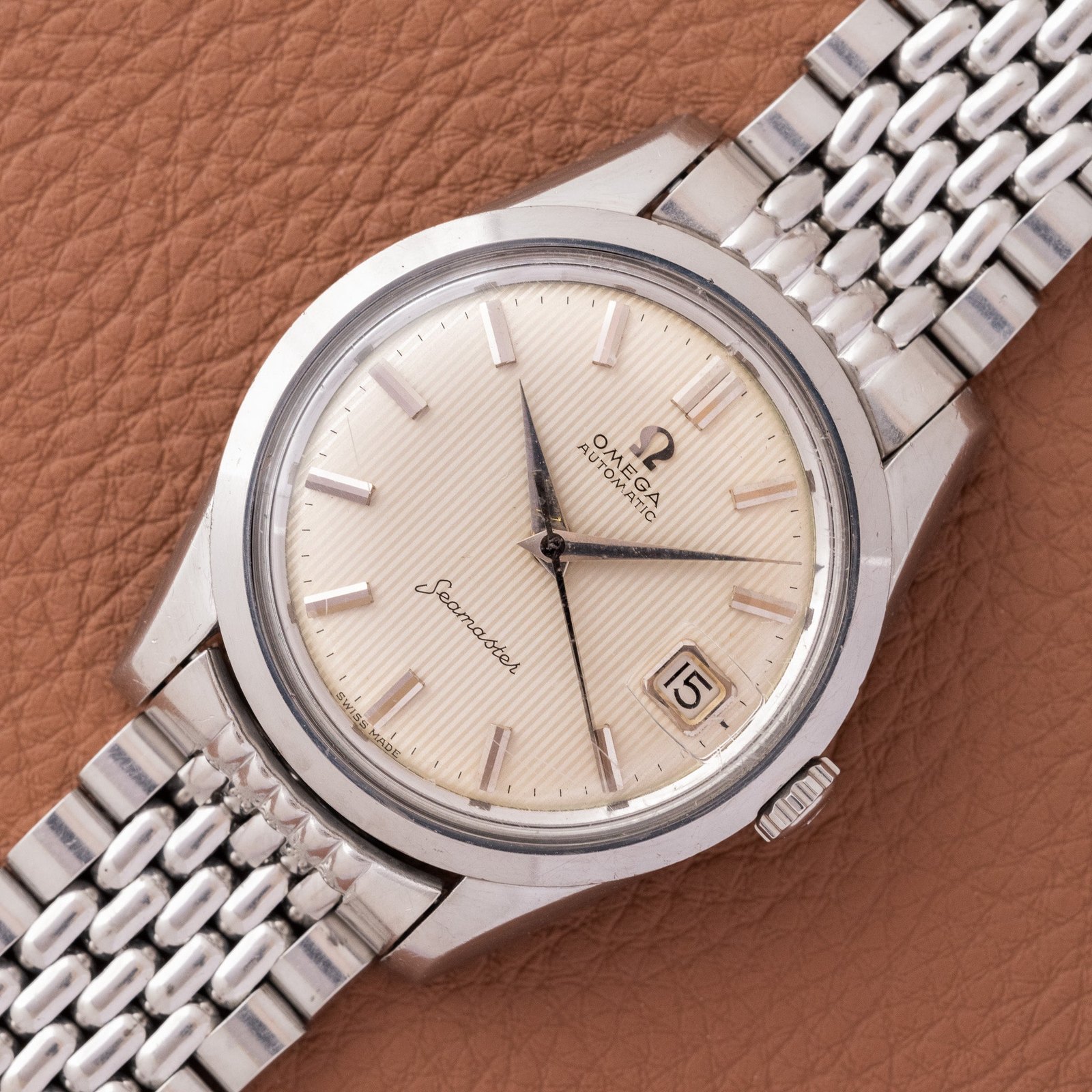
Omega Seamaster Tapestry - Beads Of Rice (Ref. 14744-1), 1960
- Maker / attribution
- Omega (maker)
- Date
- 1960
- Historical period
- Modern Mechanical Horology (1945 – 1969)
- Country of origin
- Switzerland
- Object type
- Wristwatch
- Dimensions
- Case 35 mm
- Stock no.
- Product 8269435273399
- Credit line
- Dealer listing, Huntington Company (product 8269435273399)
- Catalogue title (original)
- 1960 Omega Seamaster Tapestry - Beads Of Rice (Ref. 14744-1) (English)
View the source record (dealer listing) ↗ (opens another website in a new tab)Suggest a correction
Record summary
Catalogued by Huntington Company (dealer) (stock number Product 8269435273399), this is a wristwatch by Omega, made in Switzerland, dated 1960. The Atlas places it in the Modern Mechanical Horology period (1945 – 1969) of its Wristwatches collection. Recorded dimensions: Case 35 mm. The record is illustrated with 6 photographs.
Assembled from the source record's structured fields. Dates and attributions are given as the source states them; where a field is missing the Atlas leaves it blank rather than estimating.
Catalogue description
Dealer description — Huntington Company
Timeless & Attainable Start your vintage journey with confidence. History & Significance The Seamaster line began as a tribute to Omega’s 100th anniversary in 1948, designed with improved water resistance thanks to its O-ring gasket system. In 1957, Omega introduced the Seamaster 300, which became the brand’s first true professional diver’s model and was famously used during Jacques Cousteau’s Conshelf II experiments. By the 1990s, the Seamaster had become a cultural icon after being chosen as James Bond’s watch in GoldenEye (1995). Pierce Brosnan and later Daniel Craig wore Seamasters on screen, securing the model’s place in modern culture. This early-production Ref. 14744-1 predates that cinematic fame, a pure, mid-century Seamaster design with an understated silver tapestry dial and large hour markers. It’s a watch that bridges Omega’s early post-war dress aesthetic with the durability that would define its tool watches for decades to come. Writer’s Thoughts This is one of those references that shows why vintage Omega remains such an incredible value. The proportions are perfect, the tapestry dial texture catches light beautifully, and the case profile feels substantial yet refined. Paired with a beads-of-rice bracelet, it delivers that unmistakable 1960s Omega character, versatile, well-built, and effortlessly stylish. Our Promise Every watch is thoroughly vetted, carefully described with complete transparency, and guaranteed to be authentic. This Omega Seamaster is presented in original condition, representing both timeless style and enduring quality. Specifications Brand: Omega Model: Seamaster Ref. 14744-1 Year: 1960 Case Material: Stainless steel Case Size: 35mm diameter, 43.6mm lug-to-lug, 18mm lug width Bezel: Smooth steel bezel Dial: Silver tapestry no-lume dial with large hour markers and dauphine hands Crystal: Omega-signed acrylic crystal Movement: Automatic winding Bracelet: Beads-of-Rice bracelet Clasp: Omega-signed steel clasp Contents: Watch only Condition Case: Strong, even surfaces with thick beefy lugs; light wear consistent with age. Bezel: Smooth steel bezel, unpolished and sharp with minor surface wear. Crystal: Omega-signed acrylic crystal in excellent condition. Dial: Original silver tapestry dial with warm patina; uncommon no-lume variant with large applied markers. Hands: Original dauphine hands showing light aging. Bracelet: Tight Beads-of-Rice bracelet fitting up to a 7.5-inch wrist. Clasp: Original clasp remains tight and secure
Historical context
Modern Mechanical Horology (1945 – 1969)
Tool watches for divers, pilots and astronauts; electric watches anticipate the electronic age.
The classic era of the mechanical wristwatch: dive watches, chronographs for motor racing and space flight, GMT watches for jet travel, slim dress watches, automatic calendars, and the rise of Japanese manufacturers alongside Swiss, American, German and Soviet industries.
Read the period in the timelineMore wristwatches from this periodEarlier: Golden Age of Mechanical Watchmaking
Atlas type guide
Dive and water-resistant watches
Keeping water and dust out of a wristwatch was a long-standing challenge. Rolex's screw-down Oyster case (1926) and Omega's Marine (1932) were landmarks; in the early 1950s Blancpain's Fifty Fathoms and Rolex's Submariner defined the professional dive watch with rotating bezels for timing dives, luminous dials and high water resistance. The ISO 6425 standard (1982) later codified what a 'diver's watch' must do.
Dive watches became icons of post-war design and exploration, and their evolution — helium escape valves, ceramic bezels, saturation-diving depth ratings — records the history of underwater work.
What to look for
- Unidirectional or bidirectional rotating bezel with minute markings.
- Screw-down crown and case back; depth rating printed on the dial.
- Luminous hands and markers (radium before c. 1960, tritium c. 1960–1998, then Super-LumiNova).
- Reference numbers on the case between the lugs or inside the back.
Dating clues
- Screw-down Oyster cases: from 1926.
- Professional dive watches: from 1953.
- Tritium 'T' marks on dials: c. 1960–1998.
General guidance written by the Atlas editors about this kind of object. It is not a statement about this particular piece; for that, rely on the source record above and on physical examination.
Related records

Instruments · 1950–1976
Omega Megaquartz 2400 marine chronometer, 1950–1976
Science Museum Group, London

Instruments · 1960–1979
Stopwatch / timer by Omega, 1960–1979
Science Museum Group, London

Instruments · 1960–1979
Stopwatch / timer by Omega, Switzerland, 1960–1979
Science Museum Group, London

Instruments · 1960–1979
Stopwatch by Omega, Swiss made, single-button type reading 0 - 60 seconds in fifths and 0 - 5 minutes in minutes on subsidiary dial, 1960-79.
Science Museum Group, London

Wristwatches · 1945
Wristwatch by Eterna, 1945
Museum Rotterdam

Wristwatches · c. 1945
Breitling Premier, ref. 790, c. 1945
Antiquorum auction archive, Geneva

Wristwatches · c. 1945
Universal Genève Uni-Compax, ref. 22492, c. 1945
Antiquorum auction archive, Geneva

Wristwatches · c. 1950s
Baume & Mercier wristwatch, c. 1950s
Antiquorum auction archive, Geneva