
Wristwatches · Wristwatch
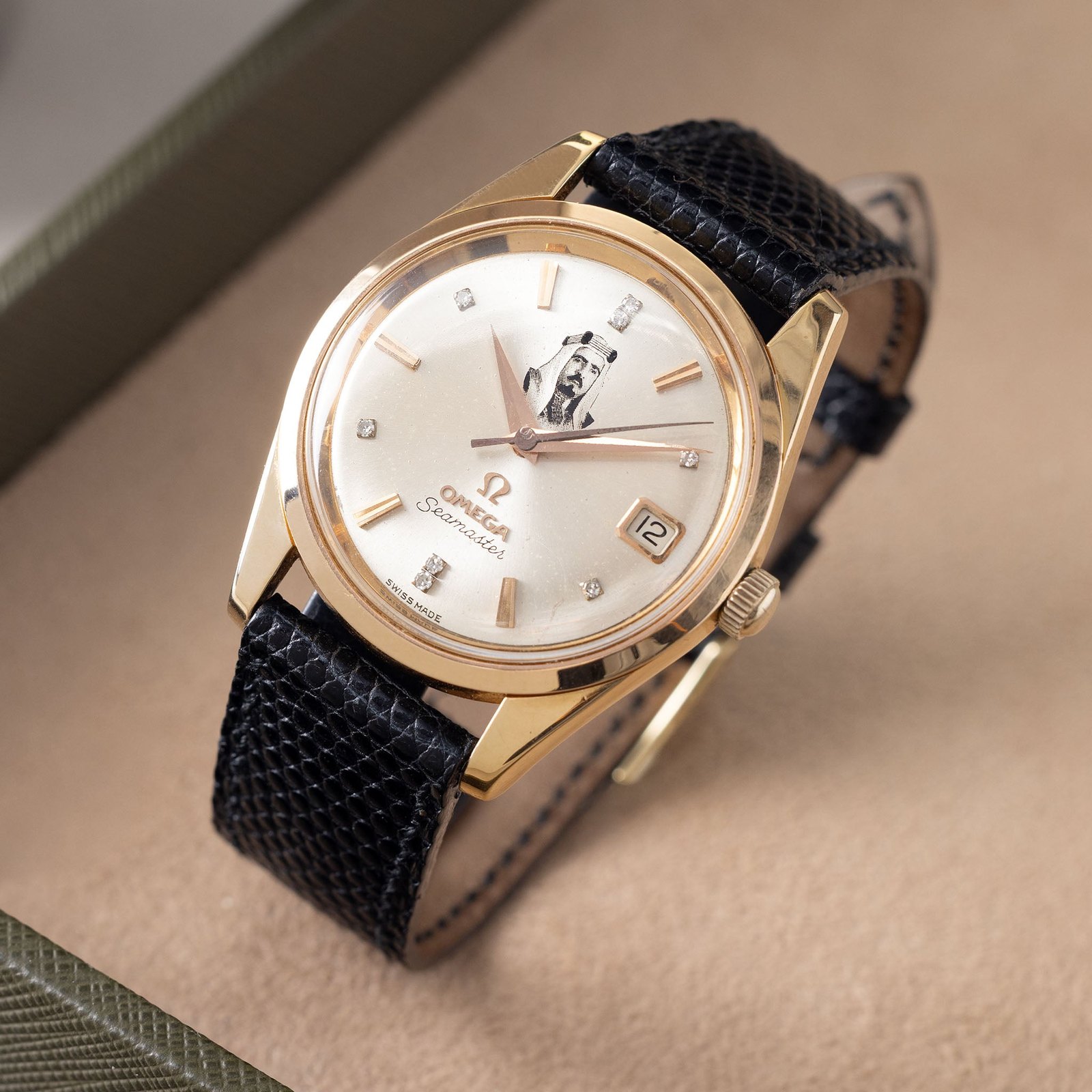
Omega Seamaster Dresswatch in 18k Rose Gold Diamond Markers for Sheikh Bin Salman of Bahrein ref. 166010 62, 1962
- Maker / attribution
- Omega (maker)
- Date
- 1962
- Historical period
- Modern Mechanical Horology (1945 – 1969)
- Country of origin
- Switzerland
- Object type
- Wristwatch
- Materials / technique
- 18k rose gold
- Dimensions
- Case 34 mm
- Stock no.
- W-3941
- Credit line
- Dealer listing, Bulang & Sons (W-3941)
- Catalogue title (original)
- Omega Seamaster Dresswatch in 18k Rose Gold Diamond Markers for Sheikh Bin Salman of Bahrein ref. 166010 62 (English)
View the source record (dealer listing) ↗ (opens another website in a new tab)Suggest a correction
Record summary
Catalogued by Bulang & Sons (dealer), Copenhagen (stock number W-3941), this is a wristwatch by Omega, made in Switzerland, dated 1962. The Atlas places it in the Modern Mechanical Horology period (1945 – 1969) of its Wristwatches collection. Materials and techniques recorded by the source: 18k rose gold. Recorded dimensions: Case 34 mm. The record is illustrated with 6 photographs.
Assembled from the source record's structured fields. Dates and attributions are given as the source states them; where a field is missing the Atlas leaves it blank rather than estimating.
Catalogue description
Dealer description — Bulang & Sons
The Omega Seamaster was introduced in 1948 to celebrate Omega’s 100th anniversary. It was originally conceived as a robust yet elegant everyday watch, drawing on the water-resistant designs Omega had developed for military and civilian use during the 1930s and 1940s. The name “Seamaster” might suggest a dedicated diving instrument today, but that was certainly not how the collection began. The early Seamasters were refined everyday watches, designed to combine reliability and water resistance with the elegance expected from a dress watch. Many were fitted with beautifully finished dials, slim cases and leather straps rather than the rotating bezels and chunky bracelets we associate with modern dive watches. This makes the early Seamaster particularly interesting for collectors. During the 1950s and 1960s, Omega produced an incredibly broad range of Seamaster models, from simple three-hand dress watches to more substantial waterproof examples and, eventually, purpose-built dive watches. At hand we have a particularly interesting specimen. This 18k rose-gold Seamaster features a lovely case with thick, elegant lugs, a winding crown at 3 o’clock and a screw-down caseback carrying the distinctive Seamaster Hippocampus. The original crown was replaced during a service at some point in its life — hardly surprising after more than six decades. What really sets this watch apart, however, is its extraordinary dial. Special-order Omega watches were sometimes commissioned as presentation pieces for governments, royal families and prominent individuals to commemorate important events or milestones. In the Gulf region in particular, watches featuring royal signatures, portraits or official emblems were produced as prestigious gifts and presentation pieces. The present timepiece belongs to an exceedingly small series of Omega Seamasters featuring the portrait of Sheikh Isa Bin Salman Al Khalifa, the former Emir of Bahrain. His portrait occupies the 12 o’clock position, where one would normally find the Omega logo and Seamaster signature, instantly transforming an otherwise elegant Seamaster into something quite extraordinary. The even-numbered hour markers are also specially treated, with diamond-set markers adding a touch of royal extravagance. The dial is entirely non-luminous, as are the sharp original-style hands, keeping the attention firmly on the unusual presentation dial and its precious details. The watch is fitted with an original Omega leather strap and an 18k yellow-gold Omega pin buckle. Inside beats Omega’s automatic calibre 562, a reliable and well-proven movement from the brand’s famous 500-series family. The movement has been fully serviced by our watchmaker and is ready for many more years of wrist time. A Seamaster with a very different story from the dive watches we usually associate with the name. An 18k rose-gold Omega, a portrait of the former Emir of Bahrain and diamond-set markers make this one a particularly fascinating piece of Omega history — exactly the kind of unusual watch that makes vintage collecting so much fun. Bahrain royalty. 18k rose gold. Diamond markers. And a Seamaster with a portrait dial. One of those wonderfully unusual vintage Omegas that makes you stop, look twice and wonder about its story. Specifications: Omega Seamaster Dresswatch Reference 166010 62 34mm 18k Pink gold case Movement serial 2002xxxxx dating to 1962 Special order dial with diamonds and Portrait of Sheikh Bin Salman Comes on the photographed Omega leather strap , Yellow gold Omega pin buckle fitted Cal 562 automatic movement Fully serviced by our watchmaker
Historical context
Modern Mechanical Horology (1945 – 1969)
Tool watches for divers, pilots and astronauts; electric watches anticipate the electronic age.
The classic era of the mechanical wristwatch: dive watches, chronographs for motor racing and space flight, GMT watches for jet travel, slim dress watches, automatic calendars, and the rise of Japanese manufacturers alongside Swiss, American, German and Soviet industries.
Read the period in the timelineMore wristwatches from this periodEarlier: Golden Age of Mechanical Watchmaking
Atlas type guide
Dive and water-resistant watches
Keeping water and dust out of a wristwatch was a long-standing challenge. Rolex's screw-down Oyster case (1926) and Omega's Marine (1932) were landmarks; in the early 1950s Blancpain's Fifty Fathoms and Rolex's Submariner defined the professional dive watch with rotating bezels for timing dives, luminous dials and high water resistance. The ISO 6425 standard (1982) later codified what a 'diver's watch' must do.
Dive watches became icons of post-war design and exploration, and their evolution — helium escape valves, ceramic bezels, saturation-diving depth ratings — records the history of underwater work.
What to look for
- Unidirectional or bidirectional rotating bezel with minute markings.
- Screw-down crown and case back; depth rating printed on the dial.
- Luminous hands and markers (radium before c. 1960, tritium c. 1960–1998, then Super-LumiNova).
- Reference numbers on the case between the lugs or inside the back.
Dating clues
- Screw-down Oyster cases: from 1926.
- Professional dive watches: from 1953.
- Tritium 'T' marks on dials: c. 1960–1998.
General guidance written by the Atlas editors about this kind of object. It is not a statement about this particular piece; for that, rely on the source record above and on physical examination.
Related records

Instruments · 1950–1976
Omega Megaquartz 2400 marine chronometer, 1950–1976
Science Museum Group, London

Instruments · 1960–1979
Stopwatch / timer by Omega, 1960–1979
Science Museum Group, London

Instruments · 1960–1979
Stopwatch / timer by Omega, Switzerland, 1960–1979
Science Museum Group, London

Instruments · 1960–1979
Stopwatch by Omega, Swiss made, single-button type reading 0 - 60 seconds in fifths and 0 - 5 minutes in minutes on subsidiary dial, 1960-79.
Science Museum Group, London

Wristwatches · 1945
Wristwatch by Eterna, 1945
Museum Rotterdam

Wristwatches · c. 1945
Breitling Premier, ref. 790, c. 1945
Antiquorum auction archive, Geneva

Wristwatches · c. 1945
Universal Genève Uni-Compax, ref. 22492, c. 1945
Antiquorum auction archive, Geneva

Wristwatches · c. 1950s
Baume & Mercier wristwatch, c. 1950s
Antiquorum auction archive, Geneva