
Wristwatches · Wristwatch
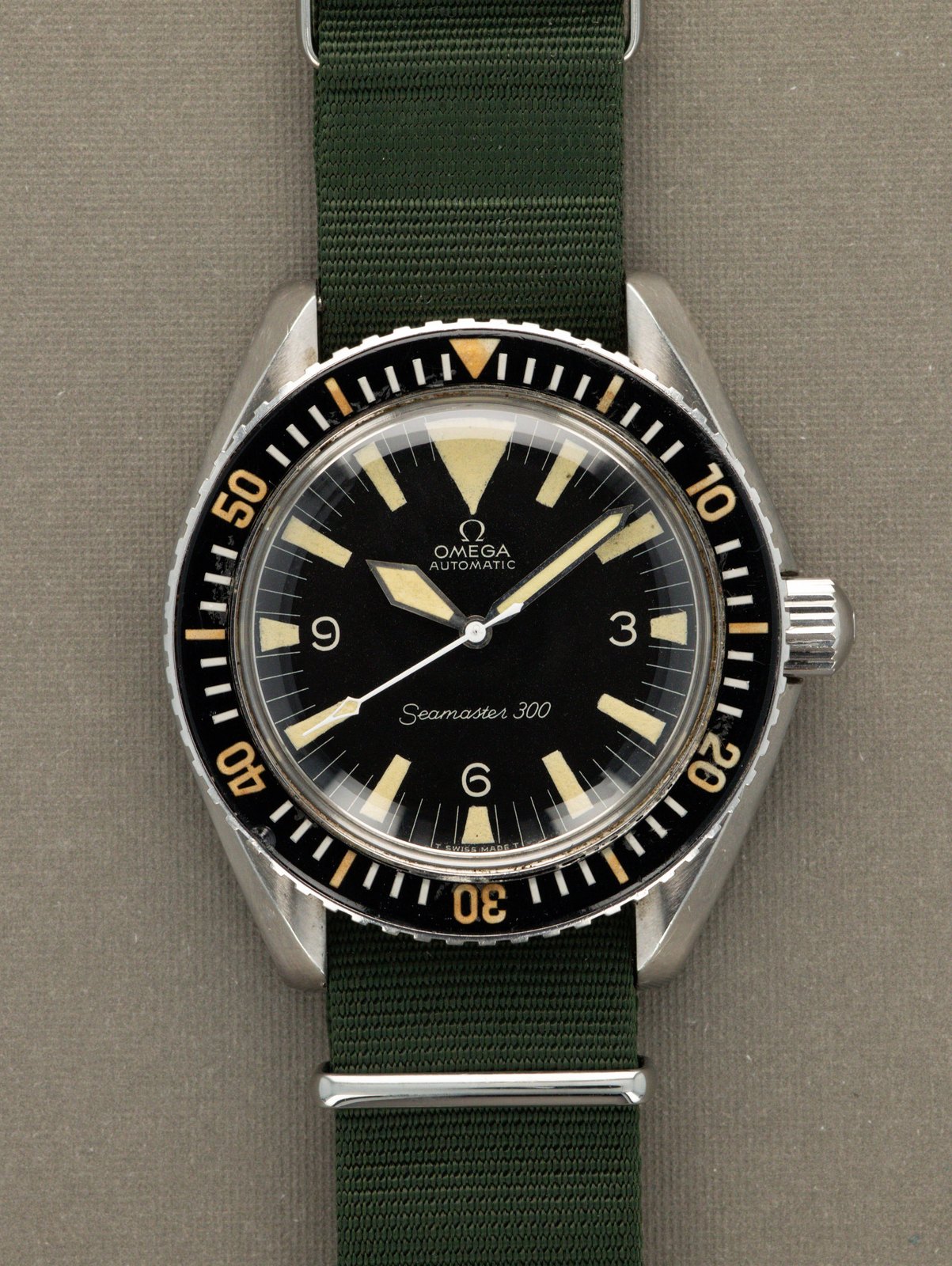
Omega Seamaster 300 ref. 165.024, 'Big Triangle' Dial
- Maker / attribution
- Omega (maker)
- Date
- c. 1966
- Historical period
- Modern Mechanical Horology (1945 – 1969)
- Country of origin
- Switzerland
- Object type
- Wristwatch
- Dimensions
- Case 41 mm
- Stock no.
- OC3247
- Credit line
- Dealer listing, Oliver & Clarke (OC3247)
- Catalogue title (original)
- Omega Seamaster 300 Ref. 165.024 - 'Big Triangle' Dial W/ Box & Papers (English)
View the source record (dealer listing) ↗ (opens another website in a new tab)Suggest a correction
Record summary
Catalogued by Oliver & Clarke (dealer), United Kingdom (stock number OC3247), this is a wristwatch by Omega, made in Switzerland, dated c. 1966. The Atlas places it in the Modern Mechanical Horology period (1945 – 1969) of its Wristwatches collection. Recorded dimensions: Case 41 mm. The record is illustrated with 6 photographs.
Assembled from the source record's structured fields. Dates and attributions are given as the source states them; where a field is missing the Atlas leaves it blank rather than estimating.
Catalogue description
Dealer description — Oliver & Clarke
The Omega Speedmaster is one of the most historically important, if not the most important wrist watch ever produced, full stop. Its story can be summed up with one simple acronym: NASA. Surely, this is not a watch that needs an introduction with our audience... However, the sibling to the Speedmaster, the Seamaster, is worth shedding some light on. The model family was conceived in 1948 as what was effectively a time-only watch, not the dive watch that is most commonly associated with the named today. It wasn't until nearly a decade later where the Seamaster 300 would show up with its rotating timing bezel and larger case size. As with so many other icons and popular vintage models, the Seamaster has seen countless iterations and variants over its nearly 70-years of continuous production, but it is the 300 that is probably what comes to mind when you hear the name. The piece that we have here, a Ref. 165.024, dates to circa 1966 and possesses many of the features that collectors love about SM300s from this period. The 41mm case with 'lyre' lugs remains in strong overall condition, having been tastefully previously polished at an earlier time. The caseback has seemingly been spared of polishing and retains clear and prominent engravings. Both show normal signs of wear throughout and present nicely. The correct bezel assembly shows matching wear and retains the correct black acrylic insert with Tritium markers. Inside, the dial is devoid of a date complication found on many 41mm Seamasters from this era, making for a wonderfully symmetrical dial layout. The Tritium indices exhibit a light and largely uniform patina throughout and are complimented by the same fantastic 'sword'-style handset first designed for the British Royal Navy per M.O.D. specifications. Powering this piece is Omega's workhorse Calibre .552 automatic-winding movement and it comes fitted to a very fitting green NATO strap from Phoenix. It would be enough to enjoy this piece all on its own, but it just so happens that it is accompanied by its original boxes, red vinyl folder, and guarantee booklet dated 9/21/1967. Been looking for an honest, daily-wearable diver from the 1960's from a storied brand? This is hard to beat.
Historical context
Modern Mechanical Horology (1945 – 1969)
Tool watches for divers, pilots and astronauts; electric watches anticipate the electronic age.
The classic era of the mechanical wristwatch: dive watches, chronographs for motor racing and space flight, GMT watches for jet travel, slim dress watches, automatic calendars, and the rise of Japanese manufacturers alongside Swiss, American, German and Soviet industries.
Read the period in the timelineMore wristwatches from this periodEarlier: Golden Age of Mechanical Watchmaking
Atlas type guide
Dive and water-resistant watches
Keeping water and dust out of a wristwatch was a long-standing challenge. Rolex's screw-down Oyster case (1926) and Omega's Marine (1932) were landmarks; in the early 1950s Blancpain's Fifty Fathoms and Rolex's Submariner defined the professional dive watch with rotating bezels for timing dives, luminous dials and high water resistance. The ISO 6425 standard (1982) later codified what a 'diver's watch' must do.
Dive watches became icons of post-war design and exploration, and their evolution — helium escape valves, ceramic bezels, saturation-diving depth ratings — records the history of underwater work.
What to look for
- Unidirectional or bidirectional rotating bezel with minute markings.
- Screw-down crown and case back; depth rating printed on the dial.
- Luminous hands and markers (radium before c. 1960, tritium c. 1960–1998, then Super-LumiNova).
- Reference numbers on the case between the lugs or inside the back.
Dating clues
- Screw-down Oyster cases: from 1926.
- Professional dive watches: from 1953.
- Tritium 'T' marks on dials: c. 1960–1998.
General guidance written by the Atlas editors about this kind of object. It is not a statement about this particular piece; for that, rely on the source record above and on physical examination.
Related records

Instruments · 1950–1976
Omega Megaquartz 2400 marine chronometer, 1950–1976
Science Museum Group, London

Instruments · 1960–1979
Stopwatch / timer by Omega, 1960–1979
Science Museum Group, London

Instruments · 1960–1979
Stopwatch / timer by Omega, Switzerland, 1960–1979
Science Museum Group, London

Instruments · 1960–1979
Stopwatch by Omega, Swiss made, single-button type reading 0 - 60 seconds in fifths and 0 - 5 minutes in minutes on subsidiary dial, 1960-79.
Science Museum Group, London

Wristwatches · 1945
Wristwatch by Eterna, 1945
Museum Rotterdam

Wristwatches · c. 1945
Breitling Premier, ref. 790, c. 1945
Antiquorum auction archive, Geneva

Wristwatches · c. 1945
Universal Genève Uni-Compax, ref. 22492, c. 1945
Antiquorum auction archive, Geneva

Wristwatches · c. 1950s
Baume & Mercier wristwatch, c. 1950s
Antiquorum auction archive, Geneva