
Wristwatches · Wristwatch
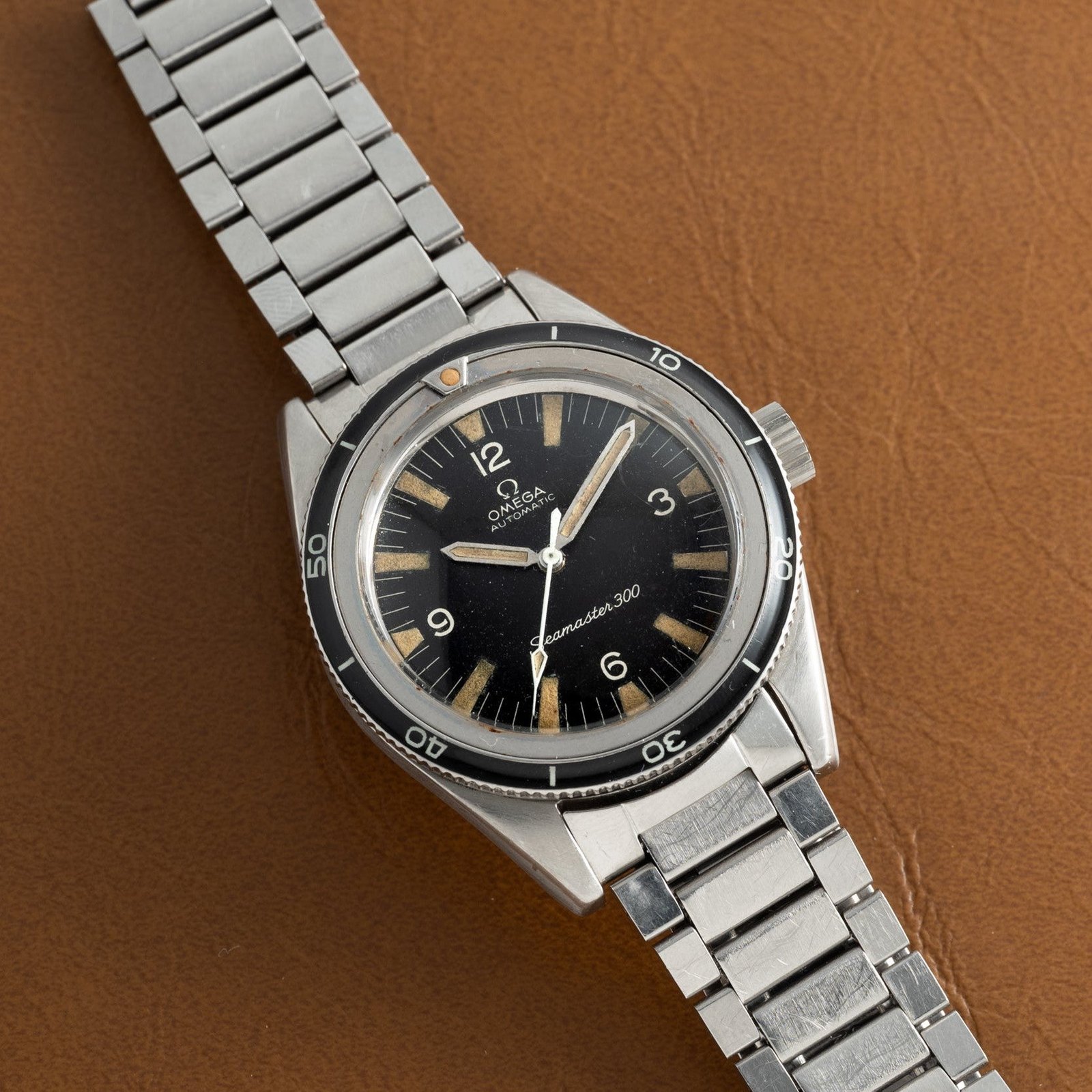
Omega Seamaster 300, c. 1967
- Maker / attribution
- Omega (maker)
- Date
- c. 1967
- Historical period
- Modern Mechanical Horology (1945 – 1969)
- Country of origin
- Switzerland
- Object type
- Wristwatch
- Dimensions
- Case 38 mm
- Stock no.
- 40960048
- Credit line
- Dealer listing, Analog/Shift (40960048)
- Catalogue title (original)
- Omega Seamaster 300 (English)
View the source record (dealer listing) ↗ (opens another website in a new tab)Suggest a correction
Record summary
Catalogued by Analog/Shift (dealer), New York (stock number 40960048), this is a wristwatch by Omega, made in Switzerland, dated c. 1967. The Atlas places it in the Modern Mechanical Horology period (1945 – 1969) of its Wristwatches collection. Recorded dimensions: Case 38 mm. The record is illustrated with 6 photographs.
Assembled from the source record's structured fields. Dates and attributions are given as the source states them; where a field is missing the Atlas leaves it blank rather than estimating.
Catalogue description
Dealer description — Analog/Shift
The origin of the Seamaster can be traced from the watches Omega developed for the Royal Air Force during the Second World War, but with the emergence of SCUBA diving as a recreational sport, it metamorphosed into something entirely its own: the Seamaster 300. Omega released the first Seamaster in 1948 to coincide with the Summer Olympics held in London. In a city ravaged by the Blitz, the Olympics represented a time to look forward while still being respectful of the past. For Omega, whose 40th anniversary was also that year, the manufacture’s role as Official Timekeeper represented the ideal opportunity to launch a new collection. Advertising material of the time touted the “ruggedness” of the Seamaster, more than the average wearer would ever likely call for in its life…which would prove all the more important with the 1957 launch of the Seamaster 300. This particular Seamaster 300, a Reference 165.014, is a genuine masterpiece of industrial and horological design. Dating to circa 1967, it features a 38mm stainless steel screw back case, matte black luminous dial and matching pencil handset, an aftermarket “Aldo” bezel, a signed crown, and a genuine model 7912/6 elasticized stainless steel bracelet with signed clasp dated to 1964. Powered by the Omega automatic Calibre 552 movement, this watch features a strong case paired to a beautifully patinated dial with rich patina. It’s not every day that one comes across a genuine legend of the horological world in such stunning vintage condition. Don’t let this one slip through your fingers!
Historical context
Modern Mechanical Horology (1945 – 1969)
Tool watches for divers, pilots and astronauts; electric watches anticipate the electronic age.
The classic era of the mechanical wristwatch: dive watches, chronographs for motor racing and space flight, GMT watches for jet travel, slim dress watches, automatic calendars, and the rise of Japanese manufacturers alongside Swiss, American, German and Soviet industries.
Read the period in the timelineMore wristwatches from this periodEarlier: Golden Age of Mechanical Watchmaking
Atlas type guide
Dive and water-resistant watches
Keeping water and dust out of a wristwatch was a long-standing challenge. Rolex's screw-down Oyster case (1926) and Omega's Marine (1932) were landmarks; in the early 1950s Blancpain's Fifty Fathoms and Rolex's Submariner defined the professional dive watch with rotating bezels for timing dives, luminous dials and high water resistance. The ISO 6425 standard (1982) later codified what a 'diver's watch' must do.
Dive watches became icons of post-war design and exploration, and their evolution — helium escape valves, ceramic bezels, saturation-diving depth ratings — records the history of underwater work.
What to look for
- Unidirectional or bidirectional rotating bezel with minute markings.
- Screw-down crown and case back; depth rating printed on the dial.
- Luminous hands and markers (radium before c. 1960, tritium c. 1960–1998, then Super-LumiNova).
- Reference numbers on the case between the lugs or inside the back.
Dating clues
- Screw-down Oyster cases: from 1926.
- Professional dive watches: from 1953.
- Tritium 'T' marks on dials: c. 1960–1998.
General guidance written by the Atlas editors about this kind of object. It is not a statement about this particular piece; for that, rely on the source record above and on physical examination.
Related records

Instruments · 1950–1976
Omega Megaquartz 2400 marine chronometer, 1950–1976
Science Museum Group, London

Instruments · 1960–1979
Stopwatch / timer by Omega, 1960–1979
Science Museum Group, London

Instruments · 1960–1979
Stopwatch / timer by Omega, Switzerland, 1960–1979
Science Museum Group, London

Instruments · 1960–1979
Stopwatch by Omega, Swiss made, single-button type reading 0 - 60 seconds in fifths and 0 - 5 minutes in minutes on subsidiary dial, 1960-79.
Science Museum Group, London

Wristwatches · 1945
Wristwatch by Eterna, 1945
Museum Rotterdam

Wristwatches · c. 1945
Breitling Premier, ref. 790, c. 1945
Antiquorum auction archive, Geneva

Wristwatches · c. 1945
Universal Genève Uni-Compax, ref. 22492, c. 1945
Antiquorum auction archive, Geneva

Wristwatches · c. 1950s
Baume & Mercier wristwatch, c. 1950s
Antiquorum auction archive, Geneva