
Wristwatches · Wristwatch
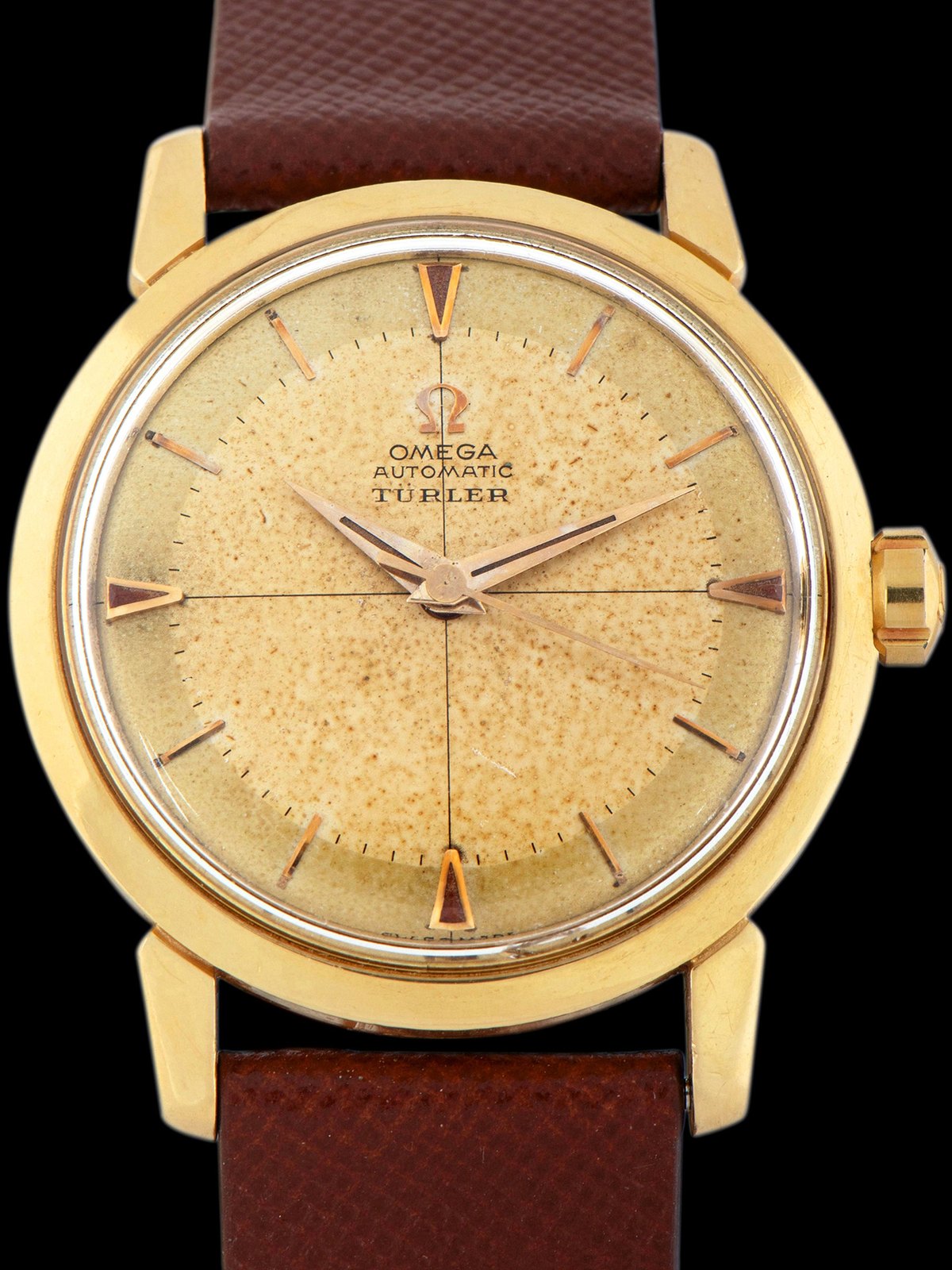
Omega Seamaster 18K YG (Ref. 2866 SC) Crosshair “Türler” Dial, 1956
- Maker / attribution
- Omega (maker)
- Date
- 1956
- Historical period
- Modern Mechanical Horology (1945 – 1969)
- Country of origin
- Switzerland
- Object type
- Wristwatch
- Stock no.
- OMSM2866
- Credit line
- Dealer listing, Craft & Tailored (OMSM2866)
- Catalogue title (original)
- 1956 Omega Seamaster 18K YG (Ref. 2866 SC) Crosshair “Türler” Dial W/ Türler Box (English)
View the source record (dealer listing) ↗ (opens another website in a new tab)Suggest a correction
Record summary
Catalogued by Craft & Tailored (dealer), Los Angeles (stock number OMSM2866), this is a wristwatch by Omega, made in Switzerland, dated 1956. The Atlas places it in the Modern Mechanical Horology period (1945 – 1969) of its Wristwatches collection. The record is illustrated with 6 photographs.
Assembled from the source record's structured fields. Dates and attributions are given as the source states them; where a field is missing the Atlas leaves it blank rather than estimating.
Catalogue description
Dealer description — Craft & Tailored
The world of vintage Omega is vast. It's filled with interesting and unique references, to a degree, unlike almost any other manufacturer. This is true whether you're looking for something for racing, dressing up, diving, or any other function. Omega does it all – and does it all to the nines. First released in 1948 in celebration of Omega’s centennial anniversary, the Seamaster became a worldwide success and was the brand’s top seller for a long time. Today, it’s the longest-running name in the Omega catalog and still holds a special place in plenty of collectors’ hearts. Case in point, this gorgeous 18K gold Seamaster Automatic dress watch from the '50s and cosigned with Türler. It offers a truly luxurious take to the classic Seamaster styling of the 1950s, with just a touch of sportiness, but not so much that you couldn't rock this watch under the cuff of your tux. Türler was established in 1883 by two brothers, Jean Henri and César Alexander Türler. The two brothers made a name for themselves by offering their customers the newest and most exclusive Swiss watch brands at the time; namely Omega, Longines, IWC, Vacheron Constantin, and Blancpain. After establishing themselves as one of the top retailers in Zurich Switzerland, and with the prestige the Türler name carried, they started to cosign the dials of some of the watches they offered, similar to the other well-respected retailers at the time. These Türler-cosigned watches produced throughout the 20th century are now desired by collectors alike for their rarity and the provenance they carry. SPECS Stock # OMSM2866 Brand Omega Style Seamaster Automatic Model 2866 SC Serial 27XXXXXX Size Men's Material 18K Yellow Gold Dial Champagne Crosshair "Türler" Millimeters 33.5 Strap 2pc Handmade Leather Strap W/ Original Omega Gold Plaque Tang Buckle CASE & BRACELET The 18K yellow gold case is in wonderful condition, showing minimal evidence of previous polishing with deep hallmarks and light signs of honest use present. The watch retains its original Omega crown. The case back remains crisp with all the factory marks present and only minor elements of use shown. The watch comes supplied on a 2pc handmade leather strap with the original Omega gold plaque tang buckle. DIAL & HANDS The original and superb two-tone champagne crosshair dial is cosigned with Türler and features a beautiful brown marbled patina throughout. Along with the patina, the dial exhibits minimal wear expected for its age. The incredible and unique markers located at 12, 3, 6, and 9 o'clock feature lumed pyramid-shaped crystals with a deep amber coloration. The lume located at the tip of the other markers is mostly missing when inspected under UV light. The original radium-lumed gold dauphine hands exhibit no degradation under UV light inspection and have achieved a deep brown color that coordinated with the lumed crystals perfectly. ACCESSORIES The watch comes with its original Türler coffin-style box. The watch is keeping time, but the service history is unknown. A movement service can be provided upon request.
Historical context
Modern Mechanical Horology (1945 – 1969)
Tool watches for divers, pilots and astronauts; electric watches anticipate the electronic age.
The classic era of the mechanical wristwatch: dive watches, chronographs for motor racing and space flight, GMT watches for jet travel, slim dress watches, automatic calendars, and the rise of Japanese manufacturers alongside Swiss, American, German and Soviet industries.
Read the period in the timelineMore wristwatches from this periodEarlier: Golden Age of Mechanical Watchmaking
Atlas type guide
Dive and water-resistant watches
Keeping water and dust out of a wristwatch was a long-standing challenge. Rolex's screw-down Oyster case (1926) and Omega's Marine (1932) were landmarks; in the early 1950s Blancpain's Fifty Fathoms and Rolex's Submariner defined the professional dive watch with rotating bezels for timing dives, luminous dials and high water resistance. The ISO 6425 standard (1982) later codified what a 'diver's watch' must do.
Dive watches became icons of post-war design and exploration, and their evolution — helium escape valves, ceramic bezels, saturation-diving depth ratings — records the history of underwater work.
What to look for
- Unidirectional or bidirectional rotating bezel with minute markings.
- Screw-down crown and case back; depth rating printed on the dial.
- Luminous hands and markers (radium before c. 1960, tritium c. 1960–1998, then Super-LumiNova).
- Reference numbers on the case between the lugs or inside the back.
Dating clues
- Screw-down Oyster cases: from 1926.
- Professional dive watches: from 1953.
- Tritium 'T' marks on dials: c. 1960–1998.
General guidance written by the Atlas editors about this kind of object. It is not a statement about this particular piece; for that, rely on the source record above and on physical examination.
Related records

Instruments · 1950–1976
Omega Megaquartz 2400 marine chronometer, 1950–1976
Science Museum Group, London

Instruments · 1960–1979
Stopwatch / timer by Omega, 1960–1979
Science Museum Group, London

Instruments · 1960–1979
Stopwatch / timer by Omega, Switzerland, 1960–1979
Science Museum Group, London

Instruments · 1960–1979
Stopwatch by Omega, Swiss made, single-button type reading 0 - 60 seconds in fifths and 0 - 5 minutes in minutes on subsidiary dial, 1960-79.
Science Museum Group, London

Wristwatches · 1945
Wristwatch by Eterna, 1945
Museum Rotterdam

Wristwatches · c. 1945
Breitling Premier, ref. 790, c. 1945
Antiquorum auction archive, Geneva

Wristwatches · c. 1945
Universal Genève Uni-Compax, ref. 22492, c. 1945
Antiquorum auction archive, Geneva

Wristwatches · c. 1950s
Baume & Mercier wristwatch, c. 1950s
Antiquorum auction archive, Geneva