
Wristwatches · Wristwatch
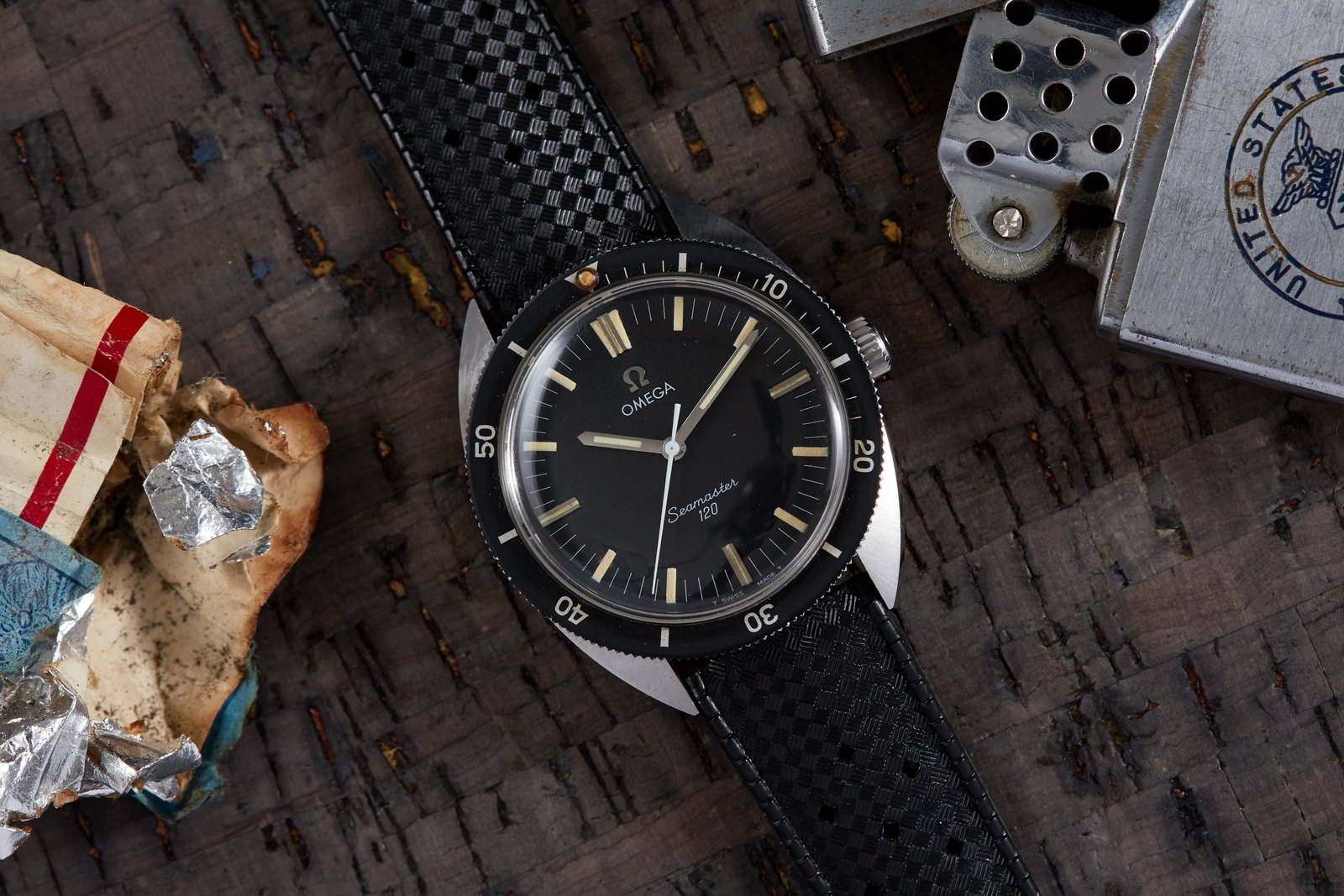
Omega Seamaster 120, 1970
- Maker / attribution
- Omega (maker)
- Date
- 1970
- Historical period
- Quartz Revolution (1969 – 1990)
- Country of origin
- Switzerland
- Object type
- Wristwatch
- Stock no.
- Product 1572834148439
- Credit line
- Dealer listing, Analog/Shift (product 1572834148439)
- Catalogue title (original)
- Omega Seamaster 120 (English)
View the source record (dealer listing) ↗ (opens another website in a new tab)Suggest a correction
Record summary
Catalogued by Analog/Shift (dealer), New York (stock number Product 1572834148439), this is a wristwatch by Omega, made in Switzerland, dated 1970. The Atlas places it in the Quartz Revolution period (1969 – 1990) of its Wristwatches collection. The record is illustrated with 6 photographs.
Assembled from the source record's structured fields. Dates and attributions are given as the source states them; where a field is missing the Atlas leaves it blank rather than estimating.
Catalogue description
Dealer description — Analog/Shift
Why We Love It The Seamaster 120 is an excellent reminder of Omega's storied past and commitment to the exploration of our oceans. Originally popular with snorkelers and skin divers, the 120 is the perfect sporty-yet-restrained choice for the dive watch or just regular watch enthusiast. The ultra-thin cushion case is wonderfully retro, and the black dial is simple, clean and to the point. This particular 120 dates to 1970, and features the Omega manual-wind calibre 601. The case, dial, hands, and bezel are completely untouched and in fantastic shape with a light patination throughout. This gorgeous piece comes with an extract from Omega archives confirming the production in July 1970 and subsequent delivery to the United States. This rare watch is in perfect collector-grade condition. Seamaster divers such as these have long been popular among collectors, and we have never seen another SM120 in condition that even comes close to this one! The Story Omega released the first Seamaster in 1948, to commemorate the brand's centennial. The Seamaster took its inspiration from their robust field watches that Omega and many other brands issued to servicemen in World War II and beyond. But the Seamaster departed from its military forebears in the use of a technology that would prove innovative in the history of horology. Omega was no stranger to producing waterproof wristwatches. In 1932 the brand released the Omega Marine, which was worn by the father of the Aqua-Lung, Yves le Prieur, and descended to a depth of 14 meters with underwater explorer William Beebe in 1936. But these watches achieved water-resistance merely through well-sealed cases, and what gaskets they used were made of materials such as lead and shellac that did not resist changes in temperature. In the design of the Seamaster, Omega employed rubber gaskets or O-rings similar to those found in submarines used during the War. To ensure maximum water resistance, Omega submitted the Seamaster to rigorous testing at the Laboratory for Water Resistance in Geneva, where the cases were exposed to rapid changes of temperature at a simulated depth of 60 meters. Needless to say, this watch was the perfect diving watch for the 1970s thanks to Omega's strict tests (Omega's watches have been to the ocean's deepest depths, and beyond earth's atmosphere, so we know they work!) and now make the perfect every day companion.
Historical context
Quartz Revolution (1969 – 1990)
Seiko's Astron begins mass quartz timekeeping; traditional industries contract sharply.
Quartz and digital watches transformed the market after 1969. Swiss employment collapsed, Japanese and Hong Kong production soared, and the Swatch (1983) helped the Swiss industry recover; mechanical watches survived as luxury goods.
Read the period in the timelineMore wristwatches from this periodEarlier: Modern Mechanical Horology
Atlas type guide
Dive and water-resistant watches
Keeping water and dust out of a wristwatch was a long-standing challenge. Rolex's screw-down Oyster case (1926) and Omega's Marine (1932) were landmarks; in the early 1950s Blancpain's Fifty Fathoms and Rolex's Submariner defined the professional dive watch with rotating bezels for timing dives, luminous dials and high water resistance. The ISO 6425 standard (1982) later codified what a 'diver's watch' must do.
Dive watches became icons of post-war design and exploration, and their evolution — helium escape valves, ceramic bezels, saturation-diving depth ratings — records the history of underwater work.
What to look for
- Unidirectional or bidirectional rotating bezel with minute markings.
- Screw-down crown and case back; depth rating printed on the dial.
- Luminous hands and markers (radium before c. 1960, tritium c. 1960–1998, then Super-LumiNova).
- Reference numbers on the case between the lugs or inside the back.
Dating clues
- Screw-down Oyster cases: from 1926.
- Professional dive watches: from 1953.
- Tritium 'T' marks on dials: c. 1960–1998.
General guidance written by the Atlas editors about this kind of object. It is not a statement about this particular piece; for that, rely on the source record above and on physical examination.
Related records

Instruments · 1950–1976
Omega Megaquartz 2400 marine chronometer, 1950–1976
Science Museum Group, London

Instruments · 1960–1979
Stopwatch / timer by Omega, 1960–1979
Science Museum Group, London

Instruments · 1960–1979
Stopwatch / timer by Omega, Switzerland, 1960–1979
Science Museum Group, London

Instruments · 1960–1979
Stopwatch by Omega, Swiss made, single-button type reading 0 - 60 seconds in fifths and 0 - 5 minutes in minutes on subsidiary dial, 1960-79.
Science Museum Group, London

Wristwatches · 1970
Wristwatch by Heno, Switzerland, 1970
Museum Rotterdam

Wristwatches · 1960–1986
'Tri-Compax' calendar chronograph wristwatch in gold case, by Universal, Geneva, Switzerland, 1960–1986.
Science Museum Group, London

Wristwatches · 1969–1970
Beta 21 Quartz wristwatch movement, made in Switzerland, 1970.
Science Museum Group, London

Wristwatches · c. 1969
Omega Speedmaster Moonwatch, ref. 145022-69st, c. 1969
Antiquorum auction archive, Geneva