
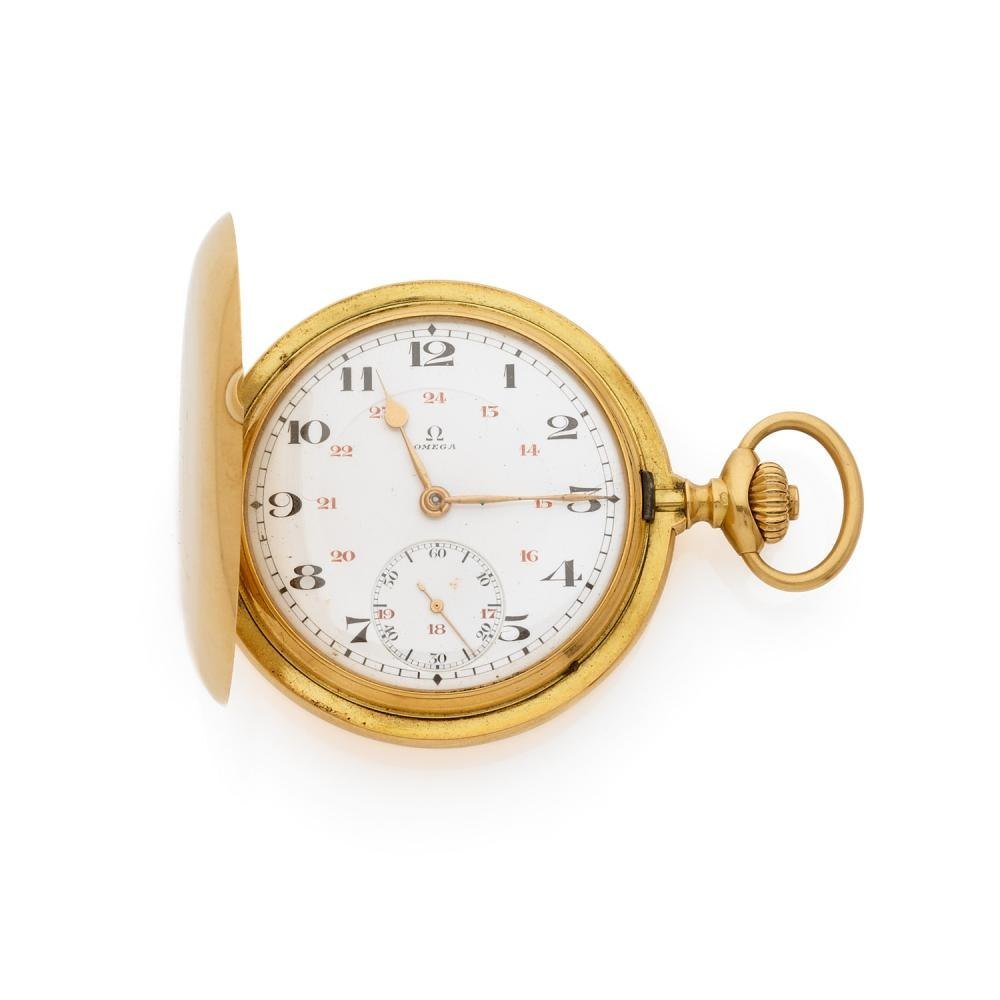
Pocket Watches · Hunting-case pocket watch
Omega Hunting Case Pocket Watch
- Maker / attribution
- Omega (source attribution)
- Date
- c. 1900
- Historical period
- Golden Age of Mechanical Watchmaking (1900 – 1945)
- Country of origin
- France
- Object type
- Hunting-case pocket watch
- Auction house
- Aguttes (via Invaluable)
- Lot
- 142
- Credit line
- Aguttes (via Invaluable)
- Catalogue title (original)
- OMEGA Boîtier no. 5177357 Mouvement no. 2270767 (English)
View the source record (auction lot) ↗ (opens another website in a new tab)Suggest a correction
Record summary
Catalogued by Aguttes (via Invaluable) (lot 142), this is a hunting-case pocket watch attributed to Omega, made in France, dated c. 1900. The Atlas places it in the Golden Age of Mechanical Watchmaking period (1900 – 1945) of its Pocket Watches collection. The record is illustrated with 1 photograph.
Assembled from the source record's structured fields. Dates and attributions are given as the source states them; where a field is missing the Atlas leaves it blank rather than estimating.
Catalogue description
Original object description
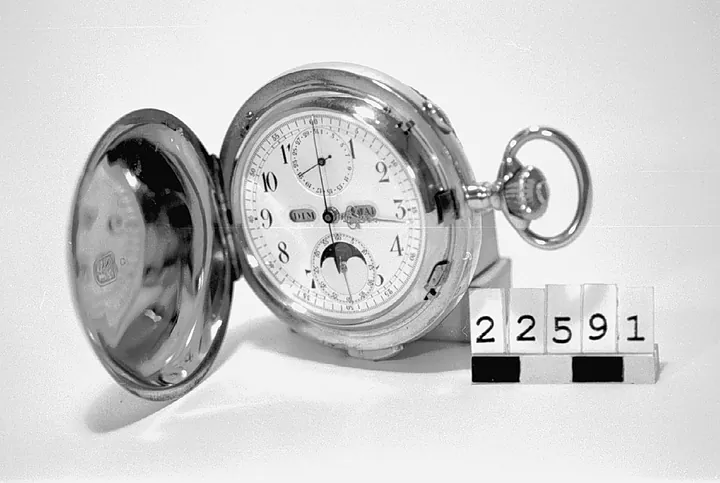
Attributed to circa 1900, this 18k yellow gold Omega pocket watch features an unadorned hunting case with smooth exterior lids, an internal gold dust cap, and an overall diameter of approximately 52 mm with a gross mass of 113.2 g. The white enamel dial is configured with two concentric hour tracks—a primary 12-hour register in black Arabic numerals and a secondary 24-hour cycle in red Arabic numerals—enclosed by a railway minute track and supplemented by an independent sunken subsidiary seconds register at 6 o'clock. Within, the stem-wound, crown-set movement employs a classic three-quarter plate configuration with jewels set in screwed chatons, a lever escapement, and a micrometric regulator for rate adjustments. Bearing the maker's signature and the serial number 2270767, the caliber is numbered separately from the engraved case. While catalogued in running order and retaining its authentic parts, the timepiece exhibits surface abrasions across its gold exterior consistent with age and requires standard maintenance for sustained use.
Inscriptions & marks
5177357
Historical context
Golden Age of Mechanical Watchmaking (1900 – 1945)
The wristwatch displaces the pocket watch; waterproof cases, self-winding and grand complications.
The pocket watch reached technical maturity and then began to give way to the wristwatch after the First World War. Complicated watches for collectors such as Henry Graves Jr. and James Ward Packard, railroad watches, and slim Art Deco dress watches are characteristic.
Read the period in the timelineMore pocket watches from this periodEarlier: Industrial Revolution
Atlas type guide
Hunter, half-hunter and open-face watches
In the nineteenth century the pocket watch case settled into a few standard forms. The hunter (French savonnette) has a hinged front lid protecting the crystal — reputedly for riders who could not risk broken glass — and is opened by pressing the crown or a push-piece. The half-hunter has a small window in the lid so the hands can be read when closed. The open-face (lépine) watch has no front cover, with the crown at 12; hunters normally carry the crown at 3.
Case types also changed with winding: key-wound watches gave way to keyless (stem-wound) mechanisms after Adrien Philippe's and others' designs of the 1840s, with pendant setting or lever setting.
What to look for
- Crown position relative to the seconds dial: at 3 for hunters, at 12 for open-face watches.
- Spring-loaded front cover with a push-piece in the pendant.
- Half-hunter chapter ring enamelled on the lid.
- Key holes in the inner dome (cuvette) versus keyless winding.
Dating clues
- Keyless winding spread after c. 1850 and became standard by c. 1890.
- English hallmarks inside gold and silver cases give the year of assay.
General guidance written by the Atlas editors about this kind of object. It is not a statement about this particular piece; for that, rely on the source record above and on physical examination.
Related records

Instruments · 1950–1976
Omega Megaquartz 2400 marine chronometer, 1950–1976
Science Museum Group, London

Instruments · 1960–1979
Stopwatch / timer by Omega, 1960–1979
Science Museum Group, London

Instruments · 1960–1979
Stopwatch / timer by Omega, Switzerland, 1960–1979
Science Museum Group, London

Instruments · 1960–1979
Stopwatch by Omega, Swiss made, single-button type reading 0 - 60 seconds in fifths and 0 - 5 minutes in minutes on subsidiary dial, 1960-79.
Science Museum Group, London
Pocket Watches · 1890–1910
Pocket watch by Union Horlogère, France, 1890–1910
Museum of City History Leipzig
Pocket Watches · c. 1900
Pocket watch by Firm of Breguet et Fils, France, c. 1900
The Metropolitan Museum of Art, New York
Pocket Watches · 1900–1930
Pocket watch by Fabrique des Billodes, France, 1900–1930
Museum of City History Leipzig
Pocket Watches · 1900–1999
Pocket watch by Surete, France, 1900–1999
Swedish National Museum of Science and Technology