
Wristwatches · Wristwatch
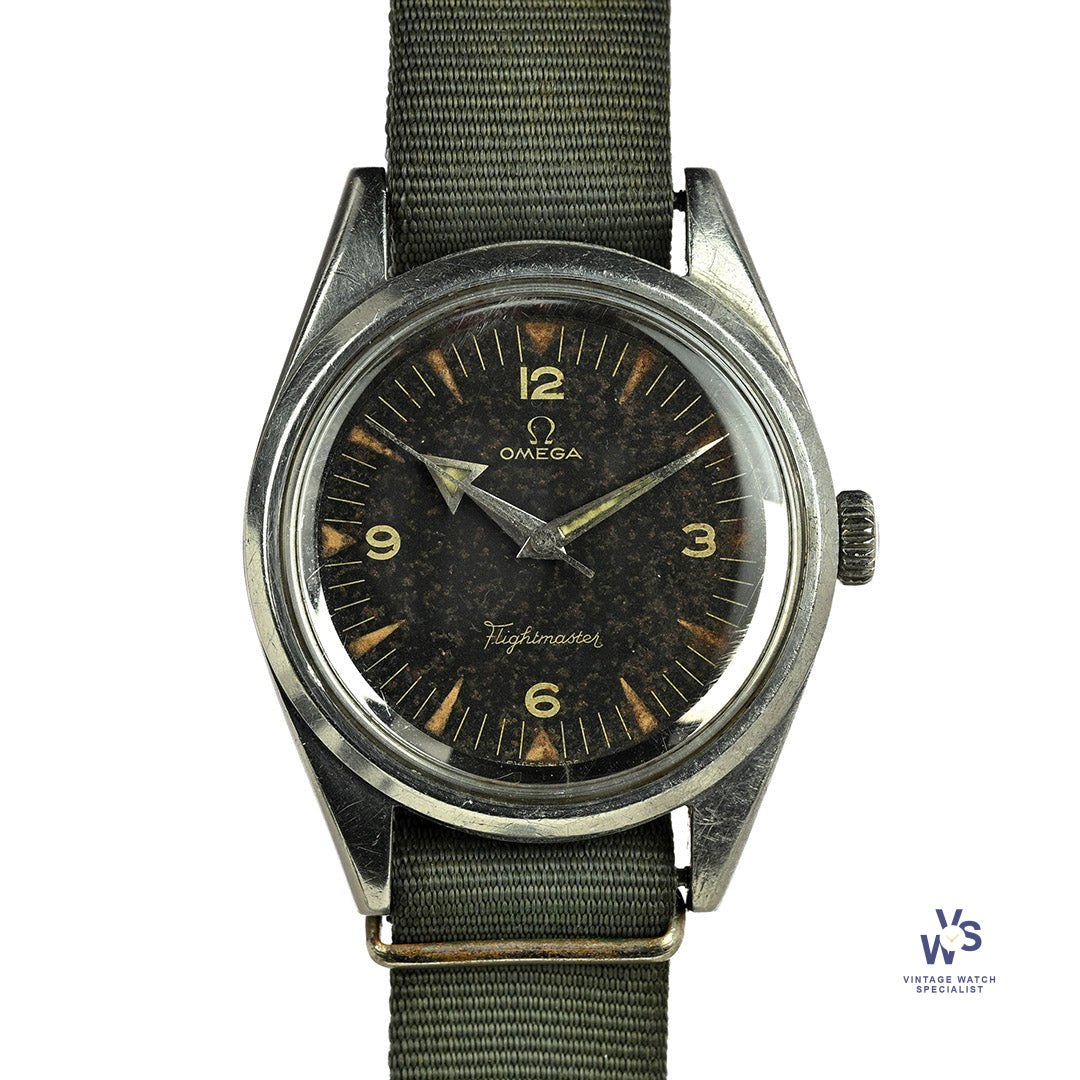
Omega Flightmaster 'Prototype' ref. 2914-2 SC, circa 1958
- Maker / attribution
- Omega (maker)
- Date
- c. 1958
- Historical period
- Modern Mechanical Horology (1945 – 1969)
- Country of origin
- Switzerland
- Object type
- Wristwatch
- Stock no.
- vws4055cs
- Credit line
- Dealer listing, Vintage Watch Specialist (vws4055cs)
- Catalogue title (original)
- Omega Flightmaster 'Prototype' Model Reference 2914-2 SC - c.1958 (English)
View the source record (dealer listing) ↗ (opens another website in a new tab)Suggest a correction
Record summary
Catalogued by Vintage Watch Specialist (dealer), United Kingdom (stock number vws4055cs), this is a wristwatch by Omega, made in Switzerland, dated c. 1958. The Atlas places it in the Modern Mechanical Horology period (1945 – 1969) of its Wristwatches collection. The record is illustrated with 6 photographs.
Assembled from the source record's structured fields. Dates and attributions are given as the source states them; where a field is missing the Atlas leaves it blank rather than estimating.
Catalogue description
Dealer description — Vintage Watch Specialist
A VERY Rare Omega Flightmaster 'Prototype' with Flightmaster dial and Railmaster case and movement (Model Reference 2914-2 SC)- c.1958 Preceding Omega’s bold, multi-crown Flightmaster of 1969, were years of experimentation with aviation tool watch designs. This ultra-rare Omega Reference 2914-2 SC appears to be an early “flight-focused” prototype, built on Railmaster architecture but fitted with a Flightmaster-signed dial. With several similar examples traced to Denmark, collectors increasingly believe these pieces represent Omega’s exploratory steps toward a dedicated pilot’s watch, making this an exceptionally intriguing discovery. What's on Offer Here we have a truly fascinating Omega Reference 2914-2 SC, dating to circa 1958, combining the familiar construction of an early Railmaster with an exceptionally unusual Flightmaster-signed dial. Its precise origins remain something of a mystery, making this a particularly intriguing piece for the serious Omega collector. At first glance, the watch has all the hallmarks of Omega's celebrated Railmaster. The stainless steel case features the robust, understated proportions associated with the Reference 2914, while the caseback bears Omega's distinctive Hippocampus emblem, a familiar feature of the brand's Seamaster family, to which the Railmaster belonged. However, it is the dial that makes this example so interesting. Rather than the expected Railmaster signature, the black dial carries the word Flightmaster , rendered in an elegant script quite unlike the lettering associated with Omega's later Flightmaster collection, introduced in 1969. The dial has developed a wonderfully rich, mottled patina, with warm brown and earthy tones scattered across its black surface. The ageing gives the watch tremendous character, complemented by the distinctive broad-arrow hour hand, slender dagger-style minute hand and aged luminous hour markers. The original-style luminous material has taken on attractive shades of cream and copper, contrasting beautifully with the dark dial. Arabic numerals at 12, 3, 6 and 9 provide excellent legibility, while the remaining hours are marked by elongated triangular plots. The Flightmaster signature sits elegantly above 6 o'clock. The stainless steel case remains in very good vintage condition, displaying marks of wear consistent with its age. Of particular interest is the small Omega symbol stamped into the reverse of one lug, an unusual detail that adds another layer of intrigue to this already remarkable watch. Inside is the manually wound Omega Calibre 284 , a 17-jewel movement associated with the early Railmaster Reference 2914. The movement is currently with our watchmaker undergoing servicing. Perhaps most fascinating is the existence of other similarly configured examples reportedly discovered in Denmark, where this watch was also found. Their shared characteristics have prompted speculation that these watches may represent experimental or special-purpose Omega production, potentially connected with aviation applications. However, there is currently insufficient documentary evidence to establish that these watches were official Omega prototypes or military evaluation pieces . We therefore present this example as an unusual Flightmaster-signed Reference 2914-2 SC, allowing its remarkable characteristics to speak for themselves. The combination of Railmaster architecture, distinctive Flightmaster lettering, unusual case markings and beautifully aged dial makes this a compelling addition to a vintage Omega collection. As the boss might say, it's as rare as hen's teeth . And whatever the full story behind its creation, it is certainly one of the more intriguing Omegas we have had the pleasure of offering. Condition Report: Crystal: Excellent Dial: Very Good Bezel: Very Good Case: Very Good Movement: Currently With Watchmaker Being Serivced Overall: Very Good
Historical context
Modern Mechanical Horology (1945 – 1969)
Tool watches for divers, pilots and astronauts; electric watches anticipate the electronic age.
The classic era of the mechanical wristwatch: dive watches, chronographs for motor racing and space flight, GMT watches for jet travel, slim dress watches, automatic calendars, and the rise of Japanese manufacturers alongside Swiss, American, German and Soviet industries.
Read the period in the timelineMore wristwatches from this periodEarlier: Golden Age of Mechanical Watchmaking
Atlas type guide
Wristwatches
Bracelet watches were worn by women from the early nineteenth century — Breguet made one for Caroline Murat, Queen of Naples, in 1810–12 — but the wristwatch only became a man's instrument with military use and aviation in the early twentieth century. Between the World Wars it overtook the pocket watch; the 1920s and 1930s brought rectangular Art Deco cases, water-resistant cases and the first automatic winding systems.
After 1945 the wristwatch became a carrier of identity — dress watches, sports and dive watches, chronographs, calendars — produced by Swiss, American, Japanese, German, Soviet and Chinese industries. The quartz revolution after 1969 and the mechanical renaissance since the 1990s, including the rise of independent watchmakers, complete the story.
What to look for
- The reference number (between the lugs or inside the case back) and serial number, the starting point for dating.
- The calibre: its maker and number are often stamped under the dial or on the bridge.
- Originality of dial, hands and crown — refinished ('redial') dials are common.
- Case material marks: 18K/750, 14K/585, stainless steel, gold-filled, plated.
Dating clues
- Wire-lug cases: before c. 1925.
- Water-resistant screw-down cases: from 1926.
- Quartz movements: from 1969; sapphire crystals widespread after c. 1980.
General guidance written by the Atlas editors about this kind of object. It is not a statement about this particular piece; for that, rely on the source record above and on physical examination.
Related records

Instruments · 1950–1976
Omega Megaquartz 2400 marine chronometer, 1950–1976
Science Museum Group, London

Instruments · 1960–1979
Stopwatch / timer by Omega, 1960–1979
Science Museum Group, London

Instruments · 1960–1979
Stopwatch / timer by Omega, Switzerland, 1960–1979
Science Museum Group, London

Instruments · 1960–1979
Stopwatch by Omega, Swiss made, single-button type reading 0 - 60 seconds in fifths and 0 - 5 minutes in minutes on subsidiary dial, 1960-79.
Science Museum Group, London

Wristwatches · 1945
Wristwatch by Eterna, 1945
Museum Rotterdam

Wristwatches · c. 1945
Breitling Premier, ref. 790, c. 1945
Antiquorum auction archive, Geneva

Wristwatches · c. 1945
Universal Genève Uni-Compax, ref. 22492, c. 1945
Antiquorum auction archive, Geneva

Wristwatches · c. 1950s
Baume & Mercier wristwatch, c. 1950s
Antiquorum auction archive, Geneva