
Wristwatches · Wristwatch
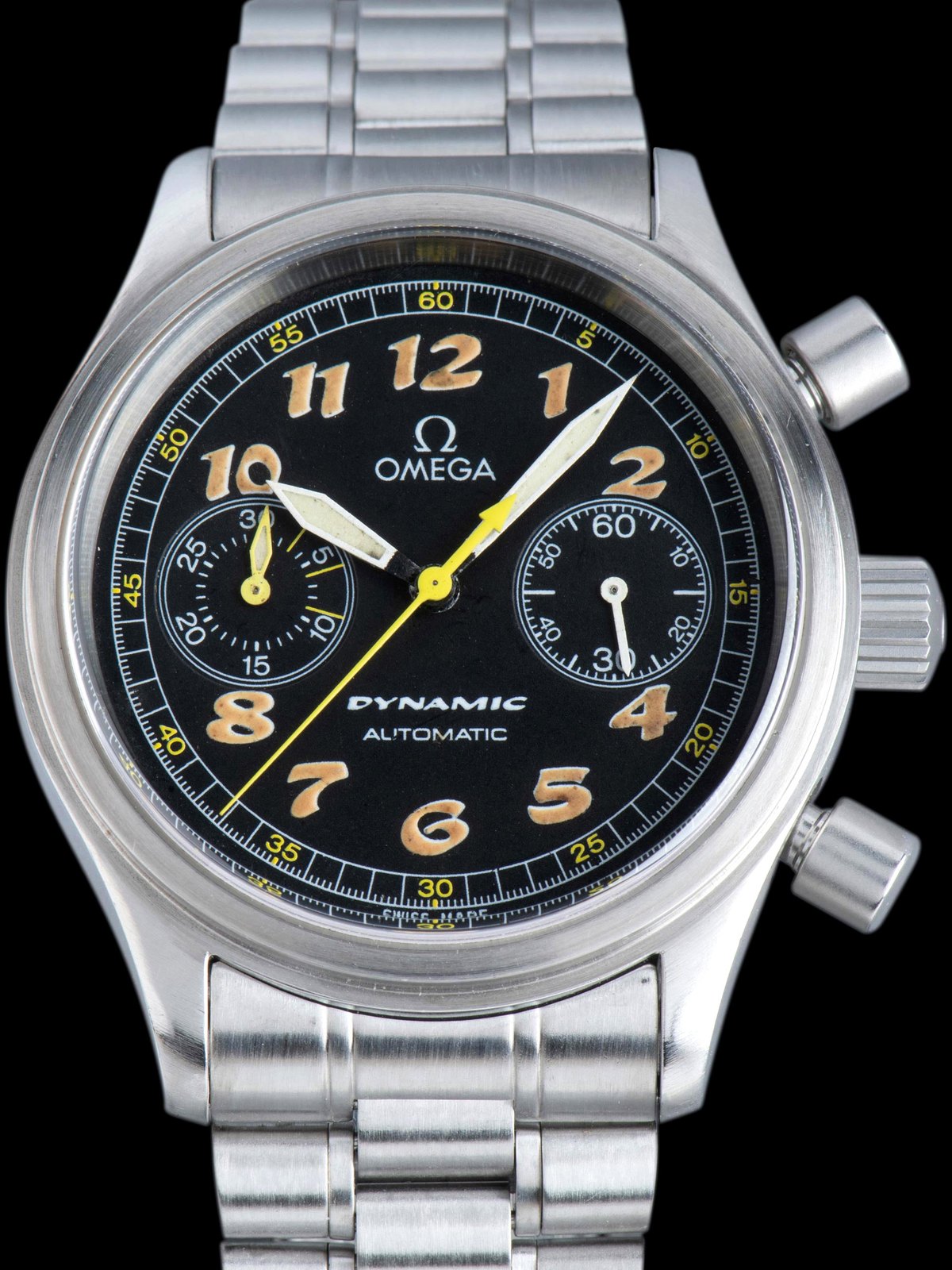
Omega Dynamic Chronograph (Ref. 175.0310), 1995
- Maker / attribution
- Omega (maker)
- Date
- 1995
- Historical period
- Mechanical Renaissance (1990 – 2010)
- Country of origin
- Switzerland
- Object type
- Wristwatch
- Stock no.
- OMGD1750310
- Credit line
- Dealer listing, Craft & Tailored (OMGD1750310)
- Catalogue title (original)
- 1995 Omega Dynamic Chronograph (Ref. 175.0310) (English)
View the source record (dealer listing) ↗ (opens another website in a new tab)Suggest a correction
Record summary
Catalogued by Craft & Tailored (dealer), Los Angeles (stock number OMGD1750310), this is a wristwatch by Omega, made in Switzerland, dated 1995. The Atlas places it in the Mechanical Renaissance period (1990 – 2010) of its Wristwatches collection. The record is illustrated with 6 photographs.
Assembled from the source record's structured fields. Dates and attributions are given as the source states them; where a field is missing the Atlas leaves it blank rather than estimating.
Catalogue description
Dealer description — Craft & Tailored
Is it a Speedmaster? Nope. Seamaster? Nope again. When it comes to Omega watches, it's usually one of those two model lines or nothing at all. But in this case, it's a little of both rolled into its own unique package. To be clear, the Dynamic part of its name is actually the name of a sort of sub-line that Omega initially debuted in 1968 with a watch simply called the Omega Dynamic. A second Dynamic was released over a decade and a half later, in 1984. Then, another decade or so after that, we got the final installment of the Dynamic line – the Dynamic Chronograph. With a design heavily inspired by the RAF-issued Omega watches from the '50s, unique-for-Omega Arabic numerals at every hour, and an Omega Calibre 1108 movement (based on an ETA 2890A2), it was like some sort of hybrid between a vintage pilot watch and a Speedmaster Reduced. It was also a bit of a misfit for the brand, which probably explains its relatively short lifespan. In fact, according to some estimates, only 8,000 of these third-gen Dynamics ever saw the light of day. Being a misfit means that this incredible ref. 175.0310, with its fantastic patinated numerals, Speedmaster-style bracelet, and almost contrarian design is not only a helluva find but also something that would make for an excellent addition to any collection. Stock # OMGD1750310 Brand Omega Style Dynamic Chronograph Model 175.0310 Serial 55XXXXXX Size Men's Material Stainless Steel Dial Matte Black Millimeters 38 Bracelet Omega 1571 / 871 Bracelet CASE & BRACELET The stainless steel bracelet has been gently polished in the past but is still in great condition with strong, beveled lugs. It retains its original Omega-signed crown and two pump pushers. The case back is extremely clean with only the Omega name etched into it. The original Omega 1571 / 871 bracelet retains 22-links with no stretch and will fit up to 7 3/4 inch wrist. DIAL & HANDS The matte black dial shows minimal age and is a simple backdrop for a whole lot of unique design cues. It starts with the heavily patinated Arabic hour numerals, which have aged to a deep yellow patina. Then there's the outer minute track with its white markings and yellow numerals. Moving inward, we see two tonal subregisters with white markings, the left of which also has a yellow hand. And speaking of hands, the pilot gauge-style hour and minute hands are also patinated with a light green lume, combined with a bright yellow seconds hand. ACCESSORIES None. Watch is functioning perfectly and keeping time, previous service history is unknown.
Historical context
Mechanical Renaissance (1990 – 2010)
Mechanical watches return as cultural objects; independent watchmaking flourishes.
Mechanical watches returned as cultural and luxury objects. Complications, tourbillons and new materials proliferated; independent watchmakers such as George Daniels, F.P. Journe and Philippe Dufour revived artisanal watchmaking; collecting vintage watches became a major field.
Read the period in the timelineMore wristwatches from this periodEarlier: Quartz Revolution
Atlas type guide
Chronographs and split-seconds watches
A chronograph is a watch with an additional seconds hand that can be started, stopped and returned to zero independently of the timekeeping. Louis Moinet built an early example in 1816 and Nicolas Rieussec a recording 'chronographe' in 1821; Adolphe Nicole's heart-shaped reset cam (patented 1862) made the modern return-to-zero possible. Split-seconds (rattrapante) chronographs add a second hand that can be stopped for intermediate times; flyback chronographs restart instantly.
Chronographs were essential tools for doctors (pulsometer scales), artillery (telemeter), engineers and sport. In wristwatches, Valjoux, Venus, Lemania and later the automatic chronographs of 1969 (Zenith El Primero, the Chronomatic Calibre 11 group and Seiko 6139) are milestones.
What to look for
- Push-pieces on the case band or a single button in the crown (monopusher).
- Subsidiary registers for minutes and hours; tachymeter, telemeter or pulsometer scales.
- Column wheel versus cam control visible in the movement.
- Calibre markings of specialist makers (Valjoux, Lemania, Venus, Landeron).
Dating clues
- Pocket chronographs with heart cam reset: after 1862.
- Wrist chronographs: from c. 1910; two-button designs from the 1930s.
- Automatic chronographs: from 1969.
General guidance written by the Atlas editors about this kind of object. It is not a statement about this particular piece; for that, rely on the source record above and on physical examination.
Read next:Flyback chronographChronograph
Related records

Instruments · 1950–1976
Omega Megaquartz 2400 marine chronometer, 1950–1976
Science Museum Group, London

Instruments · 1960–1979
Stopwatch / timer by Omega, 1960–1979
Science Museum Group, London

Instruments · 1960–1979
Stopwatch / timer by Omega, Switzerland, 1960–1979
Science Museum Group, London

Instruments · 1960–1979
Stopwatch by Omega, Swiss made, single-button type reading 0 - 60 seconds in fifths and 0 - 5 minutes in minutes on subsidiary dial, 1960-79.
Science Museum Group, London

Wristwatches · 2008
Wristwatch by Breitling?, 2008
Museum Rotterdam

Wristwatches · c. 1990s
Audemars Piguet Bamboo, c. 1990s
Antiquorum auction archive, Geneva

Wristwatches · c. 1990
Audemars Piguet Huitieme Perpetual Calendar, ref. 25696PT, c. 1990
Antiquorum auction archive, Geneva

Wristwatches · c. 1990
Breitling Chronomat, ref. b13050.1, c. 1990
Antiquorum auction archive, Geneva