
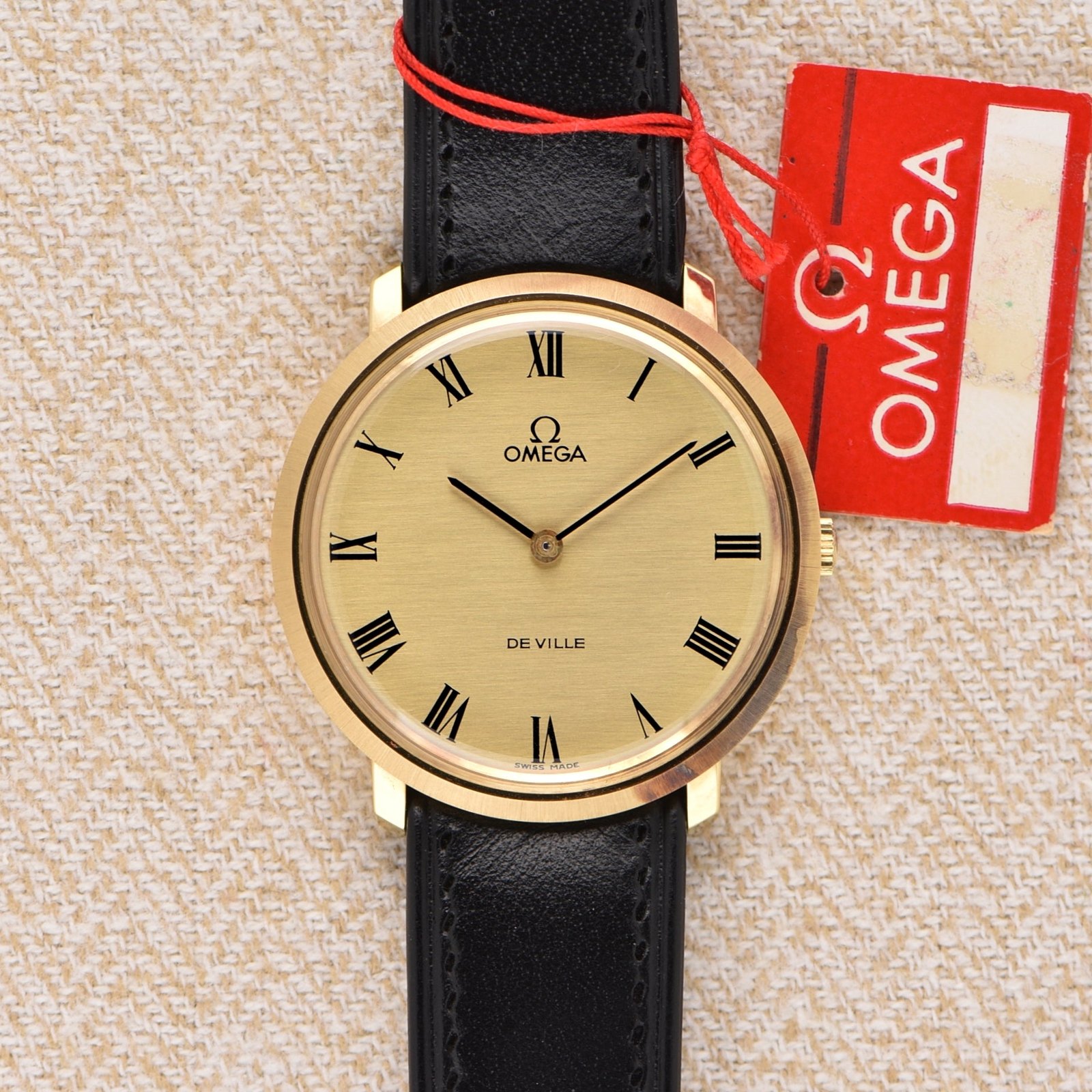
Wristwatches · Wristwatch
Omega De Ville Roman Dial - Box & Hangtag, 1971
- Maker / attribution
- Omega (maker)
- Date
- 1971
- Historical period
- Quartz Revolution (1969 – 1990)
- Country of origin
- Switzerland
- Object type
- Wristwatch
- Dimensions
- Case 33 mm
- Stock no.
- Product 7378132467895
- Credit line
- Dealer listing, Huntington Company (product 7378132467895)
- Catalogue title (original)
- 1971 Omega De Ville Roman Dial - Box & Hangtag (English)
View the source record (dealer listing) ↗ (opens another website in a new tab)Suggest a correction
Record summary
Catalogued by Huntington Company (dealer) (stock number Product 7378132467895), this is a wristwatch by Omega, made in Switzerland, dated 1971. The Atlas places it in the Quartz Revolution period (1969 – 1990) of its Wristwatches collection. Recorded dimensions: Case 33 mm. The record is illustrated with 6 photographs.
Assembled from the source record's structured fields. Dates and attributions are given as the source states them; where a field is missing the Atlas leaves it blank rather than estimating.
Catalogue description
Dealer description — Huntington Company
111.077 Box, Hangtag, Strap, and Buckle Specifications Year: 1971 Model: De Ville Case Diameter: 33mm Lug to Lug: 35mm Case: Gold Tone Condition: No significant wear as seen Dial: Champagne Movement: Manual wind Condition The case is unpolished with a brushed bezel. The gold plating on. the case has some oxidization but no plate wear. The original Omega signed crown has very light wear from normal use. The crystal is clean and has the Omega logo stamped in the center. The brushed dial still perfect with black roman hour markers. The Story The Pedigree for a DeVille watch is hard to tell by the looks, as today's DeVille line is set apart from the rest of the collections as the Bauhaus-esque option. However, during the 1960s and 70s, several watches from the Seamaster and Geneve collection did share quite some features or complete designs with the De Ville. The De Ville family has an identity now and overlaps well with the beginnings in the early 1960s. It is unclear whether the DeVille is a classic dress watch, a tool-dress watch hybrid, a playing ground for novel developments, an entry-level timepiece, or a high-end timepiece. Nonetheless, the De Ville line features some of the most fun vintage Omegas in the market. The Brand Omega, a Swiss watchmaker founded in 1848, has a rich history of innovation and precision. The company's vision was carried on by its sons Louis-Paul and César, who pioneered full watch production under the brand's roof. In 1894, the company unveiled the world's first mass-produced, interchangeable watch movement, the Omega Calibre, which streamlined production and propelled the brand to international fame. As the 20th century began, Omega watches became at the forefront of timekeeping technology and revolutionized sports watches with their precision. The Olympic Games provided an ideal stage for Omega to demonstrate its exceptional timekeeping abilities. In 1932, Omega began its role as Official Olympic Timekeeper, starting an enduring partnership spanning over 80 years. With each Games, Omega introduced groundbreaking timekeeping innovations, such as the first photo finish camera at the 1948 London Olympics. Omega's contributions to spaceflight began in 1962 when the Omega Speedmaster became the first watch worn in space on Mercury-Atlas 6. Its defining moment came in 1969 with the Apollo 11 moon landing, where Buzz Aldrin stepped onto the moon wearing his trusty Omega Speedmaster Moonwatch. The company played an indispensable role in NASA's pioneering '60s space missions, including the Apollo 13 mission, where the Speedmaster timed the engine burn, ensuring the crew's safe descent to Earth. Omega's cultural impact extends into pop culture through a long-running cinematic partnership with James Bond Movies. Since 1995's GoldenEye, James Bond has sported Omega watches on the silver screen, wearing the Seamaster Diver 300M and the rugged Omega Seamaster Planet Ocean. Omega remains dedicated to exploring new technological frontiers today, with innovations like the battery-free Pictograms model, wearable tech collaborations, and energy-harnessing movements driving progress and cementing its place in history.
Historical context
Quartz Revolution (1969 – 1990)
Seiko's Astron begins mass quartz timekeeping; traditional industries contract sharply.
Quartz and digital watches transformed the market after 1969. Swiss employment collapsed, Japanese and Hong Kong production soared, and the Swatch (1983) helped the Swiss industry recover; mechanical watches survived as luxury goods.
Read the period in the timelineMore wristwatches from this periodEarlier: Modern Mechanical Horology
Atlas type guide
Wristwatches
Bracelet watches were worn by women from the early nineteenth century — Breguet made one for Caroline Murat, Queen of Naples, in 1810–12 — but the wristwatch only became a man's instrument with military use and aviation in the early twentieth century. Between the World Wars it overtook the pocket watch; the 1920s and 1930s brought rectangular Art Deco cases, water-resistant cases and the first automatic winding systems.
After 1945 the wristwatch became a carrier of identity — dress watches, sports and dive watches, chronographs, calendars — produced by Swiss, American, Japanese, German, Soviet and Chinese industries. The quartz revolution after 1969 and the mechanical renaissance since the 1990s, including the rise of independent watchmakers, complete the story.
What to look for
- The reference number (between the lugs or inside the case back) and serial number, the starting point for dating.
- The calibre: its maker and number are often stamped under the dial or on the bridge.
- Originality of dial, hands and crown — refinished ('redial') dials are common.
- Case material marks: 18K/750, 14K/585, stainless steel, gold-filled, plated.
Dating clues
- Wire-lug cases: before c. 1925.
- Water-resistant screw-down cases: from 1926.
- Quartz movements: from 1969; sapphire crystals widespread after c. 1980.
General guidance written by the Atlas editors about this kind of object. It is not a statement about this particular piece; for that, rely on the source record above and on physical examination.
Related records

Instruments · 1950–1976
Omega Megaquartz 2400 marine chronometer, 1950–1976
Science Museum Group, London

Instruments · 1960–1979
Stopwatch / timer by Omega, 1960–1979
Science Museum Group, London

Instruments · 1960–1979
Stopwatch / timer by Omega, Switzerland, 1960–1979
Science Museum Group, London

Instruments · 1960–1979
Stopwatch by Omega, Swiss made, single-button type reading 0 - 60 seconds in fifths and 0 - 5 minutes in minutes on subsidiary dial, 1960-79.
Science Museum Group, London

Wristwatches · 1970
Wristwatch by Heno, Switzerland, 1970
Museum Rotterdam

Wristwatches · 1960–1986
'Tri-Compax' calendar chronograph wristwatch in gold case, by Universal, Geneva, Switzerland, 1960–1986.
Science Museum Group, London

Wristwatches · 1969–1970
Beta 21 Quartz wristwatch movement, made in Switzerland, 1970.
Science Museum Group, London

Wristwatches · c. 1969
Omega Speedmaster Moonwatch, ref. 145022-69st, c. 1969
Antiquorum auction archive, Geneva