
Wristwatches · Wristwatch
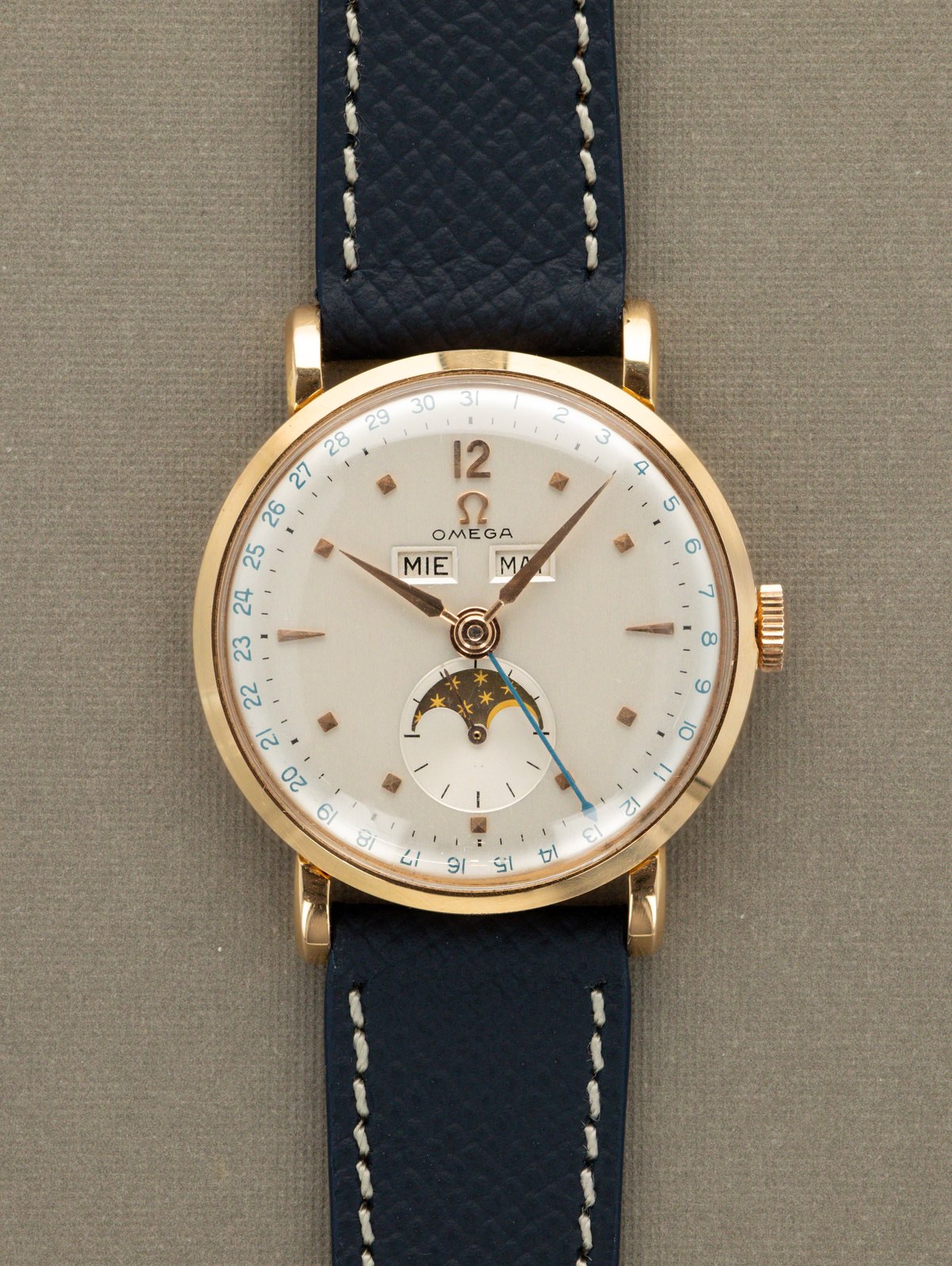
Omega Cosmic Triple Calendar Moonphase ref. 2473, Silver Dial
- Maker / attribution
- Omega (maker)
- Date
- c. 1944
- Historical period
- Golden Age of Mechanical Watchmaking (1900 – 1945)
- Country of origin
- Switzerland
- Object type
- Wristwatch
- Materials / technique
- silver
- Dimensions
- Case 34.4 mm
- Stock no.
- OC3421
- Credit line
- Dealer listing, Oliver & Clarke (OC3421)
- Catalogue title (original)
- Omega Cosmic Triple Calendar Moonphase Ref. 2473 - Silver Dial Unpolished W/ Box & Papers (English)
View the source record (dealer listing) ↗ (opens another website in a new tab)Suggest a correction
Record summary
Catalogued by Oliver & Clarke (dealer), United Kingdom (stock number OC3421), this is a wristwatch by Omega, made in Switzerland, dated c. 1944. The Atlas places it in the Golden Age of Mechanical Watchmaking period (1900 – 1945) of its Wristwatches collection. Materials and techniques recorded by the source: silver. Recorded dimensions: Case 34.4 mm. The record is illustrated with 6 photographs.
Assembled from the source record's structured fields. Dates and attributions are given as the source states them; where a field is missing the Atlas leaves it blank rather than estimating.
Catalogue description
Dealer description — Oliver & Clarke
Omega is undeniably one of the most historically important timepiece manufactures of all time. In fact, the Speedmaster is probably the most important wrist watch of all time. As a result, the Speedmaster casts a massive shadow over all of its siblings.... even over firmly planted models like the Seamaster and Constellation ranges. The resulting effect is double sided: many vintage Omegas , we feel are incredibly undervalued in the market as it exists today, with the other side of that being that hidden gems are shocking attainable. The Constellation range in particular, remain relative bargains when compared to the competition. Officially introduced in 1947, the Cosmic was amongst Omega's top-tier offerings, using a top-grade manual-winding movement co-developed with Lemania, elegant case designs finished to a high-standard, and classically-executed dials that are as stunning as they are timeless. There were six references produced through 1956 with a variety of sized, shapes, metals, and dial variants. The piece that we have here, a Ref. 2473, is a rose gold variant dating to circa 1944. It features a 34.4mm case with classic proportions and beautiful, thoughtful finishing throughout. The case bands are concave and have a 'brushed' finishing with micro-pushers on both siders, a rose gold crown at 3 o'clock, wonderfully finished lugs at each corner, and a polished rose gold bezel. The dial within is silver in color with blue date printing on the outer 'domed' edge, applied rose gold 'stud' and 'dart' indices along with an Omega logo, day and month apertures on the top half, and a running subsidiary seconds register with a moonphase aperture on the bottom half. All of this is perfectly tied together with a matching rose gold 'lance' handset and blue-painted 'pointer date' hand. Last but not least, this piece is accompanied by a very rare box set with papers. There are a handful of documented Cosmics that pre-date the official release in 1947, but they rarely surface. And any Cosmic, with their sizing, variety of materials and dial configurations, and in this case, condition, are undeniably undervalued. These are a masterwork of design and execution and represent an era of Omega where they were throwing punches with the best of them. Those that know, know. Explore more pieces in our vintage watch collection .
Historical context
Golden Age of Mechanical Watchmaking (1900 – 1945)
The wristwatch displaces the pocket watch; waterproof cases, self-winding and grand complications.
The wristwatch overtook the pocket watch. Military use in the First World War, aviation, water-resistant cases (1926), automatic winding (1923–31), rectangular Art Deco designs and early chronographs and calendars defined the period.
Read the period in the timelineMore wristwatches from this periodEarlier: Industrial Revolution
Atlas type guide
Calendar, moon-phase and perpetual calendar watches
Calendar complications range from a simple date to the perpetual calendar, which automatically allows for months of different lengths and leap years until 2100. Pocket watches with perpetual calendars were made in the eighteenth and nineteenth centuries; Patek Philippe made the first perpetual calendar wristwatch in 1925, and series production followed in 1941. The annual calendar (Patek Philippe, 1996) needs correction only once a year.
Moon-phase displays use a disc with two moons and 59 teeth advanced daily, approximating the 29.5-day lunation; more precise trains reduce the error to one day in over a century.
What to look for
- Apertures or subsidiary dials for day, date, month and leap year.
- Moon disc under a 'bosom' shaped aperture.
- Recessed correctors on the case band for setting the calendar.
Dating clues
- Triple-date wristwatches: popular c. 1940–1955.
- Perpetual calendar wristwatches: from 1925 (unique) and 1941 (series).
General guidance written by the Atlas editors about this kind of object. It is not a statement about this particular piece; for that, rely on the source record above and on physical examination.
Related records

Instruments · 1950–1976
Omega Megaquartz 2400 marine chronometer, 1950–1976
Science Museum Group, London

Instruments · 1960–1979
Stopwatch / timer by Omega, 1960–1979
Science Museum Group, London

Instruments · 1960–1979
Stopwatch / timer by Omega, Switzerland, 1960–1979
Science Museum Group, London

Instruments · 1960–1979
Stopwatch by Omega, Swiss made, single-button type reading 0 - 60 seconds in fifths and 0 - 5 minutes in minutes on subsidiary dial, 1960-79.
Science Museum Group, London

Wristwatches · 1931
Rolex 'Oyster Perpetual' rotor self-winding wrist-watch, lever escapement, in steel case with glass in back, Montres Rolex SA, Geneva, Switzerland, 1931
Science Museum Group, London

Wristwatches · 1900–1999
Wristwatch by Certina, Switzerland, 1900–1999
Nordic Museum Foundation
Wristwatches · 1900–1999
Wristwatch by Omega, Västerås, 1900–1999
Nordic Museum Foundation
Wristwatches · 1900–1999
Wristwatch by Universal, Switzerland, 1900–1999
Nordic Museum Foundation