
Wristwatches · Calendar wristwatch
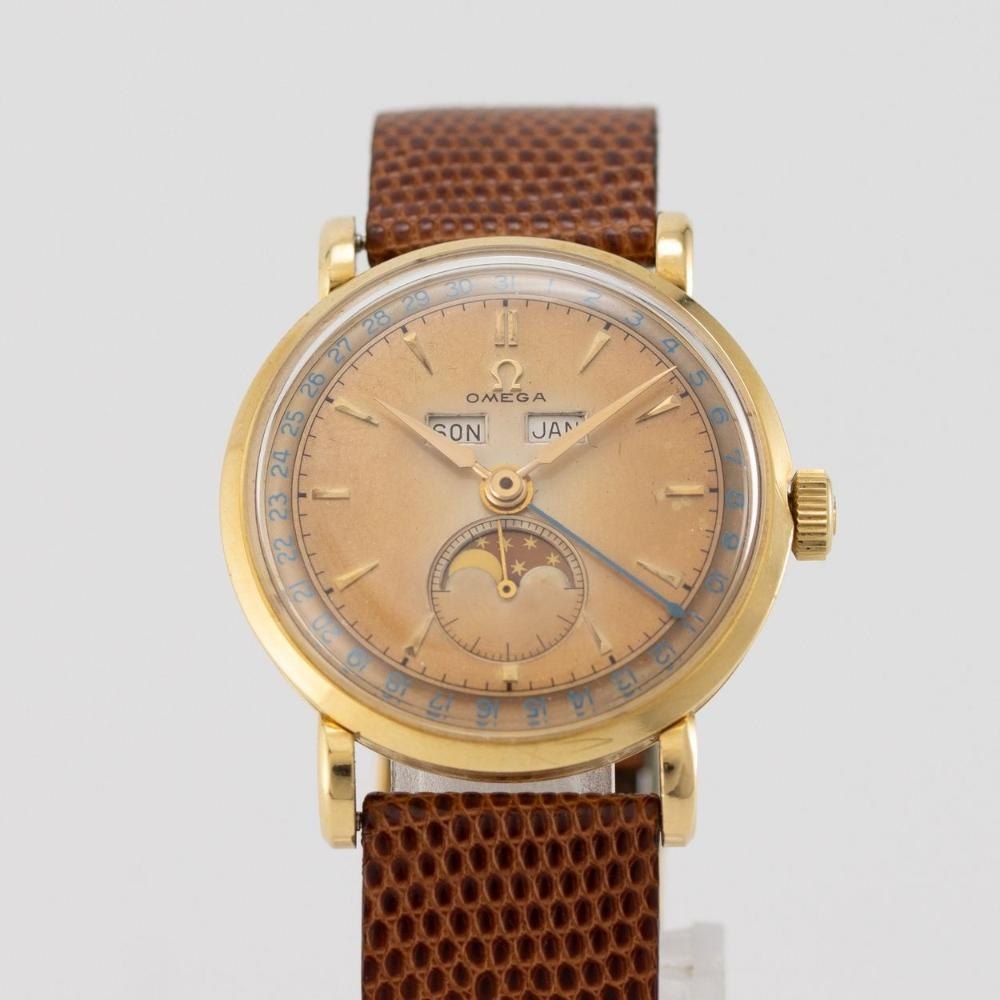
Omega Cosmic Calendar Wristwatch
- Maker / attribution
- Omega (source attribution)
- Date
- 1948
- Historical period
- Modern Mechanical Horology (1945 – 1969)
- Country of origin
- Switzerland
- Object type
- Calendar wristwatch
- Materials / technique
- 18 K gold
- Auction house
- Invaluable
- Lot
- 343
- Credit line
- Invaluable
- Catalogue title (original)
- Omega - Cosmic (English)
View the source record (auction lot) ↗ (opens another website in a new tab)Suggest a correction
Record summary
Catalogued by Invaluable (lot 343), this is a calendar wristwatch attributed to Omega, made in Switzerland, dated 1948. The Atlas places it in the Modern Mechanical Horology period (1945 – 1969) of its Wristwatches collection. Materials and techniques recorded by the source: 18 K gold. The record is illustrated with 1 photograph.
Assembled from the source record's structured fields. Dates and attributions are given as the source states them; where a field is missing the Atlas leaves it blank rather than estimating.
Catalogue description
Original object description
Documented by an official extract from the Omega archives, this vintage Cosmic calendar wristwatch (reference OT 2473) was manufactured on July 8, 1948, destined for the Swiss market. Its 34 mm 18-karat gold case incorporates a push-back rear cover, a chamfered bezel, integrated rounded lugs, and distinct gold hallmark stampings. Powering the watch is the hand-wound calibre 27 DL PC—a caliber renumbered as calibre 381 starting in 1949—numbered 10933104. The movement operates calendar complications alongside a 6 o'clock moon phase display, reading out the day and month through German-text windows, while an evenly patinated gilt dial hosts applied indices, gold alpha hands, and a blue date indicator hand. Preserved with its original presentation box and buckle, it is worn on a leather strap. Specialist condition notes indicate minor case wear and dial oxidation, evaluating the case and working movement as very good, while recommending a professional mechanical cleaning.
Inscriptions & marks
10801564
Historical context
Modern Mechanical Horology (1945 – 1969)
Tool watches for divers, pilots and astronauts; electric watches anticipate the electronic age.
The classic era of the mechanical wristwatch: dive watches, chronographs for motor racing and space flight, GMT watches for jet travel, slim dress watches, automatic calendars, and the rise of Japanese manufacturers alongside Swiss, American, German and Soviet industries.
Read the period in the timelineMore wristwatches from this periodEarlier: Golden Age of Mechanical Watchmaking
Atlas type guide
Calendar, moon-phase and perpetual calendar watches
Calendar complications range from a simple date to the perpetual calendar, which automatically allows for months of different lengths and leap years until 2100. Pocket watches with perpetual calendars were made in the eighteenth and nineteenth centuries; Patek Philippe made the first perpetual calendar wristwatch in 1925, and series production followed in 1941. The annual calendar (Patek Philippe, 1996) needs correction only once a year.
Moon-phase displays use a disc with two moons and 59 teeth advanced daily, approximating the 29.5-day lunation; more precise trains reduce the error to one day in over a century.
What to look for
- Apertures or subsidiary dials for day, date, month and leap year.
- Moon disc under a 'bosom' shaped aperture.
- Recessed correctors on the case band for setting the calendar.
Dating clues
- Triple-date wristwatches: popular c. 1940–1955.
- Perpetual calendar wristwatches: from 1925 (unique) and 1941 (series).
General guidance written by the Atlas editors about this kind of object. It is not a statement about this particular piece; for that, rely on the source record above and on physical examination.
Related records

Instruments · 1950–1976
Omega Megaquartz 2400 marine chronometer, 1950–1976
Science Museum Group, London

Instruments · 1960–1979
Stopwatch / timer by Omega, 1960–1979
Science Museum Group, London

Instruments · 1960–1979
Stopwatch / timer by Omega, Switzerland, 1960–1979
Science Museum Group, London

Instruments · 1960–1979
Stopwatch by Omega, Swiss made, single-button type reading 0 - 60 seconds in fifths and 0 - 5 minutes in minutes on subsidiary dial, 1960-79.
Science Museum Group, London

Wristwatches · 1945
Wristwatch by Eterna, 1945
Museum Rotterdam

Wristwatches · c. 1945
Breitling Premier, ref. 790, c. 1945
Antiquorum auction archive, Geneva

Wristwatches · c. 1945
Universal Genève Uni-Compax, ref. 22492, c. 1945
Antiquorum auction archive, Geneva

Wristwatches · c. 1950s
Baume & Mercier wristwatch, c. 1950s
Antiquorum auction archive, Geneva