
Wristwatches · Wristwatch
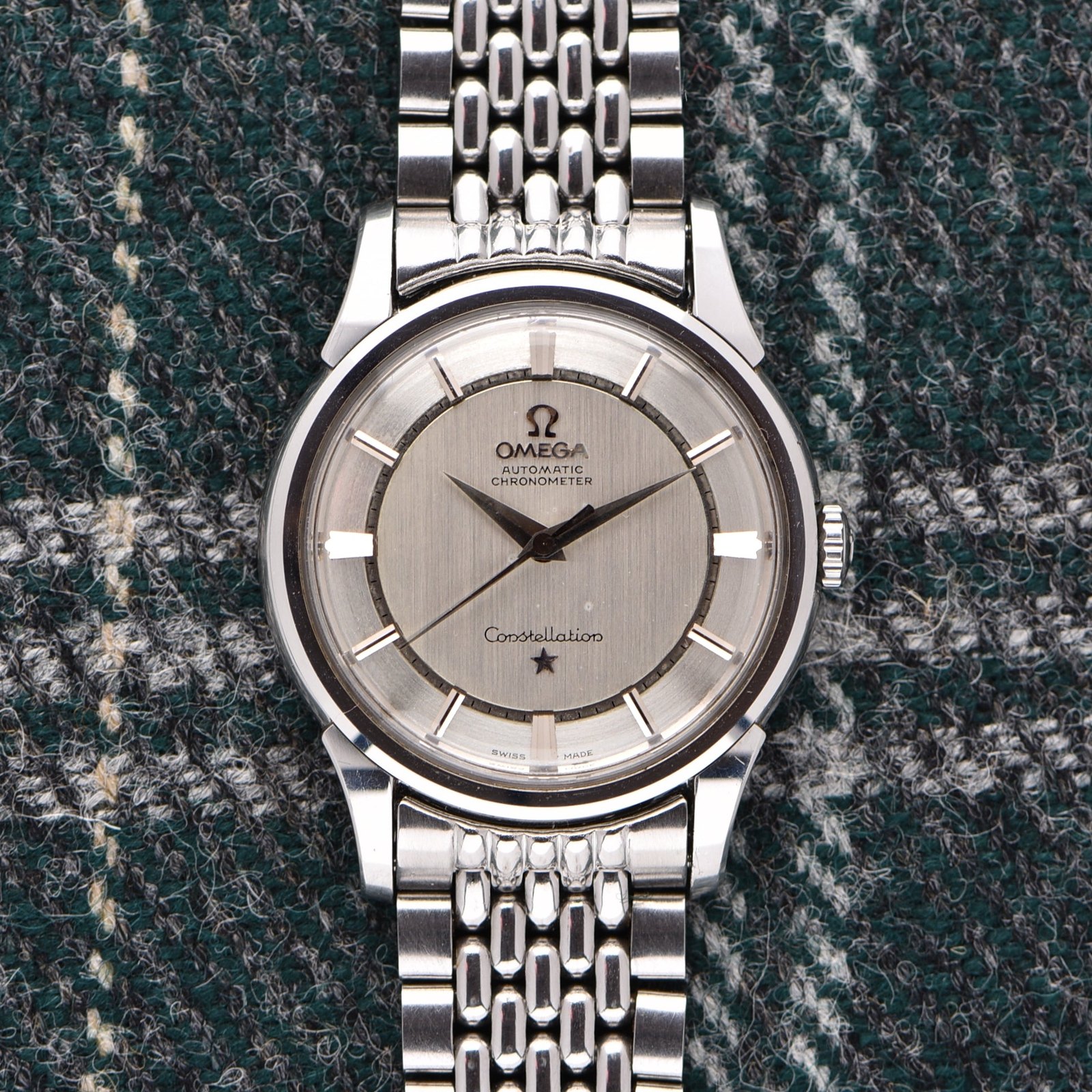
Omega Constellation Railtrack Dial - Rare Clasp, 1959
- Maker / attribution
- Omega (maker)
- Date
- 1959
- Historical period
- Modern Mechanical Horology (1945 – 1969)
- Country of origin
- Switzerland
- Object type
- Wristwatch
- Dimensions
- Case 34 mm
- Stock no.
- Product 7403778572471
- Credit line
- Dealer listing, Huntington Company (product 7403778572471)
- Catalogue title (original)
- 1959 Omega Constellation Railtrack Dial - Rare Clasp (English)
View the source record (dealer listing) ↗ (opens another website in a new tab)Suggest a correction
Record summary
Catalogued by Huntington Company (dealer) (stock number Product 7403778572471), this is a wristwatch by Omega, made in Switzerland, dated 1959. The Atlas places it in the Modern Mechanical Horology period (1945 – 1969) of its Wristwatches collection. Recorded dimensions: Case 34 mm. The record is illustrated with 6 photographs.
Assembled from the source record's structured fields. Dates and attributions are given as the source states them; where a field is missing the Atlas leaves it blank rather than estimating.
Catalogue description
Dealer description — Huntington Company
14381-4 Watch Only Specifications Year: 1959 Model: Constellation Case Diameter: 34mm Lug to Lug: 42mm Case: Steel Condition: In regular, worn condition Dial: Railtrack Movement: Automatic winding Condition The case is unpolished with sharp edges. The bracelet and clasp are in great condition with the sliding mechanism still functioning perfectly. The dial has some oxidization on the minute track and a little bit of speckling throughout. The caseback is also in great condition with the gold Constellation medallion which is still unpolished and crisp. The Story The Constellation collection, founded in 1948, is a collection of watches that began with the Centenary, a watch designed by René Banwart. The watch was made in limited numbers, with 6,000 made in 1952. The Constellation was named after the emblem on the caseback, which showed an observatory with eight stars above it. The watch was known for its distinctive faceted convex dial, known as a "pie-pan dial." The collection evolved over the 1960s, with models featuring simpler dial designs and a wider variety of case shapes. The Constellation also pioneered quartz watch technology, with the first commercially available quartz watch, the Astron, released in 1969. Today the line is still just as diverse, with mechanical chronometers and Master Chronometers. The collection includes a wide range of case materials and combinations, representing the latest chapter in the history of one of the longest-lived and most important wristwatch collections in the history of wristwatches. This Constellation is for sure one of the rarer examples. Made for only a short period of time, the Railtrack dial is slightly different than the Pie-pan dials. It has a smooth surface on the outer part of the dial with no sharp edges. This example also features a rare and original bracelet clasp. The clasp features a sliding mechanism for easy adjustment, a function that is rarely seen in vintage watches. You won't find many of these bracelets anymore because they were known to break and be very fragile. This clasp is still in perfect condition and is fully functional. We know this example was produced for the Asia Market because of the non-luminous dial and hands. This was done during that era because it was hard for watch brands to import watches into Asia with luminous material (tritium), so the non-lume dials gave them the solution to the customs regulations that were put on them. The Brand Omega, a Swiss watchmaker founded in 1848, has a rich history of innovation and precision. The company's vision was carried on by its sons Louis-Paul and César, who pioneered full watch production under the brand's roof. In 1894, the company unveiled the world's first mass-produced, interchangeable watch movement, the Omega Calibre, which streamlined production and propelled the brand to international fame. As the 20th century began, Omega watches became at the forefront of timekeeping technology and revolutionized sports watches with their precision. The Olympic Games provided an ideal stage for Omega to demonstrate its exceptional timekeeping abilities. In 1932, Omega began its role as Official Olympic Timekeeper, starting an enduring partnership spanning over 80 years. With each Games, Omega introduced groundbreaking timekeeping innovations, such as the first photo finish camera at the 1948 London Olympics. Omega's contributions to spaceflight began in 1962 when the Omega Speedmaster became the first watch worn in space on Mercury-Atlas 6. Its defining moment came in 1969 with the Apollo 11 moon landing, where Buzz Aldrin stepped onto the moon wearing his trusty Omega Speedmaster Moonwatch. The company played an indispensable role in NASA's pioneering '60s space missions, including the Apollo 13 mission, where the Speedmaster timed the engine burn, ensuring the crew's safe descent to Earth. Omega's cultural impact extends into pop culture through a long-running cinematic partnership with James Bond Movies. Since 1995's GoldenEye, James Bond has sported Omega watches on the silver screen, wearing the Seamaster Diver 300M and the rugged Omega Seamaster Planet Ocean. Omega remains dedicated to exploring new technological frontiers today, with innovations like the battery-free Pictograms model, wearable tech collaborations, and energy-harnessing movements driving progress and cementing its place in history.
Historical context
Modern Mechanical Horology (1945 – 1969)
Tool watches for divers, pilots and astronauts; electric watches anticipate the electronic age.
The classic era of the mechanical wristwatch: dive watches, chronographs for motor racing and space flight, GMT watches for jet travel, slim dress watches, automatic calendars, and the rise of Japanese manufacturers alongside Swiss, American, German and Soviet industries.
Read the period in the timelineMore wristwatches from this periodEarlier: Golden Age of Mechanical Watchmaking
Atlas type guide
Wristwatches
Bracelet watches were worn by women from the early nineteenth century — Breguet made one for Caroline Murat, Queen of Naples, in 1810–12 — but the wristwatch only became a man's instrument with military use and aviation in the early twentieth century. Between the World Wars it overtook the pocket watch; the 1920s and 1930s brought rectangular Art Deco cases, water-resistant cases and the first automatic winding systems.
After 1945 the wristwatch became a carrier of identity — dress watches, sports and dive watches, chronographs, calendars — produced by Swiss, American, Japanese, German, Soviet and Chinese industries. The quartz revolution after 1969 and the mechanical renaissance since the 1990s, including the rise of independent watchmakers, complete the story.
What to look for
- The reference number (between the lugs or inside the case back) and serial number, the starting point for dating.
- The calibre: its maker and number are often stamped under the dial or on the bridge.
- Originality of dial, hands and crown — refinished ('redial') dials are common.
- Case material marks: 18K/750, 14K/585, stainless steel, gold-filled, plated.
Dating clues
- Wire-lug cases: before c. 1925.
- Water-resistant screw-down cases: from 1926.
- Quartz movements: from 1969; sapphire crystals widespread after c. 1980.
General guidance written by the Atlas editors about this kind of object. It is not a statement about this particular piece; for that, rely on the source record above and on physical examination.
Related records

Instruments · 1950–1976
Omega Megaquartz 2400 marine chronometer, 1950–1976
Science Museum Group, London

Instruments · 1960–1979
Stopwatch / timer by Omega, 1960–1979
Science Museum Group, London

Instruments · 1960–1979
Stopwatch / timer by Omega, Switzerland, 1960–1979
Science Museum Group, London

Instruments · 1960–1979
Stopwatch by Omega, Swiss made, single-button type reading 0 - 60 seconds in fifths and 0 - 5 minutes in minutes on subsidiary dial, 1960-79.
Science Museum Group, London

Wristwatches · 1945
Wristwatch by Eterna, 1945
Museum Rotterdam

Wristwatches · c. 1945
Breitling Premier, ref. 790, c. 1945
Antiquorum auction archive, Geneva

Wristwatches · c. 1945
Universal Genève Uni-Compax, ref. 22492, c. 1945
Antiquorum auction archive, Geneva

Wristwatches · c. 1950s
Baume & Mercier wristwatch, c. 1950s
Antiquorum auction archive, Geneva