
Wristwatches · Wristwatch
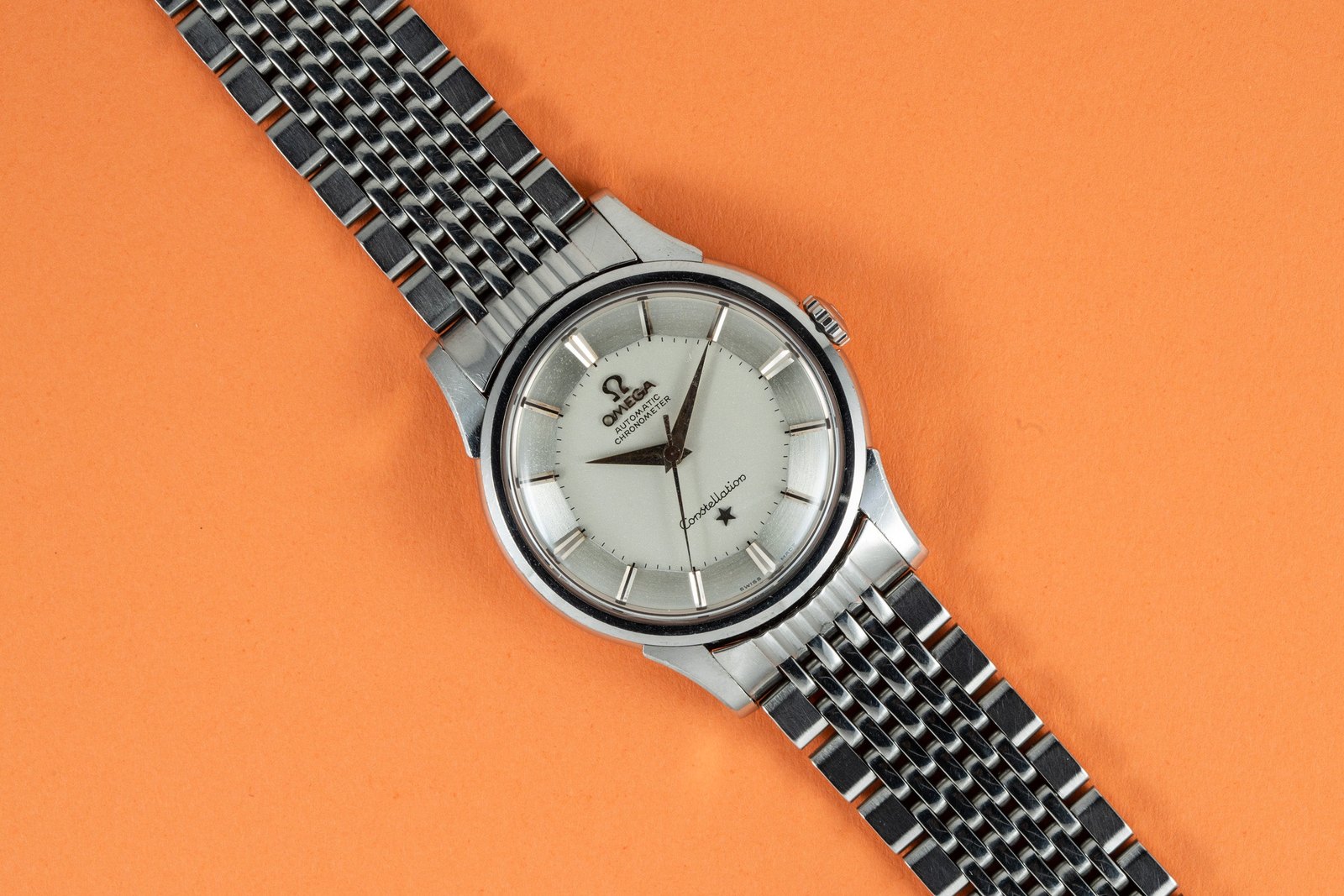
Omega Constellation, c. 1957
- Maker / attribution
- Omega (maker)
- Date
- c. 1957
- Historical period
- Modern Mechanical Horology (1945 – 1969)
- Country of origin
- Switzerland
- Object type
- Wristwatch
- Stock no.
- 40960014
- Credit line
- Dealer listing, Analog/Shift (40960014)
- Catalogue title (original)
- Omega Constellation (English)
View the source record (dealer listing) ↗ (opens another website in a new tab)Suggest a correction
Record summary
Catalogued by Analog/Shift (dealer), New York (stock number 40960014), this is a wristwatch by Omega, made in Switzerland, dated c. 1957. The Atlas places it in the Modern Mechanical Horology period (1945 – 1969) of its Wristwatches collection. The record is illustrated with 6 photographs.
Assembled from the source record's structured fields. Dates and attributions are given as the source states them; where a field is missing the Atlas leaves it blank rather than estimating.
Catalogue description
Dealer description — Analog/Shift
Why We Love It The Constellation was once Omega’s flagship model. A contemporary of the Speedmaster Professional, Seamaster SM300, Railmaster and DeVille, the Connie was top dog - known worldwide for its accuracy and high design. Throughout its years, Omega has produced many different Constellation models, with a wide variation in case shape and dial design. Perhaps the most desirable configuration amongst collectors are those featuring so-called “Pie-Pan” diala, nicknamed for their close resemblance to the design of a baking dish. Three-dimensional dress watch dials are a rarity, and it is this unique and elegant design element that has made the Pie-Pan sought after. A large number of Pie-Pan Constellations are gold-plated, as was en vogue in the 1960s, and quality steel examples are rarely seen today. This particular example, finished in stainless steel and fitted with a stunning rice bead bracelet, is a gorgeous example of one of the rarer variants, featuring a non-luminous dial. slim baton makers and a matching dauphine handset. This Constellation is driven by a Calibre 551 no-date automatic movement and dates to circa 1957, an important year in Omega's history. It also comes complete with a later red Omega Constellation box. This watch simply oozes mid-century style and elegance, and it’s hard to name a more interesting -- or better quality -- vintage dress watch for the money. The Constellation Story The Constellation line was launched by Omega in 1952, after a limited production of a watch commemorating their centennial in 1948 that was aptly named the Century. While the Century was never intended for retail production, it received such wide acclaim for both its sumptuous case design and it's chronometer-level accuracy that Omega decided to launch a new line. Beginning with their self-winding movement, Omega built a watch that matched their ideal for what a modern (at the time) watch should be. Omega adorned the newly-minted Constellation line with a likeness of the Cupola of the Geneva Observatory. This observatory was one of several in Europe that put watches through a rigorous testing process with accuracy standards much more stringent than those of the Control Officiel Suisse des Chronometres, or COSC. These tests, lasting between 30 and 50 days, were broken down into eight categories of overall accuracy. Watches that passed the rigorous scrutiny were dubbed Observatory Chronometers and were awarded a special Bulletin de Marche from the Observatory that tested it. The cupola is a reminder of the watch's superior engineering, the eight stars a nod to Omega's acing of every category of the observatory accuracy tests in 1931. For a closer look at the history of the Constellation line, have a look at the Omega Museum Online, HERE .
Historical context
Modern Mechanical Horology (1945 – 1969)
Tool watches for divers, pilots and astronauts; electric watches anticipate the electronic age.
The classic era of the mechanical wristwatch: dive watches, chronographs for motor racing and space flight, GMT watches for jet travel, slim dress watches, automatic calendars, and the rise of Japanese manufacturers alongside Swiss, American, German and Soviet industries.
Read the period in the timelineMore wristwatches from this periodEarlier: Golden Age of Mechanical Watchmaking
Atlas type guide
Wristwatches
Bracelet watches were worn by women from the early nineteenth century — Breguet made one for Caroline Murat, Queen of Naples, in 1810–12 — but the wristwatch only became a man's instrument with military use and aviation in the early twentieth century. Between the World Wars it overtook the pocket watch; the 1920s and 1930s brought rectangular Art Deco cases, water-resistant cases and the first automatic winding systems.
After 1945 the wristwatch became a carrier of identity — dress watches, sports and dive watches, chronographs, calendars — produced by Swiss, American, Japanese, German, Soviet and Chinese industries. The quartz revolution after 1969 and the mechanical renaissance since the 1990s, including the rise of independent watchmakers, complete the story.
What to look for
- The reference number (between the lugs or inside the case back) and serial number, the starting point for dating.
- The calibre: its maker and number are often stamped under the dial or on the bridge.
- Originality of dial, hands and crown — refinished ('redial') dials are common.
- Case material marks: 18K/750, 14K/585, stainless steel, gold-filled, plated.
Dating clues
- Wire-lug cases: before c. 1925.
- Water-resistant screw-down cases: from 1926.
- Quartz movements: from 1969; sapphire crystals widespread after c. 1980.
General guidance written by the Atlas editors about this kind of object. It is not a statement about this particular piece; for that, rely on the source record above and on physical examination.
Related records

Instruments · 1950–1976
Omega Megaquartz 2400 marine chronometer, 1950–1976
Science Museum Group, London

Instruments · 1960–1979
Stopwatch / timer by Omega, 1960–1979
Science Museum Group, London

Instruments · 1960–1979
Stopwatch / timer by Omega, Switzerland, 1960–1979
Science Museum Group, London

Instruments · 1960–1979
Stopwatch by Omega, Swiss made, single-button type reading 0 - 60 seconds in fifths and 0 - 5 minutes in minutes on subsidiary dial, 1960-79.
Science Museum Group, London

Wristwatches · 1945
Wristwatch by Eterna, 1945
Museum Rotterdam

Wristwatches · c. 1945
Breitling Premier, ref. 790, c. 1945
Antiquorum auction archive, Geneva

Wristwatches · c. 1945
Universal Genève Uni-Compax, ref. 22492, c. 1945
Antiquorum auction archive, Geneva

Wristwatches · c. 1950s
Baume & Mercier wristwatch, c. 1950s
Antiquorum auction archive, Geneva