
Wristwatches · Wristwatch
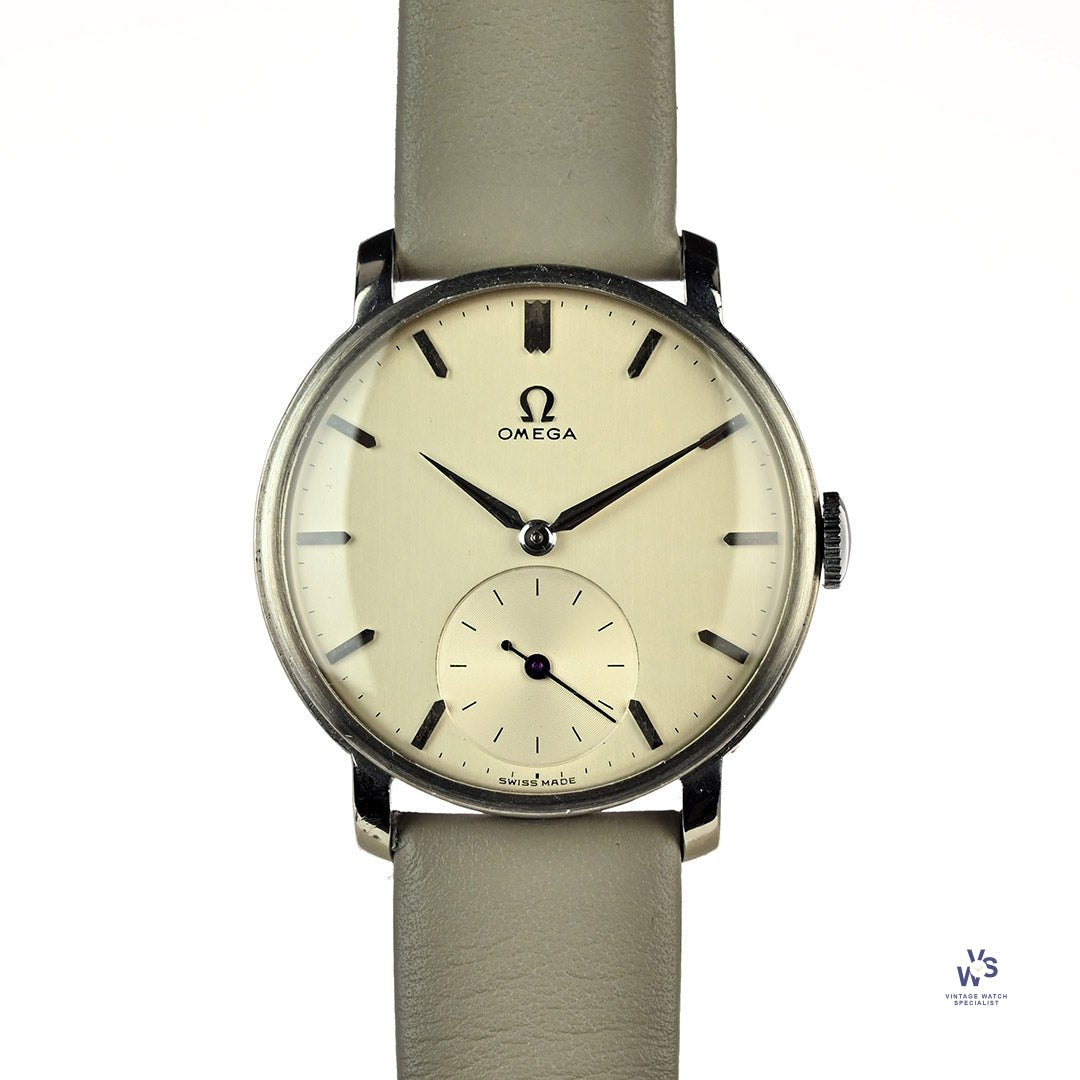
Omega 'Big Eye', Steel Dress Watch with Calibre 30T2 Movement, circa 1939
- Maker / attribution
- Omega (maker)
- Date
- c. 1939
- Historical period
- Golden Age of Mechanical Watchmaking (1900 – 1945)
- Country of origin
- Switzerland
- Object type
- Wristwatch
- Materials / technique
- steel
- Dimensions
- Case 35 mm
- Stock no.
- vws3034
- Credit line
- Dealer listing, Vintage Watch Specialist (vws3034)
- Catalogue title (original)
- Omega 'Big Eye' - c.1939 - Steel Dress Watch with Calibre 30T2 Movement (English)
View the source record (dealer listing) ↗ (opens another website in a new tab)Suggest a correction
Record summary
Catalogued by Vintage Watch Specialist (dealer), United Kingdom (stock number vws3034), this is a wristwatch by Omega, made in Switzerland, dated c. 1939. The Atlas places it in the Golden Age of Mechanical Watchmaking period (1900 – 1945) of its Wristwatches collection. Materials and techniques recorded by the source: steel. Recorded dimensions: Case 35 mm. The record is illustrated with 6 photographs.
Assembled from the source record's structured fields. Dates and attributions are given as the source states them; where a field is missing the Atlas leaves it blank rather than estimating.
Catalogue description
Dealer description — Vintage Watch Specialist
A Beautiful Omega 'Big Eye' Manual Wind Dress Watch in Fantastic Condition with Beautiful Dial Furniture and 'Big Eye' Recessed Sub-Seconds Dial, c.1939 Omega dress watches have a rich history that dates back to the early 20th century. These elegant timepieces were specifically designed to be worn with formal attire, serving as a symbol of sophistication and status. In the 1920s, Omega introduced their first collection of dress watches, featuring sleek and minimalistic designs. These watches were characterized by their slim profiles, refined dials, and luxurious materials such as gold and platinum. They quickly gained popularity among high-society individuals who sought to make a fashion statement. During the mid-20th century, Omega continued to innovate in the realm of dress watches. They introduced innovative features like automatic movements and water resistance while maintaining their commitment to timeless design aesthetics. In recent years, Omega has modernized its dress watch offerings by incorporating cutting-edge technology alongside classic design elements. What's on Offer You simply cannot go wrong with a vintage Omega, they exude class and elegance and are still very wearable. This is the perfect example of a watch that has transcended time, at over 80 years old it looks as stylish and contemporary on the wrist as many of its modern counterparts. The refined dial is blemish-free and boasts applied polished metal hour markers, sword hands and a larger than normal, 'Big Eye' sub-seconds dial, encapsulated underneath a shatterproof acrylic crystal and encased in stainless steel. The ultra-slim steel bezel means the oversized (for period) 35mm dial wears significantly larger on the wrist. The watch is powered by the reputable 30T2 movement which was first introduced in 1939 and was produced thereafter for over 25 years and over 3 million of these movements were produced - a testament to its reliability and precision! This watch is in incredible condition given its age, there are of course slight signs of wear but this is to be expected and as we always say, it is all part of the joy when considering a vintage watch. We love it!
Historical context
Golden Age of Mechanical Watchmaking (1900 – 1945)
The wristwatch displaces the pocket watch; waterproof cases, self-winding and grand complications.
The wristwatch overtook the pocket watch. Military use in the First World War, aviation, water-resistant cases (1926), automatic winding (1923–31), rectangular Art Deco designs and early chronographs and calendars defined the period.
Read the period in the timelineMore wristwatches from this periodEarlier: Industrial Revolution
Atlas type guide
Wristwatches
Bracelet watches were worn by women from the early nineteenth century — Breguet made one for Caroline Murat, Queen of Naples, in 1810–12 — but the wristwatch only became a man's instrument with military use and aviation in the early twentieth century. Between the World Wars it overtook the pocket watch; the 1920s and 1930s brought rectangular Art Deco cases, water-resistant cases and the first automatic winding systems.
After 1945 the wristwatch became a carrier of identity — dress watches, sports and dive watches, chronographs, calendars — produced by Swiss, American, Japanese, German, Soviet and Chinese industries. The quartz revolution after 1969 and the mechanical renaissance since the 1990s, including the rise of independent watchmakers, complete the story.
What to look for
- The reference number (between the lugs or inside the case back) and serial number, the starting point for dating.
- The calibre: its maker and number are often stamped under the dial or on the bridge.
- Originality of dial, hands and crown — refinished ('redial') dials are common.
- Case material marks: 18K/750, 14K/585, stainless steel, gold-filled, plated.
Dating clues
- Wire-lug cases: before c. 1925.
- Water-resistant screw-down cases: from 1926.
- Quartz movements: from 1969; sapphire crystals widespread after c. 1980.
General guidance written by the Atlas editors about this kind of object. It is not a statement about this particular piece; for that, rely on the source record above and on physical examination.
Related records

Instruments · 1950–1976
Omega Megaquartz 2400 marine chronometer, 1950–1976
Science Museum Group, London

Instruments · 1960–1979
Stopwatch / timer by Omega, 1960–1979
Science Museum Group, London

Instruments · 1960–1979
Stopwatch / timer by Omega, Switzerland, 1960–1979
Science Museum Group, London

Instruments · 1960–1979
Stopwatch by Omega, Swiss made, single-button type reading 0 - 60 seconds in fifths and 0 - 5 minutes in minutes on subsidiary dial, 1960-79.
Science Museum Group, London

Wristwatches · 1931
Rolex 'Oyster Perpetual' rotor self-winding wrist-watch, lever escapement, in steel case with glass in back, Montres Rolex SA, Geneva, Switzerland, 1931
Science Museum Group, London

Wristwatches · 1900–1999
Wristwatch by Certina, Switzerland, 1900–1999
Nordic Museum Foundation

Wristwatches · 1900–1999
Wristwatch by Omega, Västerås, 1900–1999
Nordic Museum Foundation

Wristwatches · 1900–1999
Wristwatch by Universal, Switzerland, 1900–1999
Nordic Museum Foundation