
Pocket Watches · Open-face pocket watch
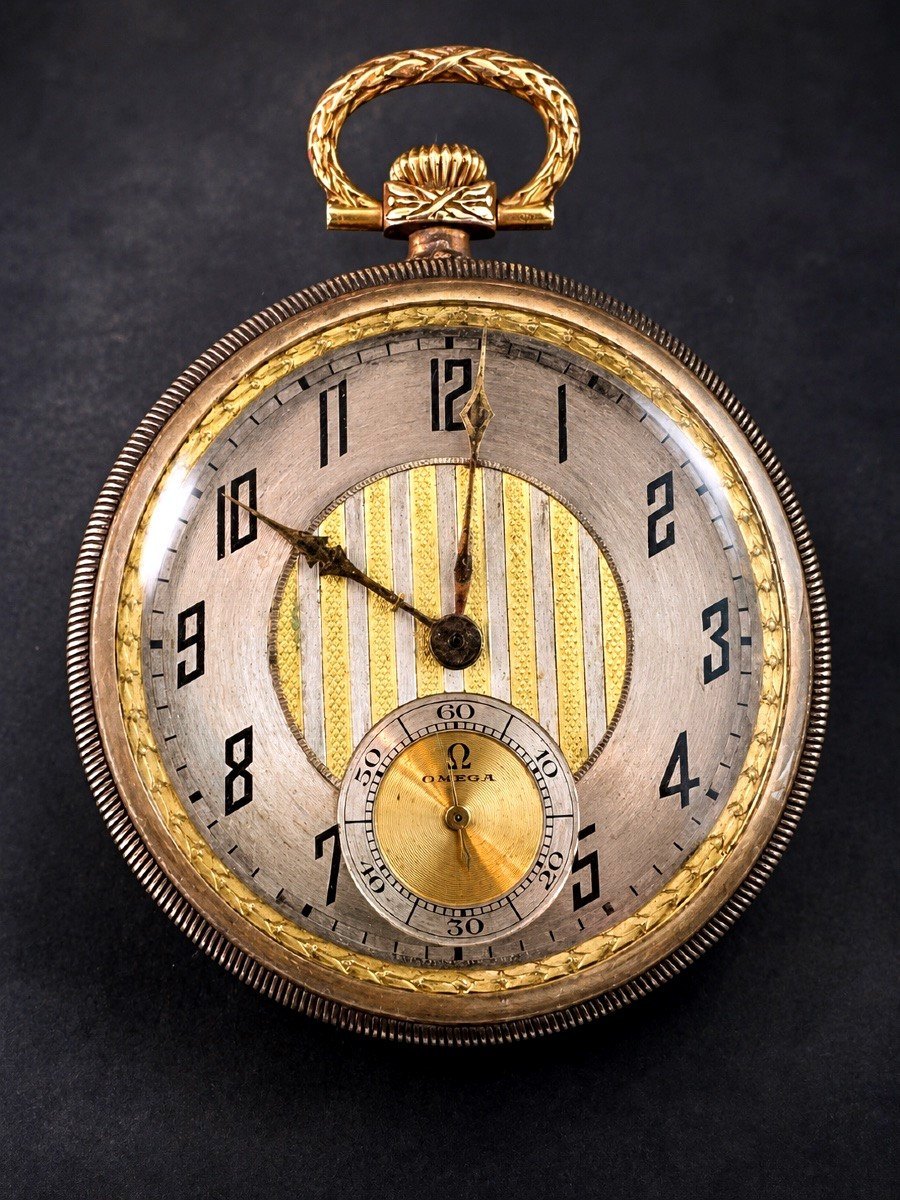
Omega 18-karat Yellow Gold Art Deco Pocket Watch
- Maker / attribution
- Omega (source attribution)
- Date
- first half of the 20th century, likely around 1920–1930
- Historical period
- Golden Age of Mechanical Watchmaking (1900 – 1945)
- Country of origin
- Switzerland
- Object type
- Open-face pocket watch
- Materials / technique
- 18-karat yellow gold (750/1000)
- Holding institution
- Le sanctuaire des curiosités / Proantic
- Accession / object no.
- omega-18-karat-yellow-gold-art-deco-pocket-watch-8df26b21d3
- Credit line
- Le sanctuaire des curiosités / Proantic
- Catalogue title (original)
- Proantic: Omega – 18-karat Yellow Gold Pocket Watch – Art Deco Period (English)
View the source record ↗ (opens another website in a new tab)Suggest a correction
Record summary
Held and catalogued by Le sanctuaire des curiosités / Proantic (object number omega-18-karat-yellow-gold-art-deco-pocket-watch-8df26b21d3), this is an open-face pocket watch attributed to Omega, made in Switzerland, dated first half of the 20th century, likely around 1920–1930. The Atlas places it in the Golden Age of Mechanical Watchmaking period (1900 – 1945) of its Pocket Watches collection. Materials and techniques recorded by the source: 18-karat yellow gold (750/1000). The record is illustrated with 1 photograph.
Assembled from the source record's structured fields. Dates and attributions are given as the source states them; where a field is missing the Atlas leaves it blank rather than estimating.
Catalogue description
Original object description
Offered as an Omega timepiece made in Switzerland during the early 20th century—tentatively dated around 1920–1930—this open-face pocket watch is constructed from 18-karat (750/1000) yellow gold, measuring 4.5 cm in diameter and weighing 56.7 grams. Its case back features diagonally fluted engine-turned guilloché within gadrooned borders, opening to reveal two internal gold flaps, while stylized foliage accents the bow and winding crown. Vendor-claimed hallmarks and serial numbers are not documented in the records or photographs. Designed in an Art Deco aesthetic, the two-tone dial is configured with an outer brushed silver chapter ring of elongated black Arabic numerals around a central core of alternating silver and gold vertical stripes. Sunken at 6 o'clock is a gold-tone subsidiary seconds subdial signed 'OMEGA' with the corporate emblem. The seller describes the mechanism as a manual-wind Omega anchor movement with pivot jewels, a gear train, and a rack-and-pinion regulator; its functionality and precision have not been verified.
Historical context
Golden Age of Mechanical Watchmaking (1900 – 1945)
The wristwatch displaces the pocket watch; waterproof cases, self-winding and grand complications.
The pocket watch reached technical maturity and then began to give way to the wristwatch after the First World War. Complicated watches for collectors such as Henry Graves Jr. and James Ward Packard, railroad watches, and slim Art Deco dress watches are characteristic.
Read the period in the timelineMore pocket watches from this periodEarlier: Industrial Revolution
Atlas type guide
Hunter, half-hunter and open-face watches
In the nineteenth century the pocket watch case settled into a few standard forms. The hunter (French savonnette) has a hinged front lid protecting the crystal — reputedly for riders who could not risk broken glass — and is opened by pressing the crown or a push-piece. The half-hunter has a small window in the lid so the hands can be read when closed. The open-face (lépine) watch has no front cover, with the crown at 12; hunters normally carry the crown at 3.
Case types also changed with winding: key-wound watches gave way to keyless (stem-wound) mechanisms after Adrien Philippe's and others' designs of the 1840s, with pendant setting or lever setting.
What to look for
- Crown position relative to the seconds dial: at 3 for hunters, at 12 for open-face watches.
- Spring-loaded front cover with a push-piece in the pendant.
- Half-hunter chapter ring enamelled on the lid.
- Key holes in the inner dome (cuvette) versus keyless winding.
Dating clues
- Keyless winding spread after c. 1850 and became standard by c. 1890.
- English hallmarks inside gold and silver cases give the year of assay.
General guidance written by the Atlas editors about this kind of object. It is not a statement about this particular piece; for that, rely on the source record above and on physical examination.
Read next:Detached lever escapement
Related records

Instruments · 1950–1976
Omega Megaquartz 2400 marine chronometer, 1950–1976
Science Museum Group, London

Instruments · 1960–1979
Stopwatch / timer by Omega, 1960–1979
Science Museum Group, London

Instruments · 1960–1979
Stopwatch / timer by Omega, Switzerland, 1960–1979
Science Museum Group, London

Instruments · 1960–1979
Stopwatch by Omega, Swiss made, single-button type reading 0 - 60 seconds in fifths and 0 - 5 minutes in minutes on subsidiary dial, 1960-79.
Science Museum Group, London

Pocket Watches · c. 1900
Patek Philippe Chronometro Gondolo, c. 1900
Antiquorum auction archive, Geneva
Pocket Watches · c. 1900
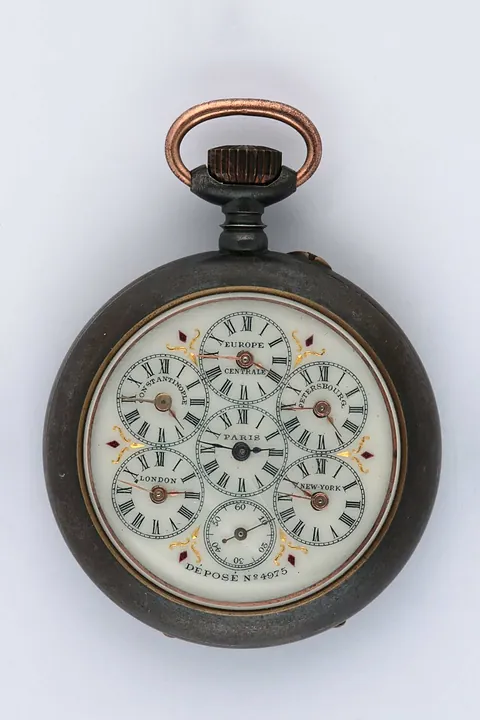
Pocket watch by A. Sandoz-Boucherin, Switzerland, c. 1900
German Clock Museum
Pocket Watches · 1900
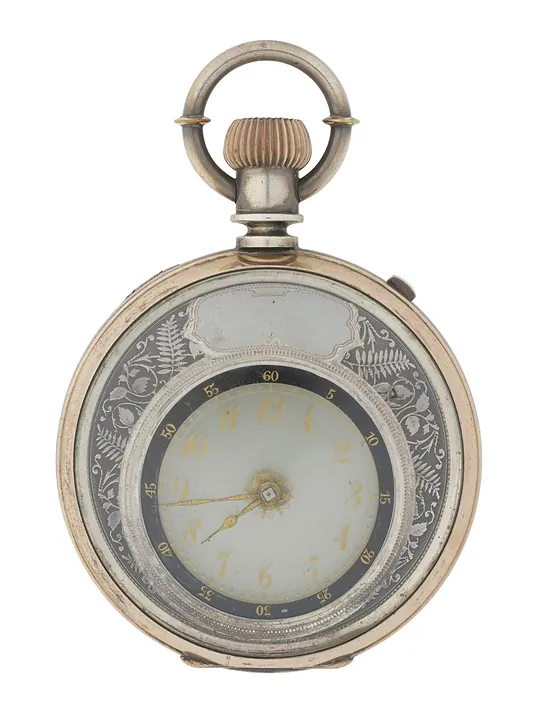
Pocket watch by Armand Schwob & Frère, Switzerland, 1900
Science Museum Group, London
Pocket Watches · c. 1900
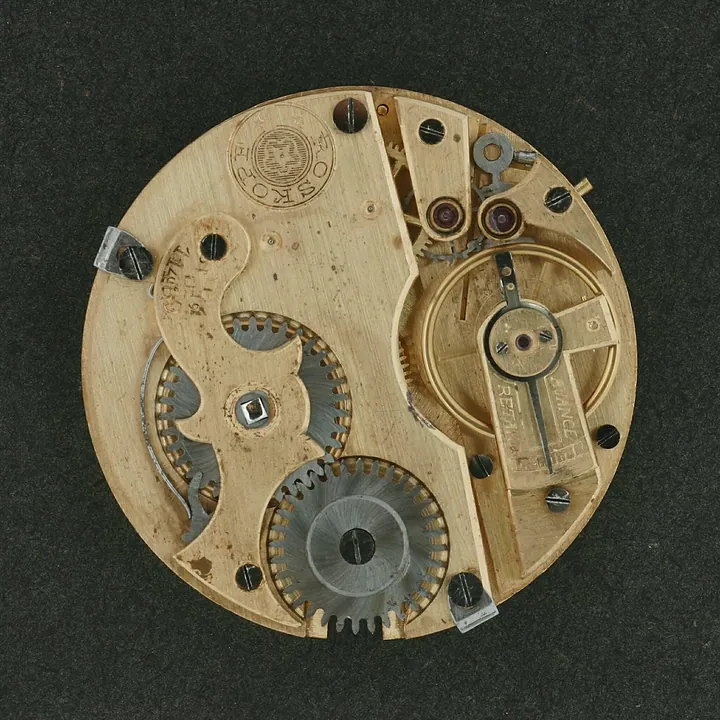
Pocket watch by Vve. Chs. Léon Schmid und Cie, Switzerland, c. 1900
German Clock Museum