
Wristwatches · Wristwatch
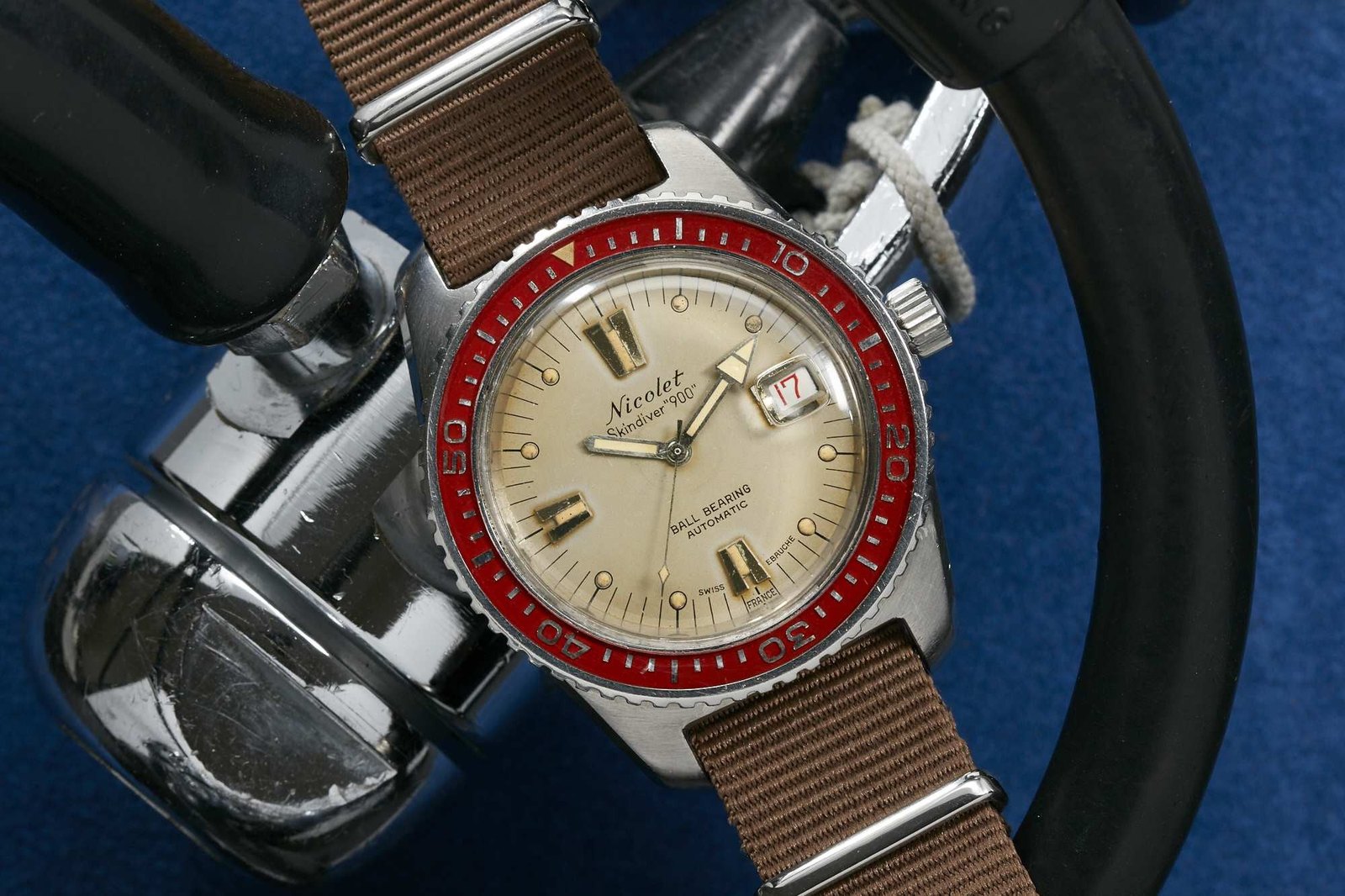
Nicolet Skin Diver 900, mid 1960s
- Maker / attribution
- Nicolet (maker)
- Date
- mid 1960s
- Historical period
- Modern Mechanical Horology (1945 – 1969)
- Country of origin
- Unrecorded in source
- Object type
- Wristwatch
- Dimensions
- Case 40 mm
- Stock no.
- Product 7942241153
- Credit line
- Dealer listing, Analog/Shift (product 7942241153)
- Catalogue title (original)
- Nicolet Skin Diver 900 (English)
View the source record (dealer listing) ↗ (opens another website in a new tab)Suggest a correction
Record summary
Catalogued by Analog/Shift (dealer), New York (stock number Product 7942241153), this is a wristwatch by Nicolet, dated mid 1960s. The Atlas places it in the Modern Mechanical Horology period (1945 – 1969) of its Wristwatches collection. Recorded dimensions: Case 40 mm. The record is illustrated with 6 photographs.
Assembled from the source record's structured fields. Dates and attributions are given as the source states them; where a field is missing the Atlas leaves it blank rather than estimating.
Catalogue description
Dealer description — Analog/Shift
When pressed to think of dive watches from the 1960s, your mind will often go to the known brands. Rolex, say, or their daughter brand Tudor, whose Submariner more or less sets the standard for what a dive watch is supposed to be. Or Blancpain, who arguably created the whole subgenre with their Jacques Cousteau-approved Fifty Fathoms . Then there's always Seiko, whose Reference 6105 saw service in the Vietnam War. But in terms of vintage divers, that's merely scratching the surface. Nicolet is a brand that might not get a lot of recognition, but has a pedigree that's just as respectable as the horological heavy hitters mentioned above. Armand Nicolet opened his manufacture in the Jura Mountains in 1875. Nicolet, the son of a watchmaker, established a reputation for producing fine pocket watches with guilloché cases. After Armand's death in 1939, his son Willy succeed him as head of the atelier . It was under Willy's leadership that the manufacture's production expanded to encompass the production of wristwatches. His divers produced in the 1960s rate among some of the most visually-appealing of the period. The technical innovation of their construction rivals even that of Rolex and Doxa. The Skin Diver 900 that we have here dates from the mid-1960s. Aesthetically, the Skin Diver resembles divers produced by Elgin or Bulova , with a chunky 40mm case and a Bakelite bezel--here a vibrant cherry red. But its warm silver dial is a true standout, softening its looks considerably. But the most salient feature of this piece is the Helium Release Valve, not necessarily the fact that it has one, but its location. Unlike Rolex and Doxa, who placed the Helium Release Valve in the side of the case (in their Sea Dweller and Sub 300T divers), Nicolet placed the valve in the screw-down crown. This unusual placement, ostensibly to make it easier for the wearer to use, is a truly utilitarian design feature, not to mention a technical triumph. Inside beats an A. Schild Caliber 1748 automatic movement. The Caliber 1748 is a no-nonsense caliber that enjoyed its heyday in the 1960s before Schild ceased production in the 1970s. It features a ball-bearing rotor that's an absolute joy to hear when in action. With attractive looks and a solid construction, the Nicolet Skin Diver 900 is a sporty alternative for the collector who desires an unusual and rarely-found diver.
Historical context
Modern Mechanical Horology (1945 – 1969)
Tool watches for divers, pilots and astronauts; electric watches anticipate the electronic age.
The classic era of the mechanical wristwatch: dive watches, chronographs for motor racing and space flight, GMT watches for jet travel, slim dress watches, automatic calendars, and the rise of Japanese manufacturers alongside Swiss, American, German and Soviet industries.
Read the period in the timelineMore wristwatches from this periodEarlier: Golden Age of Mechanical Watchmaking
Atlas type guide
Dive and water-resistant watches
Keeping water and dust out of a wristwatch was a long-standing challenge. Rolex's screw-down Oyster case (1926) and Omega's Marine (1932) were landmarks; in the early 1950s Blancpain's Fifty Fathoms and Rolex's Submariner defined the professional dive watch with rotating bezels for timing dives, luminous dials and high water resistance. The ISO 6425 standard (1982) later codified what a 'diver's watch' must do.
Dive watches became icons of post-war design and exploration, and their evolution — helium escape valves, ceramic bezels, saturation-diving depth ratings — records the history of underwater work.
What to look for
- Unidirectional or bidirectional rotating bezel with minute markings.
- Screw-down crown and case back; depth rating printed on the dial.
- Luminous hands and markers (radium before c. 1960, tritium c. 1960–1998, then Super-LumiNova).
- Reference numbers on the case between the lugs or inside the back.
Dating clues
- Screw-down Oyster cases: from 1926.
- Professional dive watches: from 1953.
- Tritium 'T' marks on dials: c. 1960–1998.
General guidance written by the Atlas editors about this kind of object. It is not a statement about this particular piece; for that, rely on the source record above and on physical examination.
Related records

Wristwatches · 1945
Wristwatch by Eterna, 1945
Museum Rotterdam

Wristwatches · c. 1945
Breitling Premier, ref. 790, c. 1945
Antiquorum auction archive, Geneva

Wristwatches · c. 1945
Universal Genève Uni-Compax, ref. 22492, c. 1945
Antiquorum auction archive, Geneva
Wristwatches · c. 1950s
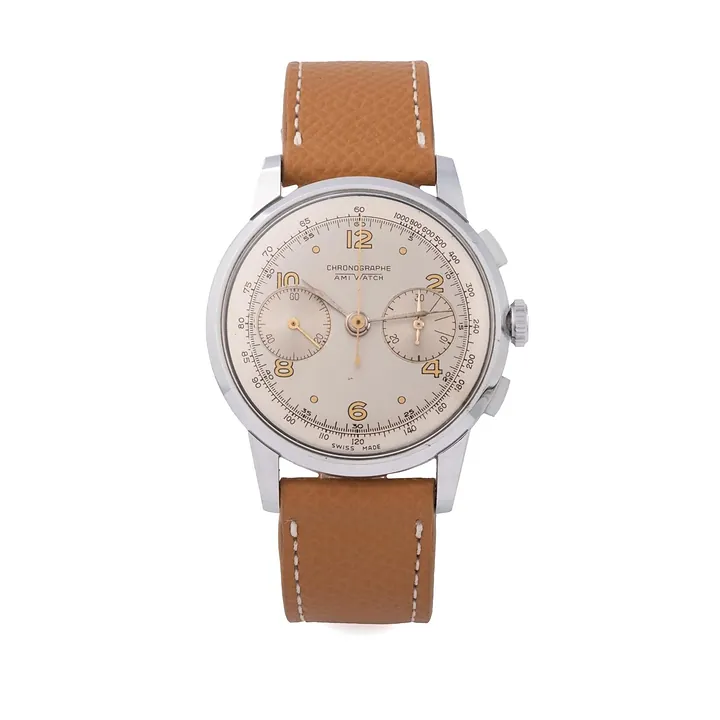
Ami Watch Chronographe, c. 1950s
Antiquorum auction archive, Geneva

Wristwatches · c. 1950s
Baume & Mercier wristwatch, c. 1950s
Antiquorum auction archive, Geneva
Wristwatches · c. 1955
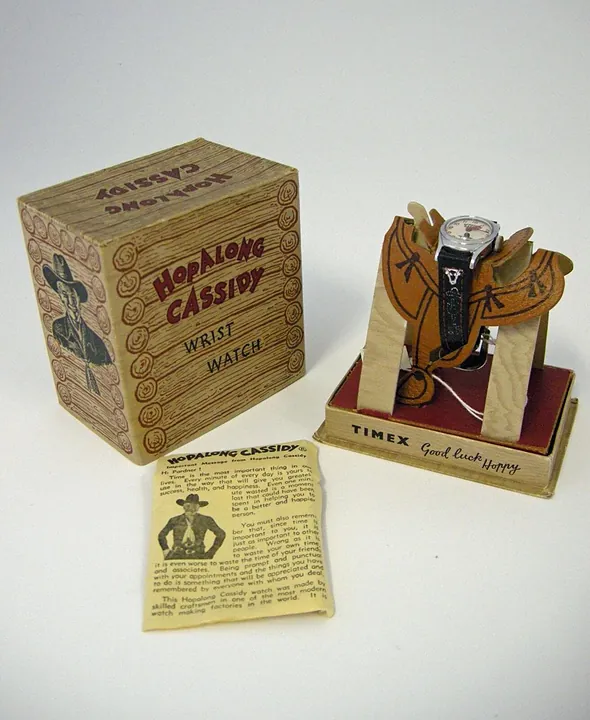
Child's wrist watch by Timex, Dundee, c. 1955
Victoria and Albert Museum, London
Wristwatches · c. 1950
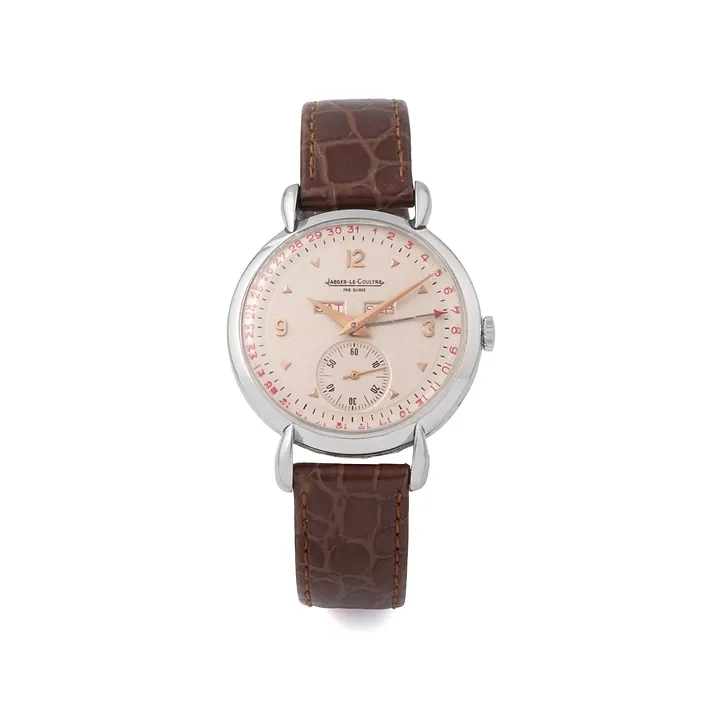
Jaeger Lecoultre Triple Calendar, c. 1950
Antiquorum auction archive, Geneva
Wristwatches · c. 1950
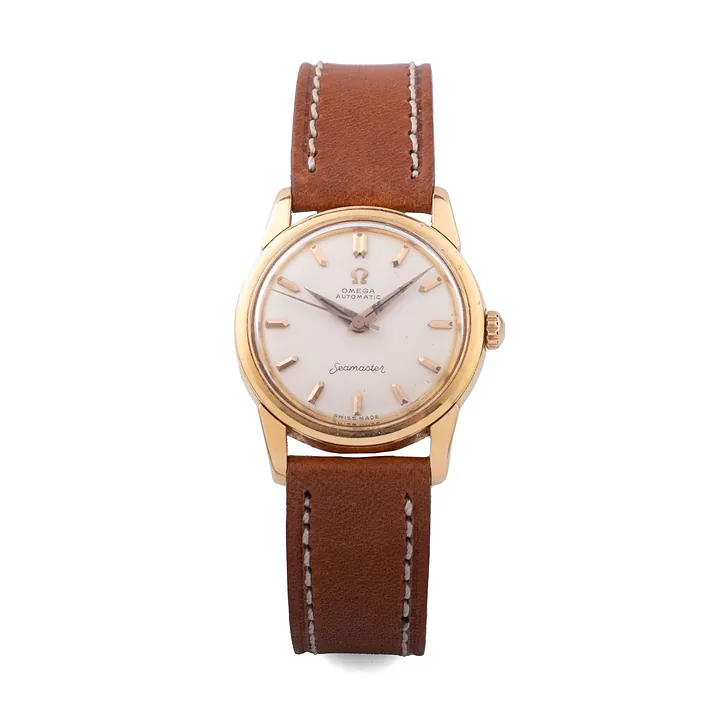
Omega Seamaster Automatic, ref. 2991-1, c. 1950
Antiquorum auction archive, Geneva