
Wristwatches · Wristwatch
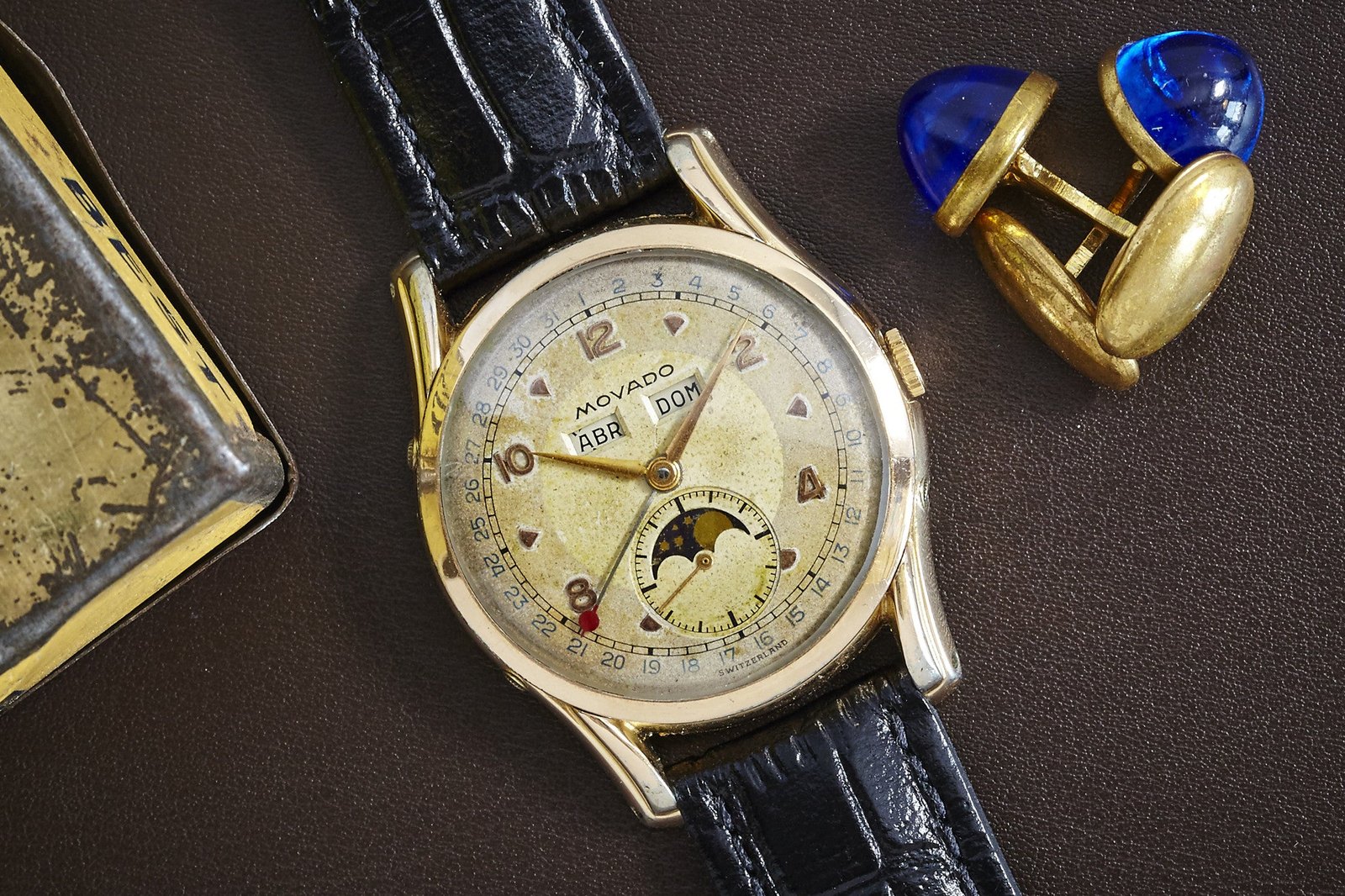
Movado Triple Date Moonphase, late 1950s
- Maker / attribution
- Movado (maker)
- Date
- late 1950s
- Historical period
- Modern Mechanical Horology (1945 – 1969)
- Country of origin
- Switzerland
- Object type
- Wristwatch
- Dimensions
- Case 33.5 mm
- Stock no.
- Product 981390081
- Credit line
- Dealer listing, Analog/Shift (product 981390081)
- Catalogue title (original)
- Movado Triple Date Moonphase (English)
View the source record (dealer listing) ↗ (opens another website in a new tab)Suggest a correction
Record summary
Catalogued by Analog/Shift (dealer), New York (stock number Product 981390081), this is a wristwatch by Movado, made in Switzerland, dated late 1950s. The Atlas places it in the Modern Mechanical Horology period (1945 – 1969) of its Wristwatches collection. Recorded dimensions: Case 33.5 mm. The record is illustrated with 6 photographs.
Assembled from the source record's structured fields. Dates and attributions are given as the source states them; where a field is missing the Atlas leaves it blank rather than estimating.
Catalogue description
Dealer description — Analog/Shift
We begin with a simple three-hand movement. The mainspring, an eager little strip of metal, is charged by the winding of a crown or by the oscillation of a rotor. But this energy is raw and needs to be controlled, its release regulated. To control its release an escapement is employed – a mechanism that alternately checks and releases this energy while transmitting impulses to a series of gears. As they move they turn hands that, in combination with the dial of the watch, indicate the passage of time. The true magic of these tiny mechanisms is that they are like miniature mirrors, reflecting to the wearer nothing more than the passage of the earth around the sun, decoding this celestial information and compiling it in a tangible and readable format. Every function that is added to a mechanism requires further math, more gears and greater attention to the precision of the passage of time. These additional functions are aptly referred to as complications. The triple-date moon phase watch has four extra complications, each marking the next higher increment of time. First we have the inclusion of the date, a common enough complication among mechanical pieces. Next is the addition of the day of the week, still a relatively straightforward addition. Beyond this, the addition of the month, a feature that necessitates further calculation, higher orders of the accumulation of time across many days. Finally, and most poetically, is the addition of a complication which indicates the phase of the moon – from the new moon to the full and back again, it marks the position of the moon in relationship to our position on the planet. Movado, which opened its doors in 1881 in La Chaux-de-Fonds, was for decades an esteemed Swiss watch manufacture, producing incredible mechanical timepieces through up through the 1960s. This particular watch dates to the late 1950s and is the embodiment of the style and precision that Movado mastered at its zenith. With a lovely rolled-gold 33.5mm case, this piece is a heartwarming vintage moon phase watch that drips with class, perfectly augmented by its uniquely aged dial and hands. For more information on the Moon Phase complication, check out this great article by Jason Heaton for Gear Patrol, HERE .
Historical context
Modern Mechanical Horology (1945 – 1969)
Tool watches for divers, pilots and astronauts; electric watches anticipate the electronic age.
The classic era of the mechanical wristwatch: dive watches, chronographs for motor racing and space flight, GMT watches for jet travel, slim dress watches, automatic calendars, and the rise of Japanese manufacturers alongside Swiss, American, German and Soviet industries.
Read the period in the timelineMore wristwatches from this periodEarlier: Golden Age of Mechanical Watchmaking
Atlas type guide
Calendar, moon-phase and perpetual calendar watches
Calendar complications range from a simple date to the perpetual calendar, which automatically allows for months of different lengths and leap years until 2100. Pocket watches with perpetual calendars were made in the eighteenth and nineteenth centuries; Patek Philippe made the first perpetual calendar wristwatch in 1925, and series production followed in 1941. The annual calendar (Patek Philippe, 1996) needs correction only once a year.
Moon-phase displays use a disc with two moons and 59 teeth advanced daily, approximating the 29.5-day lunation; more precise trains reduce the error to one day in over a century.
What to look for
- Apertures or subsidiary dials for day, date, month and leap year.
- Moon disc under a 'bosom' shaped aperture.
- Recessed correctors on the case band for setting the calendar.
Dating clues
- Triple-date wristwatches: popular c. 1940–1955.
- Perpetual calendar wristwatches: from 1925 (unique) and 1941 (series).
General guidance written by the Atlas editors about this kind of object. It is not a statement about this particular piece; for that, rely on the source record above and on physical examination.
Related records
Pocket Watches · c. 1960s
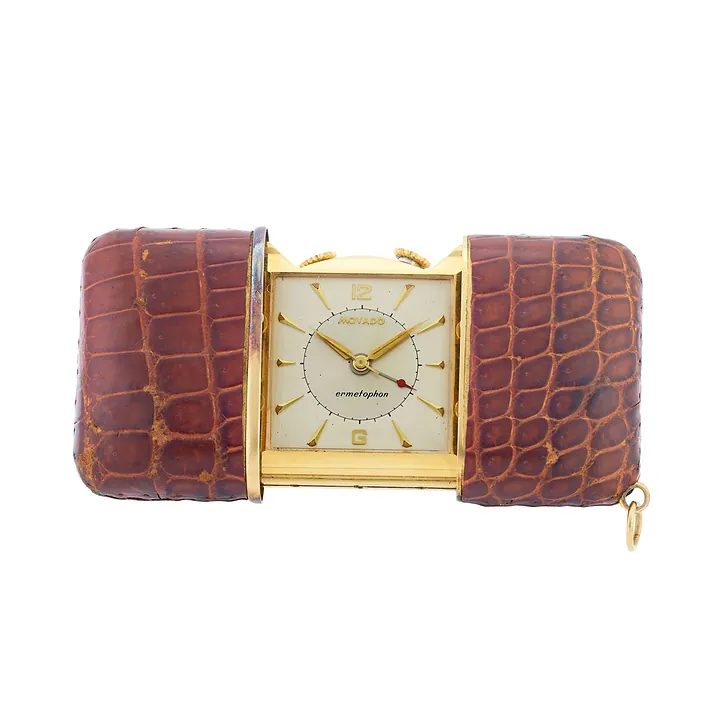
Movado Ermetophone, c. 1960s
Antiquorum auction archive, Geneva
Wristwatches · c. 1920s
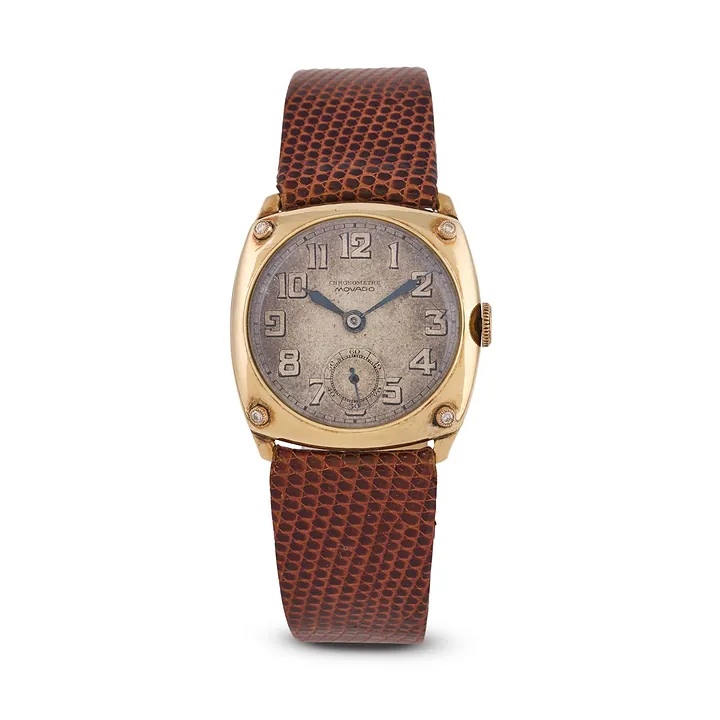
Movado Chronometre, ref. 41536, c. 1920s
Antiquorum auction archive, Geneva
Wristwatches · c. 1930s
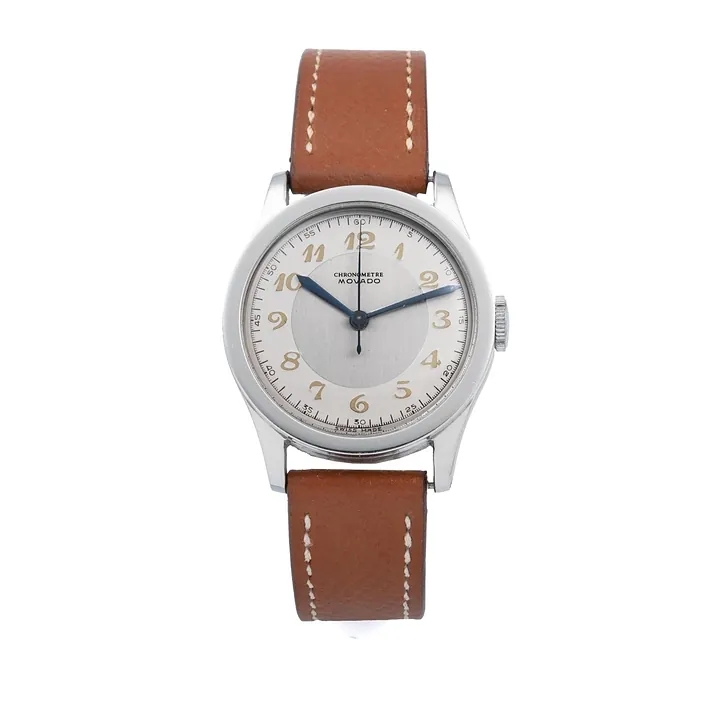
Movado "calatrava", ref. 17726, c. 1930s
Antiquorum auction archive, Geneva
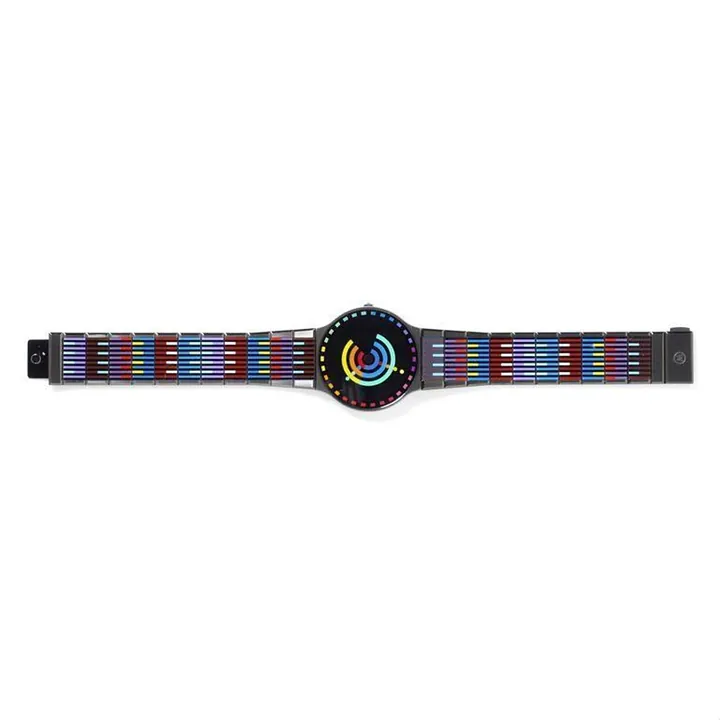
Wristwatches · c.1989
Steel, France and Switzerland, 1989; designed by Yaacov Agam (born 1928) for a limited edition by Movado
Victoria and Albert Museum, London

Wristwatches · 1945
Wristwatch by Eterna, 1945
Museum Rotterdam

Wristwatches · c. 1945
Breitling Premier, ref. 790, c. 1945
Antiquorum auction archive, Geneva

Wristwatches · c. 1945
Universal Genève Uni-Compax, ref. 22492, c. 1945
Antiquorum auction archive, Geneva

Wristwatches · c. 1950s
Baume & Mercier wristwatch, c. 1950s
Antiquorum auction archive, Geneva