
Wristwatches · Wristwatch
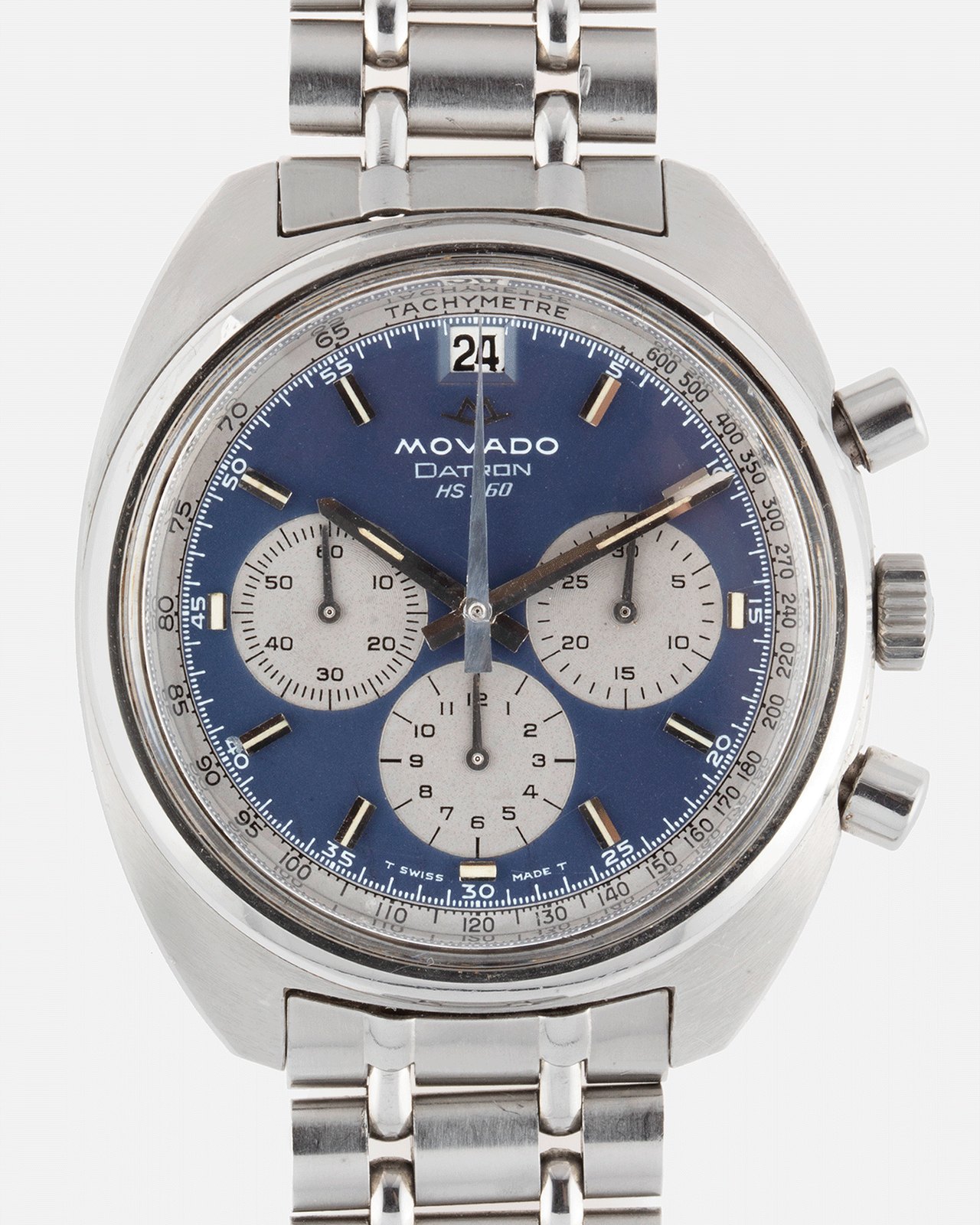
Movado HS 360 Sub Sea El Primero, 1970s
- Maker / attribution
- Movado (maker)
- Date
- 1970s
- Historical period
- Quartz Revolution (1969 – 1990)
- Country of origin
- Switzerland
- Object type
- Wristwatch
- Dimensions
- Case 38 mm
- Stock no.
- Product 4582468812887
- Credit line
- Dealer listing, S.Song Watches (product 4582468812887)
- Catalogue title (original)
- Movado HS 360 Sub Sea El Primero (English)
View the source record (dealer listing) ↗ (opens another website in a new tab)Suggest a correction
Record summary
Catalogued by S.Song Watches (dealer), Seattle (stock number Product 4582468812887), this is a wristwatch by Movado, made in Switzerland, dated 1970s. The Atlas places it in the Quartz Revolution period (1969 – 1990) of its Wristwatches collection. Recorded dimensions: Case 38 mm. The record is illustrated with 6 photographs.
Assembled from the source record's structured fields. Dates and attributions are given as the source states them; where a field is missing the Atlas leaves it blank rather than estimating.
Catalogue description
Dealer description — S.Song Watches
In horological history, the release of the Zenith El Primero in the late 60’s stands out as one of the more defining moments. Dubbed the first ever automatic chronograph to be made in production, the El Primero to this day remains largely unchanged and truly an icon. With the vintage El Primero line hogging all the attention, it is often forgotten that Movado, who were owned by the same parent company that owned Zenith, also benefitted from the revolutionary self-winding movement. This Movado Datron HS 360 is exactly that and it is quintessentially a 70’s watch in its styling. With a 38mm stainless steel tonneau case and a beautiful matte blue dial, this is truly an undervalued watch with huge watchmaking pedigree. While there is dispute as to whether it was Zenith/Movado or the consortium led by Heuer, Seiko, Buren-Hamilton, Breitling and Dubois-Depraz that created the first self-winding chronograph, there is no contest in regards to the quality of the Zenith Cal. 3019 PHC compared to the latter’s Calibre 11. Most notably, the way the hi-beat movement allows the chronograph seconds hand to move around the dial so smoothly is a joy to watch. Similarly, resetting the chronograph hand, it jumps straight back to 0 without much backlash or hand quivering. You just know this is pure quality. This Movado Datron will likely always be overshadowed by its El Primero counterparts, but if you’re in the know, and like the 70’s styling of this HS 360, this is a lot of watch for the money.
Historical context
Quartz Revolution (1969 – 1990)
Seiko's Astron begins mass quartz timekeeping; traditional industries contract sharply.
Quartz and digital watches transformed the market after 1969. Swiss employment collapsed, Japanese and Hong Kong production soared, and the Swatch (1983) helped the Swiss industry recover; mechanical watches survived as luxury goods.
Read the period in the timelineMore wristwatches from this periodEarlier: Modern Mechanical Horology
Atlas type guide
Wristwatches
Bracelet watches were worn by women from the early nineteenth century — Breguet made one for Caroline Murat, Queen of Naples, in 1810–12 — but the wristwatch only became a man's instrument with military use and aviation in the early twentieth century. Between the World Wars it overtook the pocket watch; the 1920s and 1930s brought rectangular Art Deco cases, water-resistant cases and the first automatic winding systems.
After 1945 the wristwatch became a carrier of identity — dress watches, sports and dive watches, chronographs, calendars — produced by Swiss, American, Japanese, German, Soviet and Chinese industries. The quartz revolution after 1969 and the mechanical renaissance since the 1990s, including the rise of independent watchmakers, complete the story.
What to look for
- The reference number (between the lugs or inside the case back) and serial number, the starting point for dating.
- The calibre: its maker and number are often stamped under the dial or on the bridge.
- Originality of dial, hands and crown — refinished ('redial') dials are common.
- Case material marks: 18K/750, 14K/585, stainless steel, gold-filled, plated.
Dating clues
- Wire-lug cases: before c. 1925.
- Water-resistant screw-down cases: from 1926.
- Quartz movements: from 1969; sapphire crystals widespread after c. 1980.
General guidance written by the Atlas editors about this kind of object. It is not a statement about this particular piece; for that, rely on the source record above and on physical examination.
Related records
Pocket Watches · c. 1960s
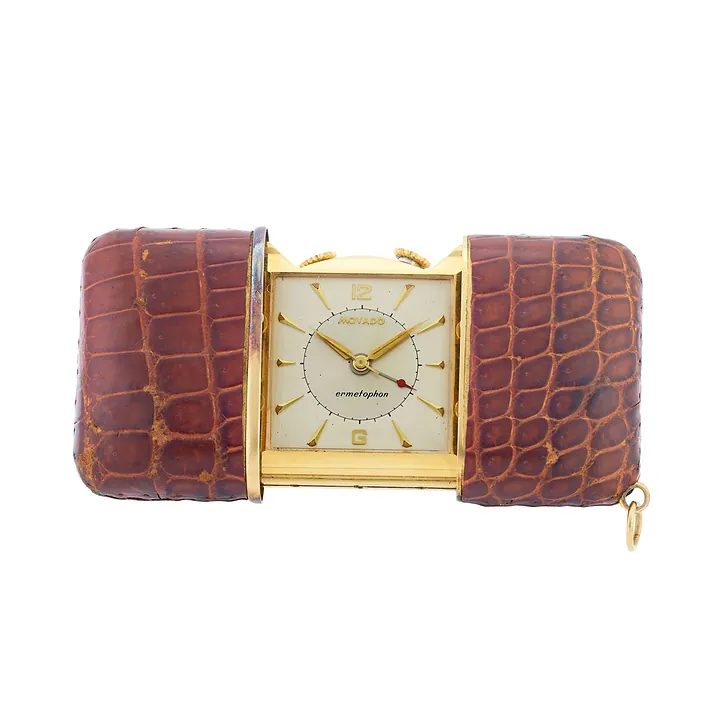
Movado Ermetophone, c. 1960s
Antiquorum auction archive, Geneva
Wristwatches · c. 1920s
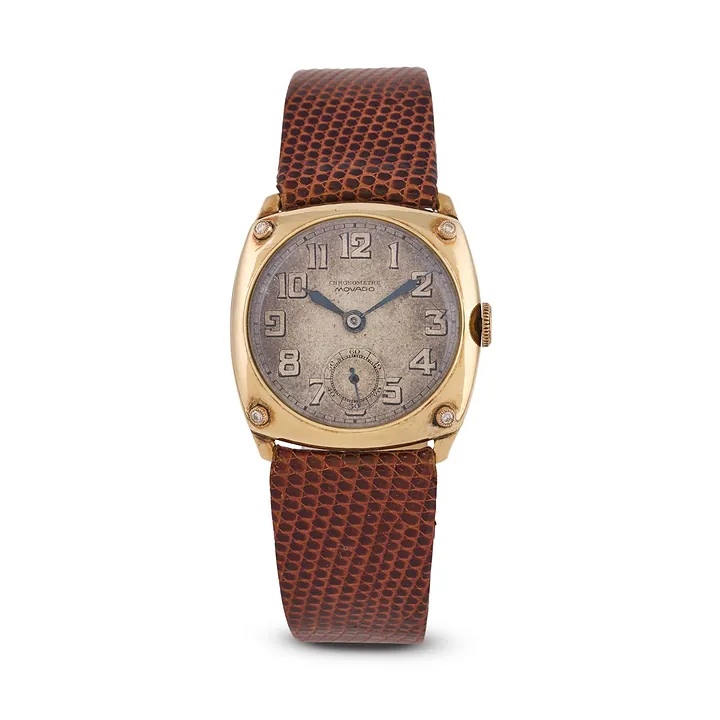
Movado Chronometre, ref. 41536, c. 1920s
Antiquorum auction archive, Geneva
Wristwatches · c. 1930s
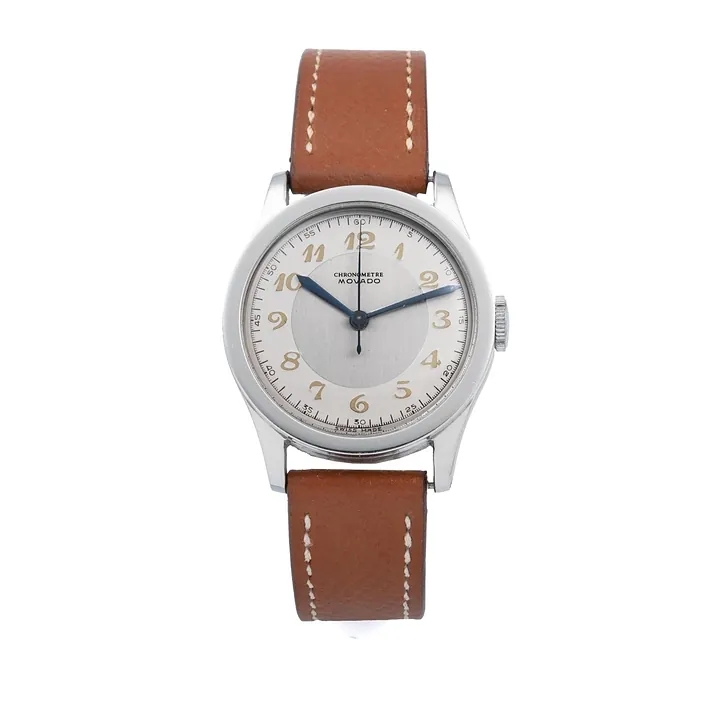
Movado "calatrava", ref. 17726, c. 1930s
Antiquorum auction archive, Geneva
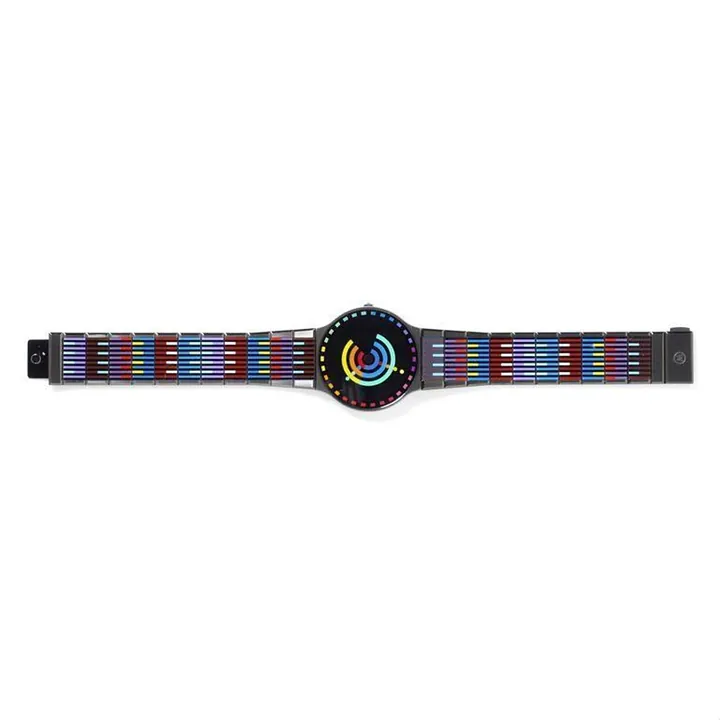
Wristwatches · c.1989
Steel, France and Switzerland, 1989; designed by Yaacov Agam (born 1928) for a limited edition by Movado
Victoria and Albert Museum, London

Wristwatches · 1970
Wristwatch by Heno, Switzerland, 1970
Museum Rotterdam

Wristwatches · 1960–1986
'Tri-Compax' calendar chronograph wristwatch in gold case, by Universal, Geneva, Switzerland, 1960–1986.
Science Museum Group, London

Wristwatches · 1969–1970
Beta 21 Quartz wristwatch movement, made in Switzerland, 1970.
Science Museum Group, London

Wristwatches · c. 1969
Omega Speedmaster Moonwatch, ref. 145022-69st, c. 1969
Antiquorum auction archive, Geneva