
Pocket Watches · Purse watch
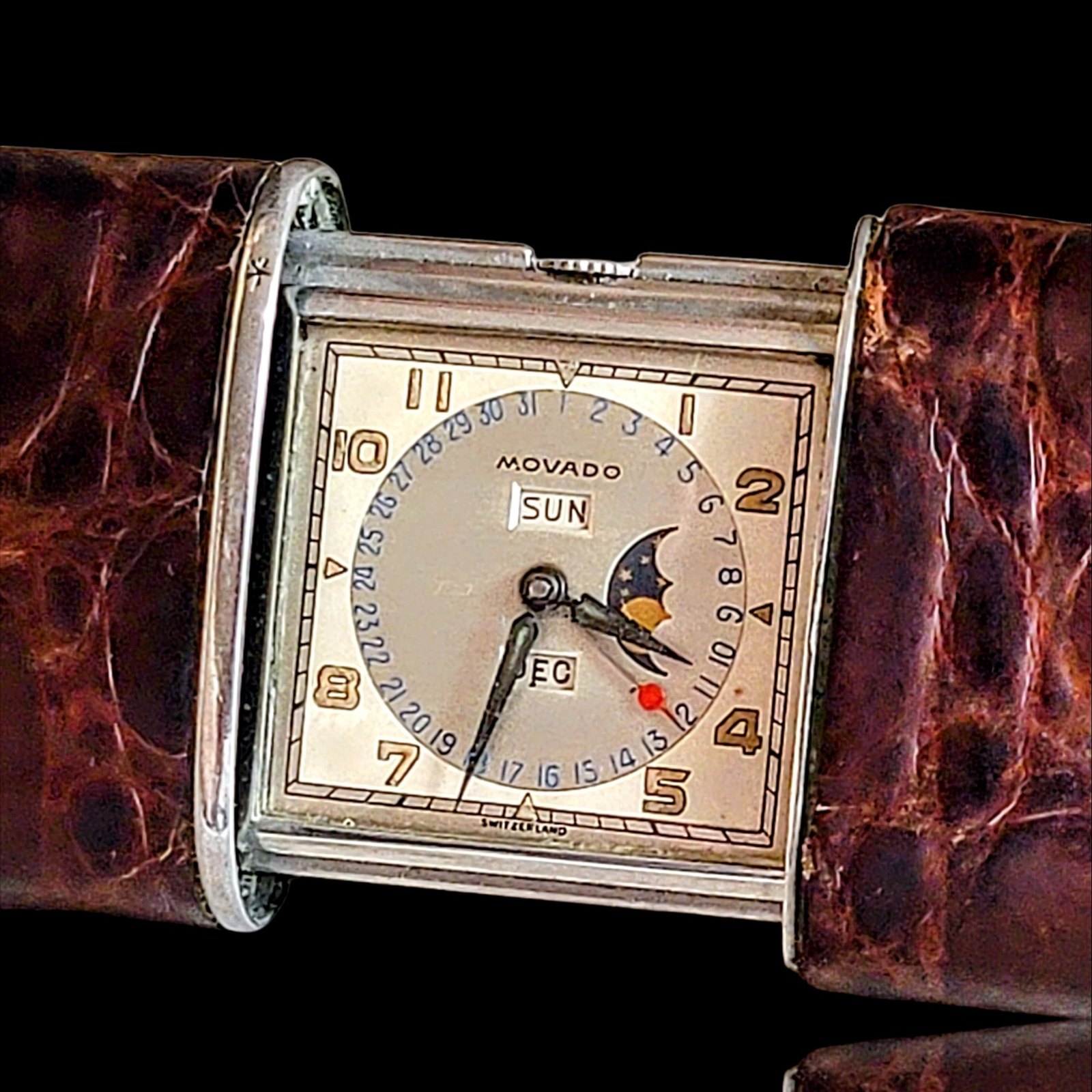
Movado Ermeto Calendarmeto Triple Calendar Moonphase purse watch
- Maker / attribution
- Movado (source attribution)
- Date
- c. 1940
- Historical period
- Golden Age of Mechanical Watchmaking (1900 – 1945)
- Country of origin
- Switzerland
- Object type
- Purse watch
- Holding institution
- Secondhand Horology
- Accession / object no.
- WA-2028
- Credit line
- Secondhand Horology
- Catalogue title (original)
- 1940's Movado Ermeto Calendarmeto Triple Calendar Moonphase Watch – SECOND HAND HOROLOGY (English)
View the source record ↗ (opens another website in a new tab)Suggest a correction
Record summary
Held and catalogued by Secondhand Horology (object number WA-2028), this is a purse watch attributed to Movado, made in Switzerland, dated c. 1940. The Atlas places it in the Golden Age of Mechanical Watchmaking period (1900 – 1945) of its Pocket Watches collection. The record is illustrated with 1 photograph.
Assembled from the source record's structured fields. Dates and attributions are given as the source states them; where a field is missing the Atlas leaves it blank rather than estimating.
Catalogue description
Original object description
Reported to date from circa 1940, this Movado Ermeto Calendarmeto purse timepiece is cased in dark brown crocodile leather that slides outward to wind an unspecified central movement via internal rack gears or by hand using the crown. When fully opened, the piece measures 76 mm wide by 36 mm high and can be propped up for table display with a fold-out rear strut. The square dial incorporates Arabic numerals, apertures for the month and day, a lunar phase display, and a pointer indicating a concentric date ring.
Object Identity and Configuration
Belonging to the Ermeto family manufactured between the 1920s and the 1960s, this Calendarmeto model is dated by the seller to circa 1940. Identified as the second-largest format in the collection, the extended leather case spans 76 mm wide by 36 mm high and includes a rear hinged kickstand designed for desk or bedside use.
Dial and Complications
Marked "MOVADO" and inscribed "SWITZERLAND" along its bottom edge, the square metal dial features luminous-type Arabic hours with arrow indices at the cardinal points. Its layout incorporates a day aperture at the top, a month window below, a crescent moonphase display to the right, and a 1–31 date scale followed by a pointer ending in red.
Mechanical Operation
Sliding the exterior covers back and forth engages internal opposing tracks against the central crown, an action reported by the dealer to furnish a 24-hour power reserve across six cycles, though standard winding by the crown is also possible. Although the precise caliber is not recorded, the seller notes that the time, moonphase, and full calendar mechanisms are in working order.
Historical context
Golden Age of Mechanical Watchmaking (1900 – 1945)
The wristwatch displaces the pocket watch; waterproof cases, self-winding and grand complications.
The pocket watch reached technical maturity and then began to give way to the wristwatch after the First World War. Complicated watches for collectors such as Henry Graves Jr. and James Ward Packard, railroad watches, and slim Art Deco dress watches are characteristic.
Read the period in the timelineMore pocket watches from this periodEarlier: Industrial Revolution
Atlas type guide
Calendar, moon-phase and perpetual calendar watches
Calendar complications range from a simple date to the perpetual calendar, which automatically allows for months of different lengths and leap years until 2100. Pocket watches with perpetual calendars were made in the eighteenth and nineteenth centuries; Patek Philippe made the first perpetual calendar wristwatch in 1925, and series production followed in 1941. The annual calendar (Patek Philippe, 1996) needs correction only once a year.
Moon-phase displays use a disc with two moons and 59 teeth advanced daily, approximating the 29.5-day lunation; more precise trains reduce the error to one day in over a century.
What to look for
- Apertures or subsidiary dials for day, date, month and leap year.
- Moon disc under a 'bosom' shaped aperture.
- Recessed correctors on the case band for setting the calendar.
Dating clues
- Triple-date wristwatches: popular c. 1940–1955.
- Perpetual calendar wristwatches: from 1925 (unique) and 1941 (series).
General guidance written by the Atlas editors about this kind of object. It is not a statement about this particular piece; for that, rely on the source record above and on physical examination.
Related records
Pocket Watches · c. 1960s
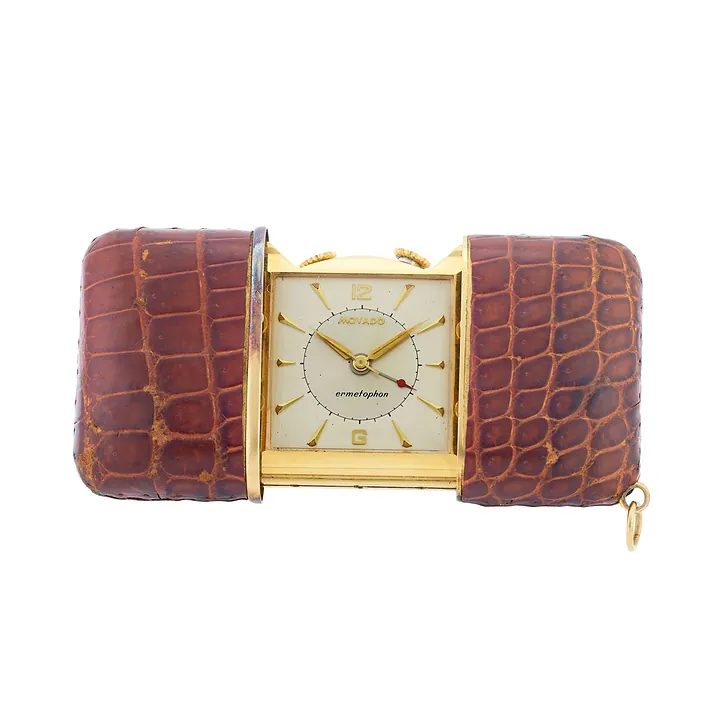
Movado Ermetophone, c. 1960s
Antiquorum auction archive, Geneva
Wristwatches · c. 1920s
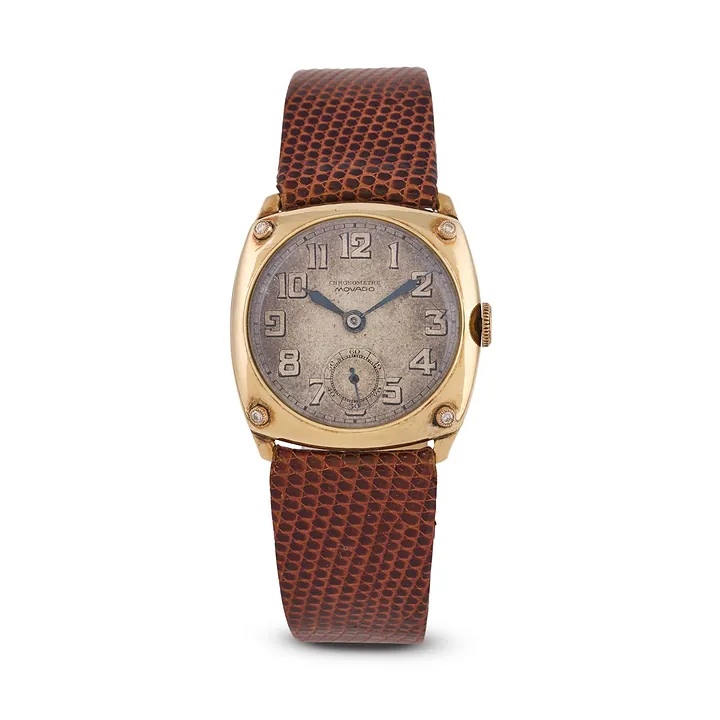
Movado Chronometre, ref. 41536, c. 1920s
Antiquorum auction archive, Geneva
Wristwatches · c. 1930s
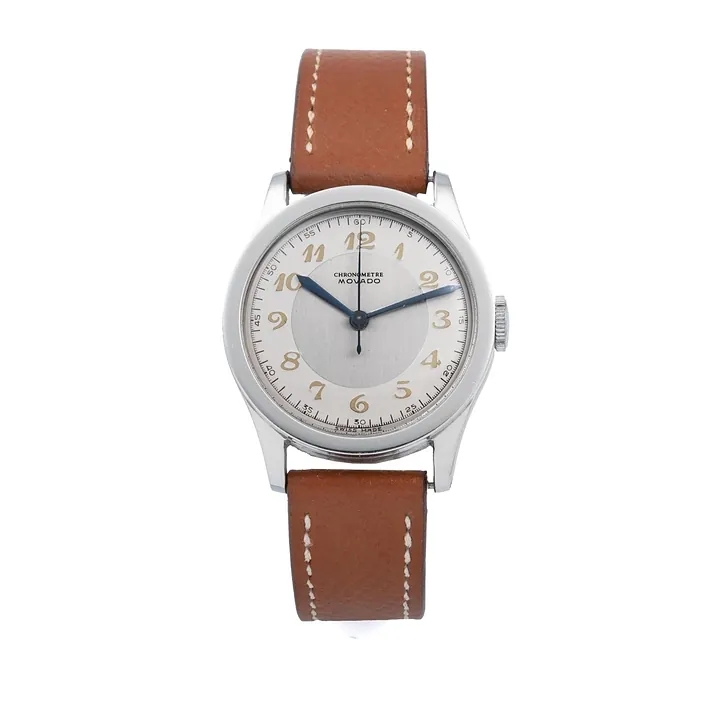
Movado "calatrava", ref. 17726, c. 1930s
Antiquorum auction archive, Geneva
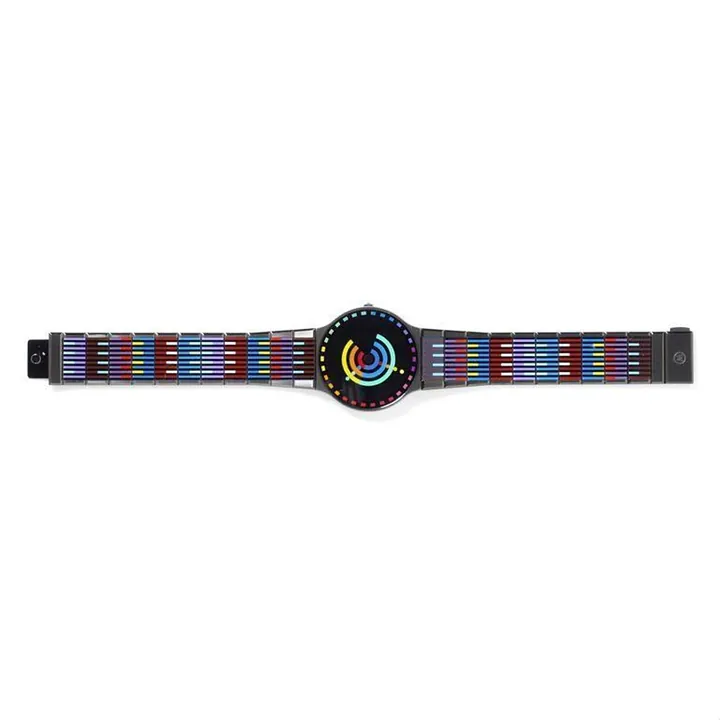
Wristwatches · c.1989
Steel, France and Switzerland, 1989; designed by Yaacov Agam (born 1928) for a limited edition by Movado
Victoria and Albert Museum, London

Pocket Watches · c. 1900
Patek Philippe Chronometro Gondolo, c. 1900
Antiquorum auction archive, Geneva
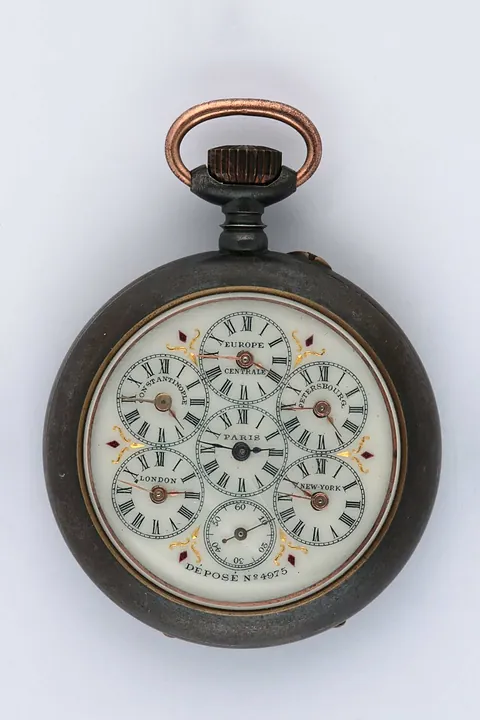
Pocket Watches · c. 1900
Pocket watch by A. Sandoz-Boucherin, Switzerland, c. 1900
German Clock Museum
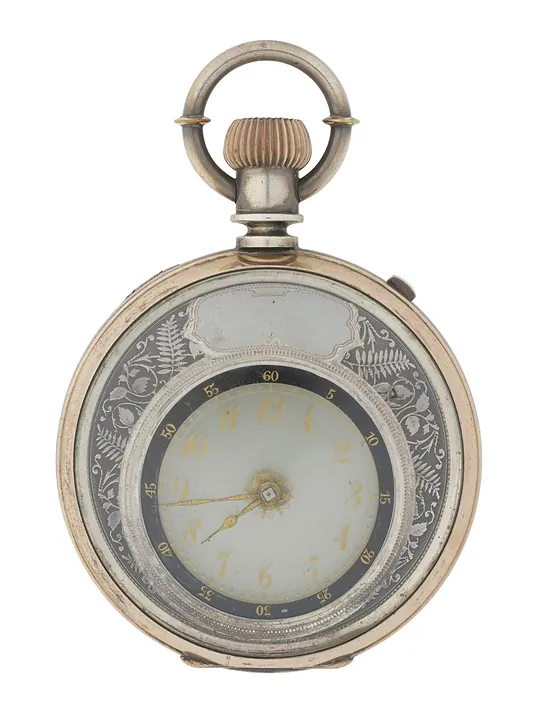
Pocket Watches · 1900
Pocket watch by Armand Schwob & Frère, Switzerland, 1900
Science Museum Group, London
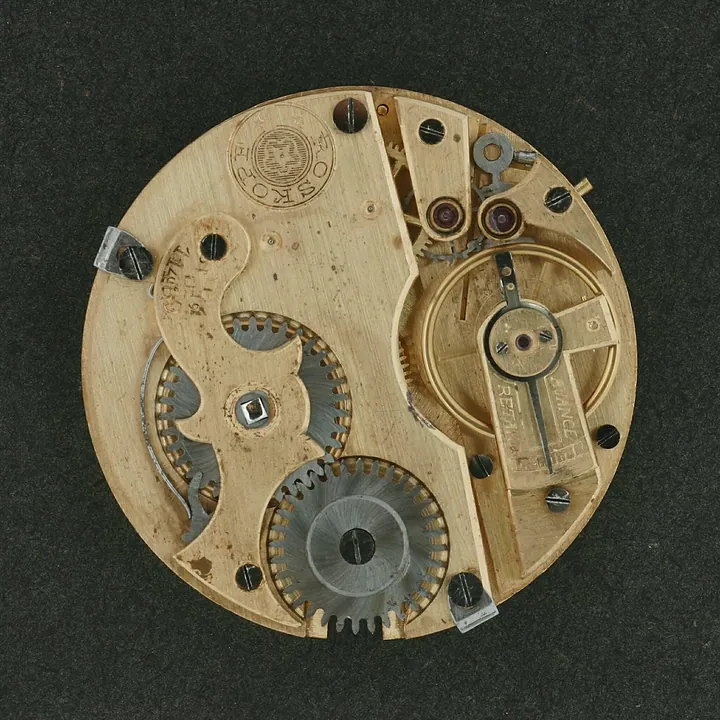
Pocket Watches · c. 1900
Pocket watch by Vve. Chs. Léon Schmid und Cie, Switzerland, c. 1900
German Clock Museum